Chinese car manufacturers are ramping up investments in developing their own ro-ro (roll-on/roll-off) fleets this year, aiming to bolster ocean shipping capabilities and expand their footprint in international markets.
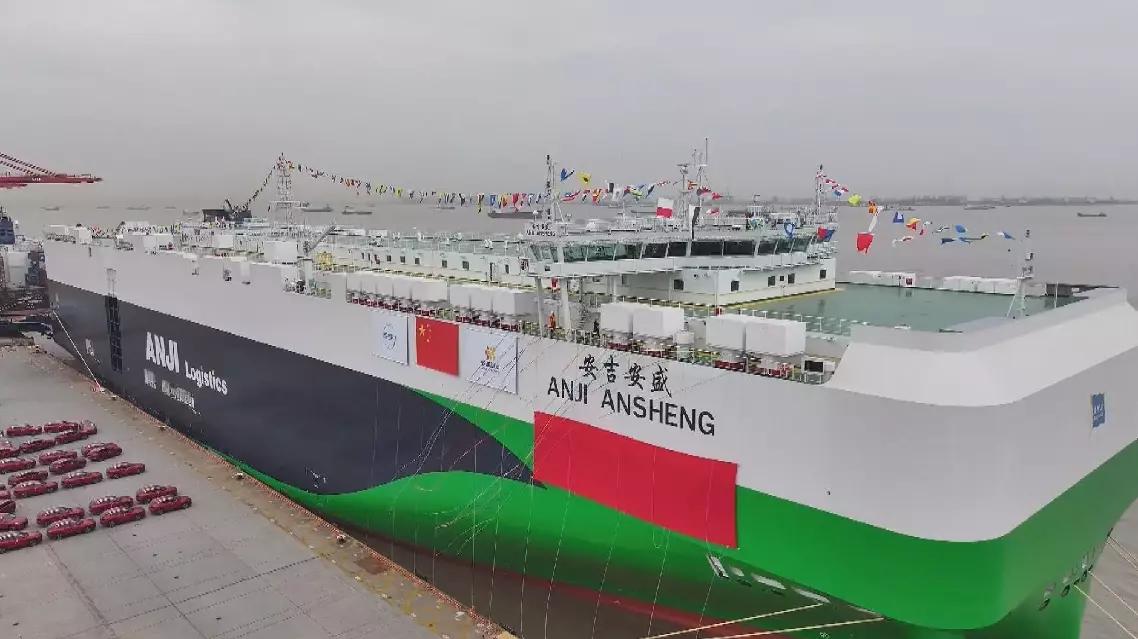
On Thursday, Anji Ansheng, a domestically built ro-ro ship of SAIC Motor, set sail from the Shanghai Haitong International Automotive Terminal on its maiden voyage to Europe, carrying about 7,000 China-made vehicles.
The vessel is one of the world's largest ocean-going car carrier with a maximum capacity of carrying 9,500 standard vehicles and a maximum speed of 19 knots, according to Zhuang Jingxiong, general manager of SAIC Anji Logistics Company, a subsidiary of SAIC Motor.
"Later, we will put seven more super-large car carriers into service. Our ocean shipping routes for finished vehicles will cover all major car markets around the world, with more than 100 destinations," Zhuang said.
Apart from this state-owned automaker, Chinese electric vehicle giant BYD and leading car brand Chery Automobile are also building their own fleets. In late April, BYD delivered its fourth large car carrier in east China's Jiangsu Province, ahead of the ship's maiden voyage to Brazil. Named BYD Shenzhen, it also has a capacity of carrying more than 9,000 vehicles.
In the first quarter of the year, BYD's fleet transported more than 25,000 new energy vehicles to overseas markets, according to Gao Xiaolin, a shipping operations employee of BYD.
The automaker is expected to deliver its next ro-ro ship BYD Xi'an, which has a capacity of carrying 9,200 vehicles, in the middle of the year, and all its eight ro-ro ships will be put into operation by the end of the year.
On January 21 this year, the first ocean-going car carrier of Chery Automobile set sail for Europe. The company plans to put its second ship into service in June and is building the third one.
The new-generation homegrown ro-ro ships feature various innovations, making them advanced and environmentally friendly.
For instance, the Anji Ansheng is designed with a methanol fuel reserve, and the BYD Shenzhen can run on both liquefied natural gas (LNG) and traditional marine fuels, enabling it to reduce carbon dioxide emissions by about 23 percent compared to traditional vessels fueled by heavy oil.
The BYD Shenzhen is fitted with cutting-edge technologies, including self-developed photovoltaic energy storage systems that can achieve zero carbon emissions during loading and unloading operations.
Chinese automakers ramp up ro-ro fleet investments to boost exports