China's largest wind profiler radar was formally put into operation on Thursday in Xining, the capital of northwestern Qinghai Province, which officially entered its flood season on the day.
The new radar system atop Xiaoyou Mountain at the Xining Meteorological Station marks a significant upgrade in the region's meteorological monitoring capabilities, especially for flood prevention and disaster mitigation.
With a construction footprint of 256 square meters (16 meters by 16 meters), this wind profiler radar is the largest of its kind in China. It can perform wind layer observations every 120 meters in altitude, providing higher-precision monitoring of upper-air wind shear and convective activity. After undergoing trial operations starting March 1, the system was fully commissioned in mid-May, just in time for the critical flood season.
Meteorological staff at the Xining station are now conducting regular checks to ensure the stable operation of the radar, which is capable of continuously monitoring various atmospheric elements. It offers real-time observation and forecasting capabilities for extreme weather conditions such as tornadoes, hailstorms, snowfall, and general precipitation.
"Typically, the wind profiler radars we commonly see can only detect up to an altitude of eight kilometers. However, this wind profiler radar can detect from 150 meters above the ground up to 17 kilometers in altitude. Ordinarily, the coverage radius of a wind profiler radar is around two kilometers, but this radar has a coverage radius of up to four kilometers. As a result, it can monitor changes in the upper-level wind field across the entire main urban area of Xining in real time. During the flood season, it plays a monitoring role in detecting short-term heavy rainfall and short-term severe convective weather," said Guo Hang, director of the Xining Meteorological Station.
The Qinghai Climate Center has warned that, compared to the seasonal norm, this year's flood season carries a higher risk of extreme rainfall and simultaneous drought and flooding events.
In preparation, the provincial, municipal, and county-level meteorological departments across the province completed comprehensive inspections of weather observation stations. These included in-depth checks of antenna systems, signal links, power supplies, and lightning protection.
As the flood season begins, radar operation modes and schedules are also being adjusted.
"During the flood season, the number of radar scanning layers increases from the original nine layers to 14. In the non-flood season, the radar operates from 10:00 to 15:00, but once the flood season begins, the equipment runs 24 hours a day. We also carry out regular maintenance -- daily remote checks are conducted to ensure the system is functioning properly, and every month, support personnel visit the site for inspections and maintenance. Under the complex weather conditions of the flood season, we must ensure that the radar's data availability rate reaches over 99 percent," said Zhao Juan, director of the Xining Meteorological Observatory.
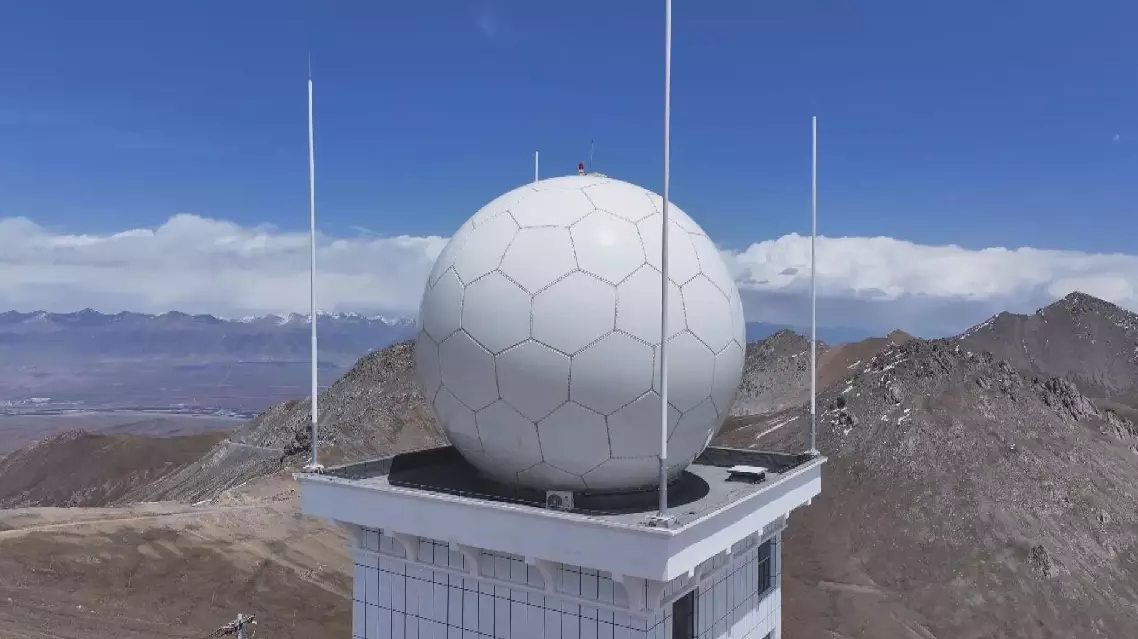
China's largest wind profiler radar begins operation in Qinghai