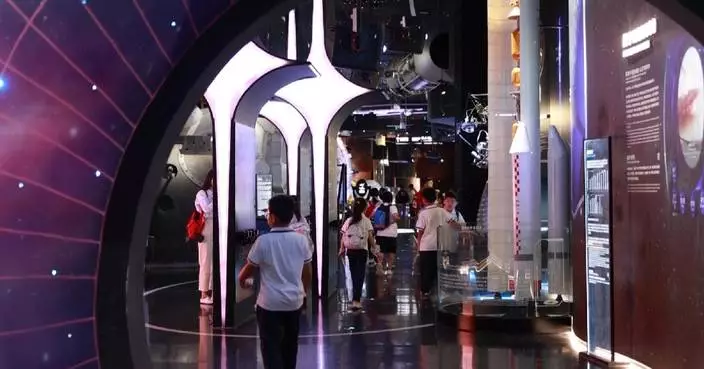
On the occasion of the May 18 International Museum Day, an exhibition featuring more than 400 relics retrieved from two ancient shipwrecks discovered in the South China Sea has been helping the visitors better understand how ancient "Made in China" goods reached the rest of the world.
Located at the China (Hainan) Museum of the South China Sea in Qionghai City of south China's tropical island province of Hainan, the exhibition is showcasing more than the 400 artifacts which had been submerged in the sea for over 500 years at a depth of more than 1,500 meters.
Curator Xin Lixue said the collection of high-grade cultural relics is substantial in size, diverse in variety, and well-preserved. He said the exhibition aims to show the prosperity of the Maritime Silk Road in ancient China and exchanges between Chinese and foreign civilizations.
These archaeological discoveries prove that Jingdezhen colored porcelain was exported in the middle of the Ming Dynasty (1368-1644). The two ancient shipwrecks from the Ming Dynasty were discovered near the northwest continental slope in the South China Sea in October 2022.
Jingdezhen is a prefecture-level city in east China's Jiangxi Province. It is known as the "Porcelain Capital" because it has been producing Chinese ceramics for at least 1,000 years. The city has a well-documented history that stretches back over 2,000 years.
Xin said 138 underwater heritage sites have now been found in the South China Sea, highlighting the richness of ancient maritime trade and cultural exchange.
One example is a type of water vessel on display, which was inspired by vessels from India, crafted with Chinese blue-and-white porcelain techniques and patterns, and then exported to Southeast Asia.
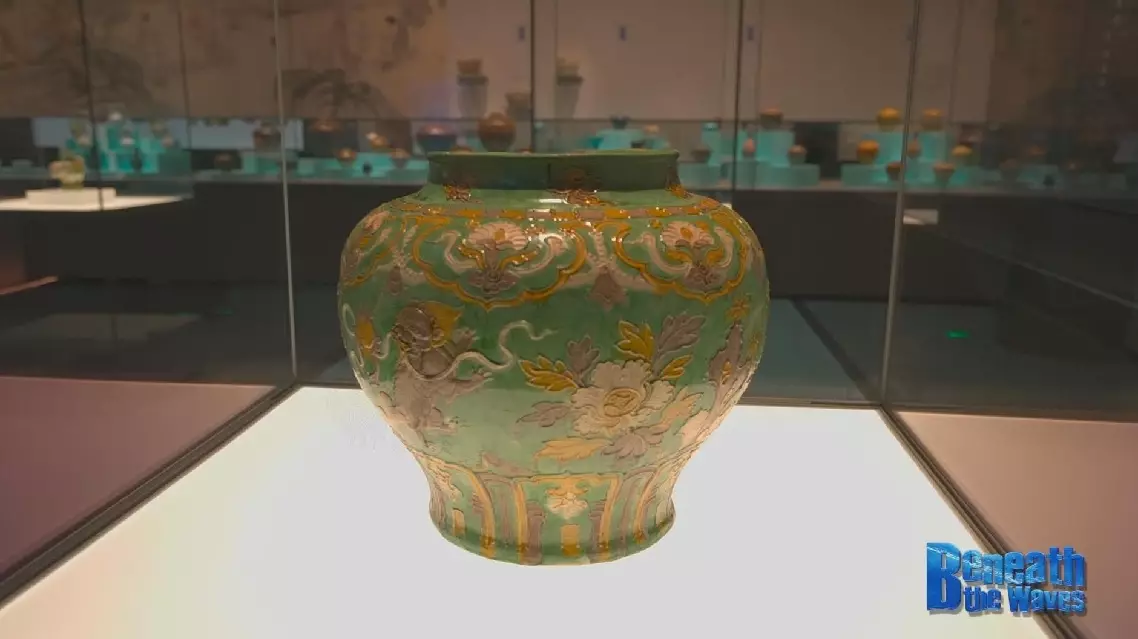
The most eye-catching exhibit is a Fahua-colored porcelain, which marks the first archaeological discovery of the porcelain type in a shipwreck.
"The lion motif came to China with Buddhism during the Eastern Han Dynasty. Over time, it was reshaped -- gentle, auspicious and beloved -- now a part of Chinese tradition. This reflects the inclusive nature of Chinese culture," said Xin while introducing the exhibit.
A large dish designed for Arab traders fit their custom of communal dining, while its decoration was purely Chinese.
"Arab families sit in circles to eat, with food in the center and sauces around. This plate suits that perfectly," Xin said.
Xin said new tools and techniques will help uncover more relics and stories deep in the sea.
Exploring "Made in China" through museum of South China Sea
Scholars from several Latin American countries have underscored the importance of the bilateral relationship between China and the United States, particularly expressing hope for cooperation in technology and climate change response.
At the invitation of Chinese President Xi Jinping, U.S. President Donald Trump is on a state visit to China from Wednesday to Friday, marking the first visit by a U.S. president to China in nearly nine years, since President Xi hosted Trump in the Chinese capital in November 2017.
In a recent interview with China Global Television Network (CGTN), Cecilia Ibarra, a researcher and professor at the Faculty of Government of the University of Chile, emphasized that China and the United States both represent great hope for developing concrete and cost-effective solutions to global crises.
"Right now, China and the United States are technological and scientific powers, which is where we can find hope for concrete solutions, for solutions that will be cost-effective. Therefore, given the urgency, all possible alliances, all wisdom, funds, innovation, and intelligence need to be made available and coordinated by those who ultimately have the power and legitimacy to convene these solutions," she said.
Without collaboration between the two countries, it will be difficult to address climate change, said Cristóbal de la Maza, director of the Center for Economics for Sustainable Development at San Sebastián University in Chile.
"If the two countries reduce their collaboration, we are in a position where there is no progress. China has built a renewable energy, battery, and low-carbon technology industry. The United States, on the other hand, has resisted this and has strengthened its oil industry over time. For powers like China and the United States, making progress in reducing their dependence on fossil fuels is key and part of their global leadership strategy," he said.
Juan Carlos Gachúz Maya, a researcher at Mexico's University of the Americas Puebla, praised Beijing's strategy in the face of trade pressure, saying that its stance paves the way for a possible rapprochement.
"The Chinese government has taken a somewhat correct stance within this complicated situation of trade tensions and the trade war with the United States, and I believe that, eventually, bilateral negotiations could yield concrete results," he said.
Gachúz, also a member of the National System of Researchers, highlighted the major issues on the agenda and the areas where there may be room for cooperation.
"We hope that scientific, technological, and academic cooperation can also be a relevant point for dialogue between both countries, and that these restrictions can eventually be nuanced or renegotiated on other terms," he added.
Rasel Tomé, former vice president of the National Congress of Honduras, emphasized that cooperation between the two sides in science and technology benefits all humanity.
"Beijing and Washington must maintain a fundamental link to ensure that competition does not lead to a disconnect that affects the international system and global access to knowledge. We believe this is a great step, and that multilateral solutions should always be the path forward. They must be attentive to climate change, the food security situation, and public health issues, and the major powers must always maintain these multilateral relationships," he said.

Latin American scholars stress importance of China-U.S. cooperation on climate, technology