China's Tianwen-2 robotic probe for asteroid exploration was transported on Sunday to its launch area at the Xichang Satellite Launch Center in southwest China's Sichuan Province, according to the China National Space Administration.
The probe is scheduled for launch at the end of May.
Click to Gallery
China's Tianwen-2 probe for asteroid exploration transported to launch area
China's Tianwen-2 probe for asteroid exploration transported to launch area
China's Tianwen-2 probe for asteroid exploration transported to launch area
China's Tianwen-2 probe for asteroid exploration transported to launch area
After completing assembly, testing and fueling at the technical area, the probe has been transported to the launch area, where it will undergo functional checks and joint tests.
Previously, the Long March-3B Y110 rocket, which will carry out the Tianwen-2 launch mission, was transferred from the technical area to the launch area on Wednesday, where it completed lifting and docking operations.
The Tianwen-2 probe will undertake multiple tasks with a single launch, including collecting samples from the near-Earth asteroid 2016 HO3 and conducting an exploration of comet 311P.
Asteroid 2016HO3, which orbits stably near the Earth, is known as the Earth's quasi-satellite. It contains ancient substances from the early solar system, making it a "living fossil" valuable for studying the formation and evolution of the solar system.
Comet 311P orbits within the main asteroid belt between Mars and Jupiter and exhibits characteristics of both comets and asteroids. Studying it will help researchers better understand the composition, structure, and evolution of small celestial bodies, filling gaps in knowledge of the solar system.

China's Tianwen-2 probe for asteroid exploration transported to launch area

China's Tianwen-2 probe for asteroid exploration transported to launch area

China's Tianwen-2 probe for asteroid exploration transported to launch area

China's Tianwen-2 probe for asteroid exploration transported to launch area
Chinese scientists announced Monday that they have achieved a breakthrough in yak cloning, with 10 cloned calves all naturally delivered in southwest China's Xizang Autonomous Region.
These calves, consisting of three black yaks and seven white ones, were born from March 25 to April 5 at a yak breeding and research base in Xizang's Damxung County, all meeting expected standards and steadily gaining weight.
The mass births came after the first cloned yak was born in July 2025, which has grown healthily and weighs about 183 kg now.
The achievement was made using a domestically developed breeding system that combines whole-genome selection with somatic cell cloning, following three years of research by a Chinese scientific team.
"Whole-genome selection can accurately pinpoint excellent genetic loci associated with large body size, fast growth, strong fecundity and disease resistance, high feed conversion efficiency, and tolerance to high-altitude and low-oxygen conditions (cold resistance). On this basis, somatic cell cloning enables 1:1 precise replication of the genotype through asexual rapid propagation (cloning), thereby compressing the breeding cycle to within five years," said Fang Shengguo, a professor at the College of Life Sciences at Zhejiang University and director of the State Conservation Center for Gene Resources of Endangered Wildlife.
Yak farming is one of the key industries targeted for development in Xizang during the country's 15th Five-Year Plan period (2026-2030). Traditional yak breeding has relied on phenotype selection, a process that can take up to 20 years and often leads to declining genetic quality.
Researchers said the new method can shorten the breeding cycle to less than five years by accurately identifying desirable genetic traits such as faster growth, disease resistance, feed efficiency and adaptation to high-altitude, low-oxygen environments, while enabling rapid replication of elite breeding stock.
Experts added that the technology could also support conservation efforts for rare yak genetic resources, including the endangered golden wild yak, whose population in Xizang is estimated at more than 300.
So far, the research team has developed more than 200 cloned embryos of golden wild yaks and hybrid wild-blood yaks, laying the groundwork for future embryo transfer and species recovery programs.
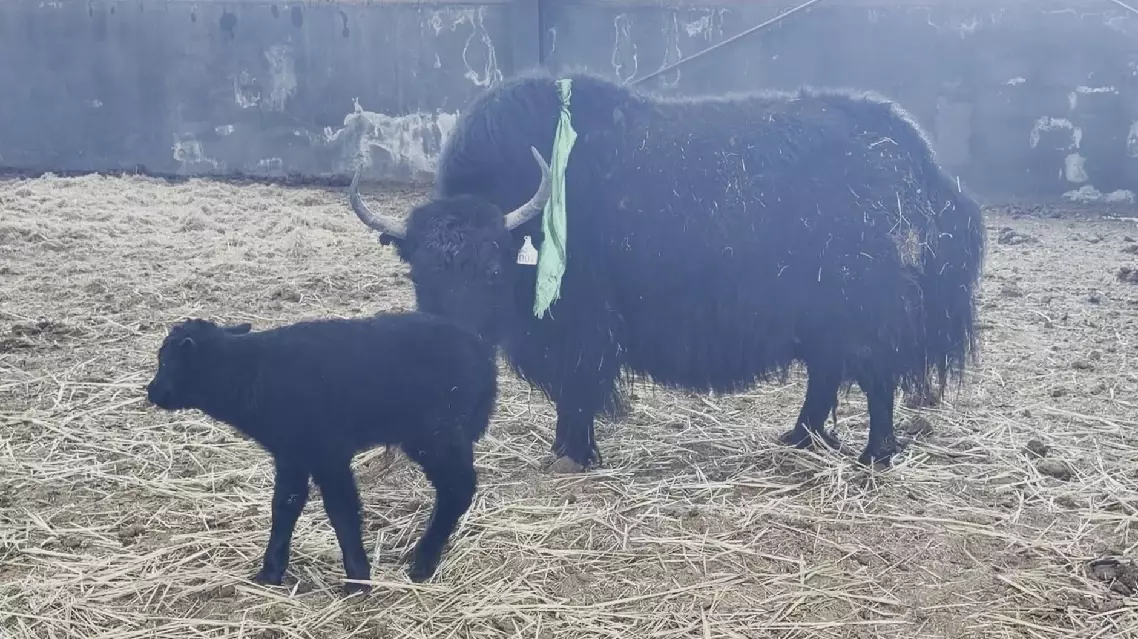
China achieves large-scale births of cloned yaks