The Maritime Silk Road Museum of Guangdong -- based in Yangjiang City of south China's coastal Guangdong Province -- showcases relics and historic documents around the famous Nanhai One shipwreck, which is China's first underwater archaeological discovery.
Nanhai One, a Chinese merchant cargo ship which sank on the Maritime Silk Road during the Song Dynasty (960-1279), serves as an example of the prosperous trade that took place along the maritime route across the South China Sea. As the first submarine archaeology-themed museum in China, the Maritime Silk Road Museum of Guangdong focuses on the excavation, protection, display and research of the relics discovered within the wreck of Nanhai One.
In 2007, after two decades of preparation, the entire ship was raised in one piece using a massive steel cage, and was then brought here to its final home - the Maritime Silk Road Museum of Guangdong.
Guo Hengwen, vice director of the Maritime Silk Road Museum of Guangdong, participated in the project since the beginning.
"This method (museum preservation) to the greatest extent preserves the relevant information of the shipwreck and ruins, with which archaeologists can work in a better environment," Guo said in an interview with China Global Television Network prior to the May 18 International Museum Day.
Over 180,000 artifacts have been found in the ship. Most are porcelain wares totaling more than 170,000 pieces. Some items show foreign styles, such as Arab-inspired ewers, necklace and bangles.
"Many ceramics from Nanhai One feature foreign styles. One example is the ewer, which is obviously of an Arabian style. It is possible that Arab traders brought metal versions as samples, and Chinese craftsmen copied them in making porcelain wares," said Liang Chengzuo, a docent of the museum.
From spices to porcelain wares, these artifacts tell the story of the Maritime Silk Road -- a sea route connecting the East and West.
A 60-meter-long scroll is displayed at the museum, showcasing the dynamic trade, exotic charm, and rich cultural exchanges of the Song Dynasty.
Experts said it not only preserves cultural heritage but also provides convincing evidence of China's longstanding development and utilization of South China Sea routes, reinforcing its historical claims to sovereignty.
"Nanhai One actually bears two very significant features. One is that it is the most important physical evidence of the Maritime Silk Road, and the second is that it is a witness to the development of underwater archaeology in China," Guo said.
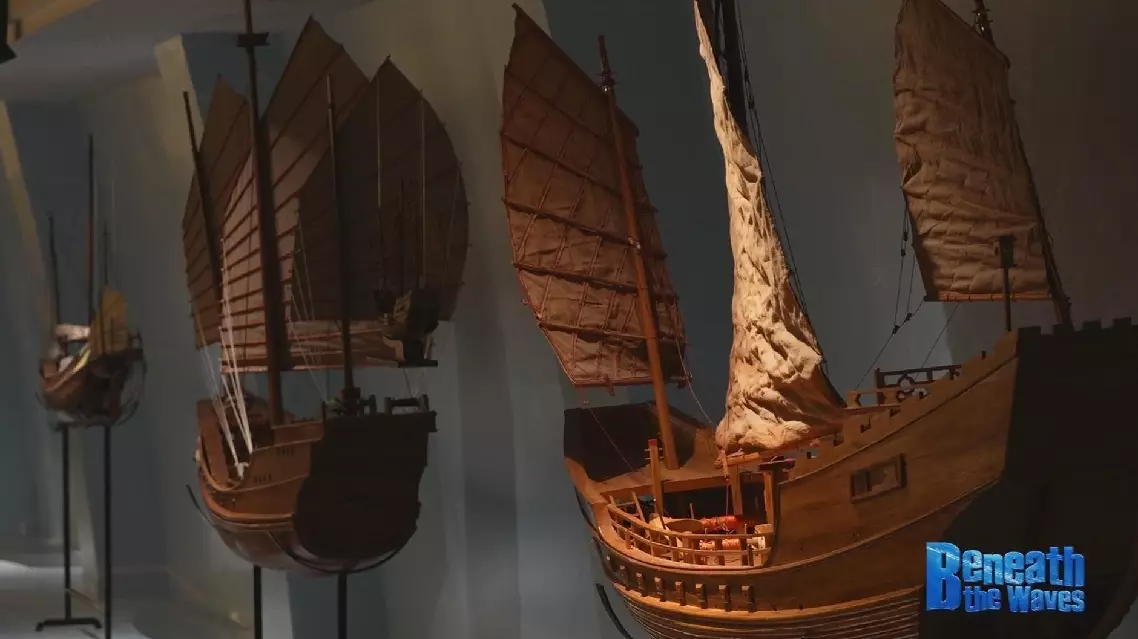
Museum displays relics, historic documents about famous Nanhai One shipwreck