Established more than half a century ago, the Hong Kong Air Cadet Corps (HKACC) has long been a foundation for the development of local aviation talent. Until recently, however, training was carried out at borrowed school and community centre facilities.
HKACC Commanding Officer Chan Mang-lang highlighted the challenges faced over the years. “Venue limitations restricted our ability to hold training activities according to our needs or introduce professional equipment like flight simulators.”
Click to Gallery
HKACC Commanding Officer Chan Mang-lang (left) and HKACC Deputy Officer Commanding Operations Group Martin Choi believe the new headquarters give cadets everything they need to explore aviation careers.
A helicopter simulator is included in a suite of cutting-edge equipment for cadets to train on at the corps’ new premises.
The site’s former playground has been converted into a parade ground for Chinese-style foot drills and a flag-raising training zone.
GFS Air Crewman Officer III Nicholas Choi explains that the GFS played a key supporting role in the establishment of the HKACC’s new headquarters.
Government Flying Service (GFS) Acting Senior Pilot Martin Yu (right) believes visits to GFS headquarters enhance cadets’ interest in aviation.
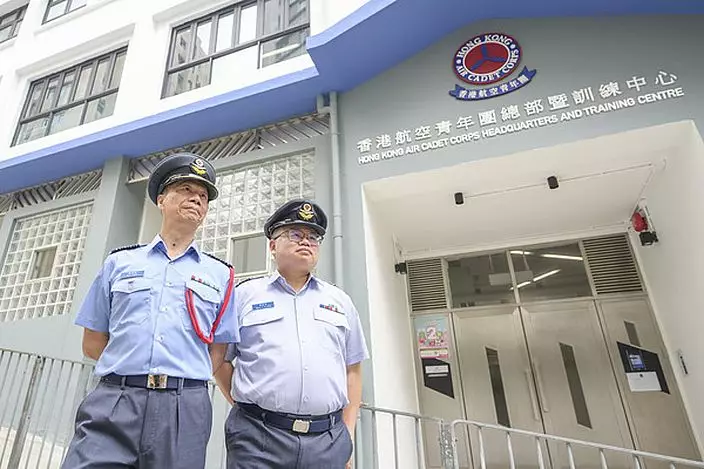
HKACC Commanding Officer Chan Mang-lang (left) and HKACC Deputy Officer Commanding Operations Group Martin Choi believe the new headquarters give cadets everything they need to explore aviation careers.
Renovation project
To improve its training environment, in 2018 the corps began looking for a suitable location to establish a new headquarters and training centre. Ultimately, in 2023, it chose a vacant school on Shiu Fai Terrace in Wan Chai.
HKACC Deputy Officer Commanding Operations Group Martin Choi explained that the original school had 12 classrooms and an assembly hall, meaning the refit could be accomplished without major renovations, allowing for time and cost savings.
After over a year of refurbishments, the new headquarters officially opened in March. Classrooms were transformed into multi-purpose rooms, conference rooms and other facilities, providing cadets with ample training and learning areas. The corps also added several small flight simulators and a helicopter simulator.
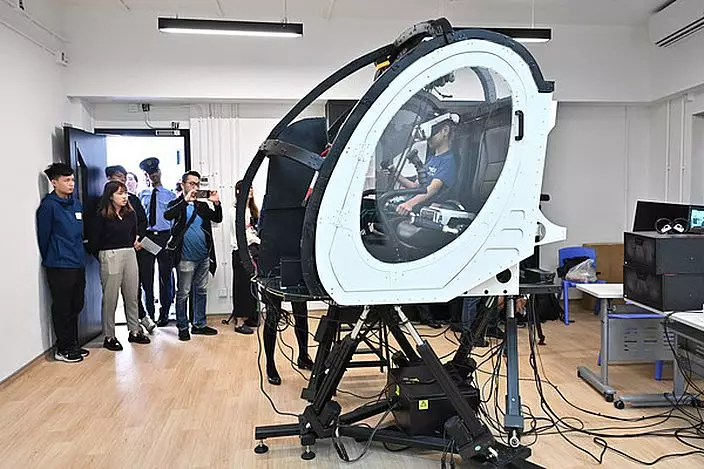
A helicopter simulator is included in a suite of cutting-edge equipment for cadets to train on at the corps’ new premises.
“As Hong Kong integrates into the Greater Bay Area’s aerospace developments, the new headquarters equip the youth with cutting-edge facilities to explore aviation careers,” said Mr Choi. “These professional facilities could enhance the cadets’ technical skills. In future, we will also introduce one-to-one fixed-wing aircraft simulators for cadets.”
Overcoming challenges
As a youth uniformed group, foot drill training is vital for the corps. The original playground has been converted into a parade ground for Chinese-style foot drills and a flag-raising training zone. During reconstruction, however, technical challenges arose when it came to installing flagpoles.
Due to the lack of road access, which prevented large machinery from entering the site, the contractor opted to use manual labour and small machines to lift and install three steel sections for the 15m main flagpole and the two 13m flagpoles on either side of it.
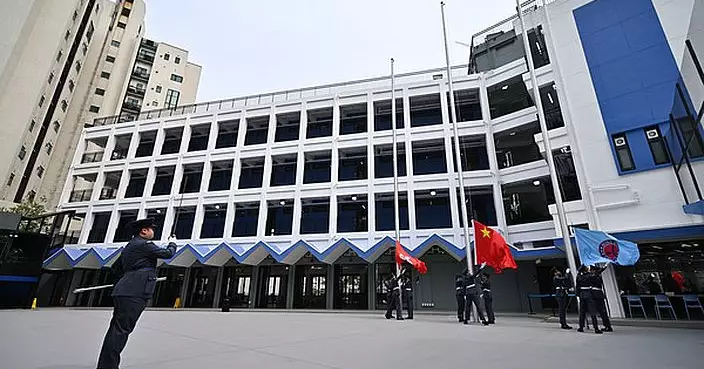
The site’s former playground has been converted into a parade ground for Chinese-style foot drills and a flag-raising training zone.
Building pride
The new headquarters also features a national education corner aimed at strengthening young people’s national identity and pride through showcasing the country’s achievements and development.
HKACC No. 402 Squadron Non-commissioned Officer-in-charge Lui Wai-fung, who joined the corps five years ago, outlined that the new training centre offers numerous opportunities for training and growth, as well as increasing cadets’ sense of belonging.
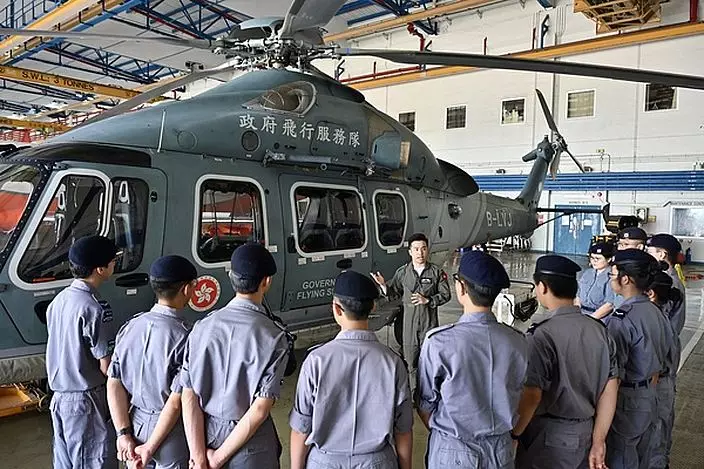
GFS Air Crewman Officer III Nicholas Choi explains that the GFS played a key supporting role in the establishment of the HKACC’s new headquarters.
Vital support
From April 2024, the corps has been supported and funded by the Government Flying Service (GFS), which also assisted in establishing the new headquarters.
GFS Air Crewman Officer III Nicholas Choi stated that the service participated in site selection meetings led by the Security Bureau and the Development Bureau to ensure that the facilities at the new headquarters would meet the corps’ future development needs. Having offered technical and professional advice to assist the corps in setting up its flight simulation equipment and teaching facilities, it also provides ongoing virtual reality and flight simulator training for cadets. In addition, it hosts cadets at GFS headquarters on enriching educational field trips.

Government Flying Service (GFS) Acting Senior Pilot Martin Yu (right) believes visits to GFS headquarters enhance cadets’ interest in aviation.
Bright prospects
GFS Acting Senior Pilot Martin Yu explained that on such visits, “when the cadets enter the hangar, they may actually have a quick touch on the helicopters, so they are usually very happy and become more interested in our daily job for GFS and aviation on the whole.”
Mr Yu also revealed that over 10% of current flight personnel in the GFS are former cadets, and said he hopes this percentage can rise even further in the future.
“Apart from that, many cadets has become a professional in aviation industry, including in many different streams, like the air traffic controllers, like in the maintenance industry, in the aviation, as well as a pilot.”
FEHD releases fourth batch of gravidtrap indexes for Aedes albopictus in May
The Food and Environmental Hygiene Department (FEHD) today (May 21) released the fourth batch of gravidtrap indexes and density indexes for Aedes albopictus in May, covering 12 survey areas, as follows:
District |
Survey Area |
May 2026 |
First Phase Gravidtrap Index |
First Phase Density Index |
Eastern |
Shau Kei Wan and Sai Wan Ho |
9.1% |
1.4 |
Islands |
Tung Chung |
2.0% |
1.0 |
Kowloon City |
Hung Hom and To Kwa Wan |
6.7% |
1.5 |
Tai Po |
Tai Po East |
2.2% |
2.0 |
Tai Po West |
15.5% |
1.0 |
Tuen Mun |
Tuen Mun South |
9.1% |
1.4 |
District |
Survey Area |
May 2026 |
Area Gravidtrap Index |
Area Density Index |
Central and Western |
Kennedy Town and Shek Tong Tsui |
16.8% |
1.3 |
Eastern |
Chai Wan |
15.4% |
1.0 |
North Point and Quarry Bay |
18.9% |
1.4 |
Southern |
Aberdeen and Ap Lei Chau |
20.8% |
1.7 |
Sha Tin |
Sha Tin Town Centre and Fo Tan |
18.3% |
1.4 |
Tsuen Wan |
Tsuen Wan Town |
6.9% |
2.3 |
The fourth batch of gravidtrap indexes for Aedes albopictus in May includes First Phase Gravidtrap Indexes covering six survey areas and Area Gravidtrap Indexes covering six survey areas. Among which, six survey areas recorded gravidtrap indexes above 10 per cent, while Aberdeen and Ap Lei Chau in Southern District recorded a gravidtrap index above 20 per cent. Meanwhile, the gravidtrap indexes of six survey areas, namely Kennedy Town and Shek Tong Tsui in Central and Western District; North Point and Quarry Bay in Eastern District; Shau Kei Wan and Sai Wan Ho in Eastern District; Aberdeen and Ap Lei Chau in Southern District; Tai Po East in Tai Po District; and Tuen Mun South in Tuen Mun District, have recorded a decrease as compared to the indexes recorded in the last survey period, reflecting the progress of relevant mosquito control work.
With reference to the data from the past few years, the gravidtrap indexes start to rise from April or May every year. The actual timing and extent of the rise are affected by factors like weather conditions and rainfall. The average temperature and rainfall recorded in April this year were higher than those in the same period last year, creating favourable conditions for mosquito growth and breeding. As a result, the rise in gravidtrap indexes occurred earlier this year. With the increase in rainfall in May, the gravidtrap indexes are expected to rise further.
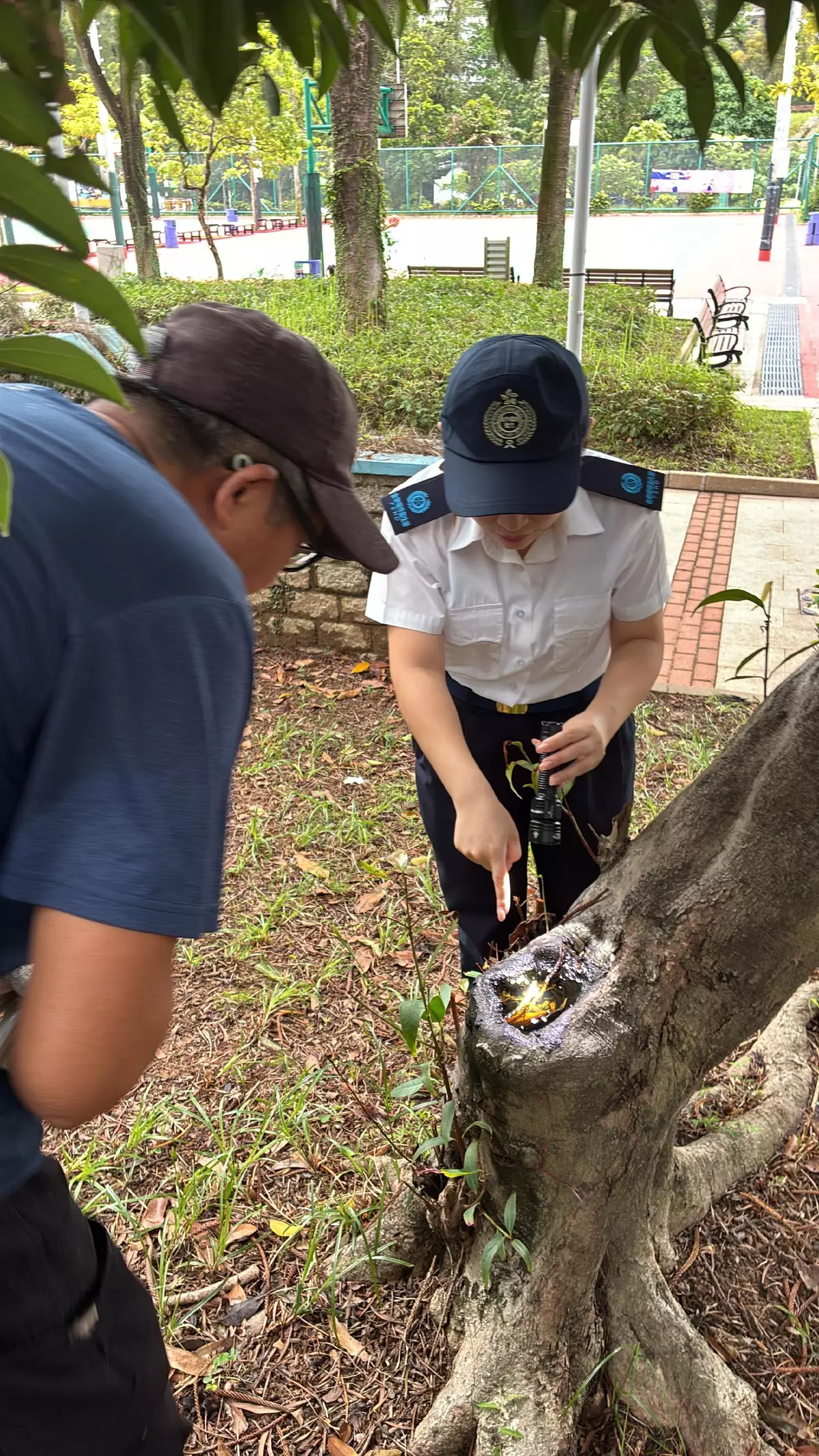
For survey areas which recorded indexes exceeding 10 per cent, in accordance with the mechanism implemented by the FEHD in response to the chikungunya fever (CF) situation (i.e. strengthening mosquito control work in areas with a gravidtrap index between 10 per cent and 20 per cent, instead of 20 per cent or above under the original mechanism), the FEHD is collaborating with relevant departments and stakeholders to identify locations with high mosquito infestations and carry out intensive and targeted mosquito control measures. The FEHD has initiated two prosecutions against the relevant construction site contractors following the discovery of mosquito breeding at construction sites in Tai Po District and Southern District. Moreover, following the discovery of stagnant water or stagnant water containers in a park, a construction site, a private housing estate, a clinic and a private premises in Tai Po District, Central and Western District, as well as Southern District, the FEHD has issued five statutory notices to the responsible persons-in-charge, requiring the clearance of such items within a specified timeframe. The FEHD, the relevant departments and stakeholders are following up on the mosquito control work, and will also organise exhibitions, distribute leaflets and posters, and notify residential estates that have subscribed to the gravidtrap Rapid Alert System, advising property management agents and residents to stay vigilant and work together in taking mosquito prevention and elimination measures. In addition, the FEHD will strengthen the monitoring of the gravidtrap index in the areas to review the effectiveness of the mosquito control work.
Public participation is crucial to the effective control of mosquito problems. The FEHD appeals to members of the public to continue to work together in strengthening personal mosquito control measures, including:
tidy up their premises and check for any accumulation of water inside the premises;
remove all unnecessary water collections and eliminate the sources;
check household items (those placed in outdoor and open areas in particular), such as refuse containers, vases, air conditioner drip trays, and laundry racks to prevent stagnant water;
change water in flower vases and scrub their inner surfaces thoroughly, and remove water in saucers under potted plants at least once a week;
properly cover all containers that hold water to prevent mosquitoes from accessing the water;
properly dispose of articles that can contain water, such as disposable meal boxes and empty cans; and
scrub drains and surface sewers with alkaline detergent at least once a week to remove any mosquito eggs.
Starting in August 2025, following the completion of the surveillance of individual survey areas, and once the latest gravidtrap index and the density index are available, the FEHD has been disseminating relevant information through press releases, its website and social media. It aims to allow members of the public to quickly grasp the mosquito infestation situation and strengthen mosquito control efforts, thereby reducing the risk of CF transmission.
Following recommendations from the World Health Organization and taking into account the local situation in Hong Kong, the FEHD sets up gravidtraps in districts where mosquito-borne diseases have been recorded in the past, as well as in densely populated places such as housing estates, hospitals and schools to monitor the breeding and distribution of Aedes albopictus mosquitoes, which can transmit CF and dengue fever. At present, the FEHD has set up gravidtraps in 62 survey areas of the community, with a surveillance period of two weeks. During the surveillance period, the FEHD will collect the gravidtraps once a week. After the first week of surveillance, the FEHD will immediately examine the glue boards inside the retrieved gravidtraps for the presence of adult Aedine mosquitoes to compile the Gravidtrap Index (First Phase) and Density Index (First Phase). At the end of the second week of surveillance, the FEHD will instantly check the glue boards for the presence of adult Aedine mosquitoes. Data from the two weeks of surveillance will be combined to obtain the Area Gravidtrap Index and the Area Density Index. The gravidtrap and density indexes for Aedes albopictus in different survey areas, as well as information on mosquito prevention and control measures, are available on the department's webpage (www.fehd.gov.hk/english/pestcontrol/dengue_fever/Dengue_Fever_Gravidtrap_Index_Update.html#).
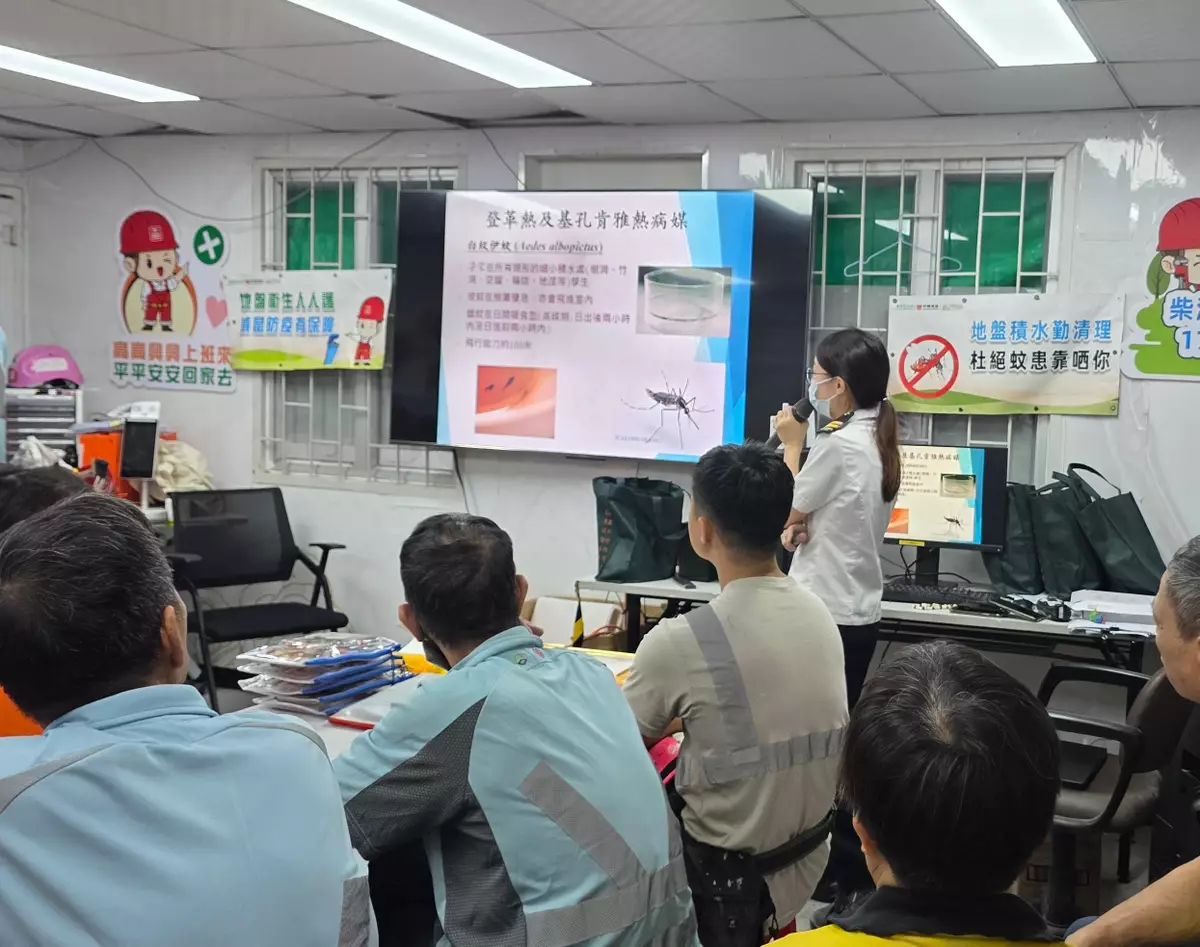
FEHD releases fourth batch of gravidtrap indexes for Aedes albopictus in May Source: HKSAR Government Press Releases
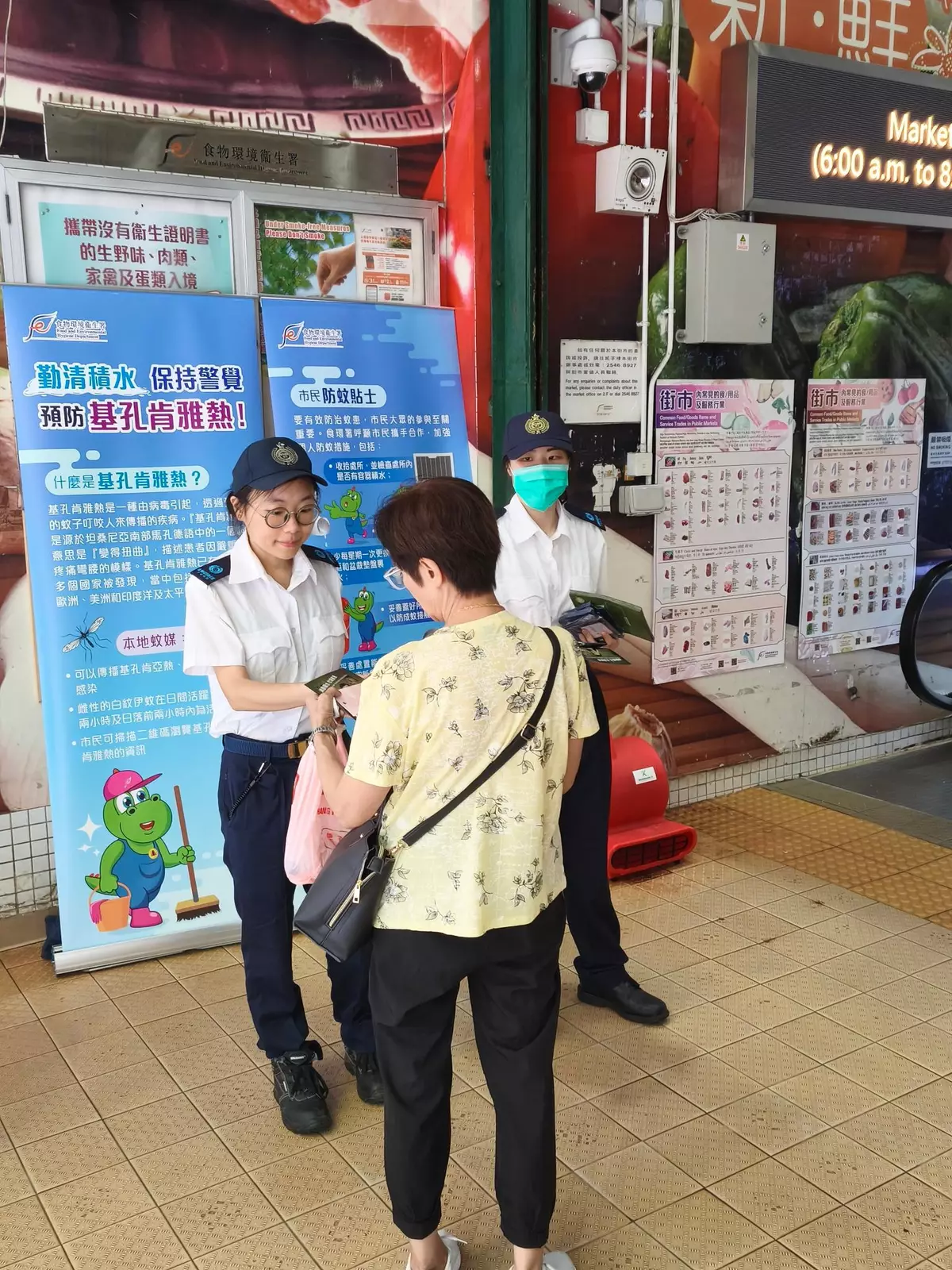
FEHD releases fourth batch of gravidtrap indexes for Aedes albopictus in May Source: HKSAR Government Press Releases
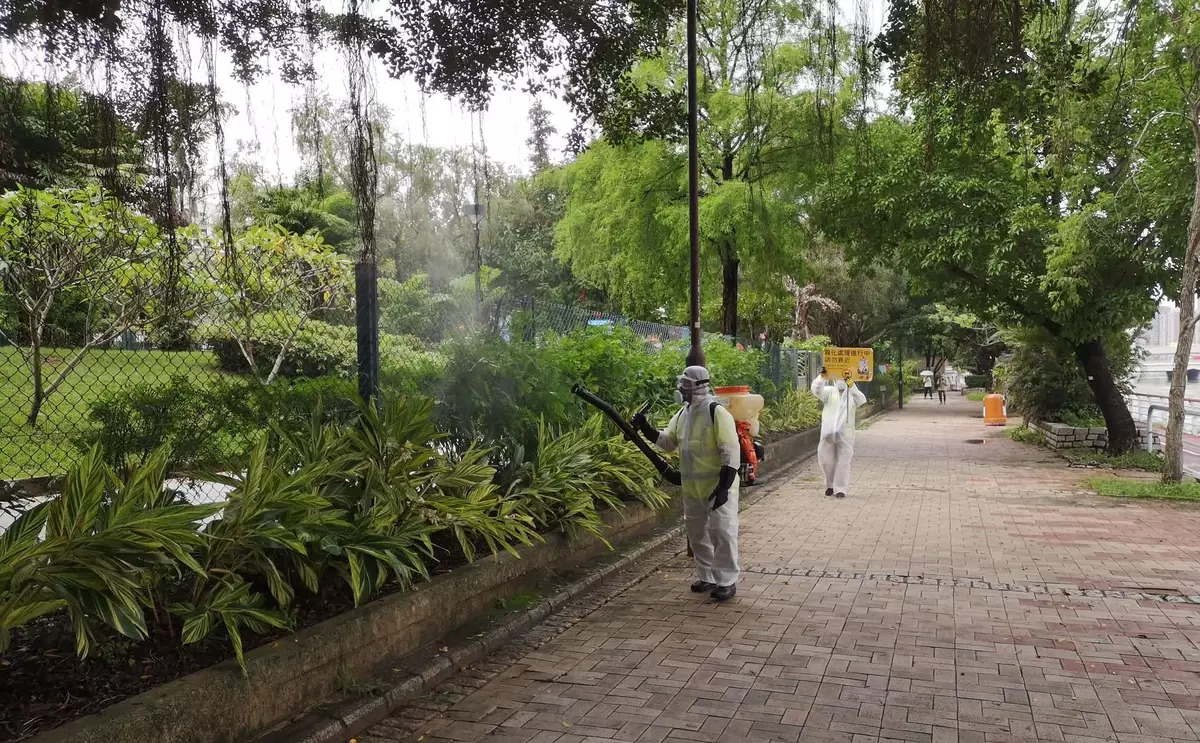
FEHD releases fourth batch of gravidtrap indexes for Aedes albopictus in May Source: HKSAR Government Press Releases
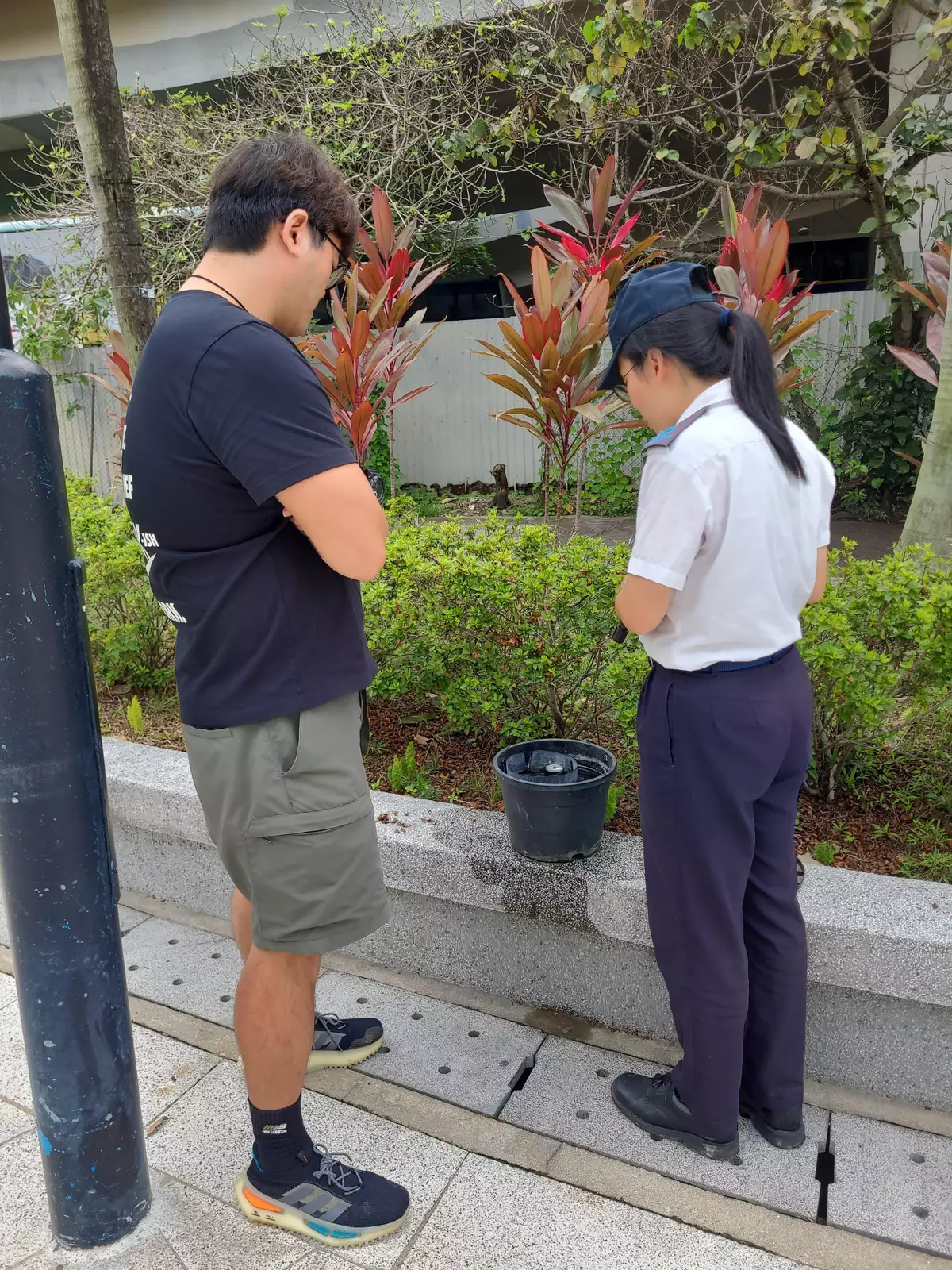
FEHD releases fourth batch of gravidtrap indexes for Aedes albopictus in May Source: HKSAR Government Press Releases
FEHD releases fourth batch of gravidtrap indexes for Aedes albopictus in May Source: HKSAR Government Press Releases