Skip to Content Facebook Feature Image

There's an American pope, and he's just like us. At least, we really, really want him to be

ENT

There's an American pope, and he's just like us. At least, we really, really want him to be
ENT

ENT

There's an American pope, and he's just like us. At least, we really, really want him to be

2025-05-20 03:04 Last Updated At:03:10

WASHINGTON (AP) — By the middle of last week, it became clear that something odd was happening. It was about the time that the fake video started circulating about the woman purporting to recount the “situationship” she'd had with Robert Prevost, the new American pope, decades ago when he was just another guy from Chicago.

We'd already seen Topps, the baseball-card company, issue a new card of Pope Leo XIV that was all over eBay. We'd heard about his affinity for the White Sox and seen a glimpse of him in the crowd at the 2005 World Series. And in the wake of online speculation over whether he favored the Chicago beef sandwich or Chicago-style hot dogs, we'd seen Portillo's, a local eatery, name a sandwich after him — ""a divinely seasoned Italian beef, baptized in gravy and finished with the holy trinity of peppers."

More Images
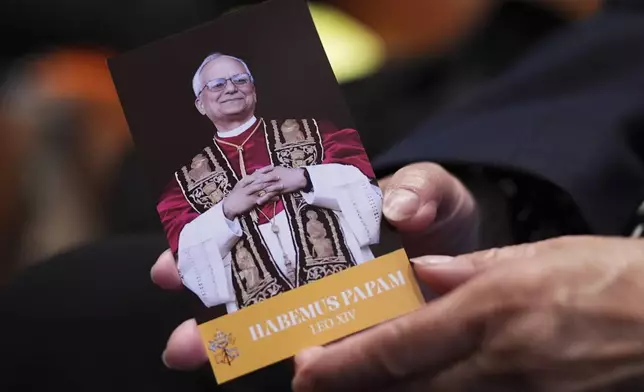
Grace Mellor prays as she holds a brochure that reads "A prayer of thankfulness for the election of Pope Leo XIV" during a mass at Holy Name Cathedral in Chicago, Sunday, May 11, 2025. (AP Photo/Nam Y. Huh)
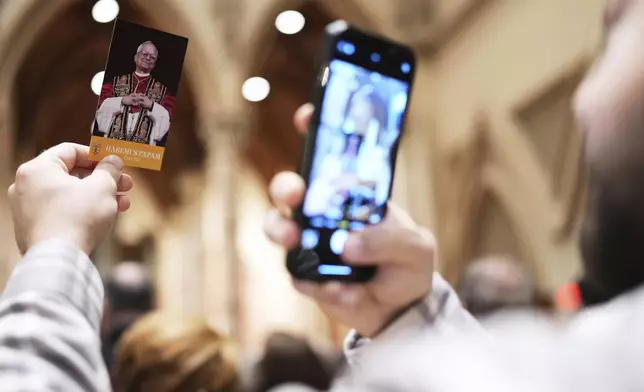
Grace Mellor prays as she holds a brochure that reads "A prayer of thankfulness for the election of Pope Leo XIV" during a mass at Holy Name Cathedral in Chicago, Sunday, May 11, 2025. (AP Photo/Nam Y. Huh)
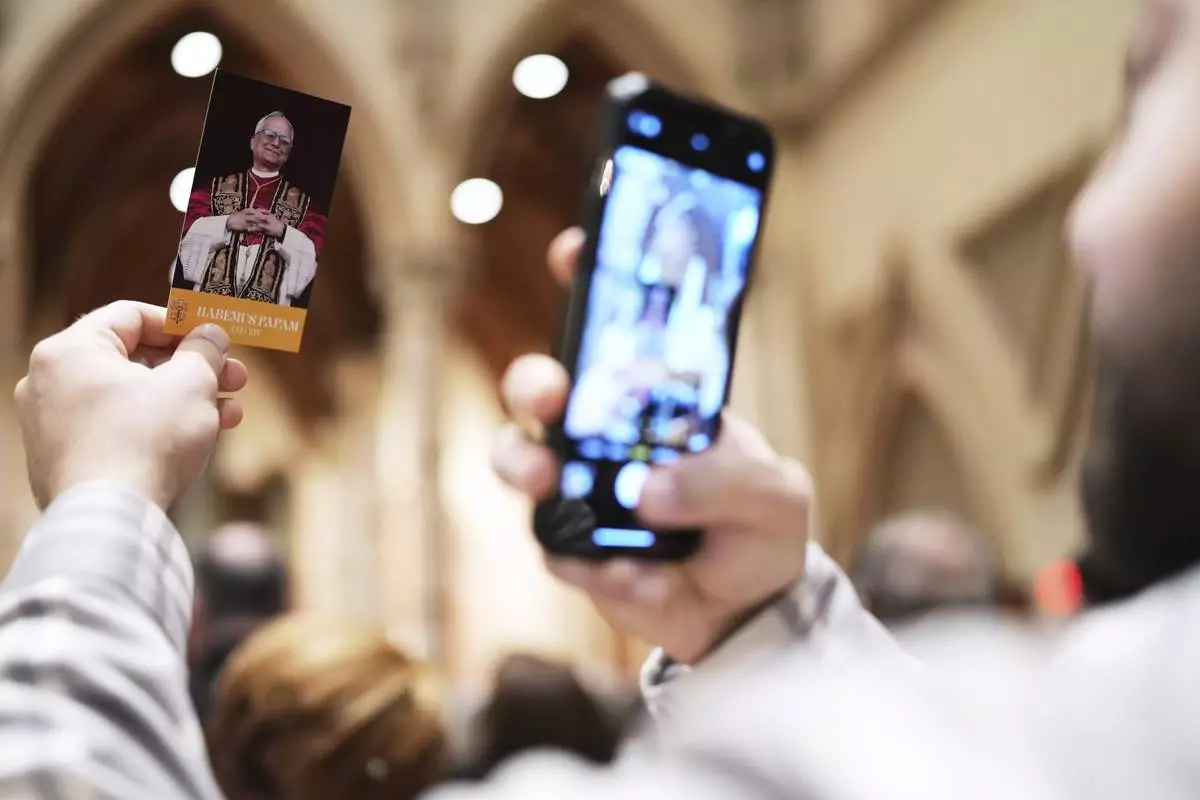
A man takes a picture of a brochure that reads "A prayer of thankfulness for the election of Pope Leo XIV" during a mass at Holy Name Cathedral in Chicago, Sunday, May 11, 2025. (AP Photo/Nam Y. Huh)

A man takes a picture of a brochure that reads "A prayer of thankfulness for the election of Pope Leo XIV" during a mass at Holy Name Cathedral in Chicago, Sunday, May 11, 2025. (AP Photo/Nam Y. Huh)

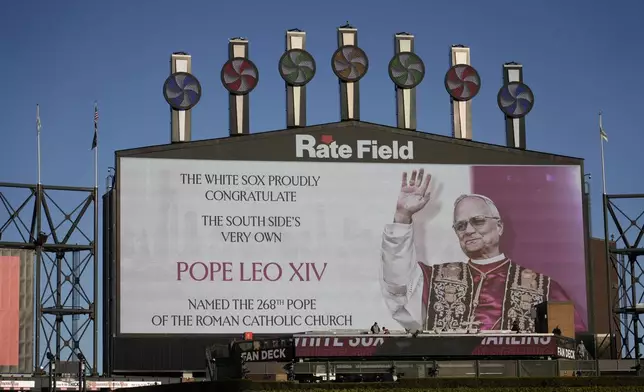
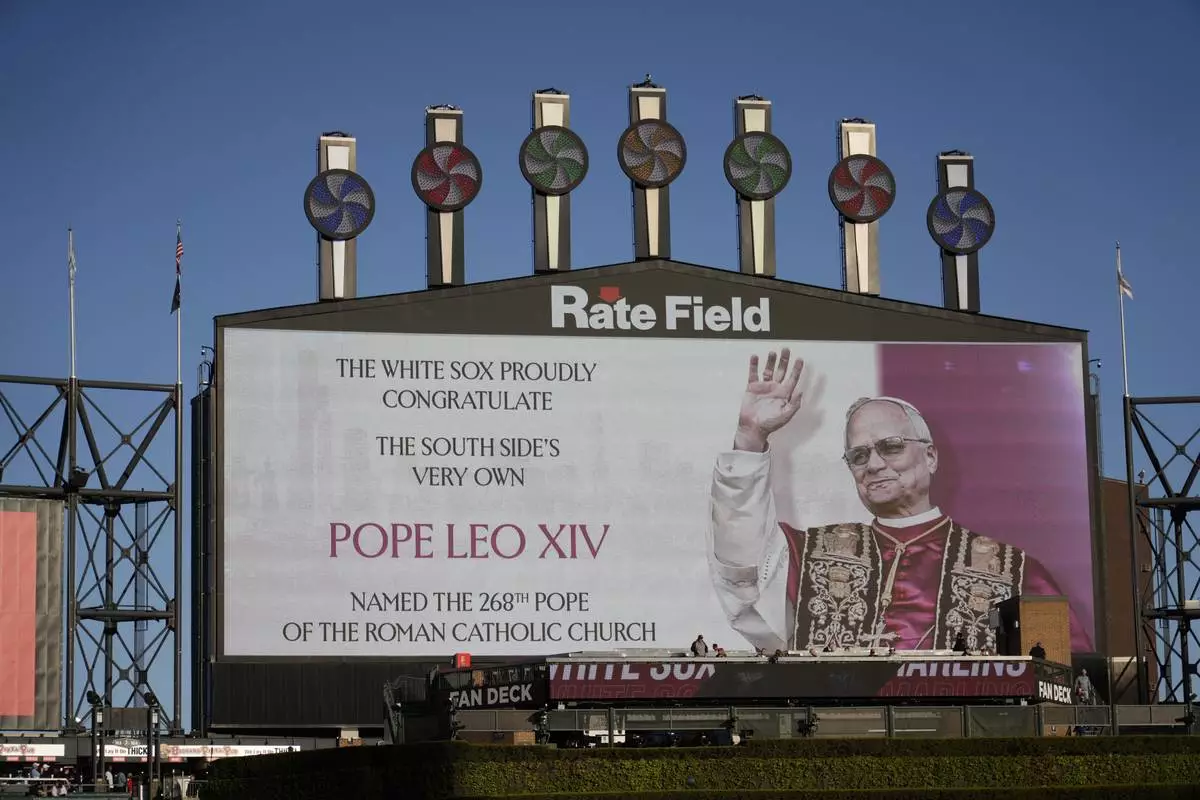
The Chicago White Sox honors Pope Leo XIV on the scoreboard before a baseball game against the Miami Marlins, Friday, May 8, 2025, in Chicago. (AP Photo/David Banks)
The Chicago White Sox honors Pope Leo XIV on the scoreboard before a baseball game against the Miami Marlins, Friday, May 8, 2025, in Chicago. (AP Photo/David Banks)

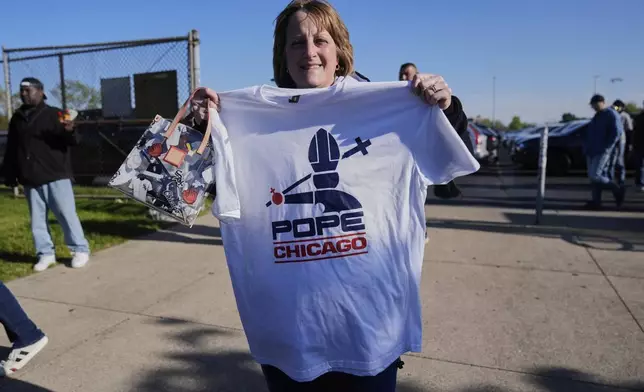
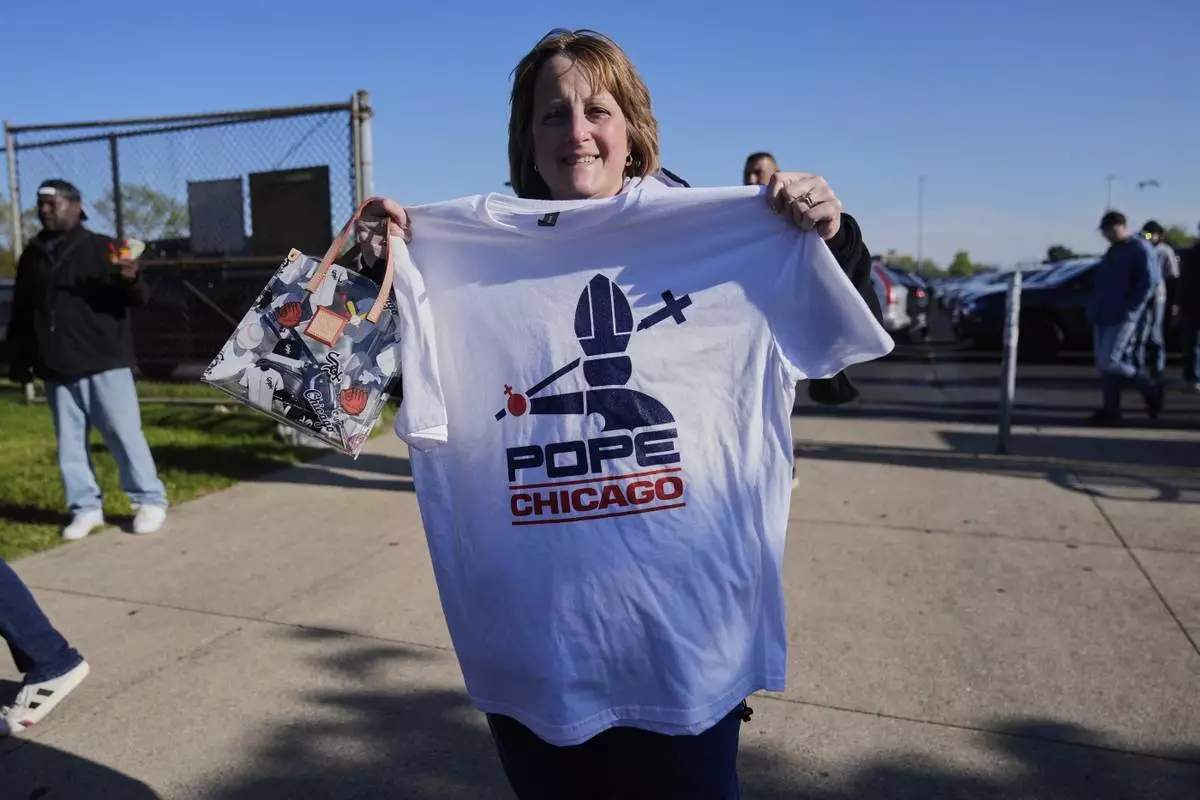
Sue Rosinski holds a Pope Leo XIV-themed shirt she bought outside Rate Field before a baseball game between the Chicago White Sox and Miami Marlins, Saturday, May 10, 2025, in Chicago. (AP Photo/Erin Hooley)
Sue Rosinski holds a Pope Leo XIV-themed shirt she bought outside Rate Field before a baseball game between the Chicago White Sox and Miami Marlins, Saturday, May 10, 2025, in Chicago. (AP Photo/Erin Hooley)

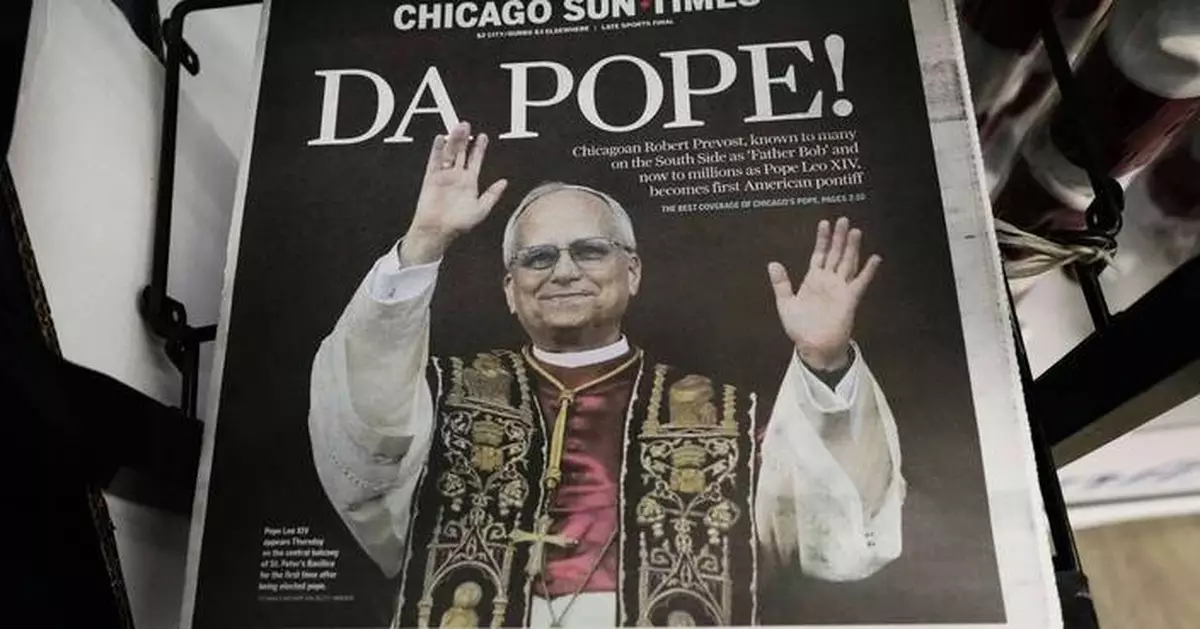
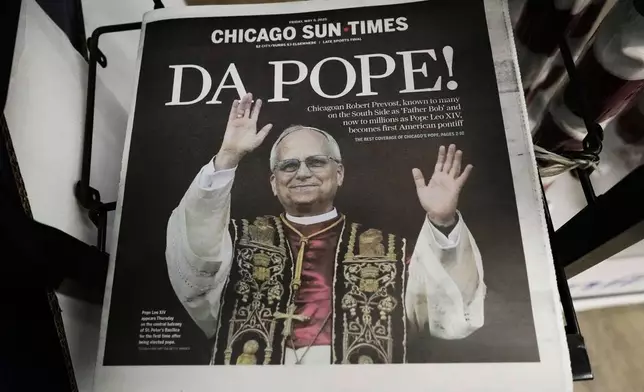
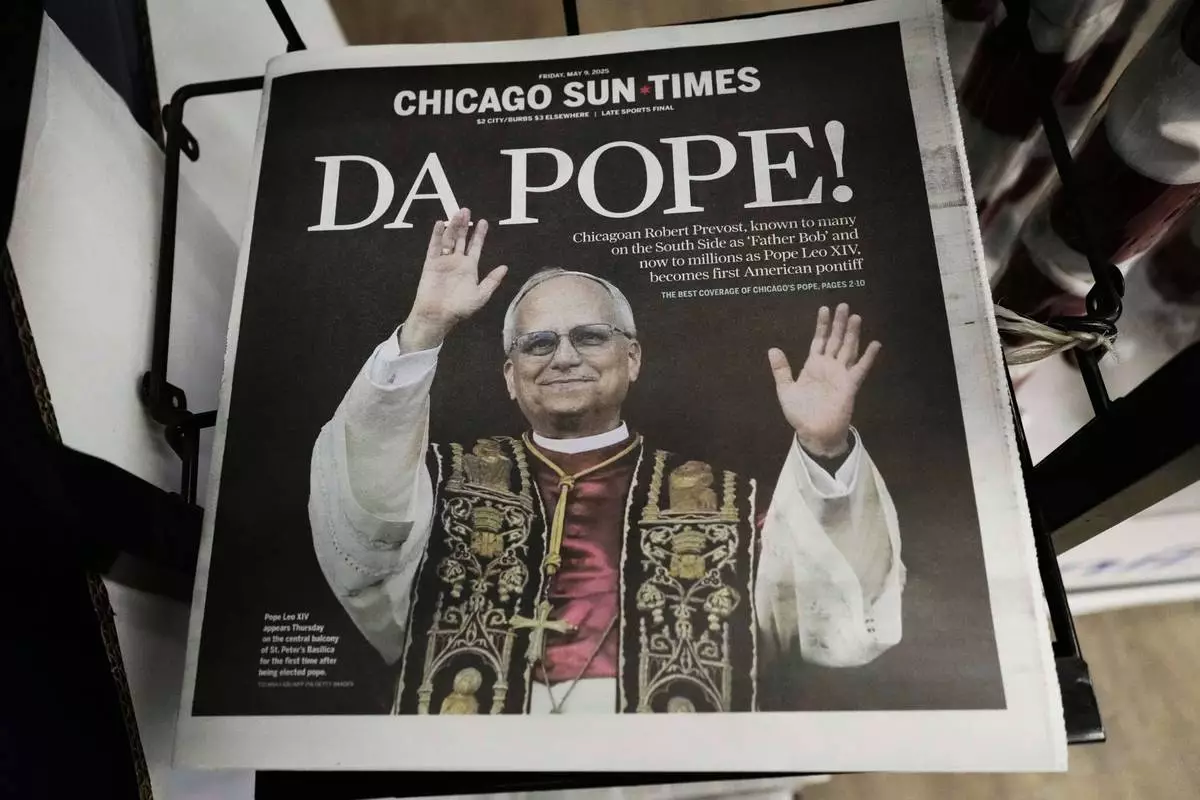
A Chicago Sun-Times newspaper front page shows "DA POPE!" at a grocery store in Mount Prospect, Ill., Thursday, May 9, 2025. (AP Photo/Nam Y. Huh)

A Chicago Sun-Times newspaper front page shows "DA POPE!" at a grocery store in Mount Prospect, Ill., Thursday, May 9, 2025. (AP Photo/Nam Y. Huh)

Then there was the Instagram video featuring two guys outlining the ways the new pontiff was a product of his upbringing: “The pope's a Midwesterner. Bread and wine is now cheese and beer," says one. Retorts the other: “The pope's a Midwesterner. Collection baskets now accept Kohl's cash.”

Popes: They’re just like us?

Not exactly. The former Bob Prevost is hardly just another guy from Chicago. But you wouldn’t know that by the burst of American fanfare surrounding the newly minted Pope Leo XIV. He has been called out for his eating proclivities (Jimmy Fallon: “deep-dish communion wafers?”), for his sports affiliations, for his lively sibling relationships and more. Fake videos of him weighing in on basketball and Donald Trump in classic Midwestern ways are proliferating.

Why are we so focused on making sure the supreme leader of the Roman Catholic Church is also a regular guy from the Midwest? Some of it is pride, you betcha. But another answer lies in Americans’ peculiar and complex relationship with fame and power that goes way back to the founding of the nation itself.

When the United States became the United States in 1776, it rejected King George III, the crown's taxes and the ornate accoutrements and sensibilities that surrounded royalty.

In its place grew democracy, effectively the cult of the regular guy. As the decades passed, the sensibility of “effete” royalty from back east — whether “back east” was England or, ultimately, Washington — became scorned. By the time Andrew Jackson's form of populism began to flourish in the 1830s, the “regular guy” in the rising democratic republic became a revered trope. Thus the tales of Abraham Lincoln growing up in a log cabin and splitting rails just like the rest of us — or, at least, the 19th-century rural American “rest of us.”

“Our culture is one that is based on the rejection of monarchy and class distinctions and yet is fascinated by monarchies and those who we see as set above and apart,” says David Gibson, director of the Center on Religion and Culture at Fordham University. "We want these figures to look up to but also to sit down with."

And it has stayed that way, politically and culturally, right up until today.

Think about how the ideal presidential candidate has evolved from the time of, say, Franklin D. Roosevelt, an effete Easterner who favored a long cigarette holder, to today. Ronald Reagan talked in the homespun language of hearth and home. Bill Clinton played a sax and answered the time-honored question of “boxers or briefs.” George Bush, now a nondrinker, became “a guy you'd want to have a beer with.” (Jon Stewart famously shot that down by saying: "I want my president to be the designated driver.”)

This down-to-Earth sensibility was evident in the press conference that American cardinals held after Leo was elevated. No intense church music accompanied their entrance; instead, it was “American Pie” and Bruce Springsteen's “Born in the USA” — foundational pillars of popular culture, with an emphasis on “popular.” The message: This is not a “back east” pope.

“Popes have always been alien — strangers," says John Baick, an American historian at Western New England University. "We like and trust that he is one of us. The Midwest is the place of hard work, the place of decency, the place of listening, the place of manners. This is the person you want to sit on the other side of that diner on a Sunday morning.”

He places Leo's ascension as a bookend to John F. Kennedy's election in 1960 — a resounding signal, this time globally, that Catholicism is compatible with Americanism.

But as for the “he's one of us” approach, that says more about the people watching Leo than about the actual pope. “He has done none of this himself," Baick says. "The connections are things that we have desperately created. We are so desperate for normalcy, for a regular guy.”

And yet ...

Americans famously adored Princess Diana, “the people’s princess.” People like the Kennedys and Grace Kelly — before she became an actual princess — were referred to as “American royalty.” And even though we’re a long way from the days of Bogie, Bacall and Greta Garbo — a generation into the “Stars: They’re Just Like Us” era — Americans still love to put people on pedestals and bring them back down, sometimes at the same time.

The latest iteration of this is tied to reality TV, which took regular people and turned them into personalities, figures, commodities.

“This country is positioned as a place where anybody can succeed. It plays directly into that — the regular person who succeeds on a large scale,” says Danielle Lindemann, author of “True Story: What Reality TV Says About Us.”

“We’re kind of obsessed with this everyday Joe who is plucked from obscurity and becomes famous. In the United States, that’s a salient and dominant narrative,” says Lindemann, a professor of sociology at Lehigh University in Pennsylvania. “We almost feel like we have relationships with these people. We’re getting so much personal information about him, and it facilitates that sense of closeness.”

Prevost, of course, is not your average Midwesterner. His Spanish, among other tongues, is fluent. He spent two decades in Peru, where he also holds citizenship (and where, it must be said, there is footage of him singing “Feliz Navidad” into a microphone at a Christmas party). And there's that small matter that he is now the head of a global church of 1.4 billion souls.

So a new era begins for both the United States and the Catholic Church — an age-old hierarchy and a society that demands egalitarianism, or the appearance of it, from the people it looks up to. And at the intersection of those two principles sits Robert Prevost, Pope Leo XIV, an accomplished man in his own right but also an empty vessel into which broad swaths of humanity will pour their expectations — be they about eternity or simply the South Side of Chicago.

“Popes want to connect with people, and the church wants that as well. But the peril is that such familiarity breeds not so much contempt as disobedience,” Gibson says.

“The pope is not your friend. He is not going to sit down and have a beer with you,” he says. “If you think the pope is your pal, will you feel betrayed when he reminds you of your religious and moral duties, and chides you for failing to follow them?”

Ted Anthony, director of new storytelling and newsroom innovation for The Associated Press, has been writing about American culture since 1990.

Associated Press religion coverage receives support through the AP’s collaboration with The Conversation US, with funding from Lilly Endowment Inc. The AP is solely responsible for this content.
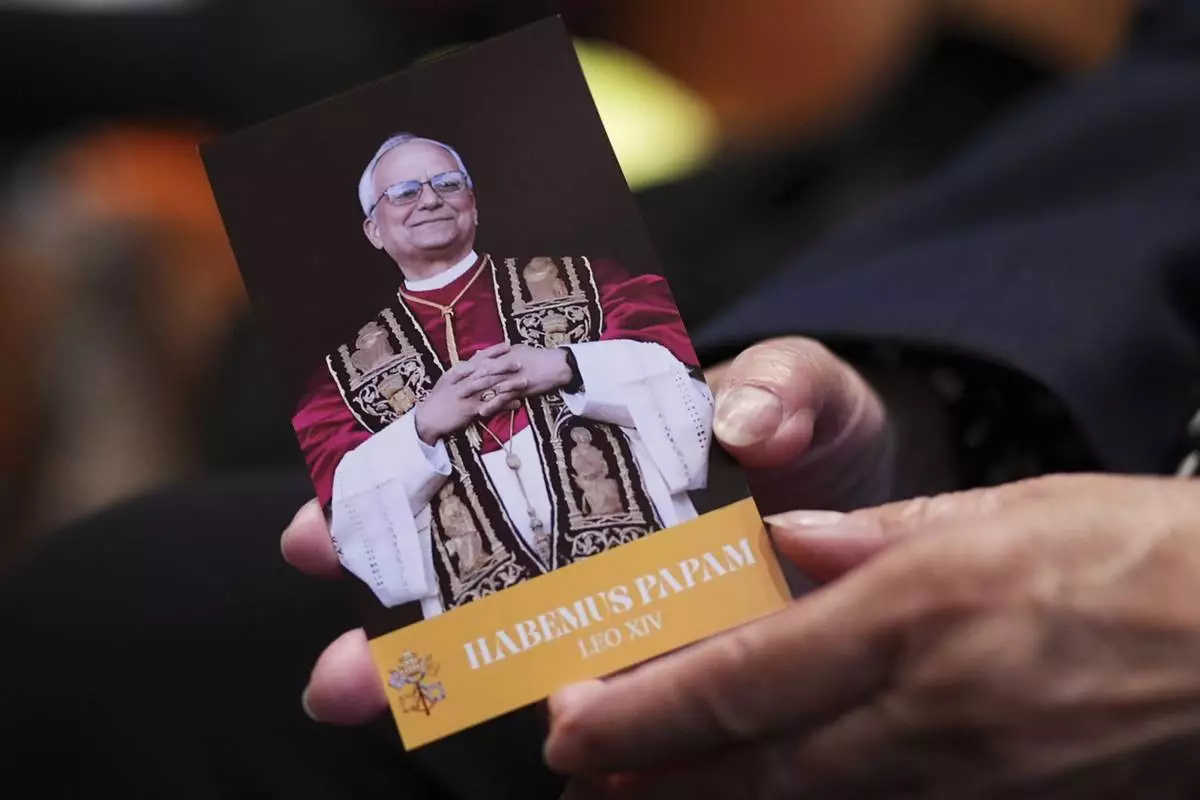
Grace Mellor prays as she holds a brochure that reads "A prayer of thankfulness for the election of Pope Leo XIV" during a mass at Holy Name Cathedral in Chicago, Sunday, May 11, 2025. (AP Photo/Nam Y. Huh)
Grace Mellor prays as she holds a brochure that reads "A prayer of thankfulness for the election of Pope Leo XIV" during a mass at Holy Name Cathedral in Chicago, Sunday, May 11, 2025. (AP Photo/Nam Y. Huh)
A man takes a picture of a brochure that reads "A prayer of thankfulness for the election of Pope Leo XIV" during a mass at Holy Name Cathedral in Chicago, Sunday, May 11, 2025. (AP Photo/Nam Y. Huh)

A man takes a picture of a brochure that reads "A prayer of thankfulness for the election of Pope Leo XIV" during a mass at Holy Name Cathedral in Chicago, Sunday, May 11, 2025. (AP Photo/Nam Y. Huh)

The Chicago White Sox honors Pope Leo XIV on the scoreboard before a baseball game against the Miami Marlins, Friday, May 8, 2025, in Chicago. (AP Photo/David Banks)
The Chicago White Sox honors Pope Leo XIV on the scoreboard before a baseball game against the Miami Marlins, Friday, May 8, 2025, in Chicago. (AP Photo/David Banks)

Sue Rosinski holds a Pope Leo XIV-themed shirt she bought outside Rate Field before a baseball game between the Chicago White Sox and Miami Marlins, Saturday, May 10, 2025, in Chicago. (AP Photo/Erin Hooley)
Sue Rosinski holds a Pope Leo XIV-themed shirt she bought outside Rate Field before a baseball game between the Chicago White Sox and Miami Marlins, Saturday, May 10, 2025, in Chicago. (AP Photo/Erin Hooley)

A Chicago Sun-Times newspaper front page shows "DA POPE!" at a grocery store in Mount Prospect, Ill., Thursday, May 9, 2025. (AP Photo/Nam Y. Huh)

A Chicago Sun-Times newspaper front page shows "DA POPE!" at a grocery store in Mount Prospect, Ill., Thursday, May 9, 2025. (AP Photo/Nam Y. Huh)
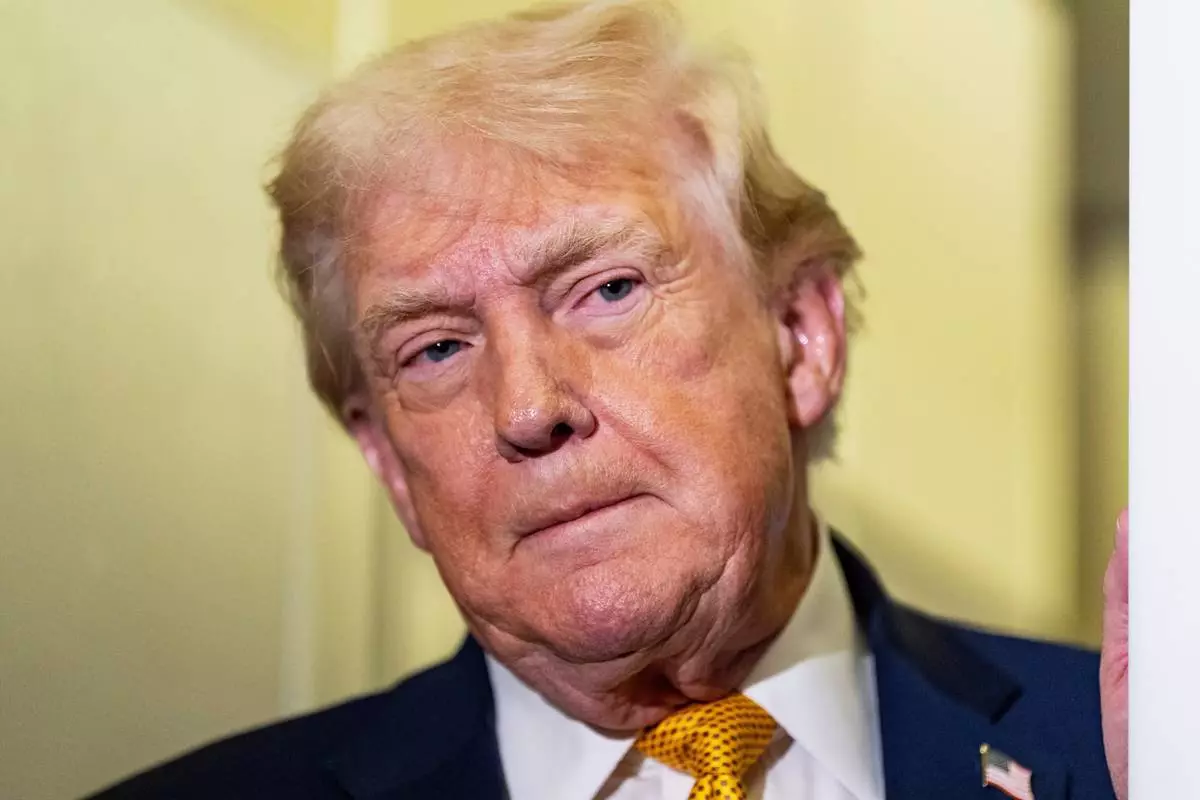
U.S. President Donald Trump wants to own Greenland. He has repeatedly said the United States must take control of the strategically located and mineral-rich island, which is a semiautonomous region that's part of NATO ally Denmark.

Officials from Denmark, Greenland and the United States met Thursday in Washington and will meet again next week to discuss a renewed push by the White House, which is considering a range of options, including using military force, to acquire the island.

Trump said Friday he is going to do “something on Greenland, whether they like it or not.”

If it's not done “the easy way, we're going to do it the hard way," he said without elaborating what that could entail. In an interview Thursday, he told The New York Times that he wants to own Greenland because “ownership gives you things and elements that you can’t get from just signing a document.”

Danish Prime Minister Mette Frederiksen has warned that an American takeover of Greenland would mark the end of NATO, and Greenlanders say they don't want to become part of the U.S.

This is a look at some of the ways the U.S. could take control of Greenland and the potential challenges.

Trump and his officials have indicated they want to control Greenland to enhance American security and explore business and mining deals. But Imran Bayoumi, an associate director at the Atlantic Council’s Scowcroft Center for Strategy and Security, said the sudden focus on Greenland is also the result of decades of neglect by several U.S. presidents towards Washington's position in the Arctic.

The current fixation is partly down to “the realization we need to increase our presence in the Arctic, and we don’t yet have the right strategy or vision to do so,” he said.

If the U.S. took control of Greenland by force, it would plunge NATO into a crisis, possibly an existential one.

While Greenland is the largest island in the world, it has a population of around 57,000 and doesn't have its own military. Defense is provided by Denmark, whose military is dwarfed by that of the U.S.

It's unclear how the remaining members of NATO would respond if the U.S. decided to forcibly take control of the island or if they would come to Denmark's aid.

“If the United States chooses to attack another NATO country militarily, then everything stops,” Frederiksen has said.

Trump said he needs control of the island to guarantee American security, citing the threat from Russian and Chinese ships in the region, but “it's not true” said Lin Mortensgaard, an expert on the international politics of the Arctic at the Danish Institute for International Studies, or DIIS.

While there are probably Russian submarines — as there are across the Arctic region — there are no surface vessels, Mortensgaard said. China has research vessels in the Central Arctic Ocean, and while the Chinese and Russian militaries have done joint military exercises in the Arctic, they have taken place closer to Alaska, she said.

Bayoumi, of the Atlantic Council, said he doubted Trump would take control of Greenland by force because it’s unpopular with both Democratic and Republican lawmakers, and would likely “fundamentally alter” U.S. relationships with allies worldwide.

The U.S. already has access to Greenland under a 1951 defense agreement, and Denmark and Greenland would be “quite happy” to accommodate a beefed up American military presence, Mortensgaard said.

For that reason, “blowing up the NATO alliance” for something Trump has already, doesn’t make sense, said Ulrik Pram Gad, an expert on Greenland at DIIS.

U.S. Secretary of State Marco Rubio told a select group of U.S. lawmakers this week that it was the Republican administration’s intention to eventually purchase Greenland, as opposed to using military force. Danish and Greenlandic officials have previously said the island isn't for sale.

It's not clear how much buying the island could cost, or if the U.S. would be buying it from Denmark or Greenland.

Washington also could boost its military presence in Greenland “through cooperation and diplomacy,” without taking it over, Bayoumi said.

One option could be for the U.S. to get a veto over security decisions made by the Greenlandic government, as it has in islands in the Pacific Ocean, Gad said.

Palau, Micronesia and the Marshall Islands have a Compact of Free Association, or COFA, with the U.S.

That would give Washington the right to operate military bases and make decisions about the islands’ security in exchange for U.S. security guarantees and around $7 billion of yearly economic assistance, according to the Congressional Research Service.

It's not clear how much that would improve upon Washington's current security strategy. The U.S. already operates the remote Pituffik Space Base in northwestern Greenland, and can bring as many troops as it wants under existing agreements.

Greenlandic politician Aaja Chemnitz told The Associated Press that Greenlanders want more rights, including independence, but don't want to become part of the U.S.

Gad suggested influence operations to persuade Greenlanders to join the U.S. would likely fail. He said that is because the community on the island is small and the language is “inaccessible.”

Danish Foreign Minister Lars Løkke Rasmussen summoned the top U.S. official in Denmark in August to complain that “foreign actors” were seeking to influence the country’s future. Danish media reported that at least three people with connections to Trump carried out covert influence operations in Greenland.

Even if the U.S. managed to take control of Greenland, it would likely come with a large bill, Gad said. That’s because Greenlanders currently have Danish citizenship and access to the Danish welfare system, including free health care and schooling.

To match that, “Trump would have to build a welfare state for Greenlanders that he doesn’t want for his own citizens,” Gad said.

Since 1945, the American military presence in Greenland has decreased from thousands of soldiers over 17 bases and installations to 200 at the remote Pituffik Space Base in the northwest of the island, Rasmussen said last year. The base supports missile warning, missile defense and space surveillance operations for the U.S. and NATO.

U.S. Vice President J.D. Vance told Fox News on Thursday that Denmark has neglected its missile defense obligations in Greenland, but Mortensgaard said that it makes “little sense to criticize Denmark,” because the main reason why the U.S. operates the Pituffik base in the north of the island is to provide early detection of missiles.

The best outcome for Denmark would be to update the defense agreement, which allows the U.S. to have a military presence on the island and have Trump sign it with a “gold-plated signature,” Gad said.

But he suggested that's unlikely because Greenland is “handy” to the U.S president.

When Trump wants to change the news agenda — including distracting from domestic political problems — “he can just say the word ‘Greenland' and this starts all over again," Gad said.

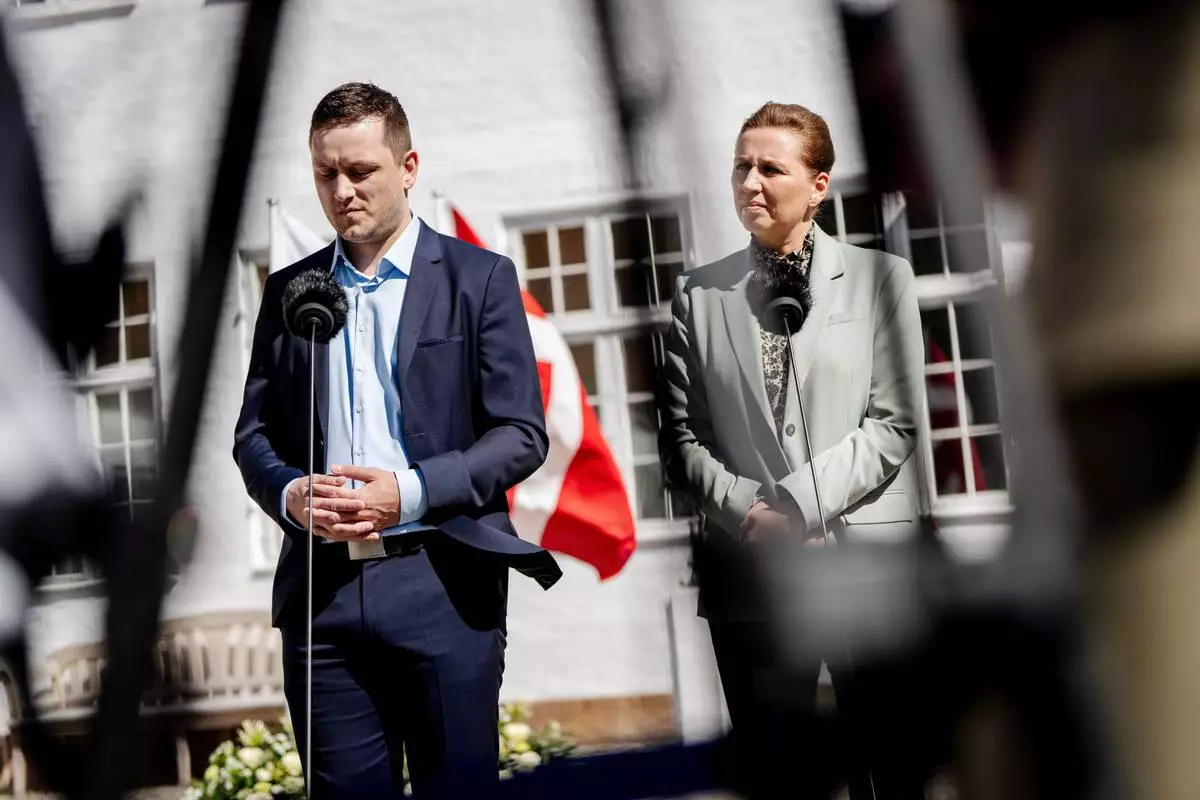
CORRECT THE ORDER OF SPEAKERS, FILE - Denmark's Prime Minister Mette Frederiksen, right, and Greenland's Prime Minister Jens-Frederik Nielsen, left, speak on April 27, 2025, in Marienborg, Denmark. (Mads Claus Rasmussen/Ritzau Scanpix via AP, File)

CORRECT THE ORDER OF SPEAKERS, FILE - Denmark's Prime Minister Mette Frederiksen, right, and Greenland's Prime Minister Jens-Frederik Nielsen, left, speak on April 27, 2025, in Marienborg, Denmark. (Mads Claus Rasmussen/Ritzau Scanpix via AP, File)

FILE - Danish military forces participate in an exercise with hundreds of troops from several European NATO members in the Arctic Ocean in Nuuk, Greenland, Sept. 15, 2025. (AP Photo/Ebrahim Noroozi, File)

FILE - Danish military forces participate in an exercise with hundreds of troops from several European NATO members in the Arctic Ocean in Nuuk, Greenland, Sept. 15, 2025. (AP Photo/Ebrahim Noroozi, File)

President Donald Trump listens as he was speaking with reporters while in flight on Air Force One, Sunday, Jan. 4, 2026, as returning to Joint Base Andrews, Md. (AP Photo/Alex Brandon)

President Donald Trump listens as he was speaking with reporters while in flight on Air Force One, Sunday, Jan. 4, 2026, as returning to Joint Base Andrews, Md. (AP Photo/Alex Brandon)

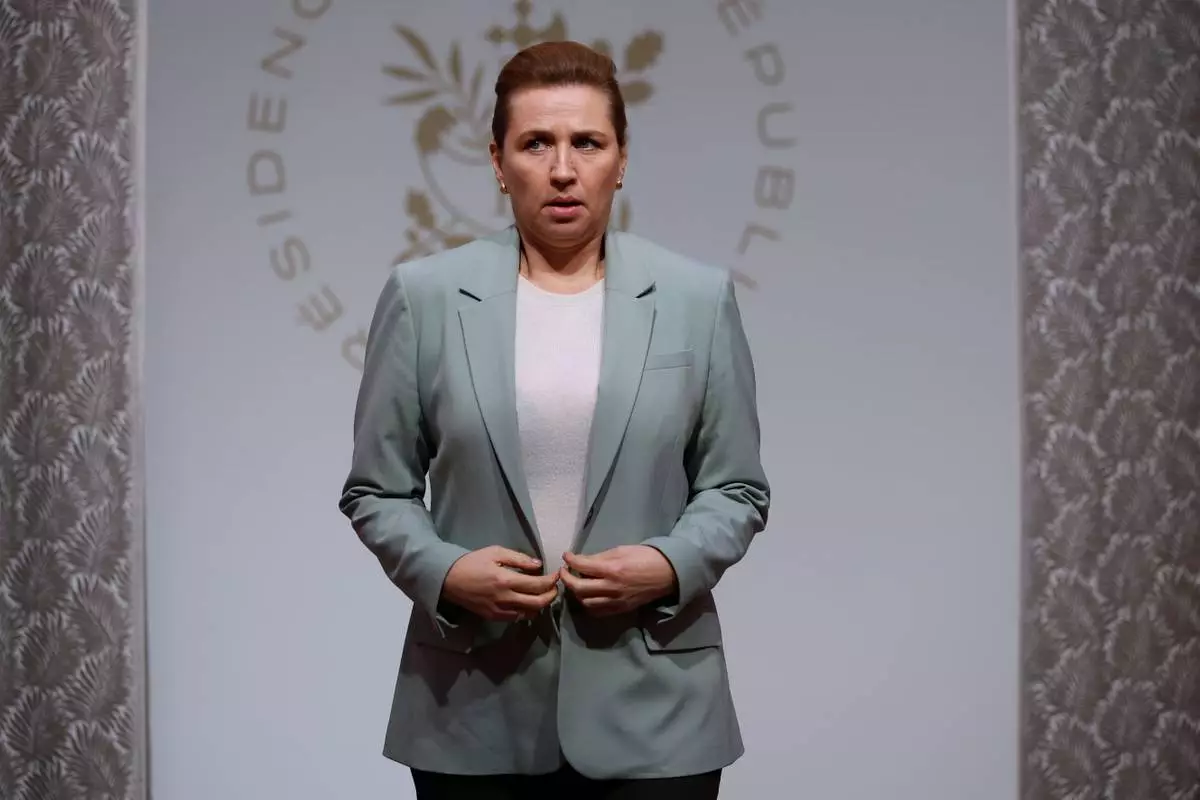
Danish Prime Minister Mette Frederiksen arrives for a meeting of the Coalition of the Willing at the Elysee Palace in Paris, France, Tuesday, Jan.6, 2026. (Yoan Valat, Pool photo via AP)

Danish Prime Minister Mette Frederiksen arrives for a meeting of the Coalition of the Willing at the Elysee Palace in Paris, France, Tuesday, Jan.6, 2026. (Yoan Valat, Pool photo via AP)

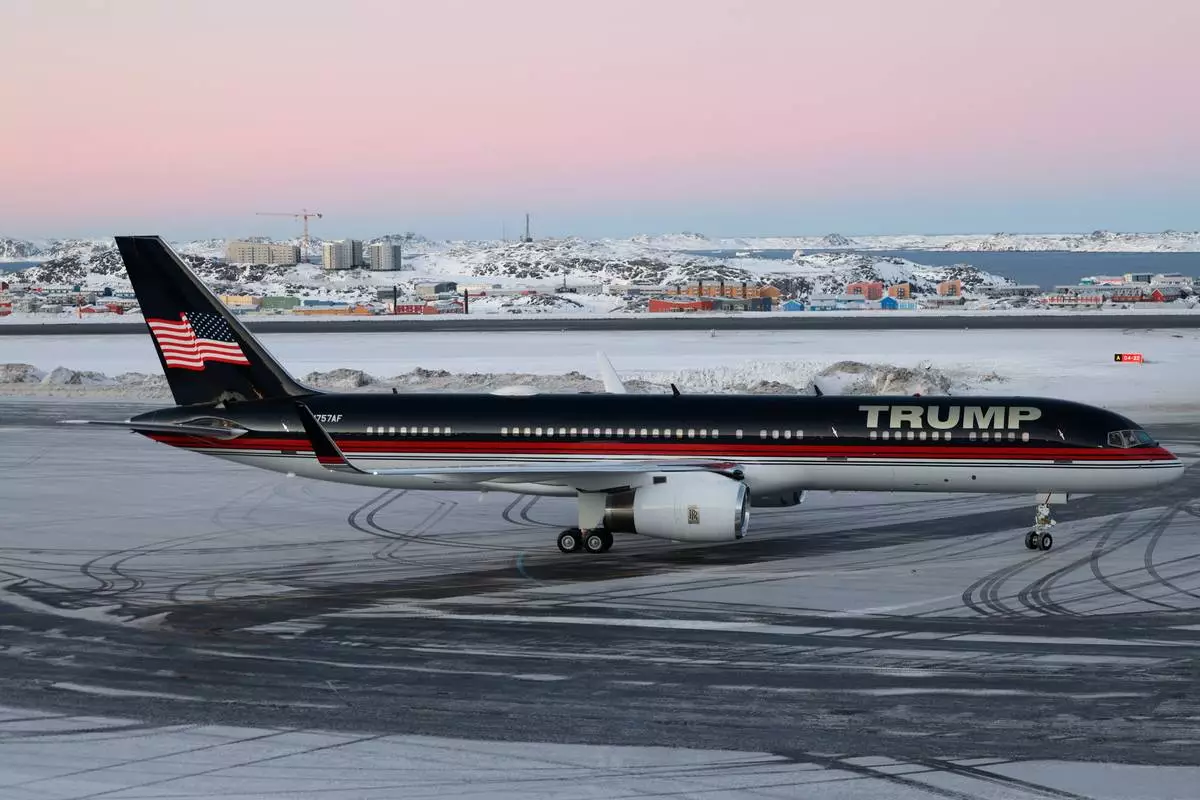
FILE - A plane carrying Donald Trump Jr. lands in Nuuk, Greenland, Jan. 7, 2025. (Emil Stach/Ritzau Scanpix via AP, file)

FILE - A plane carrying Donald Trump Jr. lands in Nuuk, Greenland, Jan. 7, 2025. (Emil Stach/Ritzau Scanpix via AP, file)

Recommended Articles