DES MOINES, Iowa (AP) — An Iowa sheriff is warning that his county may be publicly shamed by the Trump administration for insufficiently backing the president's immigration agenda, though he says he is “more than happy” to help. He said he just wants to ensure he doesn't end up with too few officers, jail beds and dollars to respond to the county's needs.
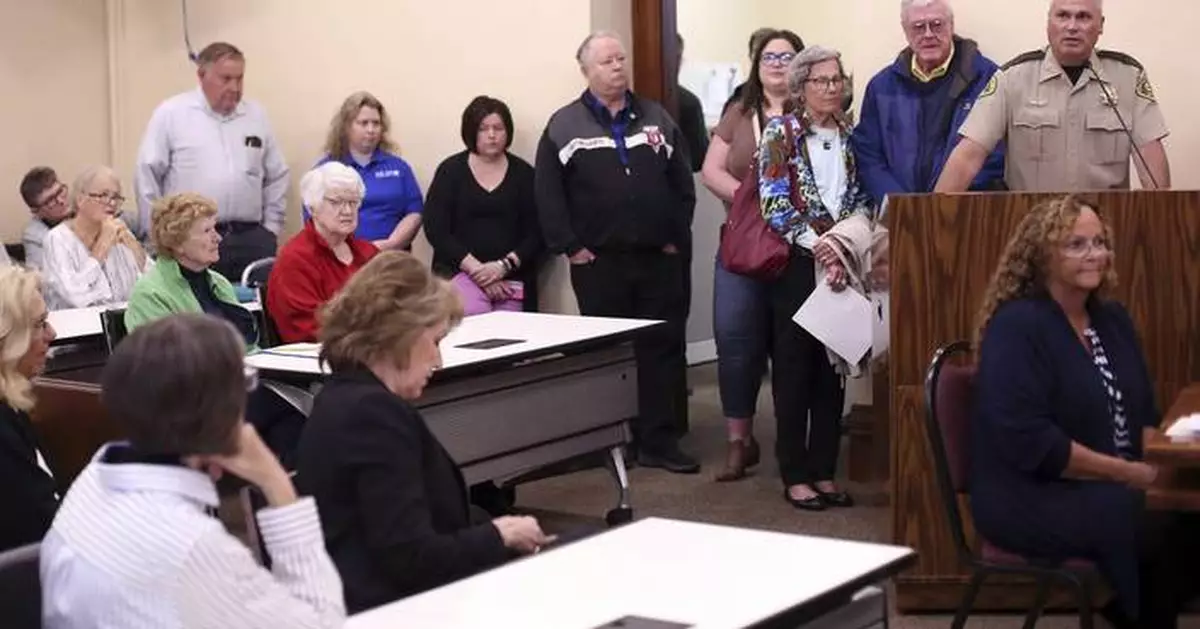
Dubuque County Sheriff Joe Kennedy, who serves nearly 100,000 people in the area bordering Wisconsin and Illinois, seemed to try not to alienate the federal government when he declined to participate in a program that would commit county revenue and jail space to immigration enforcement. He explained his decision before a packed county chamber this week, drawing mixed reactions.
President Donald Trump directed his administration in an executive order last month to “publish a list of States and local jurisdictions that obstruct the enforcement of Federal immigration laws (sanctuary jurisdictions).” Sanctuaries are generally understood to mean state and local governments that limit cooperation with federal immigration authorities, but Trump didn't elaborate on the criteria.
Jonathan Thompson, executive director and chief executive officer of the National Sheriffs' Association, addressed the order in a May 2 note to his members, including Kennedy, according to documents released for the county meeting. Thompson said the list may be published before Trump's May 28 deadline and he encouraged those interested in training and empowering their officers to enforce immigration laws to “act quickly.”
The number of state and local agencies that have deputized staff to enforce federal immigration laws has soared since Trump took office to 588 in 40 states, with 83 applications pending, as of May 19. Immigration laws are federal, and enforcing them is largely a federal responsibility.
Kennedy replied to an invitation from a U.S. Immigration and Customs Enforcement official in March, saying it wasn't “a good fit” to enter a 287(g) agreement, which refers to the section of a 1996 law that allows for state and local police to make immigration arrests. He made clear it was about money and jail space, not politics.
“It has generally been my experience that when we partner with larger entities (Federal, state), those agencies usually ‘take’ more than they ‘give.’ Essentially, we usually end up with the short end of the stick in some way,” he wrote.
Kennedy said he would be “more than happy to assist your agents in our area” but asked ICE not to rely on his 181-bed jail because he doesn't have room.
David Bindert, an official in ICE's Cedar Rapids, Iowa, office, was sympathetic in his brief response: “No worries Sir, I completely understand, and I thank you for your time in this matter.”
Some residents at a county board of supervisors meeting Monday supported Kennedy, a Democrat. Others wanted him to do more with immigration authorities. A Republican supervisor suggested a 287(g) agreement might cost the county or taxpayers but would be essential for public safety.
Kennedy told residents that his office has been, and will be, a partner to ICE but that a “binding agreement” could detract from other law enforcement work.
“When you partner with the federal government, our employees then have the potential to become their employees,” he said.
An Iowa law prohibits state and local officials from adopting policies that limit cooperation with federal immigration authorities. Attorney General Brenna Bird recently sued the Winneshiek County sheriff over a Facebook post that she said discouraged cooperation, potentially jeopardizing state funding to the county.
The Trump administration has also taken legal action against governments with policies limiting immigration arrests, suing Chicago, Denver and Rochester, New York.
Thompson, who represented his association's more than 3,000 sheriffs when Trump signed the April 28 order, said the president has been clear that he'd look to “every nook and cranny” for support in enforcing immigration laws.
But Thompson said that each sheriff has to make a decision that's right for their community. Some may not have money or jail space, jeopardizing other obligations.
“Every sheriff needs another mandate like they need a hole in their head,” he said.
So far Iowa has one agency signed up for the program: the state Department of Public Safety. No other agency is listed as having active or pending 287(g) agreements. Florida has 255, more than any state.
ICE did not respond to AP questions on whether an agency that declined a 287(g) agreement would be included on the administration's sanctuary list.
Thompson said he doesn’t know.
“What I’m trying to do is advise members,” he said. “There are challenges, there are opportunities and there are risks.”
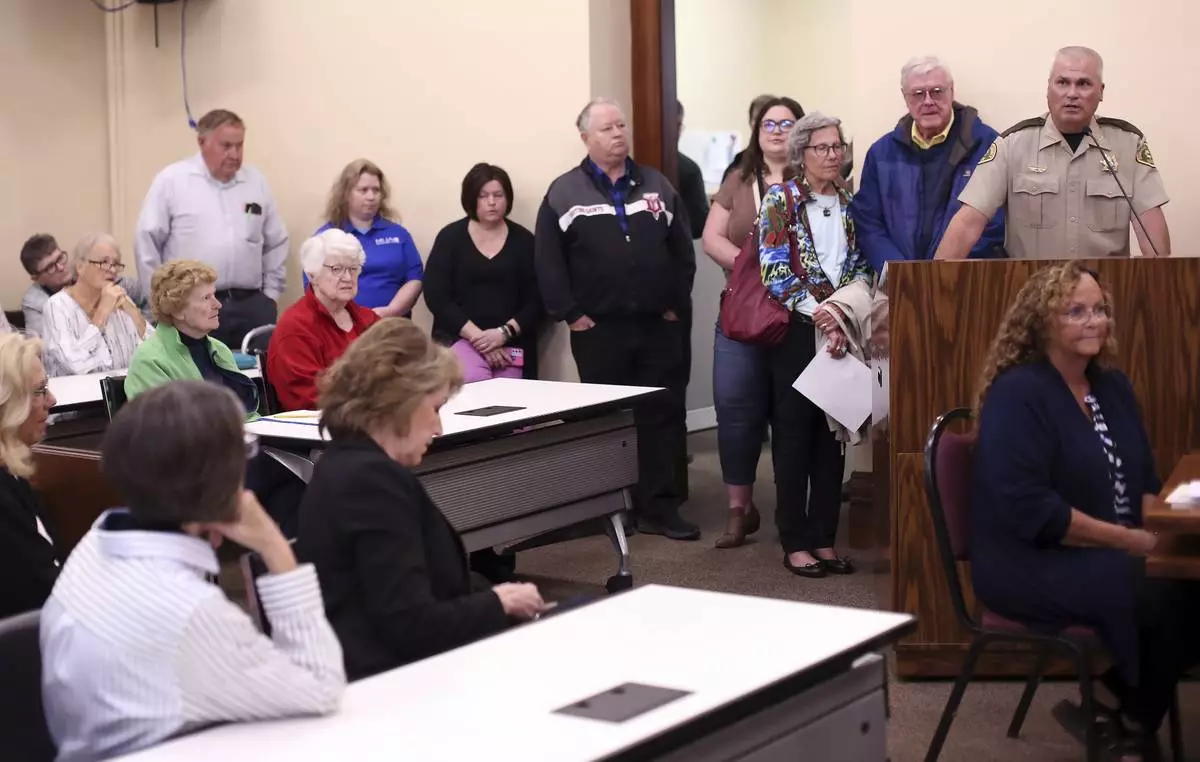
Dubuque County Sheriff Joe Kennedy addresses his decision to not sign an agreement with U.S. Immigration & Customs Enforcement that grants local law enforcement authority to perform certain immigration functions, Monday, May 19, 2025, in Dubuque, Iowa. (Benjamin Fisher/Telegraph Herald via AP)
SURIN, Thailand (AP) — Fighting raged Saturday morning along the border of Thailand and Cambodia, even after U.S. President Donald Trump, acting as a mediator, declared that he had won agreement from both countries for a new ceasefire.
Thai officials said they did not agree to a ceasefire. Cambodia has not commented directly on Trump’s claim, but its defense ministry said Thai jets carried out airstrikes Saturday morning.
Thai Foreign Minister Sihasak Phuangketkeow said Saturday that some of Trump's remarks didn't “reflect an accurate understanding of the situation.”
He said Trump’s characterization of a land mine explosion that wounded Thai soldiers as a “roadside accident” was inaccurate, and did not reflect Thailand's position that it was a deliberate act of aggression.
Sihasak said that Trump’s willingness to credit what may be “information from sources that deliberately distorted the facts” instead of believing Thailand hurt the feelings of the Thai people “because we consider ourselves — we are proud, in fact — to be the oldest treaty ally of the United States in the region.”
The latest large-scale fighting was set off by a skirmish on Dec. 7 that wounded two Thai soldiers and derailed a ceasefire promoted by Trump that ended five days of earlier combat in July over longstanding territorial disputes.
The July ceasefire was brokered by Malaysia and pushed through by pressure from Trump, who threatened to withhold trade privileges unless Thailand and Cambodia agreed. It was formalized in more detail in October at a regional meeting in Malaysia that Trump attended.
More than two dozen people on both sides of the border have officially been reported killed in this past week’s fighting, while more than half a million have been displaced.
The Thai military acknowledged 15 of its troops died during the fighting, and estimated earlier this week that there have been 165 fatalities among Cambodian soldiers. Cambodia has not announced military casualties, but has said at least 11 civilians have been killed and more than six dozen wounded.
Trump, after speaking to Thai Prime Minister Anutin Charnvirakul and Cambodian Prime Minister Hun Manet, announced on Friday an agreement to restart the ceasefire.
“They have agreed to CEASE all shooting effective this evening, and go back to the original Peace Accord made with me, and them, with the help of the Great Prime Minister of Malaysia, Anwar Ibrahim,” Trump wrote in his Truth Social post.
Trump’s claim came after midnight in Bangkok. Thai Prime Minister Anutin had, after his call with Trump, said he had explained Thailand’s reasons for fighting and said peace would depend on Cambodia ceasing its attacks first.
The Thai foreign ministry later explicitly disputed Trump’s claim that a ceasefire had been reached. Anutin's busy day on Friday included dissolving Parliament, so new elections could be held early next year.
Cambodian Prime Minister Hun Manet, in comments posted early Saturday morning, also made no mention of a ceasefire.
Hun Manet said he held phone conversations on Friday night with Trump, and a night earlier with Malaysia’s Prime Minister Anwar Ibrahim, and thanked both “for their continuous efforts to achieve a long-lasting peace between Cambodia and Thailand.”
“Cambodia is ready to cooperate in any way that is needed," Hun Manet wrote.
Anwar later posted on social media that he was urging the two sides to implement a ceasefire on Saturday night. Cambodia's prime minister, also posting online, endorsed the initiative, which included having Malaysia and the United States help monitor it. However, Thai Prime Minister Anutin denied that his country was even in negotiations over the proposal.
Thailand has been carrying out airstrikes on what it says are strictly military targets, while Cambodia has been firing thousands of medium-range BM-21 rockets that have caused havoc but relatively few casualties.
BM-21 rocket launchers can fire up to 40 rockets at a time with a range of 30-40 kilometers (19-25 miles). These rockets cannot be precisely targeted and have landed largely in areas from where most people have already been evacuated.
However, the Thai army announced Saturday that BM-21 rockets had hit a civilian area in Sisaket province, seriously injuring two civilians who had heard warning sirens and had been running toward a bunker for safety.
Thailand's navy was also reported by both sides' militaries to have joined the fighting on Saturday morning, with a warship in the Gulf of Thailand shelling Cambodia's southwestern province of Koh Kong. Each side said the other opened fire first.
——
Peck reported from Bangkok. Sopheng Cheang in Serei Saophoan, Cambodia, and Matthew Lee in Washington contributed to this report.
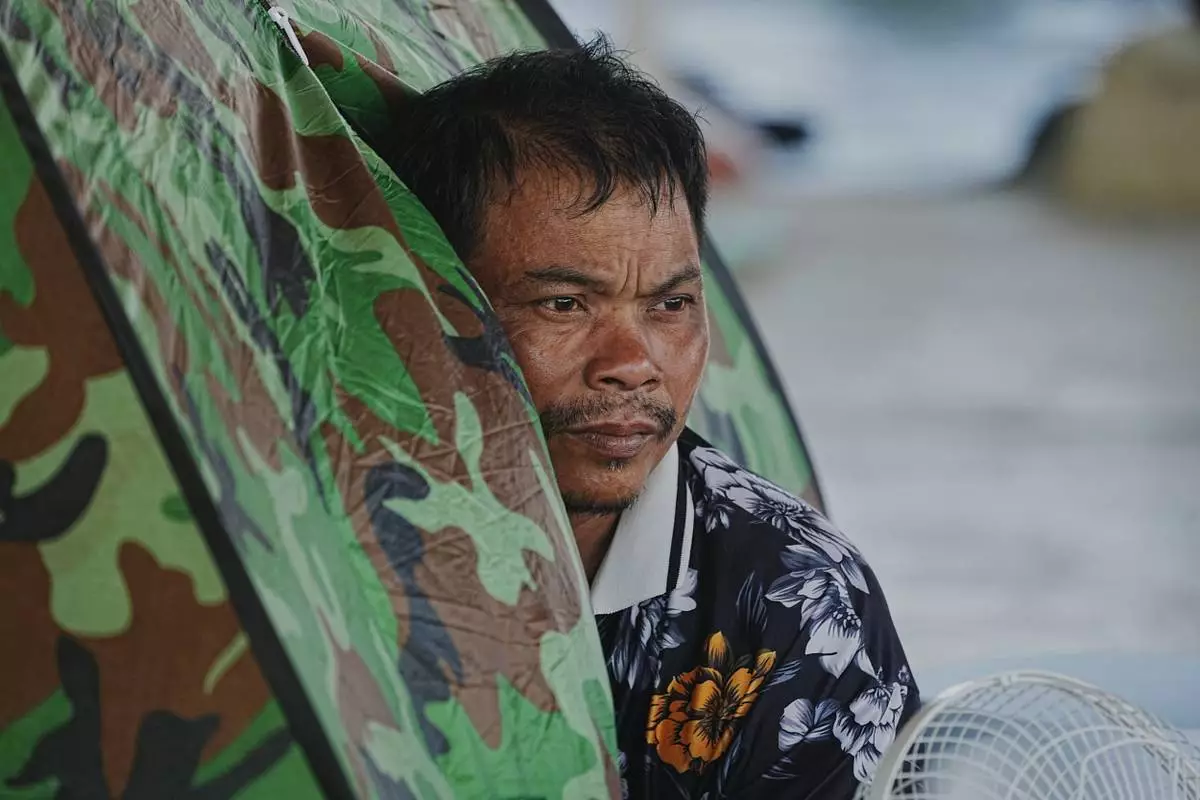
A man sits in a tent as he takes refuge in Banteay Menchey provincial town, Cambodia, Saturday, Dec. 13, 2025, after fleeing home following fighting between Thailand and Cambodia. (AP Photo/Heng Sinith)

An evacuee cooks soup as she takes refuge in Banteay Menchey provincial town, Cambodia, Saturday, Dec. 13, 2025, after fleeing home following fighting between Thailand and Cambodia. (AP Photo/Heng Sinith)
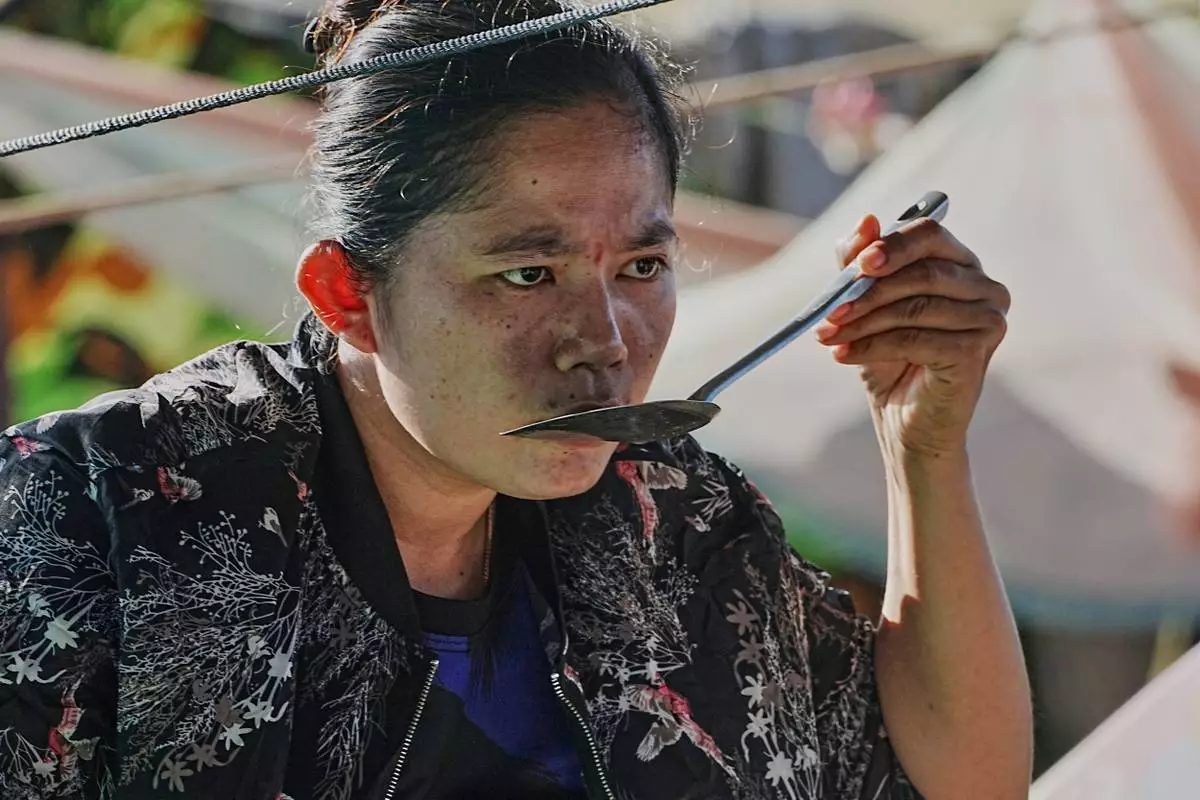
An evacuee tastes soup as she takes refuge in Banteay Menchey provincial town, Cambodia, Saturday, Dec. 13, 2025, after fleeing from home following fighting between Thailand and Cambodia. (AP Photo/Heng Sinith)
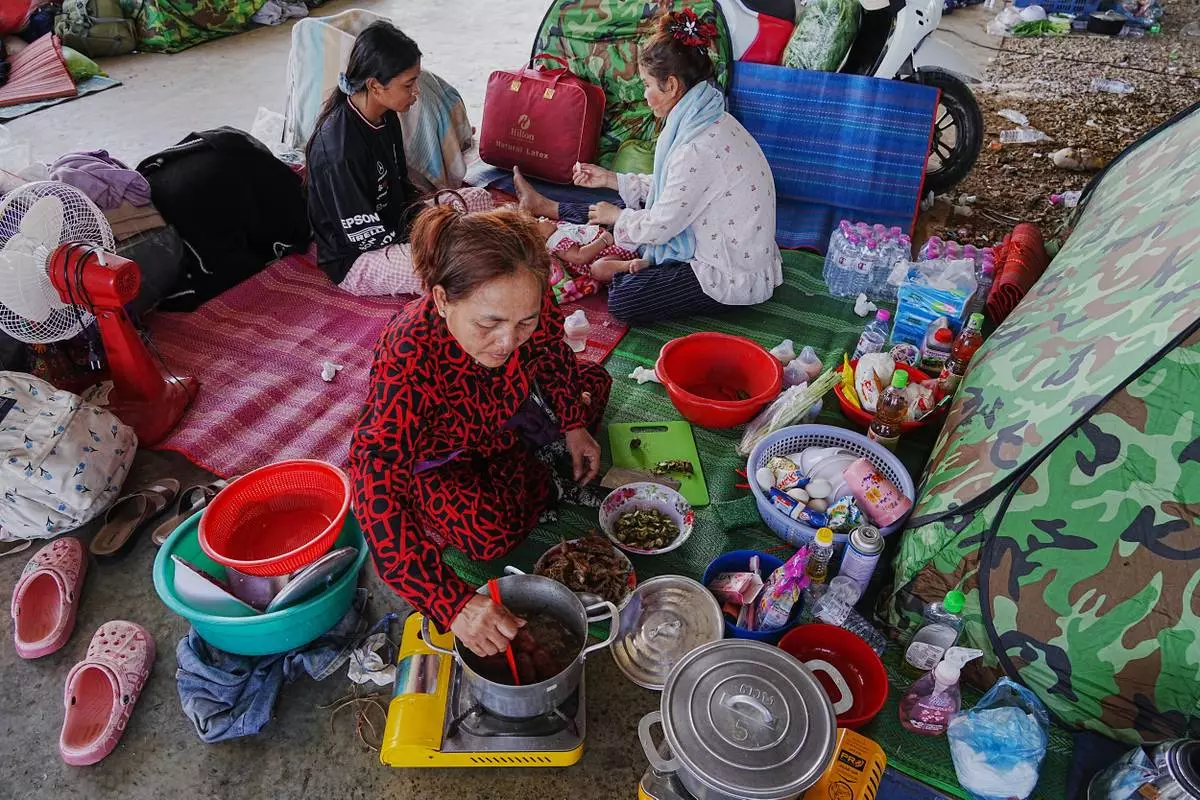
Evacuees cook food as they take refuge in Banteay Menchey provincial town, Cambodia, Saturday, Dec. 13, 2025, after fleeing homes following fighting between Thailand and Cambodia. (AP Photo/Heng Sinith)
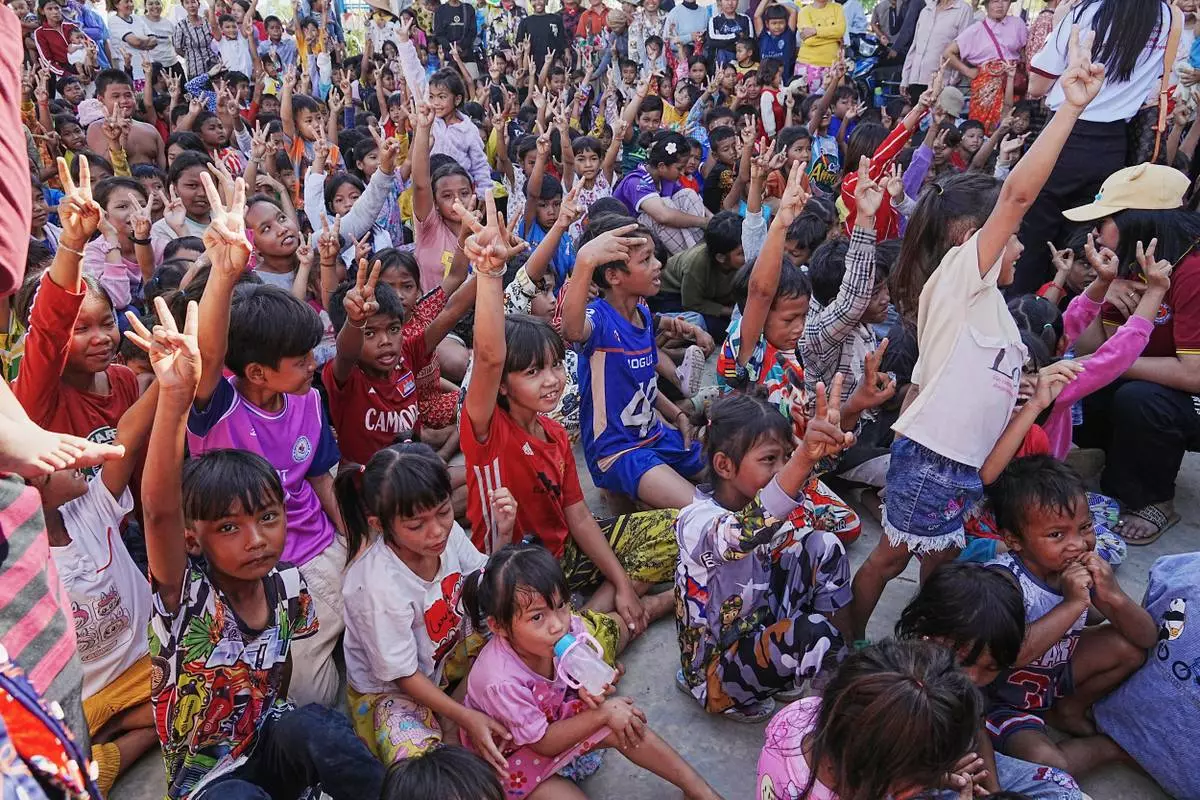
Children raise their hands while receiving donation from charity as they take refuge in Banteay Menchey provincial town, Cambodia, Saturday, Dec. 13, 2025, after fleeing homes following fighting between Thailand and Cambodia. (AP Photo/Heng Sinith)
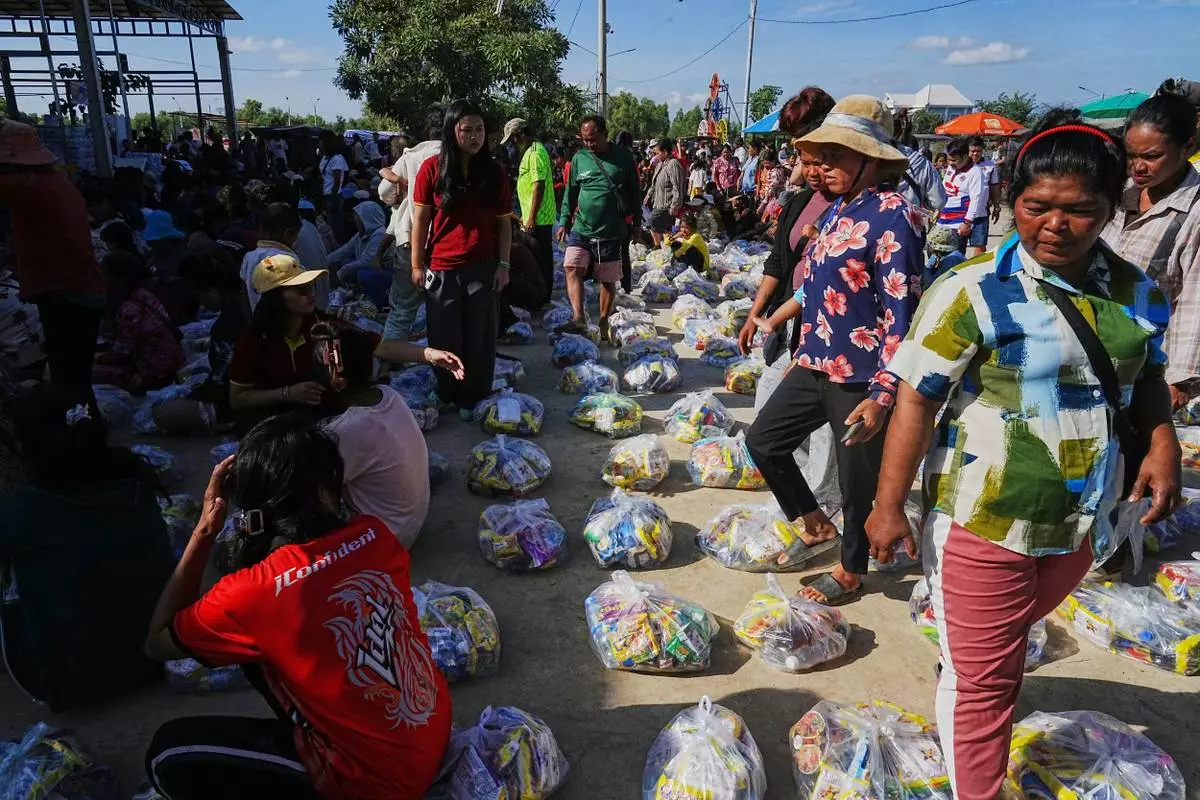
Evacuees wait to receive donation from local charity as they take refuge in Banteay Menchey provincial town, Cambodia, Saturday, Dec. 13, 2025, after fleeing homes following fighting between Thailand and Cambodia. (AP Photo/Heng Sinith)
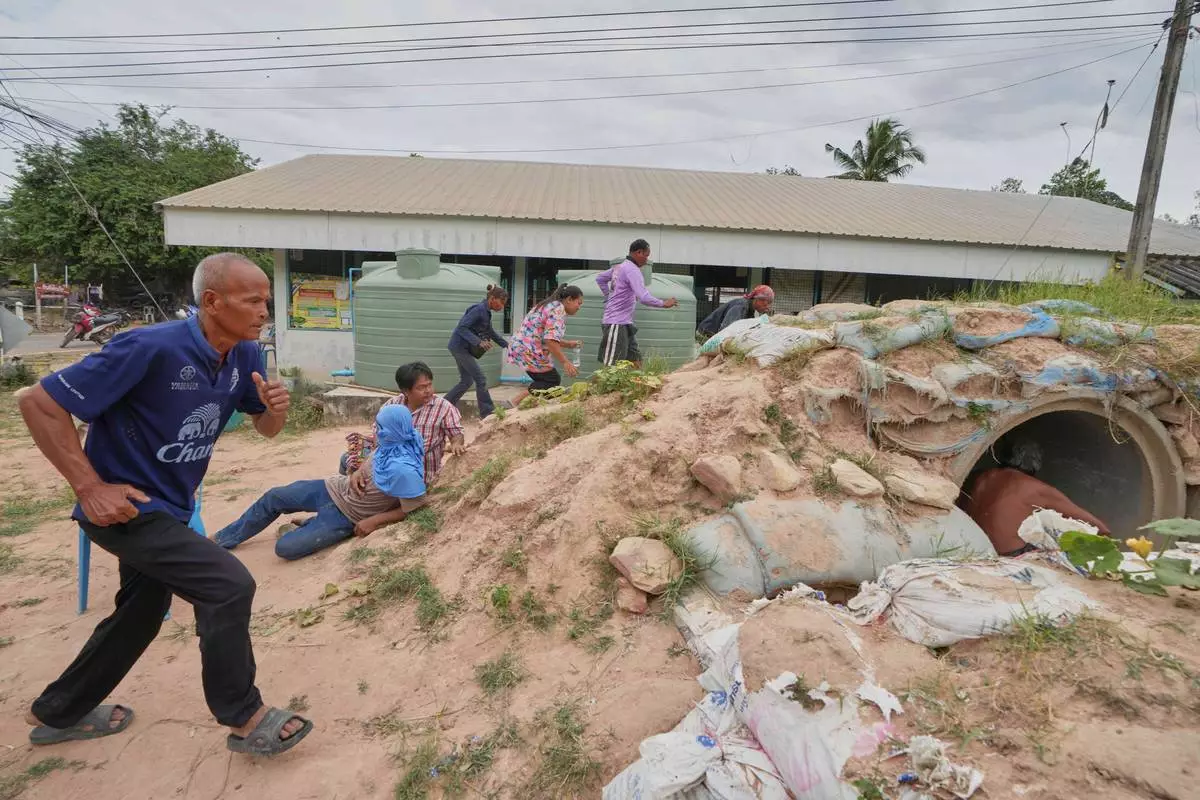
Village security volunteers and resident run into shelter while the blasts sounded too close in Buriram province, Thailand, Friday, Dec. 12, 2025, following renewed border conflict between Thailand and Cambodia. (AP Photo/Sakchai Lalit)