SAN MATEO, Calif.--(BUSINESS WIRE)--May 21, 2025--
RapidAI, the gold standard and global leader in neurovascular AI-based clinical decision support and enterprise radiology solutions, today announced new study findings that underscore its continued leadership in stroke imaging. The findings emphasize that not all AI is created equal, with results showing that RapidAI’s clinically deep algorithms deliver superior accuracy in detecting medium vessel occlusions (MeVOs) compared to Viz.ai.
This press release features multimedia. View the full release here: https://www.businesswire.com/news/home/20250521545123/en/
The data, presented as a late-breaking abstract at the European Stroke Organisation Conference (ESOC) 2025, analyzed 1,591 consecutive stroke cases at a comprehensive stroke center. Of the 1,122 eligible cases, RapidAI detected 93% (109) of MeVOs using CT Perfusion alone, compared to 70% (82) by Viz.ai.
“CT Perfusion is a powerful tool, but its full value is only realized when paired with high-performing software, especially in complex cases with smaller occlusions like MeVOs,” said Harmeet Sachdev, MD, lead investigator and neurologist. “RapidAI consistently identified more occlusions than Viz in this study, echoing what we saw in the DUEL study with large vessel occlusions. The story the data tells is clear: not all imaging tools are equally equipped to interpret complex stroke cases.”
MeVOs refer to occlusions in smaller, yet still crucial, arteries in the brain, such as the M2/M3 segments of the middle cerebral artery or the A1/A2 and P1/P2 segments of the anterior and posterior cerebral arteries. These blockages can cause severe damage if left untreated but are notoriously difficult to identify without high-performing imaging tools. The substantial number of MeVOs missed by the Viz.ai software could lead to significant delays in diagnosis and treatment.
The accuracy of Rapid CT and MR perfusion imaging for estimating core and penumbra has been extensively validated in the landmark clinical trials of DEFUSE 2, SWIFT PRIME, EXTEND-IA, and DEFUSE 3. RapidAI is the only software demonstrated to predict the subsequent infarct volume based on initial perfusion imaging. In addition, RapidAI is the only perfusion software with an FDA indication for selecting patients for mechanical thrombectomy.
“These real-world clinical findings validate what sets RapidAI apart. Deeper clinical algorithms that not only detect more but empower providers with greater clarity and confidence,” said David Stoffel, MD, chief business officer at RapidAI. “Accurate perfusion imaging is essential for identifying subtle but serious strokes. Without it, critical cases can go unrecognized, delaying treatment when every minute counts.”
The study, titled “AI Detection of Medium Vessel Occlusions: Evaluating Performance of RapidAI vs Viz.ai CT Perfusion in 1,591 Consecutive Code Strokes”, was presented at ESOC 2025.
About RapidAI
RapidAI is the world leader in AI-driven medical imaging analysis and coordinated care. With the industry’s most validated clinical AI platform, we empower care teams to rapidly, precisely, and confidently manage life-threatening conditions. Trusted by thousands of hospitals in 100+ countries, RapidAI delivers the deepest level of clinical decision support on the market to help accelerate the time to treatment and enhance patient outcomes. We go beyond the algorithm to drive care team collaboration and efficiencies that expand access to life-saving interventions. At RapidAI, we establish new standards for care teams and the patients they treat.

Example of a radiologist confirmed M2 occlusion correctly identified by RapidAI CTP (left) and missed by Viz.ai CTP (right)
The clock is ticking toward an unusual deadline in the NHL, and teams with players relevant to it are rushing to beat the final horn.
The new collective bargaining agreement goes into effect at midnight, at which time a seven-year contract will be the longest a player can re-sign with his own team — and six years in free agency. The final eight-year deals are getting done Tuesday.
Washington locked up Ryan Leonard for $84 million starting with the 2027-28 season. Making an average of $10.5 million a year through 2035, he will match new Capitals teammate Alex Tuch, who also got eight years in a sign-and-trade with Buffalo, for the highest-paid player on the team when Leonard's new deal kicks in.
“Ryan is a young and talented player who is still years away from entering his prime, and we believe he has tremendous potential to continue growing into an important player for our organization,” general manager Chris Patrick said in announcing Leonard's contract. “While reaching his full potential will take time, we have been impressed with his work ethic and the way he continues to develop his game. We are confident in Ryan’s ability to continue improving as a hockey player, and we believe this agreement provides him with the opportunity to grow and develop within our organization, while giving us the ability to keep a talented young player in our lineup for years to come.”
Leonard, a 21-year-old winger, is going into his second full NHL season after breaking in during the spring of 2025. This contract cements his place as part of the Capitals' young, post-Alex Ovechkin core, which is expected to also include brothers Ilya and Aliaksei Protas.
Washington forward Justin Sourdif also got an eight-year extension before the deadline: $50.8 million, for an annual cap hit of $6.35 million. Sourdif will be 25 when it goes into effect.
“Justin is a good young forward who has continued to develop steadily throughout his career,” Patrick said. “He is versatile and demonstrated his ability to play an important forward role for our team whenever the opportunity arose last season. ... We believe he has a bright future ahead of him and are confident that he will continue to make valuable contributions to our organization in the coming years.”
Ottawa signed Drake Batherson for $86 million, which is the most lucrative contract in Senators history. The previous record was Tim Stützle's eight-year, $66.8 million extension from September 2022.
Batherson will count $10.75 million against the salary cap starting in 2027, surpassing Stützle’s $8.35 million. He'll be 29 at that point.
“He was drafted and developed by our organization and has shown a commitment to wanting to be in Ottawa long term,” GM Steve Staios said of Batherson. “We view him as a key part of our core group.”
Batherson has set career highs in scoring each of the past seven seasons, topping out at 71 last year. He is just the second player in league history to do that seven times in a row, joining Vic Stasiuk from 1953-54 to '59-60 with Detroit.
Since the NHL and the NHL Players' Association came to an agreement on this CBA in late June 2025, 34 players have signed eight-year contracts. Thirteen of those have come in the past three months, including Colorado's Cale Makar setting the record for the most money at $163.2 million.
After being flat or nearly flat coming out of the pandemic, the salary cap is the middle of a series of record increases, now that revenues have caught up and are skyrocketing. The cap went from $95.5 million last season to $104 million this season and will be $113.5 million in 2027-28, when most of these new contracts will go into effect.
Philadelphia signing Anaheim’s Leo Carlsson to an offer sheet in July that made him the highest-paid player in the sport at $18 million a year — which the Ducks matched to keep him — led to a spike in salaries this summer.
Vegas center Jack Eichel, who is now making $13.5 million on his long-term contract signed last October, said agent Pat Brisson told him about what was coming and they had talks with NHLPA executive director Marty Walsh and others at the union and decided to go the full eight years anyway.
“It’s an incredible deal for me and my family, and we’re super grateful for the organization and the city believing in us,” Eichel said last week. “There’s no signer's remorse. Yeah, I'm a happy guy.”
Eichel led the Golden Knights to the Stanley Cup in 2023. He and fellow standouts such as Makar, Minnesota's Kirill Kaprizov, and Florida teammates Sam Bennett and Aaron Ekblad are proven commodities.
Many of the young players getting eight-year deals this offseason are team gambles of varying degrees.
As recently as Monday, Buffalo signed 22-year-old center Noah Ostlund for $52.8 million, banking on his potential. Ostlund has played in just 71 games in the league thus far.
Pittsburgh signed Ville Koivunen for $32 million over eight years in August. He has 14 points in 42 career games.
Beginning Wednesday, no contract can have more than 60% paid in signing bonuses. New Jersey and defending champion Carolina each got a deal done just in time.
The Hurricanes signed captain and Conn Smythe Trophy winner as playoff MVP Jordan Staal to a one-year extension, while the Devils extended recently acquired forward Luke Evangelista for five years and $36.25 million. Staal's contract is worth $900,000 in salary, with a $4 million signing bonus and up to $5.1 million in additional performance incentives.
“Jordan is not only our captain, he’s the bedrock of the culture we’ve established in this organization,” GM Eric Tulsky said. “His leadership and on-ice performance throughout last season and especially in the playoffs was a primary factor in bringing the Stanley Cup back to Raleigh.”
See AP’s full NHL coverage here
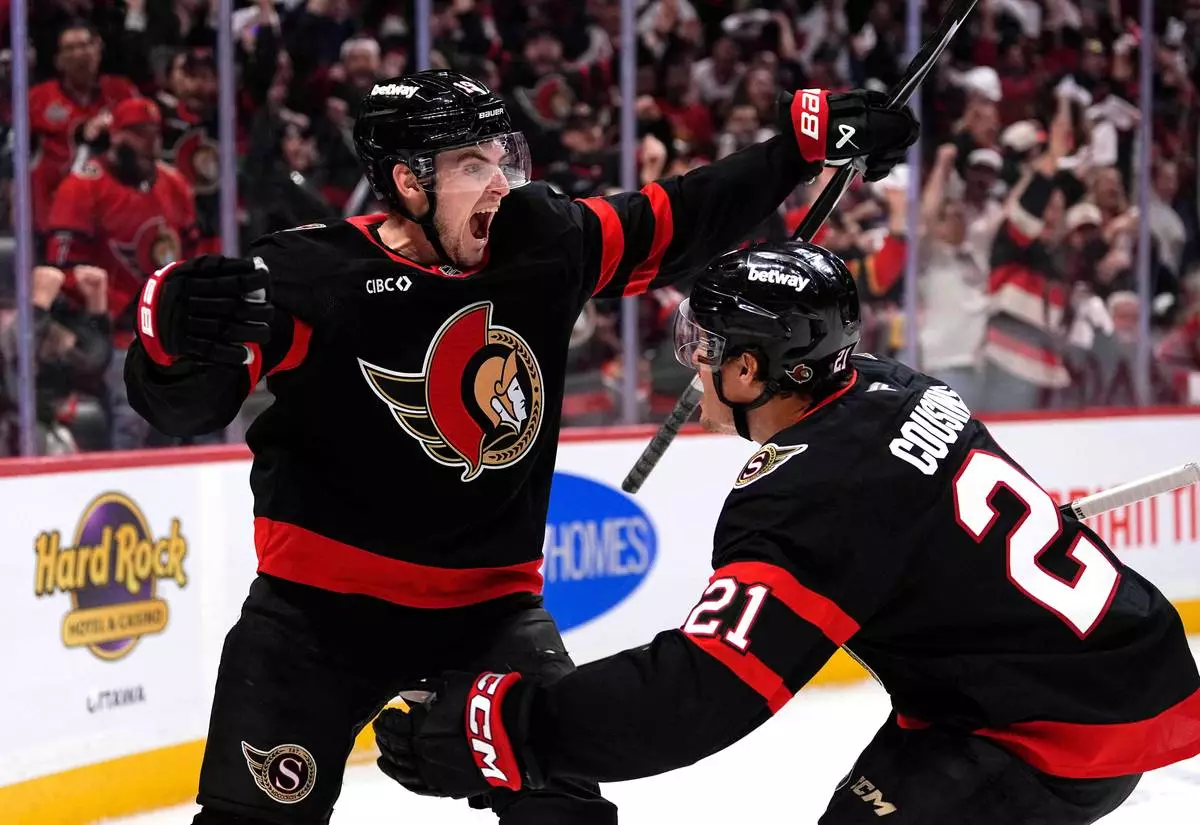
FILE - Ottawa Senators' Drake Batherson (19) celebrates his goal against the Carolina Hurricanes with teammate Nick Cousins (21) during the second period of an NHL hockey playoff game in Ottawa, Ontario, April 23, 2026. (Justin Tang/The Canadian Press via AP, File)

FILE - Washington Capitals right wing Ryan Leonard (9) in action during the third period of an NHL hockey game against the Utah Mammoth, March 3, 2026, in Washington. (AP Photo/Nick Wass, File)