 |
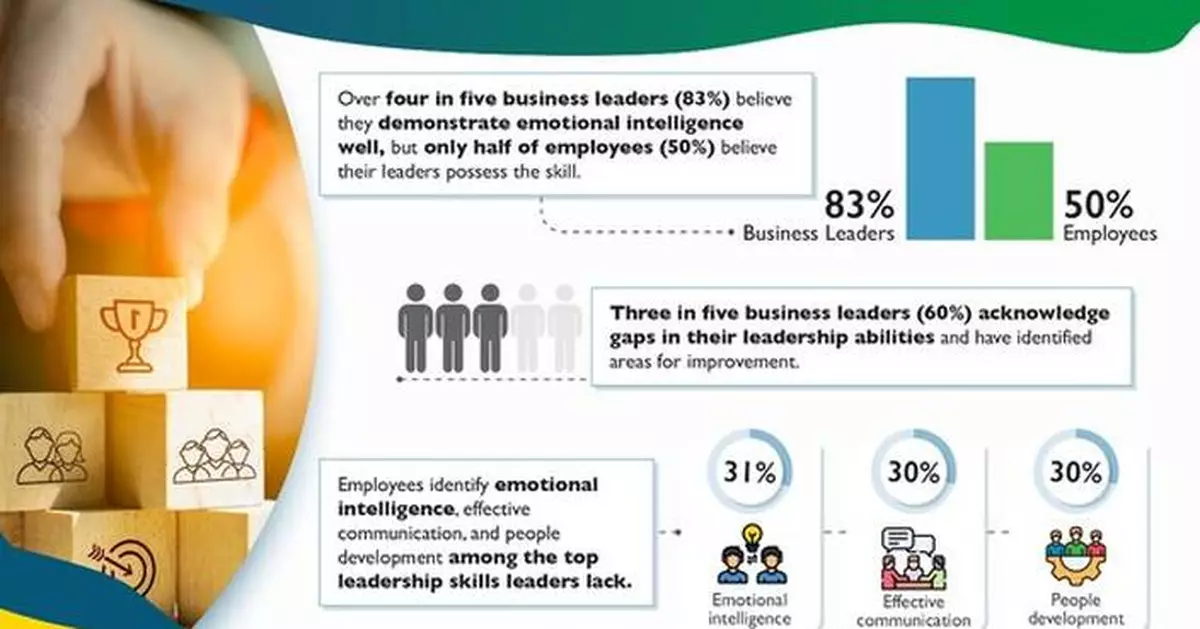
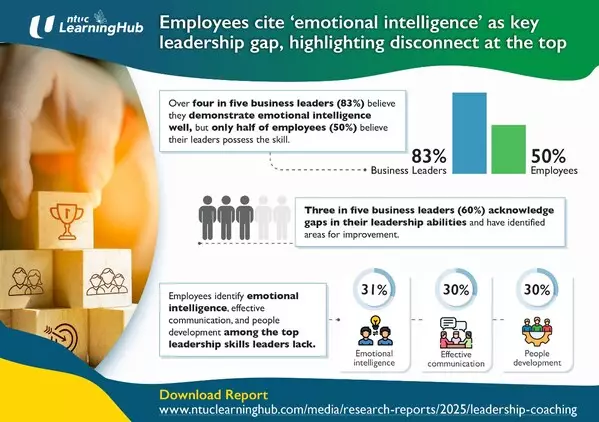
- While four in five business leaders (83%) believe they demonstrate emotional intelligence well, only half of employees (50%) echo this sentiment with a third citing emotional intelligence (31%) as the topmost skill leaders lack.
- Most business leaders (86%) are confident in their ability to lead effectively and achieve organisational goals, whereas only half of employees (55%) are confident in their leaders' capabilities.
- The majority of business leaders believe that they understand their employees' needs (89%) and meet employees' evolving expectations well (84%). However, less than half of employees feel the same way about their leaders.
- Nonetheless, three in five business leaders (60%) acknowledge gaps in their leadership abilities and have identified areas for improvement, but less than half (44%) have participated in leadership training in the past year, with two in five rarely attending training (39%).
SINGAPORE, May 22, 2025 /PRNewswire/ -- Leaders today are expected to thrive in a dynamic and digitally driven workplace, while cultivating human-centric capabilities and competencies. While over four in five business leaders (11% very well, 72% quite well) believe they demonstrate emotional intelligence well, only half of employees believe their leaders possess the skill (2% very well, 48% quite well).
According to employees, emotional intelligence (31%) is in fact the top skill they believe their leaders are lacking, followed by effective communication (30%), and people development (30%).
The majority of business leaders are confident in their ability to lead effectively and achieve organisational goals (13% very confident, 73% quite confident). However, only half of employees are confident in their leaders' capabilities (3% very confident, 52% quite confident).
This disconnect between the two groups is evident in how most business leaders believe they understand their employees' needs (17% very well, 72% quite well) and meet their evolving expectations (11% very well, 73% quite well). Yet, less than half of the employees share the same sentiment, where 46% agree leaders understand their needs "very well" or "quite well", and 45% agree leaders meet their evolving expectations "very well" or "quite well".
These are some of the key findings from NTUC LearningHub's Leadership and Coaching Report, which investigates the essential skills and competencies that future leaders must cultivate, while exploring the critical role of coaching in driving individual and organisational growth across all levels and roles.
Based on a survey involving 150 business leaders and 300 full-time working professionals, the report also examines how organisations can develop and sustain strong leadership pipelines by leveraging people-centric approaches and emotional intelligence to build resilient, high-performing teams.
More than nine in ten business leaders (41% very important, 51% quite important), as well as employees (32% very important, 56% quite important) view emotional intelligence as important in leadership.
Business leaders cite the ability to communicate more effectively (55%), make better decisions (55%), be more flexible and adaptable to changes (53%), build strong relationships with employees (51%), and motivate employees more effectively (50%) as the top reasons why they perceive emotional intelligence as important for leaders. While employees voice similar sentiments, they also highlight the ability to better manage and resolve conflicts (65%) and react to challenges or highly pressurising situations calmly (58%) as other key reasons.
The perception divide also shows up in leadership styles where business leaders are most likely to apply democratic leadership (40%), followed by situational leadership (39%), and laissez-faire leadership (31%). Meanwhile, employees ranked situational leadership (44%) as their most preferred leadership style above democratic leadership (43%) and transformational leadership style (41%).
Consequently, business leaders have to contend with keeping their teams engaged and motivated (38%), managing relationships with employees (35%), and balancing performance with employee well-being (29%) in today's workplace. This is also accompanied by other challenges cited such as developing future leaders (29%) and adapting to change and uncertainty (28%).
Despite the perception divides, three in five business leaders (60%) acknowledge gaps in their leadership abilities and have identified areas for improvement. However, less than half of business leaders (44%) have participated in relevant training to enhance their leadership skills in the past year, with two in five (39%) rarely attending training. Lack of time (48%), high workload (47%), and lack of motivation (31%) are among the top challenges business leaders face when participating in leadership training programmes.
Yet, there is a desire for frequent training, as about two in five business leaders (38%) express a desire for more frequent training to develop their leadership skills. Three in four business leaders (9% very effective, 67% quite effective) also believe that the leadership training they received was effective in developing their abilities.
Commenting on the report's findings, Mr Jeremy Ong, Chief Executive Officer, NTUC LearningHub, says, "The apparent disconnect between leaders and employees highlights an urgent need for leadership to evolve in tandem with workforce expectations. As leadership expectations broaden beyond formal roles, organisations are looking to cultivate a culture where more employees feel empowered to take initiative, make decisions, and contribute to team direction. Technical skills alone are no longer enough today, as a more balanced and human-centric approach towards leadership has become a key competency that will enable leaders to adopt the right leadership approach, connect meaningfully with their team, sustain employee engagement, and ultimately drive organisational success. Therefore, it is important for leaders to continuously improve themselves through learning and development as a strategic imperative to bridge existing skills gaps and nurture future emotionally intelligent and visionary leaders".
To download the Leadership and Coaching Report, please visit www.ntuclearninghub.com/media/research-reports/2025/leadership-coaching. To find out more about the courses, training, and grants, please contact NTUC LearningHub at www.ntuclearninghub.com.
### END ###
About NTUC LearningHub
NTUC LearningHub is the leading Continuing Education and Training provider in Singapore which aims to transform the lifelong employability of working people. Since our corporatisation in 2004, we have been working with employers and individual learners to provide learning solutions in areas such as Infocomm Technology, Generative AI & Cloud, Healthcare, Retail & Food Services, Employability & Literacy, Business Excellence, Workplace Safety & Health, Security, Human Resources & Coaching and Foreign Workers Training.
To date, NTUC LearningHub has helped over 34,000 organisations and achieved more than 3.2 million training places across more than 3,000 courses with a pool of about 1,000 certified trainers. As a Total Learning Solutions provider to organisations, we also forge partnerships to offer a wide range of relevant end-to-end training. Besides in-person training, we also offer instructor-led virtual live classes (VLCs) and asynchronous online learning. The NTUC LearningHub Learning eXperience Platform (LXP) — a one-stop online learning platform — offers timely, bite-sized and quality content for learners to upskill anytime and anywhere. Beyond learning, LXP also serves as a platform for jobs and skills development for both workers and companies.
For more information, visit www.ntuclearninghub.com.
Press Contact
Zulaikha Zulkiflee
Senior Manager, Brand & Communications
Email: zulaikha@ntuclearninghub.com
Steven Lee
Senior Executive, Comms & Event Management
Email: steven.lee@ntuclearninghub.com
- While four in five business leaders (83%) believe they demonstrate emotional intelligence well, only half of employees (50%) echo this sentiment with a third citing emotional intelligence (31%) as the topmost skill leaders lack.
- Most business leaders (86%) are confident in their ability to lead effectively and achieve organisational goals, whereas only half of employees (55%) are confident in their leaders' capabilities.
- The majority of business leaders believe that they understand their employees' needs (89%) and meet employees' evolving expectations well (84%). However, less than half of employees feel the same way about their leaders.
- Nonetheless, three in five business leaders (60%) acknowledge gaps in their leadership abilities and have identified areas for improvement, but less than half (44%) have participated in leadership training in the past year, with two in five rarely attending training (39%).
SINGAPORE, May 22, 2025 /PRNewswire/ -- Leaders today are expected to thrive in a dynamic and digitally driven workplace, while cultivating human-centric capabilities and competencies. While over four in five business leaders (11% very well, 72% quite well) believe they demonstrate emotional intelligence well, only half of employees believe their leaders possess the skill (2% very well, 48% quite well).
According to employees, emotional intelligence (31%) is in fact the top skill they believe their leaders are lacking, followed by effective communication (30%), and people development (30%).
The majority of business leaders are confident in their ability to lead effectively and achieve organisational goals (13% very confident, 73% quite confident). However, only half of employees are confident in their leaders' capabilities (3% very confident, 52% quite confident).
This disconnect between the two groups is evident in how most business leaders believe they understand their employees' needs (17% very well, 72% quite well) and meet their evolving expectations (11% very well, 73% quite well). Yet, less than half of the employees share the same sentiment, where 46% agree leaders understand their needs "very well" or "quite well", and 45% agree leaders meet their evolving expectations "very well" or "quite well".
These are some of the key findings from NTUC LearningHub's Leadership and Coaching Report, which investigates the essential skills and competencies that future leaders must cultivate, while exploring the critical role of coaching in driving individual and organisational growth across all levels and roles.
Based on a survey involving 150 business leaders and 300 full-time working professionals, the report also examines how organisations can develop and sustain strong leadership pipelines by leveraging people-centric approaches and emotional intelligence to build resilient, high-performing teams.
More than nine in ten business leaders (41% very important, 51% quite important), as well as employees (32% very important, 56% quite important) view emotional intelligence as important in leadership.
Business leaders cite the ability to communicate more effectively (55%), make better decisions (55%), be more flexible and adaptable to changes (53%), build strong relationships with employees (51%), and motivate employees more effectively (50%) as the top reasons why they perceive emotional intelligence as important for leaders. While employees voice similar sentiments, they also highlight the ability to better manage and resolve conflicts (65%) and react to challenges or highly pressurising situations calmly (58%) as other key reasons.
The perception divide also shows up in leadership styles where business leaders are most likely to apply democratic leadership (40%), followed by situational leadership (39%), and laissez-faire leadership (31%). Meanwhile, employees ranked situational leadership (44%) as their most preferred leadership style above democratic leadership (43%) and transformational leadership style (41%).
Consequently, business leaders have to contend with keeping their teams engaged and motivated (38%), managing relationships with employees (35%), and balancing performance with employee well-being (29%) in today's workplace. This is also accompanied by other challenges cited such as developing future leaders (29%) and adapting to change and uncertainty (28%).
Despite the perception divides, three in five business leaders (60%) acknowledge gaps in their leadership abilities and have identified areas for improvement. However, less than half of business leaders (44%) have participated in relevant training to enhance their leadership skills in the past year, with two in five (39%) rarely attending training. Lack of time (48%), high workload (47%), and lack of motivation (31%) are among the top challenges business leaders face when participating in leadership training programmes.
Yet, there is a desire for frequent training, as about two in five business leaders (38%) express a desire for more frequent training to develop their leadership skills. Three in four business leaders (9% very effective, 67% quite effective) also believe that the leadership training they received was effective in developing their abilities.
Commenting on the report's findings, Mr Jeremy Ong, Chief Executive Officer, NTUC LearningHub, says, "The apparent disconnect between leaders and employees highlights an urgent need for leadership to evolve in tandem with workforce expectations. As leadership expectations broaden beyond formal roles, organisations are looking to cultivate a culture where more employees feel empowered to take initiative, make decisions, and contribute to team direction. Technical skills alone are no longer enough today, as a more balanced and human-centric approach towards leadership has become a key competency that will enable leaders to adopt the right leadership approach, connect meaningfully with their team, sustain employee engagement, and ultimately drive organisational success. Therefore, it is important for leaders to continuously improve themselves through learning and development as a strategic imperative to bridge existing skills gaps and nurture future emotionally intelligent and visionary leaders".
To download the Leadership and Coaching Report, please visit www.ntuclearninghub.com/media/research-reports/2025/leadership-coaching. To find out more about the courses, training, and grants, please contact NTUC LearningHub at www.ntuclearninghub.com.
### END ###
About NTUC LearningHub
NTUC LearningHub is the leading Continuing Education and Training provider in Singapore which aims to transform the lifelong employability of working people. Since our corporatisation in 2004, we have been working with employers and individual learners to provide learning solutions in areas such as Infocomm Technology, Generative AI & Cloud, Healthcare, Retail & Food Services, Employability & Literacy, Business Excellence, Workplace Safety & Health, Security, Human Resources & Coaching and Foreign Workers Training.
To date, NTUC LearningHub has helped over 34,000 organisations and achieved more than 3.2 million training places across more than 3,000 courses with a pool of about 1,000 certified trainers. As a Total Learning Solutions provider to organisations, we also forge partnerships to offer a wide range of relevant end-to-end training. Besides in-person training, we also offer instructor-led virtual live classes (VLCs) and asynchronous online learning. The NTUC LearningHub Learning eXperience Platform (LXP) — a one-stop online learning platform — offers timely, bite-sized and quality content for learners to upskill anytime and anywhere. Beyond learning, LXP also serves as a platform for jobs and skills development for both workers and companies.
For more information, visit www.ntuclearninghub.com.
Press Contact
Zulaikha Zulkiflee
Senior Manager, Brand & Communications
Email: zulaikha@ntuclearninghub.com
Steven Lee
Senior Executive, Comms & Event Management
Email: steven.lee@ntuclearninghub.com
** The press release content is from PR Newswire. Bastille Post is not involved in its creation. **
Employees cite 'emotional intelligence' as key leadership gap, highlighting disconnect at the top
PERTH, Australia, May 24, 2026 /PRNewswire/ -- More than 2,000 teenagers and young adults gathered at the Perth Convention and Exhibition Centre on Friday 23 May for UNITE PERTH, a large-scale youth event hosted by Kingdomcity.
Held in Perth's largest tiered theatre, the event featured live music, worship, motivational messages and community engagement activities designed to encourage faith, connection and positive relationships among young people.
The event included a message from internationally recognised motivational speaker Reggie Dabbs, who has spent more than 40 years speaking to students, schools and conferences around the world, including appearances at the White House and the United Nations.
Attendees travelled from across Perth and regional Western Australia to participate in the event, which formed part of Kingdomcity's broader youth and community initiatives.
Organisers said more than 350 attendees responded to an opportunity for personal faith commitment during the event.
Lead Pastor Julian Kirtisingham of Kingdomcity Perth said the strong turnout reflected a growing desire among young people for connection and purpose.
"We're encouraged to see so many young people gathering together in a positive environment focused on faith, community and hope," he said.
Kingdomcity said it continues to invest in youth programs, community outreach and events aimed at supporting young people and families across Perth.
Founded in 2006, Kingdomcity is a global Christian church movement with campuses throughout Australia and internationally.
About Kingdomcity
Kingdomcity is a global Christian church movement founded in 2006 by Mark Varughese. With seven campuses across Perth and 44 locations globally, Kingdomcity focuses on community engagement, youth development and Christian ministry initiatives across multiple nations.
** This press release is distributed by PR Newswire through automated distribution system, for which the client assumes full responsibility. **

Thousands of Teenagers Gather in Perth for Prayer

Thousands of Teenagers Gather in Perth for Prayer