U.S. sports goods giant Nike is expected to raise the prices of its footwear, apparel, and equipment as early as this week because of the tariff impact on the retail industry, as CNBC reported on Wednesday (Eastern Daylight Time).
Many Nike products will be involved in the price hike, ranging from 2 to 10 U.S. dollars, while children products and items priced under 100 dollars will not be involved, CNBC cited source.
The hike will be 5 dollars for Nike footwear priced between 100 and 150 dollars, while 10 dollars for sneakers above 150 dollars, the source said, adding that prices for its apparel and equipment for adults will go up by 2 to 10 dollars.
The prices will be raised no later than June 1, but the hike may be visible on shelves as early as this week, the person said.
Earlier this month, the Footwear Distributors and Retailers of America (FDRA) sent a letter signed by 76 footwear brands, including Nike, Adidas, Skechers, and Under Armour, to the White House to ask for tariff exemption, saying that President Donald Trump's tariffs pose an "existential threat" to the industry.
Meanwhile, U.S. consumer sentiment dropped further in May, with the index down to 50.8 this month from a final reading of 52.2 in April, while one-year inflation expectations rose to 7.3 percent from 6.5 percent in April, according to the University of Michigan Surveys of Consumers.

Nike to raise product prices because of Trump tariff effect
China's Qingming Festival holiday has turned flower viewing into a showcase of cultural heritage, drawing tourists and boosting local economies.
From references to "The Book of Songs", a treasured Confucian classic and China's oldest poetry collection, to longstanding flower festivals, organizers are promoting flower viewing as cultural tourism, weaving poetry and tradition into spring outings.
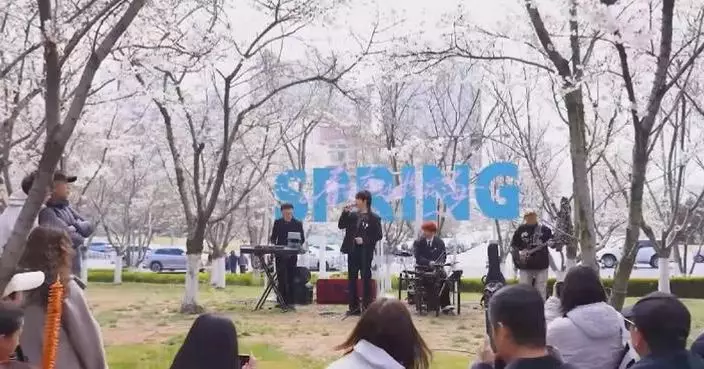
Hebi City in central China's Henan Province is drawing crowds with magnolias, tulips and crabapples, alongside 87 cherry blossom varieties. The blooms have become a major Qingming Festival attraction, prompting local authorities to pair tourism with cultural heritage.
As one of the birthplaces of The Book of Songs, Hebi has launched a campaign offering free entry to scenic spots for visitors who recite verses from the ancient classic. The initiative links flower viewing with a text long regarded as a cornerstone of Chinese literature.
In Binzhou, east China's Shandong Province, a park spanning 240 hectares, roughly the size of 330 football fields, is covered in blossoms, making it one of the largest spring displays in the region. The park uses smart drip irrigation to keep flowers hydrated and extend their peak season.
Originating in the Southern Song Dynasty (1127-1279), the Huazhao (Flower Deities) Festival in Xinzhou District of Wuhan boasts more than 800 years of history. Listed as a provincial intangible cultural heritage in 2011, it remains the largest folk celebration in eastern Hubei, drawing thousands of visitors each spring. A parade featuring 12 flower deities winds through the streets, anchoring the festival as both a cultural showcase and a tourism draw.
"The plum blossom represents noble character, the peach blossom radiant beauty. We hope more people will come to discover the Huazhao Festival," said Qinghuan, a performer portraying the Osmanthus Deity.
Outside the Shanxi Museum in Taiyuan City, apricot trees are in full bloom. Their pale pink petals flutter in the breeze, lining the museum's corridors and echoing the deep history within. Visitors pause to photograph the unique blend of ancient architecture and fleeting spring beauty.
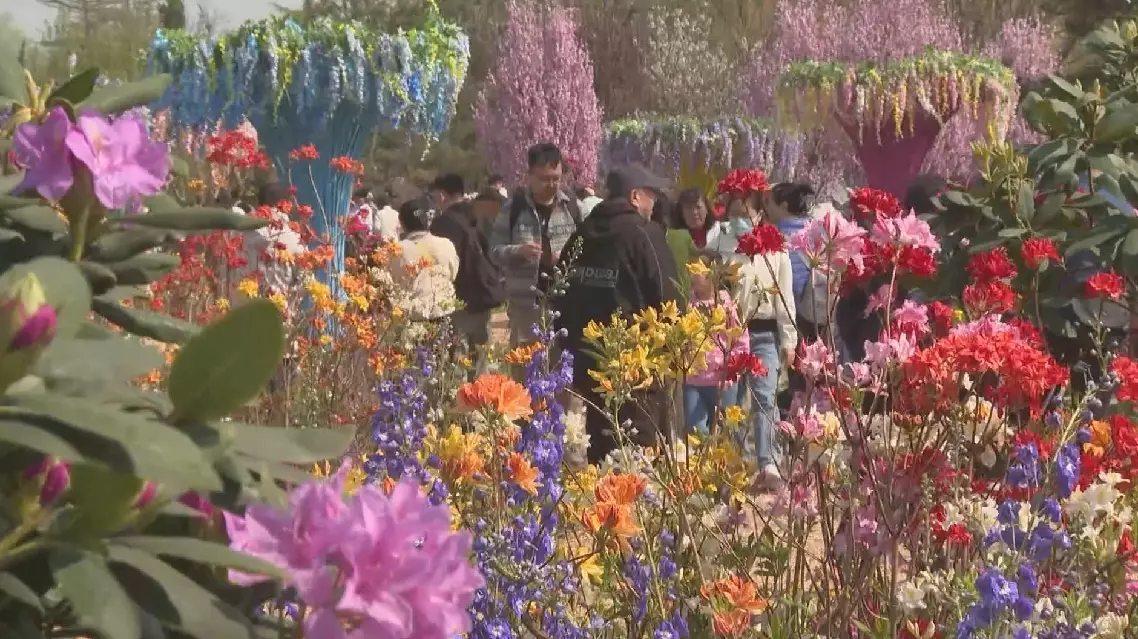
During the Qingming Festival holiday, the Beijing Garden of World's Flowers turned into a "spring palette." A nearly 2,000-square-meter sea of flowers burst into color. Against this floral backdrop, traditional experiences such as archery, tea whisking and movable-type printing drew crowds seeking a holiday filled with blossoms and cultural charm.
The garden features over 40 varieties of alpine and deciduous rhododendrons in shades of purple, pink and white, layered like clouds of silk. Along the flower-lined paths, colorful benches and ribbons create picture-perfect spots. Visitors wander, stop to admire, or raise their phones to capture a moment of spring romance.
"We hope these vibrant, contrasting floral colors bring a little healing and joy to people's lives, a space to relax and find peace amid the spring bloom," said Shi Wenfang, director of the Beijing Garden of World's Flowers. Beyond flower viewing, the garden is hosting its annual Huazhao Festival during the holiday. Now in its fifth year, the event has attracted nearly 300,000 visitors in total. The festivities run through April 6.
Falling on April 5 this year, the Qingming Festival, or Tomb-Sweeping Day, is a traditional Chinese festival for honoring the deceased and paying tributes to ancestors. The three-day holiday from Saturday to Monday also provides a short break for Chinese citizens to enjoy outdoor activities and sightseeing in pleasant springtime temperatures.
Compiled between the Western Zhou Dynasty and the Spring and Autumn Period (1100 B.C. - 476 B.C.), "The Book of Songs" contains at least 305 poems and is recognized as a Confucian classic.
Flower viewing draws holiday crowds across China during Qingming Festival