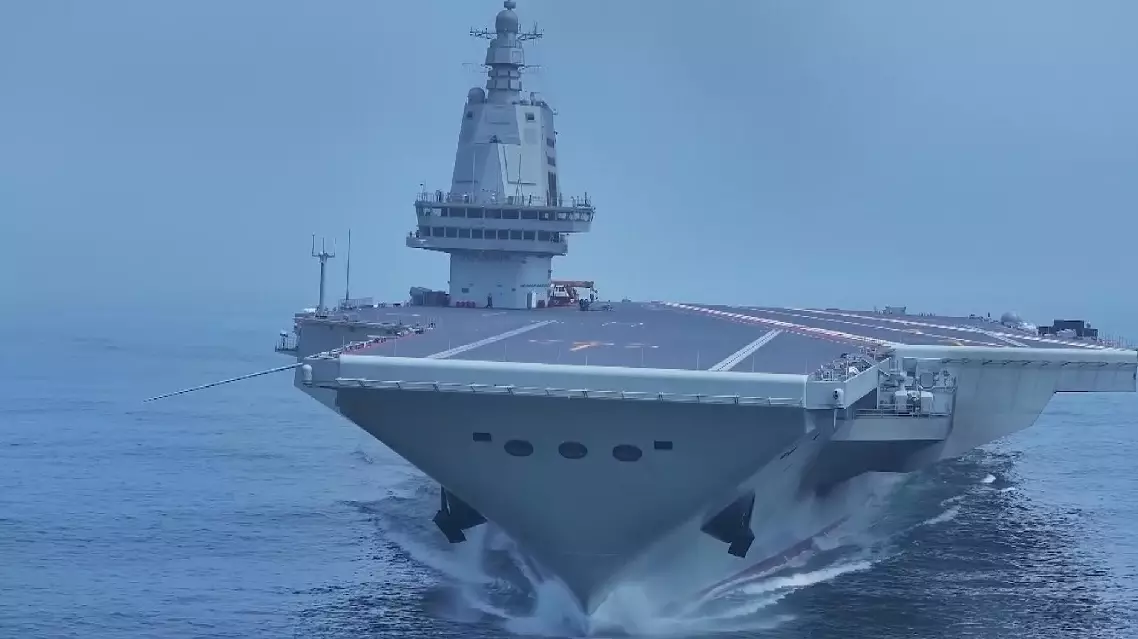
The Fujian aircraft carrier, China's first catapult-equipped vessel currently undergoing intensive sea trials, is set to significantly enhance the combat capabilities of the Chinese carrier fleet once it enters service, according to a military expert.
As the country's third aircraft carrier after the Liaoning and Shandong, the Fujian was launched in June 2022 and began its maiden sea trials in May 2024. Its electromagnetic catapult system marks a significant departure from the ski-jump model used on China’s previous two carriers to launch fixed-wing aircraft.
Experts say the carrier's catapult-assisted launch system offers key advantages over conventional ski-jump carriers. One of the most important among them is the ability for fighter jets to take off with full fuel and weapons loads, directly enhancing their combat effectiveness.
Additionally, the catapult system enables the carrier to operate fixed-wing early warning aircraft, which can greatly improve the carrier's surveillance capabilities, airspace management, and tactical command of carrier-based aircraft.
The electromagnetic catapults can also launch a wide variety of aircraft, from transport planes and early warning aircraft to small drones, offering the Fujian enhanced operational flexibility.
Cao Weidong, a military expert and former researcher at the Chinese People's Liberation Army (PLA) Naval Military Studies Research Institute, noted that the Fujian's ability to rapidly launch and recover aircraft will greatly strengthen China's capacity to secure air and sea dominance.
"With electromagnetic catapults, the number of aircraft launched and recovered by the Fujian each day will increase significantly, greatly boosting its ability to control air and sea space. As the Fujian conducts sea trials, we've also seen stealth fighters like the J-35 undergoing carrier-based flight and other tests, further enhancing its combat capabilities. Therefore, I believe once the Fujian is commissioned, it will greatly elevate the PLA Navy's operational capacity in both near-seas defense and far-seas escort and combat missions," said Cao.
China now has three aircraft carriers, named after the provinces of Liaoning, Shandong, and Fujian.
Based on the Soviet-made vessel Varyag, the Liaoning is a mid-sized carrier with a displacement of around 60,000 tonnes. After extensive refitting and modernization with domestically produced equipment, it became China's first carrier to provide true sea-air-land coordinated combat capability upon its commissioning in 2012.
Delivered in 2019, the Shandong is China's first domestically developed and built aircraft carrier. Classified as a medium-sized, conventionally powered aircraft carrier, the Shandong is over 300 meters long and more than 20 stories high, with more than 3,000 onboard compartments. Slightly larger than the Liaoning, it features an expanded flight deck that accommodates more aircraft, along with redesigned internal compartments, an optimized hangar, and upgraded electronics and weapon systems.
As China's first fully home-grown catapult-equipped carrier, the Fujian features a straight flight deck with electromagnetic catapults and arrestor gear, and a full-load displacement of more than 80,000 tonnes.
"The era of operating three aircraft carriers reflects the advancement of our defense industry, the rise of our comprehensive national strength, and progress in developing world-class military equipment. Having three carriers -- especially more advanced ones -- represents a significant boost in combat capabilities, whether for far-seas operations or for imposing maritime blockades against Taiwan separatist forces," said Cao.
Fujian aircraft carrier to enhance China's naval combat flexibility after commissioning: expert