Chinese startups and tech giants have raced this year to develop AI agents fueled by continuous breakthroughs in large language models and supportive policies in Beijing and Shanghai. Their efforts are predicted to lead AI agents to evolve from "tools" to more like "capable lives" by year-end.
Chinese online search giant Baidu launched its AI agent Xinxiang at last month's AI developer conference. Xinxiang can coordinate multiple specialized AI agents to break down complex tasks into steps, supporting over 200 task types across ten scenarios, including travel planning, health consultations, data analysis, and creative content generation.
The leading Chinese short-video platform, Kuaishou, launched Kling AI, allowing users to intelligently generate video content by inputting text, images, and other information.
Gong Zheng, an engineer at the China Academy of Information and Communications Technology, said AI agents can handle complex tasks like software programming, market research, and medical inquiries without human intervention.
He added that this potential for increased productivity and efficiency across various markets drives massive investment from leading companies.
AI agent is an advanced AI system capable of autonomous perception, reasoning, and action. It can understand, learn, and reason to perform complex tasks and make decisions.
"Previous large language models are very good at cognition and reasoning, focusing on thinking, summarizing, and analyzing. However, they couldn't actively search for information, read documents, or call application programming interfaces. AI agents give large language models 'hands' and 'eyes,' enabling them to autonomously use various tools and complete the entire process from information gathering and analysis to decision-making and output generation," said Gong.
The key differentiator of AI agents is their "human-like" ability to not only understand multimodal information but also to save memories and improve decision-making based on accumulated experience.
This capability enables them to assist with report generation, data analysis, graphic design, and content creation.
Professor Huang Tiejun of Beijing University's School of Computer Science categorizes AI agent applications into two broad types.
"Applications and products are roughly divided into two categories. One is a digital agent operating in computers and mobile devices, an interactive interface. The other one is more direct, which is the embodied intelligence in the past two years. It has a physical form, such as humanoid robots, wheeled robots, and autonomous vehicles. They are all AI agents," Huang explained.
The global AI market is expected to be worth over 320 billion yuan (About 44.6 U.S. billion dollars) in 2025, and AI agents are a major driver of this growth. Experts predict the AI agent market will grow over 40 percent yearly for the next five years.
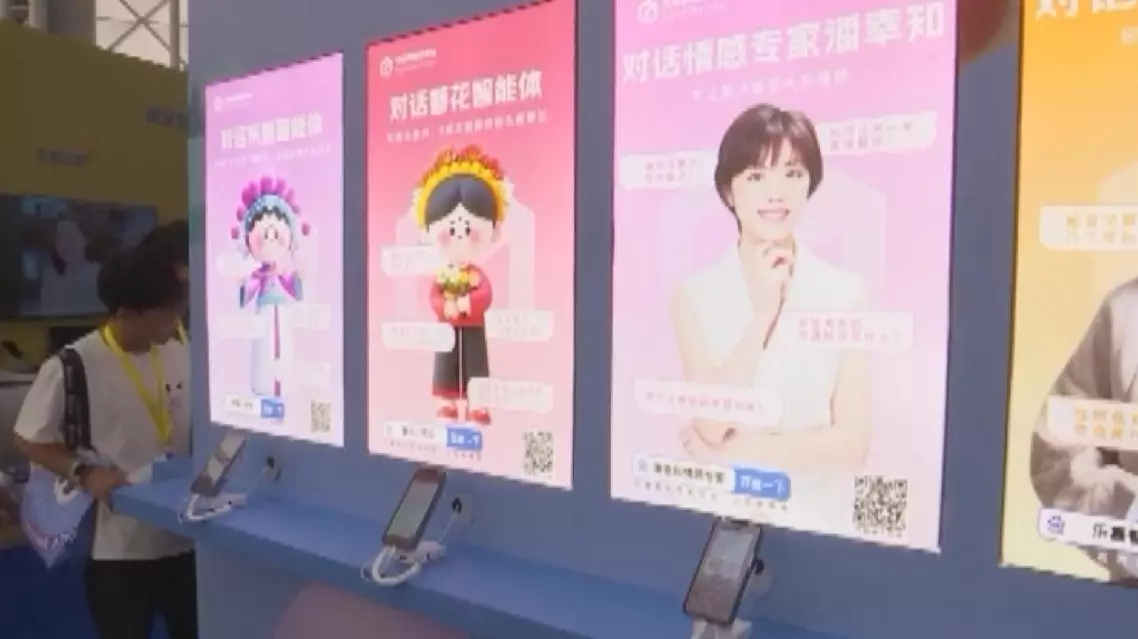
Chinese tech companies race to develop AI agents