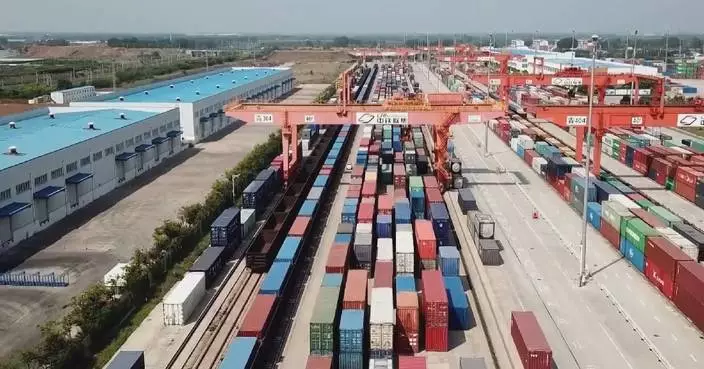
China's Belt and Road Initiative (BRI) and ASEAN Vision 2025 highlight synergies in fostering regional connectivity, inclusive growth, and economic integration, as demonstrated by landmark projects such as the Laos-China Railway and Jakarta-Bandung High-Speed Railway, a senior official said.
The 46th Association of Southeast Asian Nations (ASEAN) Summit opened on Monday in Kuala Lumpur, the capital of Malaysia, with greater regional integration and resilience against trade and economic disruptions high on the agenda.
With the Regional Comprehensive Economic Partnership (RCEP) taking into effect and the advancement of the Vision for the 21st Century Maritime Silk Road, China-ASEAN cooperation is demonstrating greater resilience and vitality.
Shi Zhongjun, Secretary General of the ASEAN-China Center -- the only inter-governmental organization co-founded by the two sides -- highlighted the significant achievements of high-standard BRI cooperation between China and ASEAN, citing the alignment between the BRI and the Master Plan on ASEAN Connectivity (MPAC) 2025 as a key driver of regional development.
"The high standard Belt and Road Initiative cooperation between ASEAN and China has made landmark achievements. Thanks to the alignment between the BRI and the Master Plan on ASEAN connectivity - MPAC 2025, a large number of projects are being implemented and continue to bring tangible benefits to the peoples of the region, such as the Laos-China railway, the Jakarta-Bandung high speed railway, Malaysia's east coast rail link and so on. ASEAN now is working on its new community vision, the ASEAN Community Vision 2045, it is timely to further strengthen the alignment between the ASEAN community vision and the BRI," Shi said.
Shi outlined four key areas to deepen collaboration during an interview with China Global Television Network (CGTN).
"Several key areas should be prioritized. First, infrastructure and connectivity should be improved by expanding transportation network, such as railways, ports and the highway to enhance intro-regional trade and logistics. Meanwhile, digital infrastructure, including 5G, AI and smart cities could boost digital trade and innovation. Secondly, trade investment facilitation should be improved by implementing the RCEP and upgrading the ACFTA (ASEAN-China Free Trade Area) to reduce trade barriers while promoting cross border e-commerce and supply chain resilience (in this area)," he said.
"Thirdly, the focus should be on green and sustainable development with joint efforts in renewable energy and low-carbon infrastructure, as well as climate adaptation and disaster resilience projects. Fourthly, the digital economy and innovation should be enhanced by developing digital payment systems and FinTech cooperation, as well as by supporting SMEs in adopting digital tools to help them to access the regional market," he added.
Finally, Shi added that soft connectivity such as people-to-people and cultural exchanges also need to be further strengthened apart from the hard connectivity.
ASEAN, made up of 10 Southeast Asian countries, is China's largest trading partner. In 2024, bilateral trade increased to 6.99 trillion yuan (968 billion U.S. dollars), accounting for 15.9 percent of China's foreign trade, according to official statistics.

China, ASEAN forge new synergies for cooperation through BRI: official