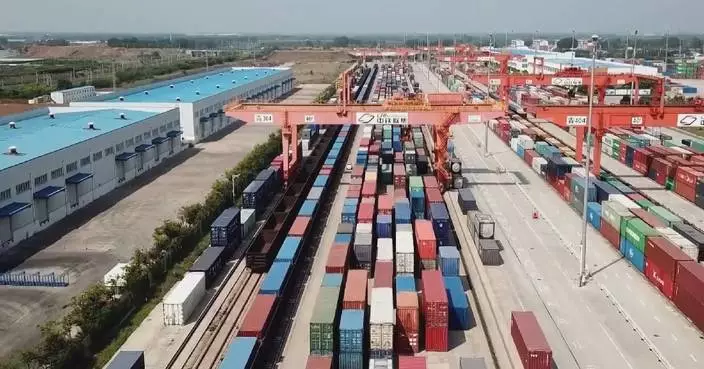
China's national economic and technological development zones (NEDZs) have registered strong performance in drawing foreign investment, fostering new quality productive forces and innovating management systems, according to a commerce official.
At a press conference in Beijing on Tuesday, Ling Ji, vice minister of commerce and deputy China international trade representative, noted that the NEDZs have leveraged both domestic and international markets and steadily improved their competitive advantages in global cooperation.
The NEDZs, now totaling 232 nationwide, have been active in cultivating an open economy. They are home to over 60,000 foreign-invested enterprises and 99,000 foreign trade enterprises registering actual import and export performances, according to Ling.
In 2024, the actual use of foreign capital in these zones reached 27.2 billion U.S. dollars and their imports and exports totaled 10.7 trillion yuan (about 1.49 trillion U.S. dollars), accounting for 23.4 percent and 24.5 percent of the country's total, respectively.
The NEDZs have also played a significant role in the country's efforts to foster new quality productive forces. A large number of domestic and foreign enterprises have invested or started businesses in these zones, having gradually established a large-scale and fully equipped industrial system covering various sectors such as electronic information, high-end equipment manufacturing, automobiles, petrochemicals, new energy and new materials, said Ling.
At present, there are over 4.9 million business entities operating in the NEDZs across China, including 73,000 industrial enterprises with yearly revenue surpassing 20 million yuan, 85,000 high-tech enterprises, and more than 15,000 research and development institutions at or above the provincial level.
"The NEDZs have innovated and optimized management systems and fostered a world-class business environment. These zones have continued to create market-oriented, professional, streamlined and efficient systems and mechanisms for personnel selection, operation management, investment promotion, and more. These zones have also achieved interconnected development with more than 30 free trade pilot zones and over 60 comprehensive bonded areas, leveraged the combined advantages of open platforms, and therefore achieved institutional innovations in many aspects such as the flow of production factors, rights and interest protection, and market order," said Ling.
China's national economic development zones attract substantial foreign investment: official