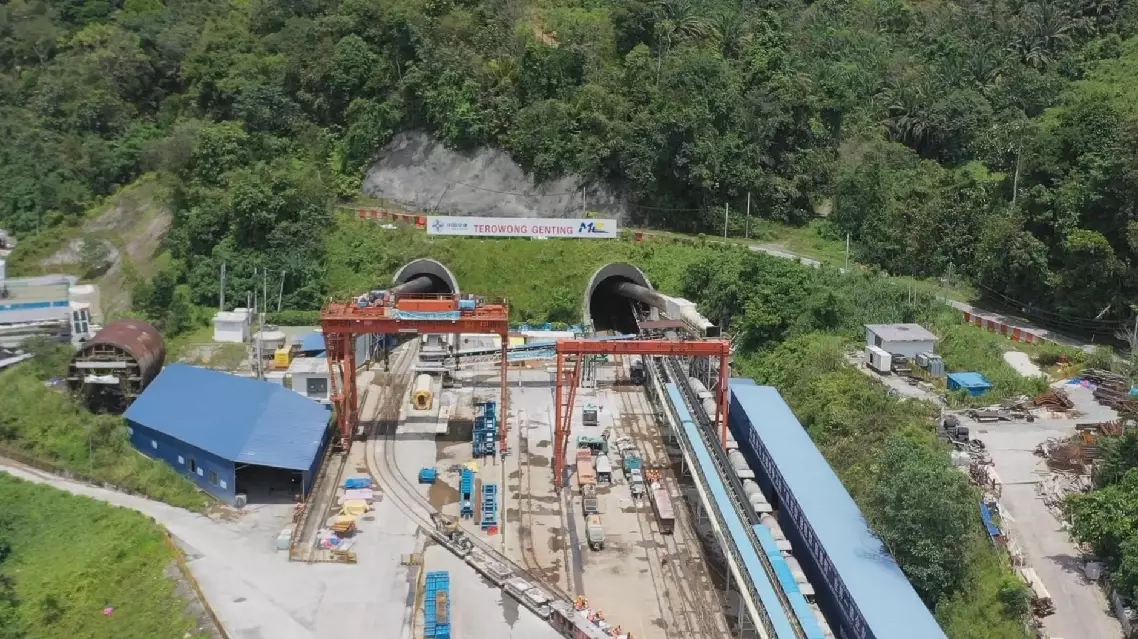
Chinese engineers are helping overcome rugged geology and extreme conditions beneath Malaysia’s Titiwangsa mountains in Pahang State, contributing in the excavation of Southeast Asia's longest rail tunnel, a vital section of the 12.5 billion U.S.-dollar East Coast Rail Link (ECRL) project.
Scheduled to open by 2027, the multi-billion-dollar ECRL project stands as a symbol of China-Malaysia cooperation, promising to revitalize Peninsular Malaysia’s underdeveloped east coast with enhanced connectivity and economic growth.
The Genting Tunnel is a crucial part of the ECRL project, which is now being excavated using the latest Chinese tunnel-boring technology. The tunnel passes beneath Malaysia's Titiwangsa mountain range and will link the eastern portion of the ECRL to the outskirts of Kuala Lumpur in the west. It’s a vital and challenging segment of the rail link.
Sun Guangbing, deputy construction director for section 7 of the ECRL project, highlighted several challenges during the tunnel excavation including injecting grout into poorly-formed geological sections and addressing water-filled fractured zones. Additional hurdles involve dealing with hard metamorphic rock, ensuring long-distance ventilation, managing high temperatures, and maintaining effective drainage systems, according to Sun.
"The biggest challenges and difficulties we faced during construction are issues such as poor geological segments and fractured zones," said Sun.
Eventually, trains will speed along the 665-kilometer length of the ECRL from the big west coast ports, across the peninsula to the under-developed east coast and north to the city of Kota Bahru near the Thailand border.
But now, there are only very rudimentary trains trundle through the tunnel at about 10 kilometers an hour, bringing supplies and workers to the boring machines. When it's completed, this will be the longest rail tunnel in Southeast Asia, stretching more than 16 kilometers.
The main contractor on the ECRL project, CCCC, brought in two giant tunnel boring machines from China, each stretching more than 250 meters in length.
Aside from boring through the mountain, the machines also simultaneously remove the debris on a conveyor belt, and line the walls of tunnel with concrete. The machines arrived from China in hundreds of segments before being reassembled at the construction site and beginning boring the two parallel tunnels.
They are now expected to break through to the other side of the mountain range within weeks. That will mark a major milestone for the rail link project, which is now more than 80 percent complete.
Chinese engineers aid breakthrough on Southeast Asia's longest rail tunnel in Malaysia
The 6th China Media Group (CMG) Chinese Language Video Festival held at Palace of Nations in Geneva, Switzerland, on Friday to mark the 2026 United Nations Chinese Language Day.
Co-hosted by CMG, China's Permanent Mission to the UN in Geneva, and the UN Office at Geneva, the event brought together over 350 guests from more than 30 countries.
At the event, Tatiana Valovaya, director-general of the United Nations Office at Geneva, said as one of the six official languages of the United Nations, the Chinese language is an important link between China and the world, and between Chinese civilization and other civilizations, which not only reflects its great value to human society, but also highlights the significance of the Chinese language in multilateral diplomacy.
Addressing the event via video link, Shen Haixiong, vice minister of the Publicity Department of the Communist Party of China Central Committee and CMG president, said that as a world-class mainstream media outlet, CMG has always been committed to spreading Chinese culture and promoting civilizational exchanges. It has carefully produced a large number of cultural programs that make China's fine traditional culture shine with new brilliance in the new era.
Shen said CMG will continue to advance "5G plus 4K/8K plus AI" innovation and build more pragmatic cultural exchange platforms.
Jia Guide, China's permanent representative and ambassador to the United Nations Office at Geneva and other international organizations in Switzerland, said that the establishment of UN Chinese Language Day not only protects linguistic diversity, but also promotes the exchange of ideas and the mutual understanding of concepts.
He expressed the hope to take this event as an opportunity to integrate historical experience, institutional advantages and innovative vitality of countries, show their strategic vision and political wisdom, and jointly inject positive energy into building a more just and rational global governance system and a better future.
During the event, many Chinese and international youths were invited to share their understanding of Chinese characters. Through this activity, young people from different cultural backgrounds can intuitively feel the emotional resonance and civilizational connection behind the language.
Many cultural television programs produced by CMG, including "The Chinese Calligraphy Conference" and "Crafted in China," were screened during the event. CMG also specially set up a creative products booth and an interactive experience area, allowing guests to experience traditional Chinese culture — such as calligraphy, embroidery, and paper-cutting — and try out intelligent interactive devices.
Chinese Language Day, established by the United Nations in 2010, is celebrated annually on Guyu, or Grain Rain, the sixth of the 24 traditional Chinese solar terms, to highlight the global significance of the Chinese language.
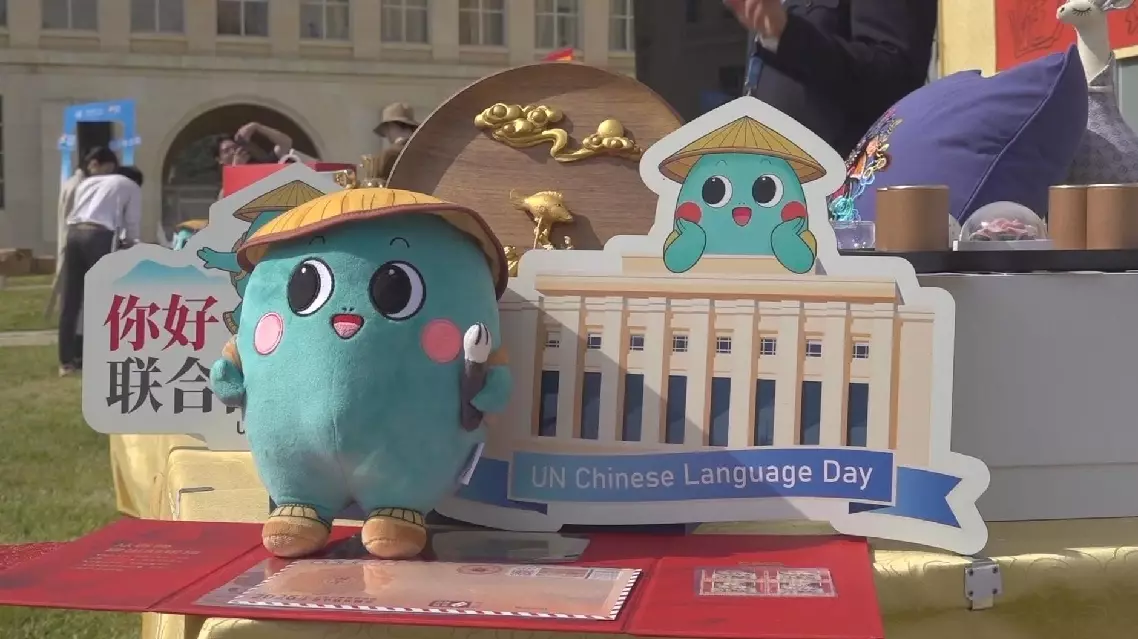
CMG Video Festival held in Geneva to mark 2026 UN Chinese Language Day