China's fast-growing low-altitude economy is continuing to hit new heights as the sector's innovative development now sees it take on more practical roles across various key sections of society, from disaster response to transport solutions.
Referring to activities taking place within 1,000 meters above the ground, the low-altitude economy is now expected to reach a total scale of 1.5 trillion yuan (over 100 billion U.S. dollars) in China this year, with the country's Civil Aviation Administration estimating the industry could hit a staggering 3.5 trillion yuan by 2035.
Those engaged in the fledging industry are now pushing for ways to fully exploit its vast potential, and the sky is really the limit. The concept of "delivering what matters" has become a key focus for the low-altitude economy, including in the all-important field of emergency response.
In rural areas, drones may soon become the best friends of future firefighters. From providing real-time situational awareness, mapping fire perimeters, to identifying hot spots and carrying water hoses or extinguishing materials, these machines can quite literally carry the burden of the crucial disaster relief efforts in any crisis.
One company has developed specialist drones which are capable of carrying up to 400 kilograms of water for a period of between two to four hours, thanks to the petrol engines under each propeller, helping reach areas that others simply cannot.
"Apart from heavy lifting and long-endurance, emergency response drones need to carry out precise positioning and maneuverability for complex tasks. In this line of business, we focus on what others cannot deliver," said Guan Lingfei, technical director of the Optimal Aerospace Science and Industry Group.
Beyond high-rise firefighting, these drones also perform well in high-risk environments such as chemical parks and in hazardous materials warehouses, helping remove the threat posed to human responders.
Earlier this year, a drone powered by an ultra-low-temperature lithium battery completed a test flight in China's northernmost city under extreme frigid conditions of minus 36 degrees Celsius.
Developed by the Dalian Institute of Chemical Physics in northeast China, this technological leap significantly extends mission duration for drones operating in polar or high-altitude regions.
Another innovation-driven growth area is in commercial short-distance flights, which are proving particularly useful for areas which lack sufficient road infrastructure.
In the coastal city of Dalian in the northeastern Liaoning Province, commercial flights are set to be launched later this year to reach some of the surrounding islands.
The operator believes that electric vertical take-off and landing aircraft, or eVTOLs, which use electric power to hover, take off, and land vertically, can be a real game changer, and will also eventually offer an affordable option for those in need of such a service.
"Once our eVTOLs are put into commercial service, the operational costs per hour is about 5,000 yuan. One hour is more than enough for a round journey around the city. So break down that number for a four-seater eVTOL, the fare is just about 500 yuan per passenger. That's very competitive," said Leo Wu, executive director of the Suzhou Aviation company.
Demand for talent is also growing rapidly as the low-altitude economy gathers steam. Yang Ming, a retired fighter jet pilot now working as flight instructor, said that he believes the sky can become more accessible to all in the near future.
"Like a driving license, not many people had that in the past, but now almost every one in two people in China drives a car. I think this scenario can also happen for private flight license in the future," he said.
As the market related to the low-altitude economy expands, it is also creating a substantial increase in demand for skilled workers, as the country looks to hire more aviation professionals.
While close to 2 million drones have been registered in China, there are only 220,000 certified operators available, leaving a sizable gap in the market. However, in addition to the call for more pilots, various drone-related jobs are continuously emerging spanning the entire chain, such as the need for more assembly engineers and maintenance technicians.
"Currently, there is a huge demand for drone operators in agricultural and forestry crop protection, commercial photography, and law enforcement," said Tian Geng, an instructor from the Qihang Drone Technology (Liaoning) company.
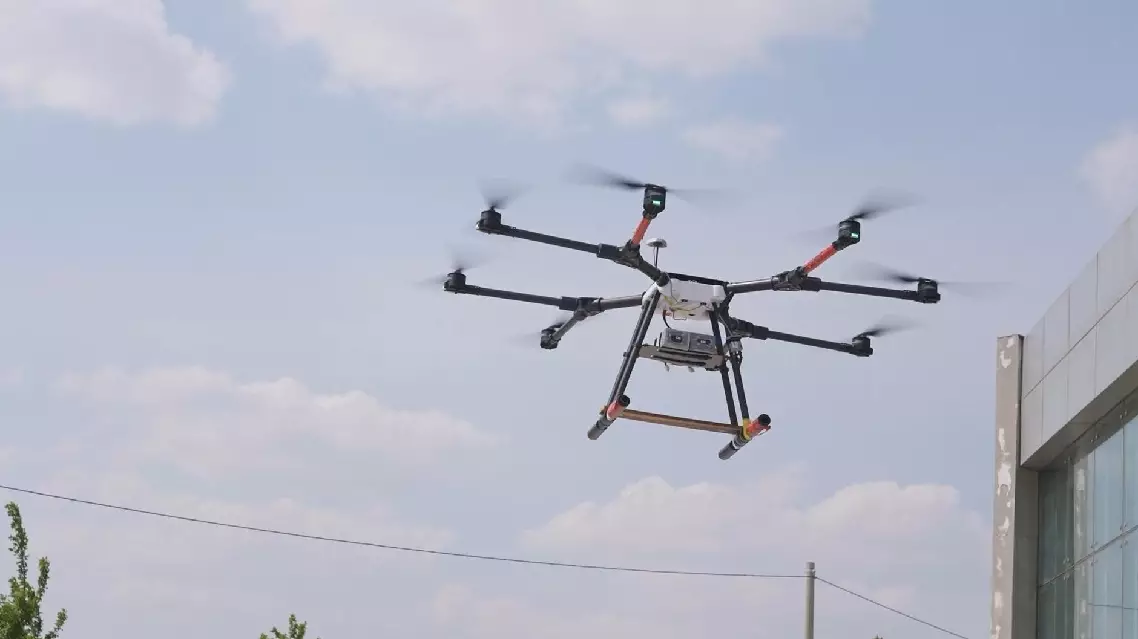
China's low-altitude economy hits new heights as innovation-driven growth fuels trillion-yuan market