SAN FRANCISCO--(BUSINESS WIRE)--May 28, 2025--
Chalk, the data platform for AI inference, announced today that it has raised a $50 million Series A at a $500 million valuation. The round was led by Felicis with participation from Triatomic Capital and existing investors General Catalyst, Unusual Ventures, and Xfund. Aydin Senkut, Founder and Managing Partner at Felicis, will join Chalk’s board. The capital will be used to accelerate development of Chalk’s platform, onboard new customers, and grow its engineering and go-to-market hubs in San Francisco and New York.
This press release features multimedia. View the full release here: https://www.businesswire.com/news/home/20250528882026/en/
As AI adoption accelerates, compute is shifting from training to inference to improve predictions, transform customer experiences, and reduce costs. Existing solutions like Databricks and Snowflake solve training data pipelines, and feature stores provide low-latency access to pre-computed data. But these incumbents don’t provide a solution for applications that require fresh data, with complex computation, at inference time.
Chalk fills a critical gap in the market – inference data pipelines. Chalk’s real-time data platform enables customers to make predictions with fresh data at inference time to prevent identity theft, issue instant loans, increase clean energy efficiency, and moderate harmful content.
Senkut shared, “Chalk is poised to become the Databricks of the AI era. It’s one of the fastest-growing data companies we’ve ever seen. The team has fundamentally redefined how data moves through the AI stack, a crucial advancement for chain-of-reasoning models. What’s even more remarkable is Chalk’s ability to deliver 5-millisecond data pipelines at massive scale - something that, until now, was considered out of reach. We couldn’t be more excited to partner with Marc, Elliot, and Andy, who are all repeat technical founders passionate about building infrastructure that delivers an incredible developer experience.”
Marc Freed-Finnegan, Chalk Co-Founder and CEO, added, “We feel incredibly fortunate to have Aydin and Felicis as our partners for the next phase of our growth. We have a shared vision of the future, and we’re honored to be part of the cohort of companies they have invested in.”
Chalk powers real-time ML across industries including fintech, identity, healthcare, and e-commerce. Companies like Socure, Found, Medely, and Iwoca use Chalk as a core infrastructure layer across their business.
“Chalk helps us deliver financial products that are more responsive, more personalized, and more secure for millions of users. It’s a direct line from infrastructure to impact,” said Meng Xin Loh, Senior Technical Product Manager, MoneyLion.
Chalk has become critical infrastructure for its customers by enabling teams to rapidly operationalize machine learning and AI. At its core, Chalk's Compute Engine empowers teams to write features in pure Python, automatically translating them into high-performance C++ and Rust pipelines to deliver real-time data without complex ETL. Additionally, Chalk’s LLM Toolchain unifies structured and unstructured data, offering native vector storage, automated evaluations, and seamless integrations with major LLM providers.
Rahul Madduluri, CTO at Doppel, said, "Chalk powers our LLM pipeline, turning complex inputs — HTML, URLs, screenshots — into structured, auditable features. It lets us serve lightweight heuristics up front and rich LLM reasoning deeper in the stack, so we detect threats others miss without compromising speed or precision.”
Chalk was co-founded by Freed-Finnegan, Elliot Marx, and Andrew Moreland — veterans of fintech and data infrastructure. After meeting at Stanford, Marx and Moreland solved large-scale data problems at Affirm and Palantir before co-founding Haven Money, acquired by Credit Karma. Before Chalk, Freed-Finnegan helped launch Google Wallet and started Index, acquired by Stripe (it’s now called Stripe Terminal). Across these ventures, the team saw how real-time data pipelines enabled entirely new product categories and business models. Fast forward to today — real-time decisions at inference are essential for all modern applications, and Chalk makes that possible.
About Chalk
Chalk is the data platform for inference, providing critical infrastructure that empowers teams to rapidly operationalize machine learning and AI. The developer-friendly platform consists of a Compute Engine that automatically compiles features into high-performance Rust pipelines without complex ETL, and an LLM Toolchain that seamlessly unifies structured and unstructured data. Chalk powers real-time, low-latency machine learning for the world’s leading companies, enabling instant loans, fraud prevention, personalized recommendations, and even clean energy optimization. Founded in 2022 and headquartered in San Francisco, Chalk has raised over $60M from Felicis, General Catalyst, Triatomic Capital, Unusual Ventures, and Xfund.
To learn more about Chalk, visit www.chalk.ai.

Chalk Co-founders Elliot Marx, Marc Freed-Finnegan and Andrew Moreland pictured in San Francisco.
DUBAI, United Arab Emirates (AP) — Iran sent its response to the latest U.S. ceasefire proposal to end the Iran war via Pakistani mediators on Sunday, but U.S. President Donald Trump quickly rejected it in a social media post as “TOTALLY UNACCEPTABLE!” — the latest setback to efforts to resolve the standoff in the Persian Gulf that has throttled shipping and sent energy prices soaring.
Iranian state media reported that Tehran rejected the U.S. proposal as amounting to surrender, insisting instead on “war reparations by the U.S., full Iranian sovereignty over the Strait of Hormuz, an end to sanctions, and the release of seized Iranian assets.”
Washington’s latest proposal addressed a deal to end the war, reopen the strait and roll back Iran’s nuclear program.
Trump's rejection of the Iranian response included no details. In an earlier post, he accused Tehran of “playing games” with the United States for nearly 50 years, adding: "They will be laughing no longer!"
Trump is giving diplomacy “every chance we possibly can before going back to hostilities,” the U.S. ambassador to the United Nations, Mike Waltz, told ABC earlier.
Iran's new supreme leader, Mojtaba Khamenei, who has not been seen or heard publicly since the war began, “issued new and decisive directives for the continuation of operations and the powerful confrontation with the enemies” while meeting with the head of the joint military command, the state broadcaster reported, with no details.
The fragile ceasefire was tested when a drone ignited a small fire on a ship off Qatar and the United Arab Emirates and Kuwait reported drones entering their airspace. The UAE said it shot down two drones and blamed Iran. No casualties were reported, and no one immediately claimed responsibility.
Qatar's Foreign Ministry called the ship attack a “dangerous and unacceptable escalation that threatens the security and safety of maritime trade routes and vital supplies in the region." The United Kingdom Maritime Trade Operations Center gave no details about the ship's owner or origin.
Kuwait Defense Ministry spokesperson Brig. Gen. Saud Abdulaziz Al Otaibi said forces responded to drones but did not say where they came from.
Iran and armed allied groups such as the Lebanese militant Hezbollah group have used drones to carry out hundreds of strikes since the war began with U.S. and Israeli attacks on Feb. 28.
Trump has reiterated threats to resume full-scale bombing if Iran does not accept an agreement to reopen the strait and roll back its nuclear program. Iran has largely blocked the strategic waterway that's key to the global flow of oil, natural gas and fertilizer since the war began, rattling world markets.
The U.S. military in turn has blockaded Iranian ports since April 13, saying it has turned back 61 commercial vessels and disabled four. On Friday, it struck two Iranian oil tankers it said were trying to breach the blockade. Iran’s Revolutionary Guard navy says any attack on Iranian oil tankers or commercial vessels would be met with a “heavy assault” on U.S. bases in the region and enemy ships.
Another sticking point in negotiations is Iran’s highly enriched uranium. The U.N. nuclear agency says Iran has more than 440 kilograms (970 pounds) enriched up to 60% purity, a short, technical step from weapons grade.
In an interview posted late Saturday, an Iranian military spokesperson said forces were on “full readiness” to protect sites where uranium is stored.
“We considered it possible that they might intend to steal it through infiltration operations or heli-borne operations,” Brig. Gen. Akrami Nia told the IRNA news agency.
Israeli Prime Minister Benjamin Netanyahu in an excerpt of an interview with CBS airing Sunday said the war isn't over because the enriched uranium needs to be taken out of Iran. “Trump has said to me, ‘I want to go in there,’ and I think it can be done physically,” he said.
Russian President Vladimir Putin said Saturday that Moscow’s proposal to take enriched uranium from Iran to help negotiate a settlement remains on the table.
The majority of Iran’s highly enriched uranium is likely at its Isfahan nuclear complex, the International Atomic Energy Agency director-general told The Associated Press last month. The facility was hit by U.S.-Israeli airstrikes in the 12-day war last year and faced less intense attacks this year.
Iran's deputy foreign minister warned against a planned French-British effort that aims to support maritime security in the Strait of Hormuz after hostilities are over.
“The presence of French and British vessels, or those of any other country, for any possible cooperation with illegal U.S. actions in the Strait of Hormuz that violate international law will be met with a decisive and immediate response from the armed forces,” Kazem Gharibabadi said on social media.
French President Emmanuel Macron responded by saying it won't be a military deployment but an international mission to secure shipping once conditions allow.
Several attacks against ships in the Persian Gulf have occurred over the past week, and a U.S. effort to “guide” ships through the strait was quickly paused.
South Korea announced initial findings from an investigation that said two unidentified objects struck the South Korean-operated vessel HMM NAMU about one minute apart while it was anchored in the strait last week, causing an explosion and fire. Officials have yet to determine who was responsible.
Magdy reported from Cairo. Associated Press writers Munir Ahmed in Islamabad; Melanie Lidman in Tel Aviv, Israel; Tong-hyung Kim in Seoul, South Korea; Julia Frankel in Jerusalem and Josh Boak in Washington contributed to this report.

Women walk in northern Tehran, Iran, Sunday, May 10, 2026. (AP Photo/Vahid Salemi)
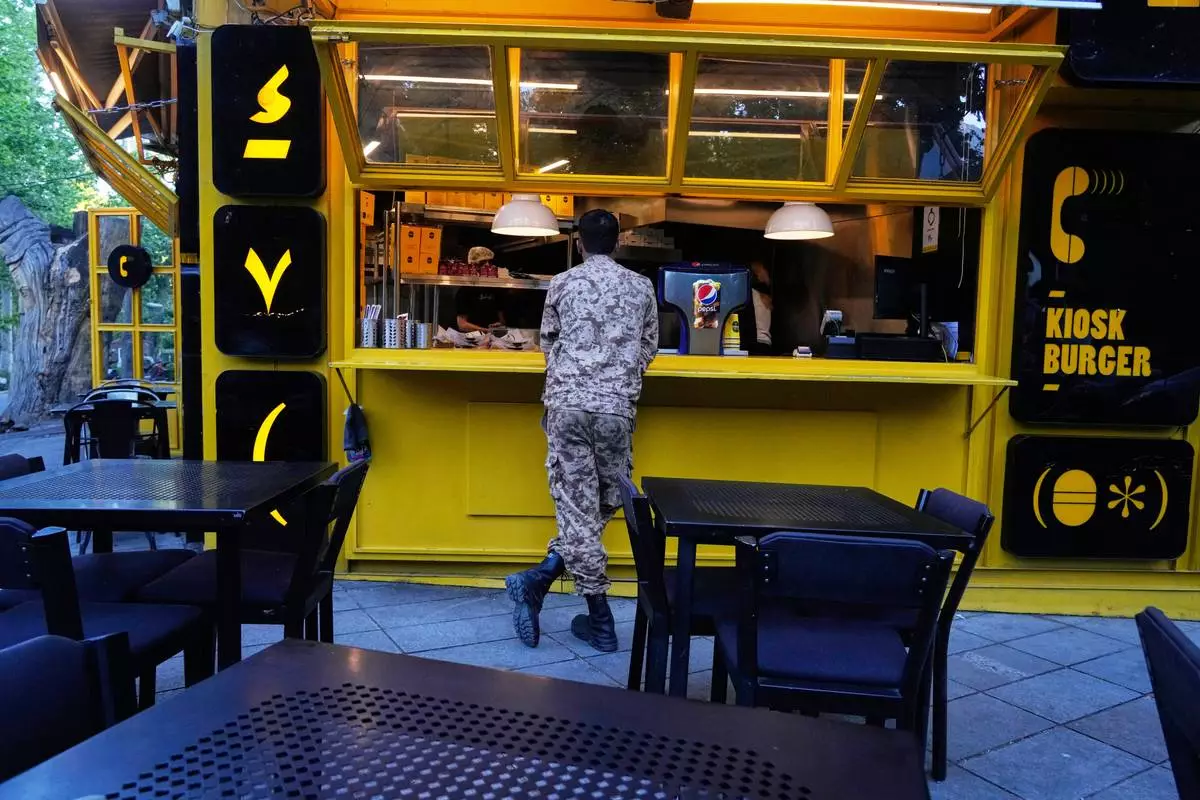
A Revolutionary Guard soldier stands at the counter of a fast food restaurant in northern Tehran, Iran, Sunday, May 10, 2026. (AP Photo/Vahid Salemi)
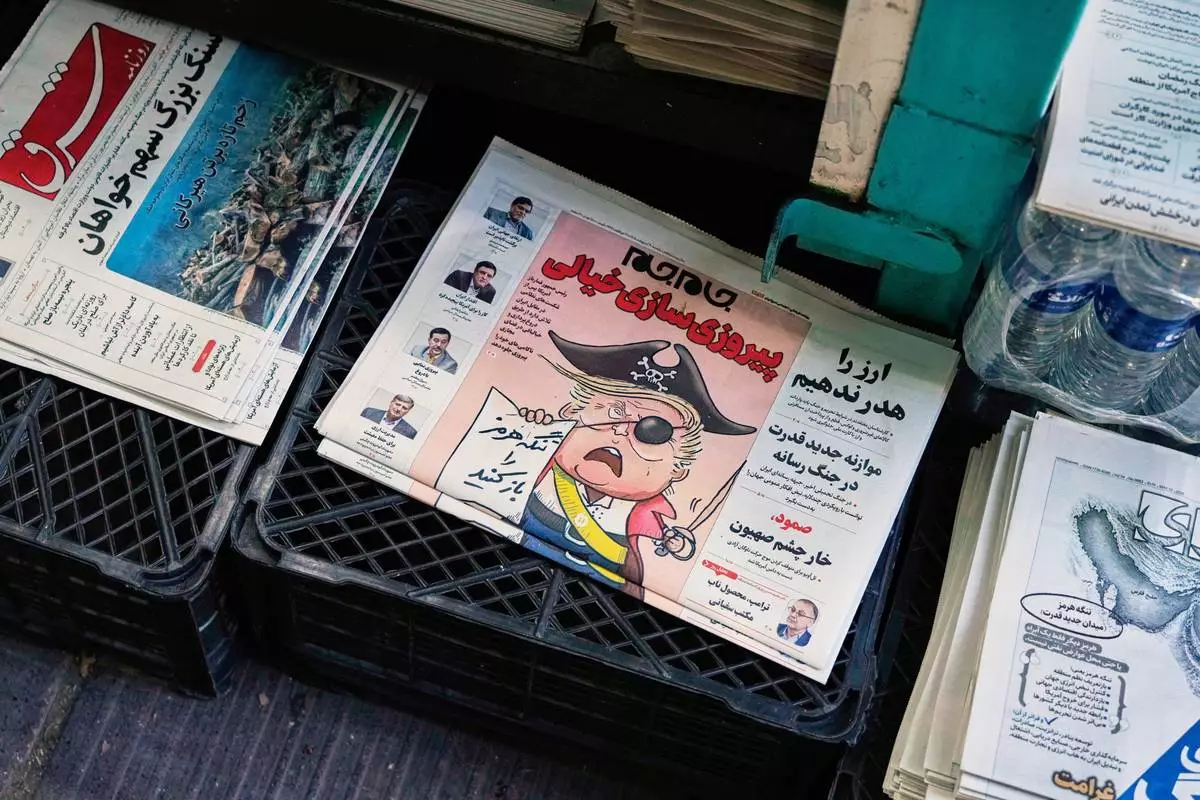
The front page of the Sunday May 10, 2026, edition of Iranian newspaper, Jamejam, is seen with a cartoon satirizing the U.S. President Donald Trump that asks: "Open the the Strait of Hormuz" on a news stand in northern Tehran, Iran, Sunday, May 10, 2026. (AP Photo/Vahid Salemi)
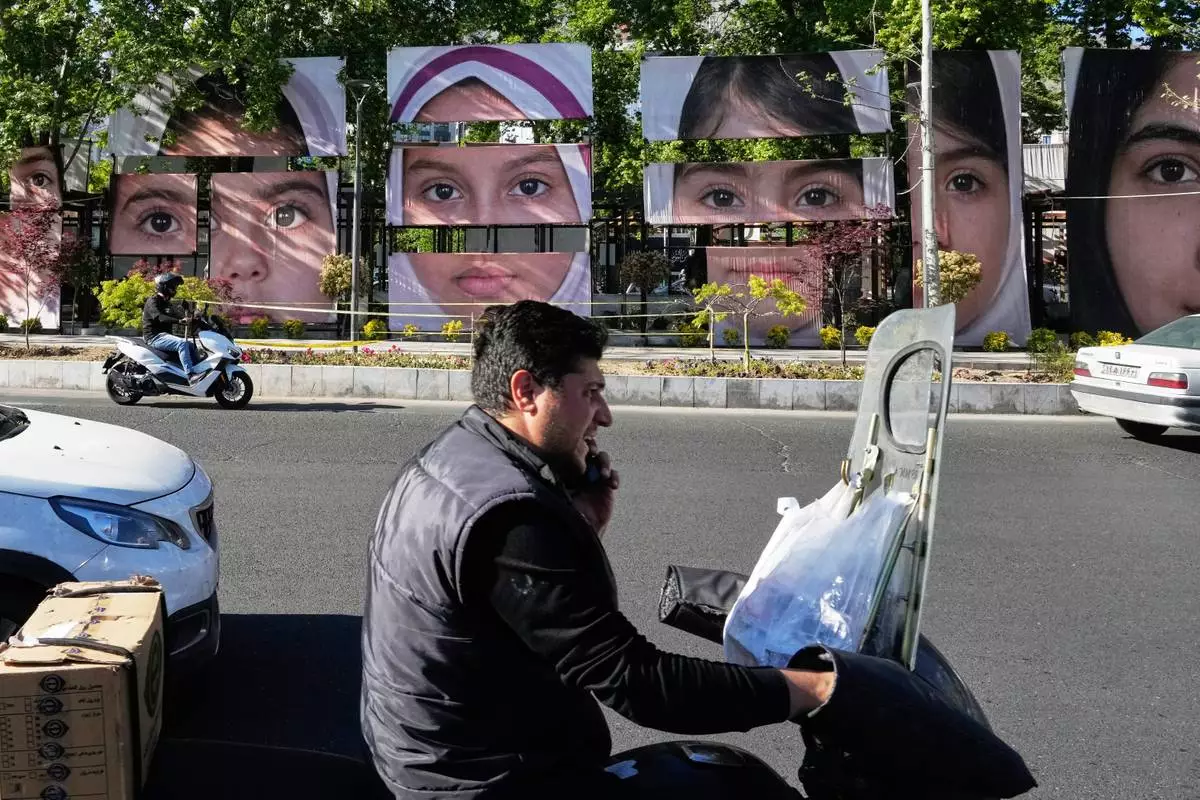
Vehicles drive past banners showing portraits of the school children who were killed during a strike on a school in southern town of Minab on Feb. 28, at Tajrish square in northern Tehran, Iran, Sunday, May 10, 2026. (AP Photo/Vahid Salemi)
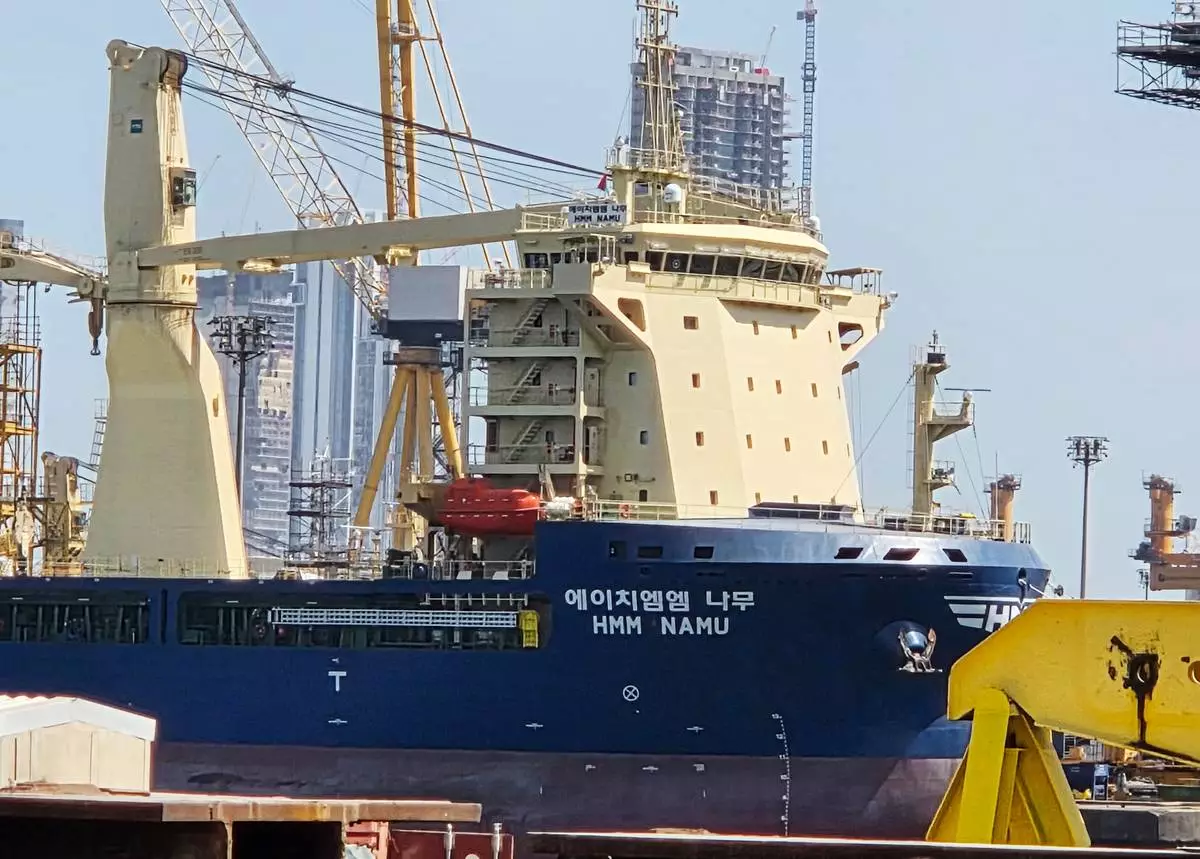
The South Korean-operated vessel HMM NAMU is docked after being damaged from a fire following an explosion in the Strait of Hormuz, at a port in Dubai, United Arab Emirates, Friday, May 8, 2026. (Kim Sang-hun/Yonhap via AP)
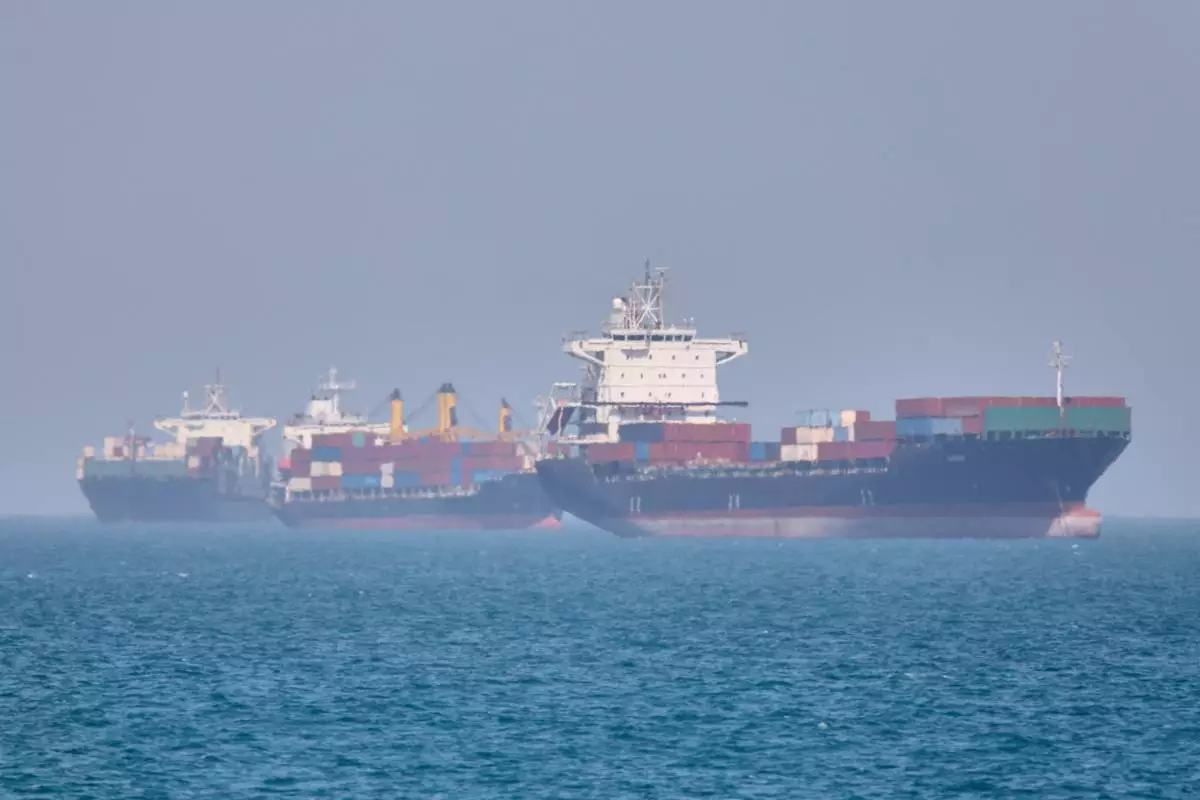
Container ships sit at anchor in the Strait of Hormuz off Bandar Abbas, Iran, Saturday, May 2, 2026.(Amirhosein Khorgooi/ISNA via AP)