Chinese Foreign Minister Wang Yi outlined the consensus reached at the just-concluded third China-Pacific Island Countries (PICs) Foreign Ministers' Meeting during a joint press conference with Kiribati's President and Foreign Minister Taneti Maamau in Xiamen on Wednesday.
Wang, also a member of the Political Bureau of the Communist Party of China Central Committee, said that this session of China-Pacific Island Countries Foreign Ministers' Meeting was the first to be held face-to-face in China since the establishment of the China-Pacific Island Countries Foreign Ministers' Meeting mechanism in 2021.
The meeting took place in Xiamen in eastern China's Fujian province, the so-called starting point of the "21st Century Maritime Silk Road", which has deep historical ties with Pacific Island countries.
When Chinese President Xi Jinping worked in Fujian 25 years ago, Wang said, he personally promoted cooperation between China and Pacific Island countries, with the Juncao Project a shining example of sustainable development cooperation.
Juncao, which literally means "mushroom" and "grass," refers to a Chinese-invented technology using grass to grow mushrooms.
Wang said he and the other foreign ministers at the meeting talked in depth about advancing bilateral cooperation, and international and regional issues of common concern, reaching a consensus in five key areas.
First, all the parties at the meeting agreed to treat each other equally, Wang said, noting that China consistently upholds the principle that all countries, regardless of size, are equal. In its engagement with the Pacific Island nations, China steadfastly adheres to the "Four Principles of Full Respect." China appreciates that the Pacific Island nations have voluntarily reaffirmed their commitment to the one-China principle and understand and support China's legitimate rights to safeguard its national sovereignty and territorial integrity.
Second, said Wang, all sides agreed to advocate for common development. They committed to closely aligning the Belt and Road Initiative with the Blue Pacific 2050 Strategy and strengthening mutually beneficial cooperation in areas such as infrastructure, trade, investment, agriculture, fishery, tourism and civil aviation. China will provide more opportunities for high-quality exports from the Pacific Island nations, enabling them to share the benefits of China's vast market, he said.
Third, all sides agreed to advocate for fairness and justice, Wang said, adding that they will take the commemoration of the 80th anniversary of the founding of the United Nations as an opportunity to firmly uphold multilateralism and safeguard the international system with the UN at its core. The foreign ministers agreed on the importance of maintaining the international order based on international law, safeguarding the multilateral trading system with the World Trade Organization at its core, and protecting the legitimate rights and interests of developing countries.
Fourth, all sides agreed to advocate for openness and inclusiveness, according to Wang. The Pacific Ocean is large enough to accommodate win-win cooperation between all countries. The international community should support the Pacific Island countries' independent choice of development partners. When developing relations with these nations, the most urgent issues, such as addressing climate change, promoting economic development, and improving people's livelihoods and social stability, should be given priority.
Fifth, said Wang, the ministers agreed to advocate for mutual learning and exchange. Chinese civilization and the unique marine civilizations of the Pacific Island countries are precious world heritages, he said, calling on all sides to carry forward their traditional friendships and emotional bonds, jointly implement the Global Civilization Initiative, further strengthen exchanges and cooperation in various fields such as education, culture, media, think tanks, youth, women, sports and local areas, enhance mutual understanding and support through mutual learning, and jointly promote the progress of human civilization.
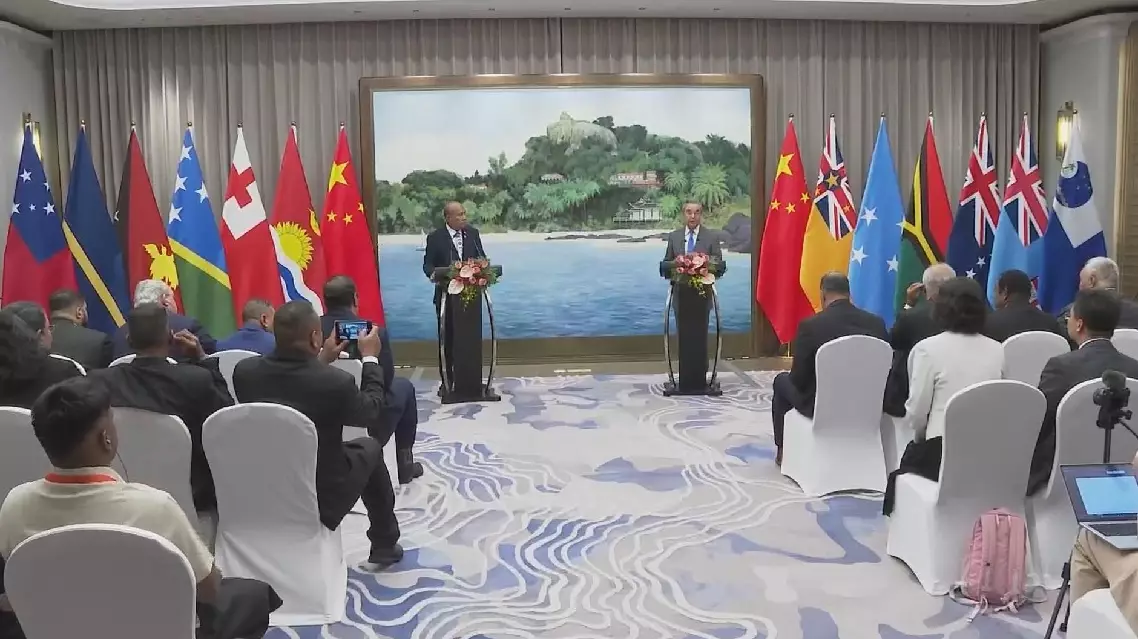
Wang Yi introduces consensus reached at 3rd China-PICs foreign ministers' meeting
Wang Yi introduces consensus reached at 3rd China-PICs foreign ministers' meeting