A group of archaeologists in China have uncovered concrete evidence proving that material exchanges between the East and West began long before the Silk Road was formally established in ancient China's Han Dynasty (202 BC-220 AD), shedding new light on evidence proving the existence of ancient trade routes.
Findings released by the Chinese Academy of Social Sciences (CASS) on Tuesday reveal that glass beads which resemble dragonfly eyes unearthed from four sites in northwest China's Xinjiang Uygur Autonomous Region are similar with those discovered earlier in central China's Hubei Province.
Both sets of beads are believed to have originated from the Levant region along the eastern Mediterranean coast.
This discovery suggests that long before ancient China's explorer Zhang Qian's missions to the Western Regions in the Han Dynasty, material cultural exchanges between the East and West were already occurring on what could be described as the "pre-Silk Road", before the Silk Road was formally opened in the Han Dynasty.
These unique "dragonfly-eye" glass beads are created by embedding one or more colors of glass into the base glass, forming patterns resembling the compound eyes of a dragonfly.
The origin of these beads can be traced back to ancient Egypt around the 16th century BC.
In China, large quantities of such beads have also been discovered in tombs of the State of Chu during the Spring and Autumn and Warring States periods (770 BC-221 BC) in what is now central China's Hubei, Hunan, and Henan Provinces.
Numerous sites in Xinjiang have also yielded soda-lime glass beads.
"We've analyzed a large number of these glass beads unearthed in Xinjiang. Through major element analysis, we were able to identify that some of them contain ingredients that are consistent with those of soda-lime glass. These dragonfly-eye beads come from four sites, mainly distributed in the Ili region on the western slopes of the Tianshan Mountains, and also in other regions around the Tianshan Mountains including Urumqi," said Liu Nian, assistant researcher, Key Laboratory of Scientific Archaeology and Cultural Heritage Preservation under the CASS.
Through further trace element analysis, the archaeologists confirmed that the dragonfly-eye beads from these four sites in Xinjiang are consistent with those found in the Levant region.
Using synchrotron radiation micro-CT imaging technology, they also discovered that the beads share similarities in color, shape, and manufacturing techniques with those found in Hubei and northwest China's Gansu Province.
"We've traced the origins of these soda-lime glass beads to the Levant region. Previous researches by other scholars have also pointed to similar glass types being found in Gansu. This solidifies our evidence, showing a route from the Mediterranean to Xinjiang through the Hexi Corridor in Gansu, and eventually reaching Hubei. This route also reveals the existence of the pre-Silk Road, a path that can be substantiated by trade in glasswares. Long before the official establishment of the Silk Road during the Han Dynasty, material cultural exchanges and interactions had already taken place on this 'Silk Road,'" Liu said.
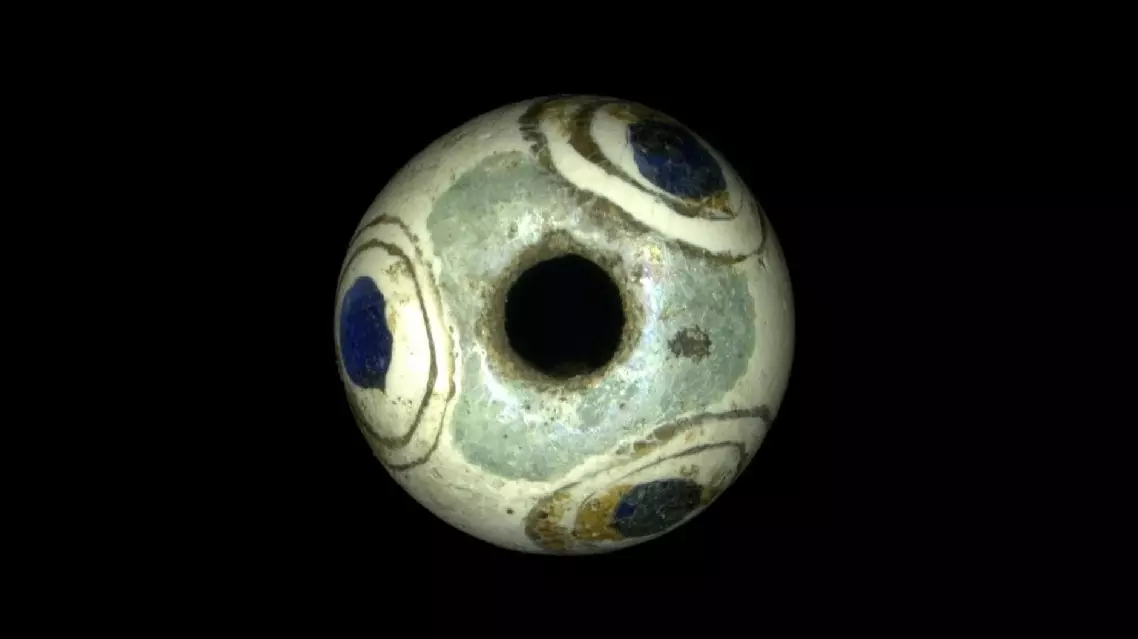
Chinese archaeologists uncover evidence of early East-West cultural exchanges