NEW YORK (AP) — When Angelina Rivera was a third grader, she wanted to be a scientist and was excited by bugs, rocks and everything in the natural world.
But a family trip to visit relatives in Honduras changed her perspective. Police stopped her family’s car and aggressively questioned her father about a crime someone else committed the night before. The experience left Rivera, then 8, shaken but also realizing that people may be treated differently based on their appearance and location.
Over time, that pivotal experience evolved into an interest in politics. After studying international relations in college, Rivera, now 22, works as an assistant at the Consulate General of Japan in Detroit.
“The more I tried to explore different interests(,) ... I found that it was hard for me to ignore that urge, that calling, to go into diplomacy,” she said.
Sometimes career paths follow a straight line, with early life ambitions setting us on a clear path to training or a degree and a specific profession. Just as often, circumstance, luck, exposure and a willingness to adapt to change influence what we do for a living.
Developmental psychologists and career counselors recommend exposing children to a wide variety of career paths at a young age.
“It’s not so that they’ll pick a career, but that they will realize that there’s lots of opportunities and not limit themselves out of careers,” said Jennifer Curry, a Louisiana State University professor who researches career and college readiness.
Sometimes children assume they can't work certain jobs because of their gender, race or background, Curry said. “That’s what we’re trying to avoid, because kids do start limiting very young, like age 5,” she said.
Here's what experts have to say about how to talk with kids about careers.
Toddlers begin making sense of occupations while visiting a pediatrician’s office or waving to garbage truck crews. Encourage their curiosity by pointing out the people working at a post office or bakery, or appearing in books or on television.
You can ask young children, “What jobs do you see? What kind of things do they do?” advised Curry, who consults on career content for the PBS show “Skillsville,” which is geared toward children ages 4-8.
Once kids identify different jobs in the community, they can try those roles while playing at home.
If children enjoy pretending to be a doctor, explain that nurses, X-ray technicians and receptionists also work in hospitals. If they love building with Legos, talk about how architects, construction workers, brick masons and welders all played a part in building a certain bridge, Curry said.
"If we were to give kids lots of exposure and access, and ask them, ‘What do you think of yourself in that career? It seems to me you enjoy this kind of thing,’ that can really open the door for kids to see themselves and those possibilities.” Curry said.
There are many occupations that children don't learn about in early reader books, which frequently portray police officers, firefighters or doctors. After finding no children's books about public relations, Curtis Sparrer wrote one, placing a 10-year-old at the center of the action.
Sparrer, who co-founded a public relations agency, Bospar, wanted to help young readers avoid the confusion he felt growing up, when movies made him think being an actor meant flying around on spaceships. Before he found his niche in PR, he worked in television production but didn't enjoy the late-night shifts.
“Once you figure out what you really liked and why you liked it, you can really zero in on your passion,” Sparrer said.
Aside from topic interests, there are personality traits to consider. Children know from an early age whether they like to be around a lot of people or by themselves, whether they prefer using their hands or enjoy reading, according to Jobs for the Future CEO Maria Flynn.
“Very early you can start helping kids get a sense of what are they drawn to, and make that connection, how those skills and attributes show up in jobs,” said Flynn, whose nonprofit organization focus on education and workforce initiatives that advance economic opportunities.
When her daughter played video games with friends, Flynn noticed strong communication skills and pointed out that providing clear direction to teammates and solving problems together were skills she could apply in future jobs.
Some U.S. high schools offer elective courses in fields like marketing, computer science and health care. They also are again investing in vocational classes such as wood shop, welding and mechanics, which fell out of fashion as school systems came under criticism for not preparing enough students for college. Meanwhile, some middle schools are offering career exploration courses.
“Really help them see — at an earlier age, even in middle school — what is the apprenticeship option? How does that work?” Flynn said. “How does the pay work on things like that? What are different trade school options?”
Some young people have questioned the value of four-year degrees because of spiraling costs, student debt loads and difficulty finding jobs. Many want to be able to earn and learn at the same time, Flynn said.
Enrollment in two-year and four-year college programs remains below where it stood before the COVID pandemic, according to the National Student Clearinghouse Research Center. By contrast, enrollment in two-year vocational programs that emphasize learning skilled trades has grown, surpassing pre-pandemic levels, the non-profit organization said.
“The public has really started to get the message about the benefits” and is seeing career and technical education as a viable option, said Catherine Imperatore, research and content director at the Association for Career and Technical Education, a nonprofit organization that advocates for career-readiness initiatives.
Programs offering certificates in fields such as information technology and health care are providing another path to a stable job and decent salary, she said.
In addition to exposing children to career routes through early conversations and school courses, experts recommend teaching children about artificial intelligence and how it is reshaping the world and work.
Employers are looking for people who can leverage AI to make their workplaces more efficient, but many employees don't know how to comfortably use the technology, said Hadi Partovi, founder and CEO of Code.org, a nonprofit that works to expand K-12 access to computer science education.
Partovi encourages parents and teachers to help children learn about artificial intelligence at a young age. For example, they can speak with first and second graders about the benefits and drawbacks of self-driving cars, he said. Children also would benefit by learning to write computer programs, ideally when they've learned to read, although even preschoolers can learn some skills, Partovi said.
If parents are unfamiliar with AI, they can learn about it alongside their children while also encouraging enduring skills such as resiliency, curiosity, collaboration and teamwork, Flynn, of Jobs for the Future, said.
“We are living in an ever-changing world, and I think it’s important for kids at a young age to start getting used to the fact that things are moving and changing quickly,” Partovi said. “Teaching kids how to harness AI is going to be the most important thing after reading and writing.”
__
Share your stories and questions about workplace wellness at cbussewitz@ap.org. Follow AP’s Be Well coverage, focusing on wellness, fitness, diet and mental health at https://apnews.com/hub/be-well.
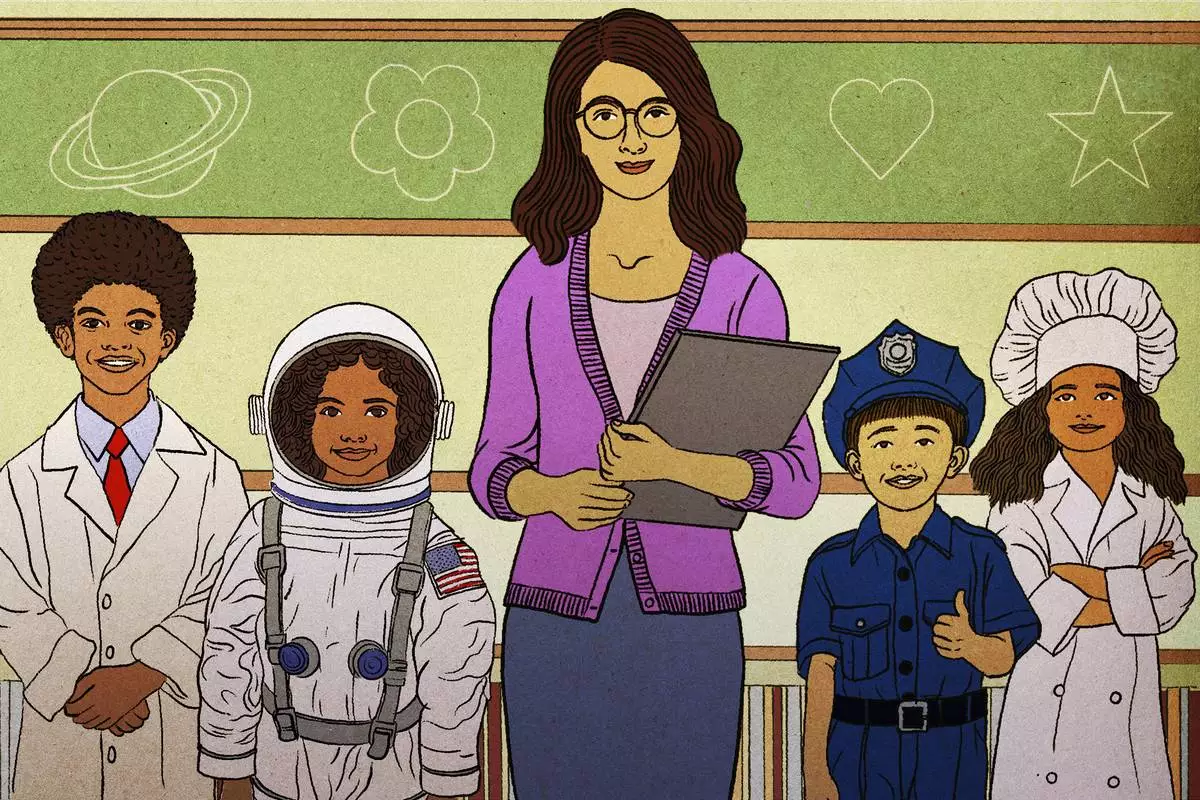
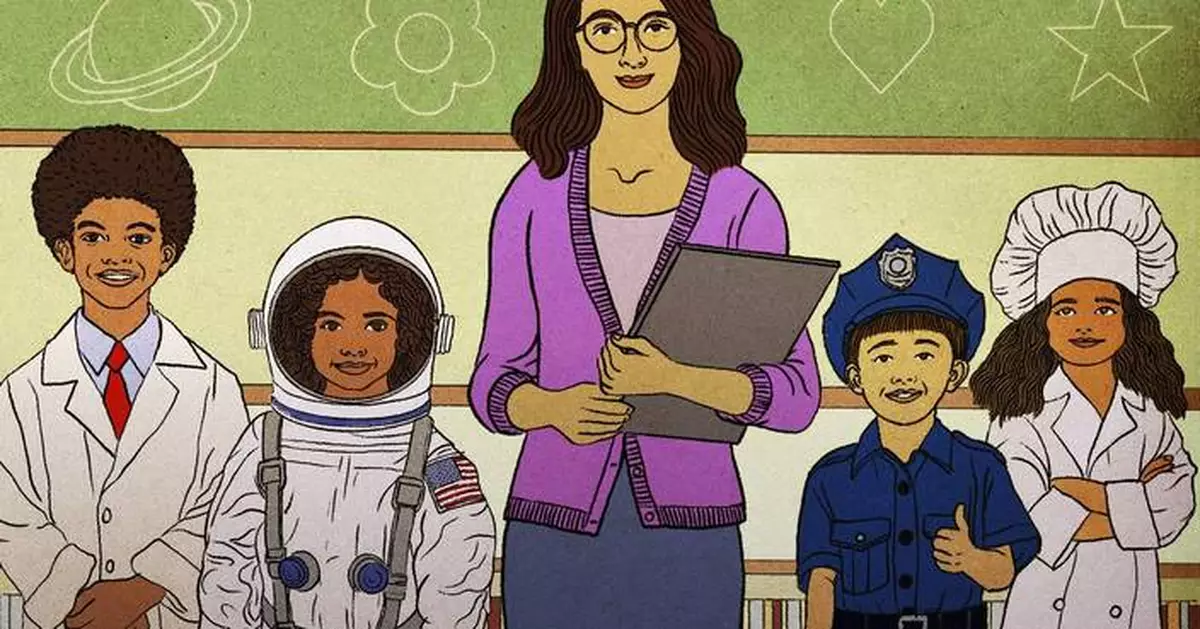
(AP Illustration / Peter Hamlin)