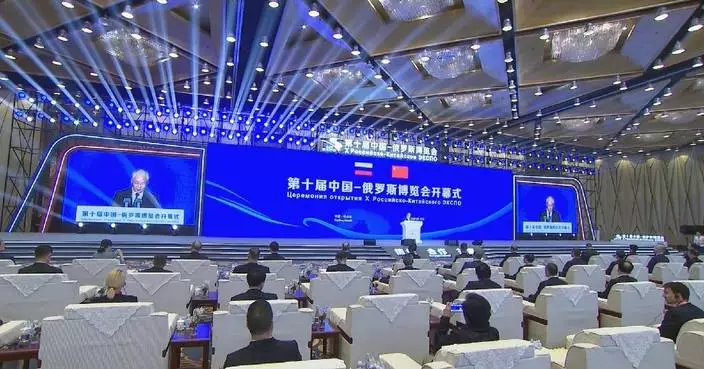
As China, the Association of Southeast Asian Nations (ASEAN), and the Gulf Cooperation Council (GCC) vowed to deepen their partnership at their inaugural joint summit, a new and dynamic mechanism of multilateral cooperation is taking shape, a China Media Group commentary hailed on Wednesday, a day after the summit opened in Kuala Lumpur, capital of Malaysia.
An edited English translation of the commentary is as follows:
As is shown in the world map, China, ASEAN countries, and GCC countries form a large triangle, which has led Malaysian media to dub this emerging trilateral cooperation the "golden triangle".
This summit was initiated by Malaysia that holds the rotating presidency of ASEAN this year, with China actively participating and playing a key role.
At the summit, China proposed deepening the substance of trilateral cooperation and building a model for global cooperation and development in the world today, while also outlining plans for collaboration in key areas. These proposals were incorporated into the joint statement released after the summit, which laid out a series of cooperative measures in economic integration, connectivity, energy security and sustainability, digital transformation and innovation, as well as food and agriculture. As the Chinese side noted, the trilateral cooperation mechanism "can be regarded as a major innovation in regional economic cooperation".
Xu Liping, researcher at the National Institute of International Strategy of the Chinese Academy of Social Sciences pointed out that from a regional perspective, the ASEAN-GCC-China Summit spans three major areas -- East Asia, Southeast Asia, and the Middle East -- and such cross-regional cooperation is rare in Asia. From an institutional viewpoint, compared with previous bilateral summits such as the China-ASEAN Summit and the China-GCC Summit, the trilateral summit introduces innovations in its structural design. As high-quality Belt and Road cooperation continues to advance, this trilateral cooperation mechanism is poised to become a vital new platform, setting a benchmark for mutual respect and win-win cooperation among emerging economies, and playing a demonstrative and leading role.
Given the current international landscape, trilateral cooperation carries greater practical necessity and strategic significance. AFP reported on Tuesday that the United States has announced a series of tariffs on other countries this year, undermining global trade norms and prompting ASEAN and other nations to accelerate the diversification of their trade networks. As a result of these tariff policies, the International Monetary Fund (IMF) downgraded its global economic growth forecast for this year to 2.8 percent in late April.
Against the backdrop of a global landscape marked by instability and sluggish economic growth, China, ASEAN, and the GCC are working together to build a vibrant economic circle and new poles of growth. This cooperation will not only contribute to their respective economic prosperity but also promote peace and development across Asia and the wider world. In this sense, the tripartite cooperation is expected to produce a synergy where "one plus one plus one is greater than three."
First and foremost, this new model of cooperation will unlock the full economic potential of the three parties.
China possesses strengths in industrial manufacturing, scientific and technological innovation, and a vast domestic market; ASEAN countries are rich in natural resources and have a youthful population structure; GCC nations boast abundant energy reserves and strong financial capabilities. The economy of the three parties are highly complementary, offering broad prospects for cooperation.
The joint statement issued by the three parties outlined a range of priority areas for collaboration, including advancing free trade, fostering new economic opportunities in emerging and future-oriented industries such as digital and green technologies, exploring the establishment of regional business councils, and enhancing cooperation on local currency usage and cross-border payment systems.
China also announced a trial visa-free policy for four Gulf countries, including Saudi Arabia. With the move, China now extends visa-free access to all GCC member states.
The joint efforts aim to build a shared market characterized by more efficient circulation of resources, technology, and talent, as well as freer and more convenient trade and investment, thereby achieving common development. This trilateral cooperation will also inject fresh momentum into regional and global economic growth and help uphold fairness and justice in the international system.
Data show that the total economic output of China, ASEAN countries, and GCC nations totals 24.87 trillion U.S. dollars, with a population of 2.15 billion—approximately one-quarter of the global total. Efficient economic circulation among the three parties is expected to significantly boost both regional and global economic development.
Furthermore, the three parties issued a common call to uphold the multilateral trading system, expressing their firm opposition to unilateralism and protectionism.
China, ASEAN, and GCC countries are all important members of the Global South. The ASEAN-GCC-China Summit has explored a new model of cross-regional cooperation within the Global South, which carries exemplary significance.
As noted by the Malaysian National News Agency on Tuesday, this partnership is distinctive in that it is rooted in mutual benefit and win-win outcomes, rather than ideology. The trilateral cooperation model—marked by complementarity, inclusiveness, and a focus on development—serves as a valuable reference for collaboration among countries of the Global South.
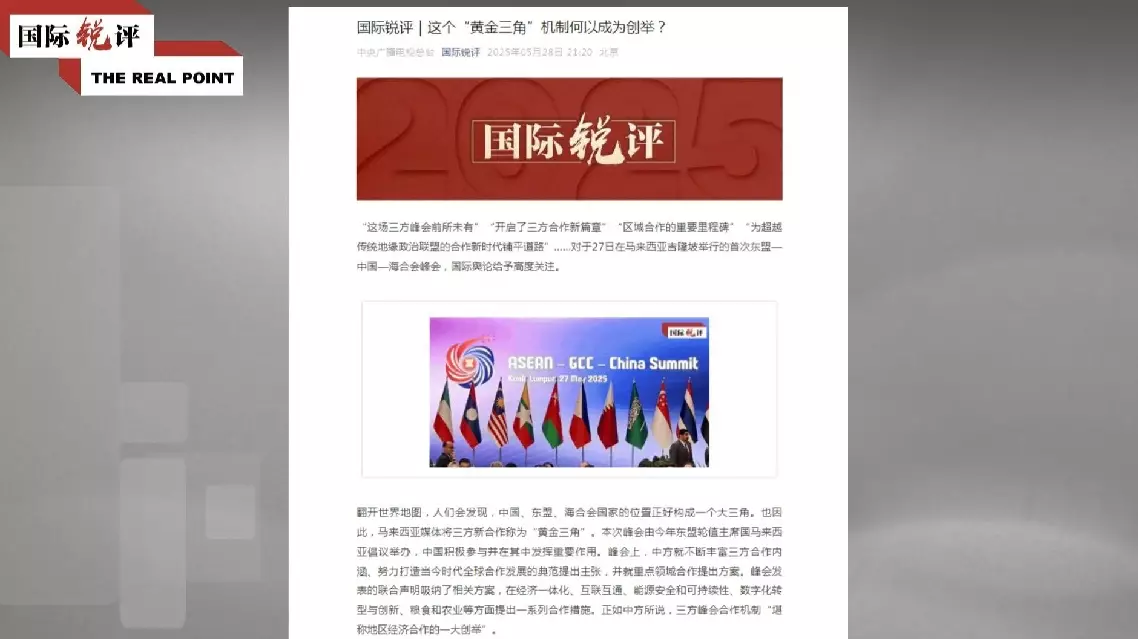
ASEAN-GCC-China cooperation a new "golden triangle" in global affairs: commentary
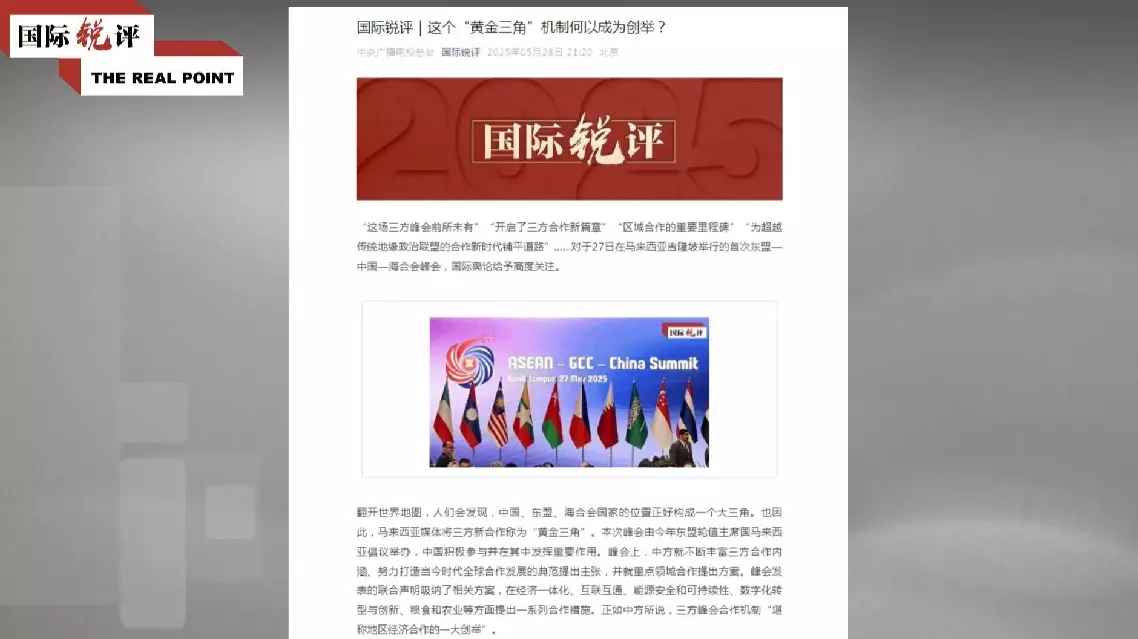
ASEAN-GCC-China cooperation a new "golden triangle" in global affairs: commentary