Skip to Content Facebook Feature Image

New Year holiday railway travel rush starts across China

China

China

China

New Year holiday railway travel rush starts across China

2025-12-31 17:21 Last Updated At:19:07

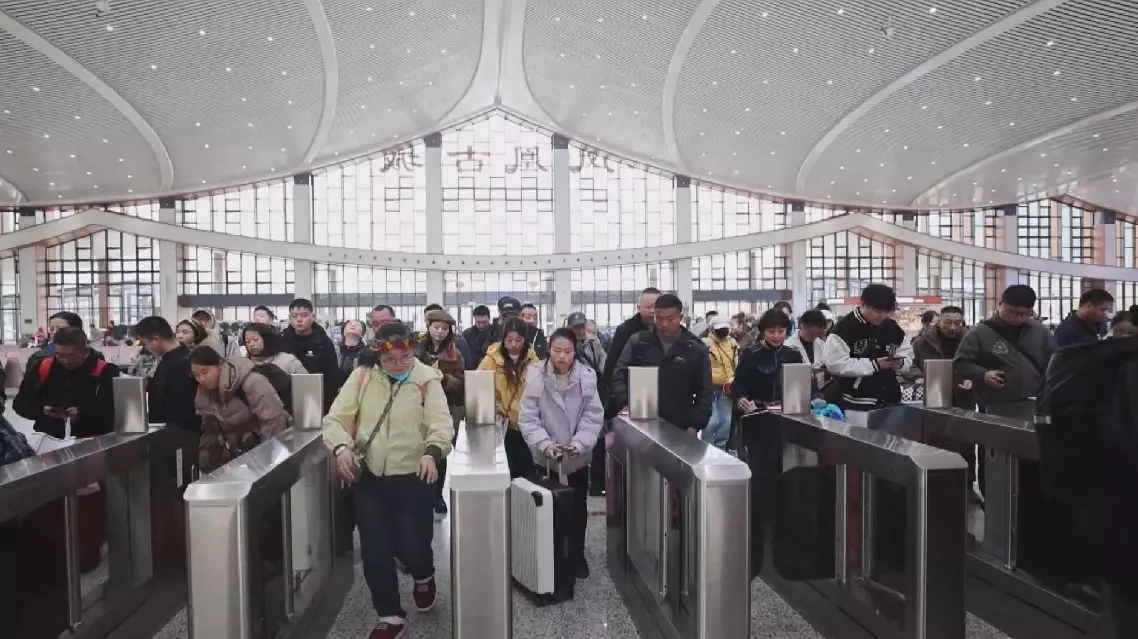
China's railway travel rush for the New Year holiday kicked off on Wednesday, with more than 16 million trips expected on the day before the three-day public holiday.

Cities including Beijing, Shanghai and Guangzhou are experiencing high passenger flows.

The national railway system has scheduled 1,328 additional passenger trains on Wednesday to accommodate the increased travel demand.

The travel rush, expected to last till Sunday, will see about 77.8 million railway passenger trips, with Jan 1 anticipated as the peak travel day.

During the period, Beijing South Railway Station will operate extra trains to cities like Tianjin, Jinan, Qingdao and Linyi.

More than 200 overnight high-speed trains will operate for popular travel destinations such as Fuzhou, Xiamen, Nanchang, Ganzhou, Shenzhen and Hangzhou.

Road and waterway passenger flows have also seen growth since Wednesday.

In response to higher traffic flow and severe weather conditions in some parts of the country, traffic management departments have reinforced precautionary measures to ensure safe and smooth transportation.
New Year holiday railway travel rush starts across China

New Year holiday railway travel rush starts across China

Seventy-two hours after Cambodia and Thailand signed a joint ceasefire declaration, situations along parts of the shared border have stabilized, though the impact of the fighting remains lingering in the affected villages in Cambodia.

On December 27, Cambodia and Thailand signed a joint ceasefire statement at a special meeting of the Joint Boundary Commission (JBC).

By midday on December 30, three days after the truce took effect, border villages on the Cambodian side showed no signs of renewed fighting.

Cambodia's National Road 58, which connects the border city of Poipet with nearby villages, was once a busy transport route but now sees only sparse traffic. Several villages along the road were heavily damaged during the conflict.

In Sela Khmer Village, small shops along the roadside remain closed, and this village of more than 2,000 residents was nearly empty.

Unexploded ordnance left behind during the fighting continues to pose a serious risk, requiring caution and protective measures for anyone moving through the area.

A local official said the border village was repeatedly shelled by Thai military forces during the 20-day conflict.

"The village still has no water and no electricity. It is very dangerous here, and no one dares to come to repair the facilities, so it is still uncertain when power will be restored," said Yern Pov, head of Sela Khmer Village.

As the situation calmed, some residents began returning from evacuation shelters. Near evening, a couple was seen making their way back to the village after spending 20 days at a shelter about 50 kilometers away.

"In the first two days of the conflict, we could hear the intermittent artillery shelling. Later, the shelling became more and more intense, and we had no choice but to evacuate. At the shelter, many people slept together on mats, and it was very crowded. Those who arrived later could hardly find a place to sleep," said Launh, a local resident.

Despite the ceasefire, large numbers of displaced people remain in shelters located dozens or more than 100 kilometers away from the border and are still unable to return home.

Local governments face mounting pressure to provide food and daily necessities, while charitable organizations have stepped up deliveries of relief supplies to affected populations.

Cambodia border villages remain deserted despite ceasefire implementation

Cambodia border villages remain deserted despite ceasefire implementation

Recommended Articles