China's two leading rescue teams have successfully passed the United Nations International Heavy Urban Search and Rescue Reclassification Assessment, receiving their certifications during a ceremony in Beijing on Thursday.
The United Nations Office for the Coordination of Humanitarian Affairs (OCHA) and the International Search and Rescue Advisory Group (INSARAG) brought together 18 international assessors from 14 countries to conduct a rigorous 40-hour earthquake rescue simulation on the China Rescue Team and the China International Search and Rescue Team from Tuesday to Wednesday, according to the Ministry of Emergency Management.
The assessors unanimously agreed that the two teams met the standards required to pass the reclassification, the ministry said.
China is now the first Asian country to have two INSARAG-certified heavy urban search and rescue teams. This enables them to carry out operations both domestically and internationally in accordance with global guidelines.
Both Chinese teams have participated in international rescue missions in countries including Türkiye and Myanmar over the past few years.
At the ceremony, Sarah Muscroft, director of the response support branch at OCHA, presented the certification and expressed hope that the Chinese teams will play a greater role in future global rescue operations. She also conveyed gratitude for China's contributions to international humanitarian efforts.
"For us in the United Nations, we very much value the leadership that China plays not just in the region, but within the INSARAG network," Muscroft said in an interview with the China Global Television Network (CGTN).
More than 60 international rescue experts, along with representatives from China's national fire and rescue forces, the Hong Kong rescue team and civil emergency organizations, observed the assessment, according to the ministry.
"(Rescue teams) China One and China Two have the ability to move very, very quickly. They don't stop. Whenever they get an opportunity to deploy, they will, and that's great for the affected people in the affected countries," said Kevin Anderson, a staff member at INSARAG.
Since its establishment in August 2018, the China Rescue Team has passed the UN's heavy rescue team evaluation twice. The China International Search and Rescue Team, established in April 2001, has now received the certification four times.
Only 33 rescue teams worldwide have met the UN's stringent International Heavy Urban Search and Rescue standards, the Ministry of Emergency Management said.
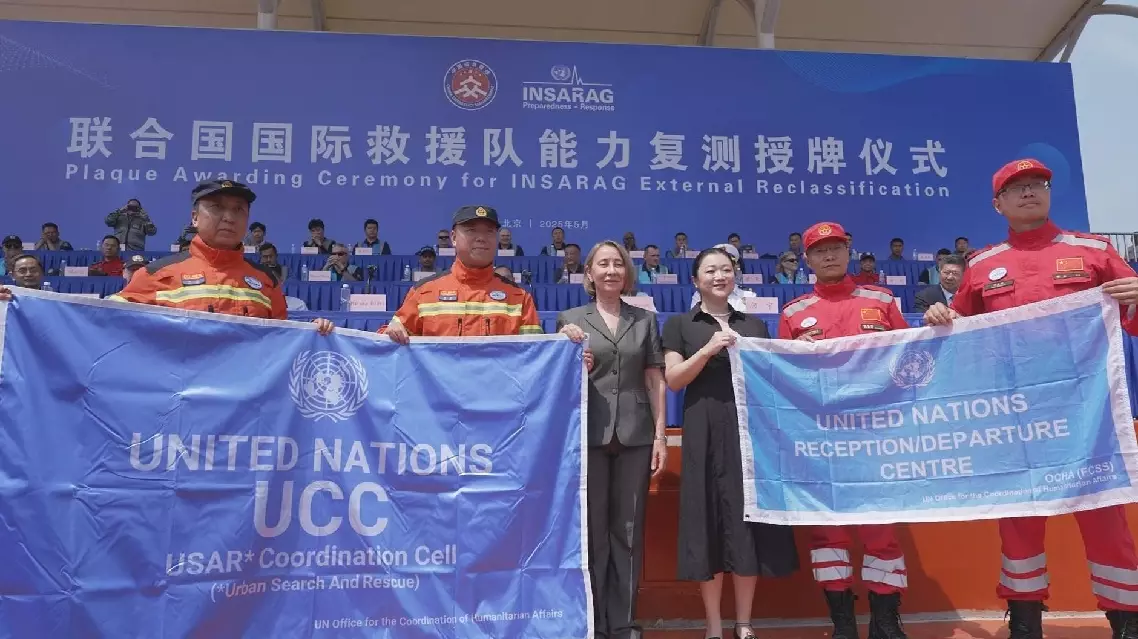
Two Chinese rescue teams pass UN reclassification, marking first for Asia