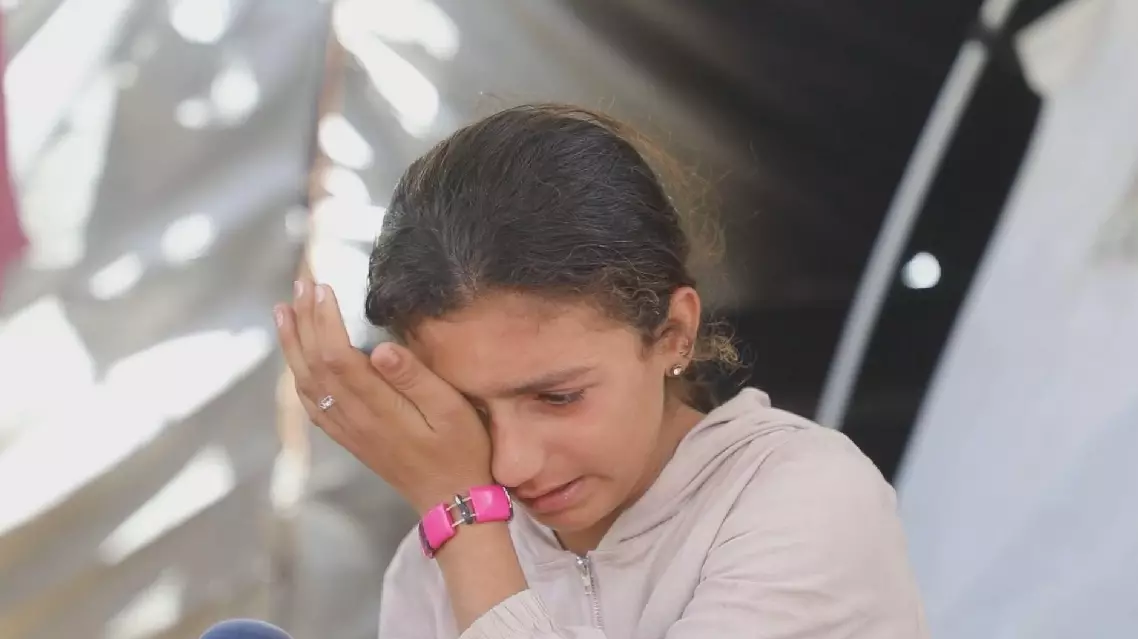
Twelve-year-old displaced Gazan girl Dima Abdelhadi has become the face of a generation grappling with the devastating aftermath of the Israeli offensive, as her daily life is consumed by survival rather than childhood.
Amid the turmoil, Dima Abdelhadi shared a heart-wrenching glimpse of her life, transformed by the conflict.
"My name is Dima Abdelhadi. I'm from Beit Hanoun city, 12 years old, in sixth grade. Before the war, we used to wake up at 6 a.m. and go to school, me and my siblings. We'd go there, have breakfast and go to the playgrounds to play, with friends, and my siblings. Now, the situation is hard. We can't go out. Everywhere is dangerous. Bombing is everywhere, and we could get hurt," she said.
Dima's mother is beyond concerned about her daughters' conditions, but there is nothing for her to do.
"Life now is completely different from what it used to be. Life now is filled with fear, terror, and panic. I keep searching for a safe place to take my children to. Their mental state is carrying more than their age can handle," she said.
After the education system was shut down across the enclave, Dima, her sisters, and other peers all have to throw themselves into fetching daily necessities.
"I wake up at 6 a.m. My siblings and I go to fetch water. We have no transportation, so we carry the water with our hands. Our backs and hands start to hurt. Then we go search for firewood under the rubble, under threat, me and my siblings. After that, we go looking for soup kitchens to get food," said the girl.
"There is no such thing as education anymore. Education has disappeared for two years now. Their biggest concern now is getting water and food from the soup kitchens," said her mother.
The little girl burst into tears when talking about the heavy responsibilities on her young shoulders.
"No one helps me here. I don't have any brothers. We are seven girls. My married sister, whose husband was martyred, has two daughters. I'm one of the youngest among them, I have to take care of my sisters, and I go out to look for water and food for us. They killed our childhood. What did we do wrong? What did we do to deserve this? Why are they doing this to us? We are children who have become older than our age," she cried.
To her and her younger siblings, doing handwork gives them an escape from the struggles. But in the end, they cannot keep or wear any of their beautiful hand-made accessories, they have to sell them for food instead.
"We draw and play during our free time. Then we string beads and make bracelets, necklaces, and earrings. I sell them to buy food for my family," Dima said.
"I wish for my daughters to live in peace, and for the war to end. I want them to have a place in society and to continue their education. Education is the most important thing, without it, society and life cannot thrive. I dream of seeing my daughters educated, one in journalism, another in nursing, etc," her mother still wishes for the best.
"We don't like the night. The night comes heavy with sorrow. The sound of bombing, the ambulances, the missiles and rockets. We're afraid of the night. We used to sleep on one mattress, me and my sisters, out of fear," she recalled.
UN humanitarians on Friday described the situation in Gaza, beleaguered by airstrikes, malnutrition, displacement and a breakdown in public order, as catastrophic and the worst since the war began in October 2023.
According to Gaza's Health Ministry on Saturday, at least 54,381 Palestinians have been killed by Israeli attacks since October 2023, and another 124,054 have been injured.
Gazan girl shares daily struggles in war-torn enclave
Gazan girl shares daily struggles in war-torn enclave