Chinese scientists are sounding the alarm over the mounting threats facing coral reefs while accelerating restoration efforts to preserve these vital ecosystems for future generations.
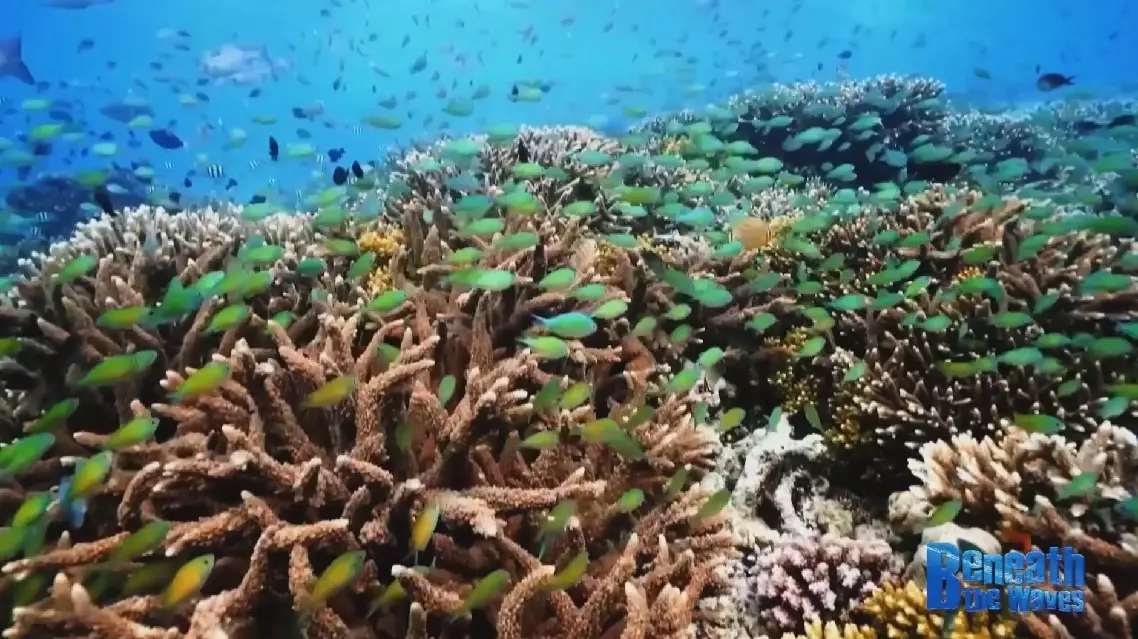
Coral reefs, often described as the rainforests of the sea, are under severe threat from climate change, ocean acidification, and destructive human activities. In a four-part CGTN special titled "Coral Reefs Whisper" which began airing on Sunday, XR visual technology immerses viewers in an interactive deep-sea experience, highlighting both the fragility and resilience of coral ecosystems in the South China Sea.
These reefs are not just natural wonders, but they are biological fortresses built over millennia.
"Coral reefs are primarily formed by reef-building corals, coralline algae, and other calcifying algae and reef-building organisms, all of which secrete calcium carbonate. Coral reefs, through years of gradual accumulation, have formed a unique underwater geological structure," said Yang Hongqiang, professor at the South China Sea Institute of Oceanology, Chinese Academy of Sciences.
He noted that it usually takes tens of thousands of years of continuous growth and geological buildup to create a coral reef ecosystem. Small reefs take hundreds of years to form, while the larger ones have been growing through millions, even tens of millions of years.
Yet these ancient ecosystems are now rapidly deteriorating. Yang pointed to rising sea temperatures and extreme weather events fueled by climate change as major drivers of coral bleaching and species loss.
"First, global climate change. Rising sea temperatures have triggered widespread coral bleaching and death. The frequency and intensity of tropical storms have also increased, destroying reef structures. Excess carbon dioxide in the atmosphere dissolves into the ocean, leading to excessive acidification which causes a reduced calcification ability in reef-building corals, making the entire coral reef more fragile," he said.
Beyond the environment, biological threats and human impact add to the crisis, he added.
Despite growing challenges, hope emerges from the laboratories and fieldwork of dedicated scientists. Among them is Professor Huang Hui, known affectionately as "Coral Mum."
"We've been working on coral reef restoration for nearly 20 years across the entire South China Sea, from the southernmost Nansha Islands to the Xisha Islands, the coastal waters of Hainan Island, and parts of Guangdong Province, where we have several coral reef restoration demonstration sites of various sizes. So far, we've restored around 30 hectares with nearly 400,000 corals," said Huang.
Inside Huang's lab, massive aquariums simulate marine environments to allow delicate coral species to grow in controlled conditions.
"Among our coral nurseries, one large group is used primarily for species conservation. In this relatively small area here, we're cultivating over 100 species of reef-building corals. Many of them are rare and unique to island reef ecosystems," she said.
The transition from lab to ocean is already underway, with restored coral being transplanted back to the reefs.
China races to save coral reefs in South China Sea