Shanghai recorded a historical high of nearly 17 million inbound and outbound passenger trips in the first five months of the year, marking a remarkable 20 percent year on year growth, according to customs data on Monday.
During the period, Shanghai Customs oversaw a record 104,000 inbound and outbound aircraft, reflecting a 14.5 percent year-on-year growth.
The surge in cross-border travel is largely attributed to China's visa-free policies, which have made the country more accessible to international travelers.
"We love Shanghai, so I wear 'I love Shanghai' T-shirt," said a South Korean tourist .
"We are going to visit the Oriental Pearl Tower and the Bund. Also, I have some Chinese friends and I plan to meet them," said another tourist from South Korea.
China has been steadily adjusting and optimizing its visa policies to boost cross-border mobility. Since late 2023, the country has rolled out a series of traveler-friendly measures.
In late May of this year, it announced that citizens of four Gulf countries -- Saudi Arabia, Oman, Kuwait and Bahrain -- will also enjoy visa-free entry for up to 30 days, from June 9, 2025, through June 8, 2026.
In addition, China on Sunday began implementing a trial policy that unilaterally grants visa-free entry to citizens of Brazil, Argentina, Chile, Peru and Uruguay. It is the first time that China has extended such access to nations in Latin America and the Caribbean.
The move is part of China's broader efforts to expand visa-free access in line with its commitment to high-level opening-up. With this expansion, China now offers unilateral visa-free entry to 43 countries.
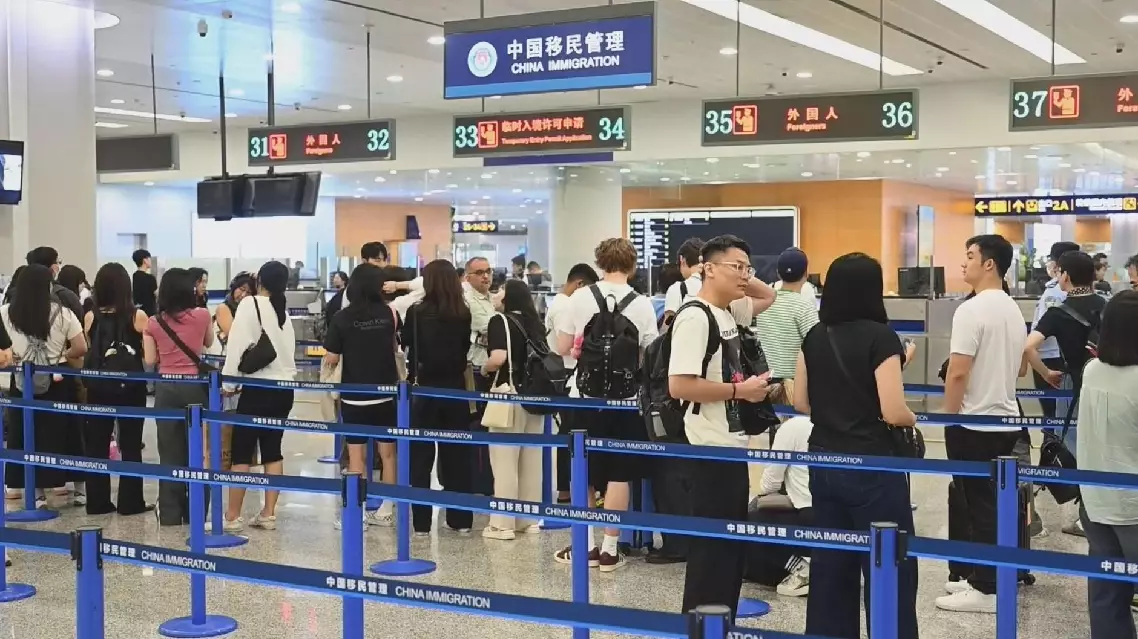
Shanghai sees nearly 17 mln inbound, outbound air passenger trips during Jan-May period
China unveiled a large wind-assisted propulsion system for ships in the coastal city of Dalian, northeast China's Liaoning Province, on Friday, marking a major leap forward for the country in the field of high-end vessel marine environmental protection equipment.
The wind-assisted propulsion system - rotating sail system (WAPS-RSS), is developed by Luoyang Ship Material Research Institute of China State Shipbuilding Corporation Limited (CSSC).
The system's rotor has diameter of 5 meters, is 35 meters high, and weighs 150 tons.
Experts say that the system can efficiently capture wind energy while the ship is sailing, providing additional thrust for the vessel.
On average, it can save fuel consumption by 5 to 25 percent for large ocean-going vessels, and lower carbon emissions accordingly.
It relies on the Magnus effect, which is much like a loop in table tennis, featuring a rapidly spinning sphere that causes the surrounding air to rotate. Pressure decreases on the side with faster airflow and increases on the side with slower airflow, creating a lateral pressure difference that generates lateral thrust.
"Standing on the deck, the powerful thrust generated by its rotation assists the ship's sailing. Our system - the world's largest rotary sail - reaches a maximum rotational speed of 180 revolutions per minute and can generate a maximum of 355 kilonewtons of thrust. Additionally, the system's intelligent control integrates multiple sensors to detect real-time wind and ship conditions. Through smart algorithms, it automatically adjusts to maintain optimal performance at all times, maximizing the utilization of wind energy," said Guo Yu, vice president of SunRui Marine Environment Engineering Company Limited under Luoyang Ship Material Research Institute.
Not only does the system's performance meet international advanced standards, but the project team has also overcome a series of engineering challenges, including the fabrication of giant composite structures, complex system integration, and intelligent coordinated control.
Compared with mainstream international technological approaches, it offers greater production efficiency and cost advantages.
Currently, the system has secured its first batch of orders and will complete actual vessel applications as scheduled.
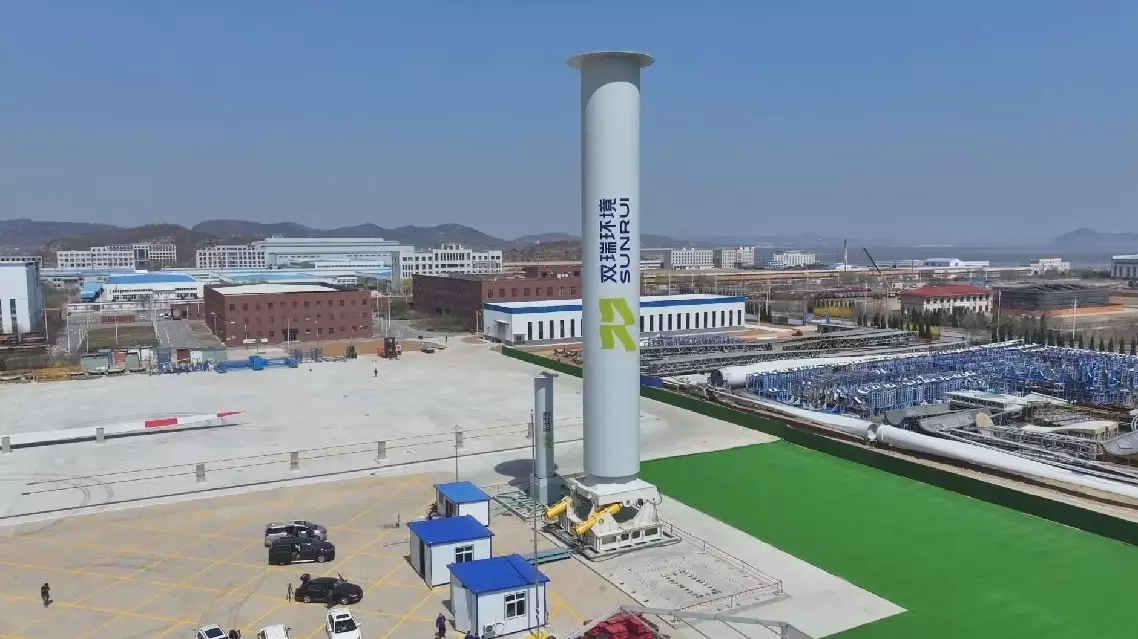
China unveils large wind-assisted propulsion system for ships