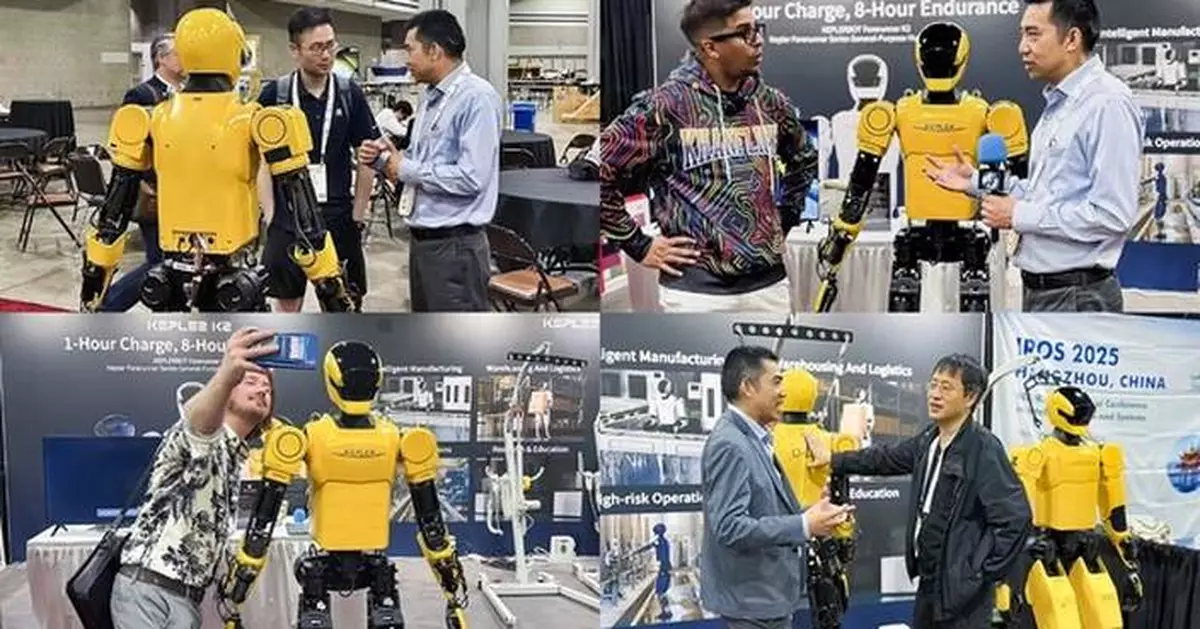
ATLANTA, June 3, 2025 /PRNewswire/ -- During the IEEE International Conference on Robotics and Automation 2025 (ICRA 2025) held in Atlanta from May 19 to 23, Shanghai Kepler Robotics Co., Ltd ("Kepler Humanoid Robot") introduced its latest industrial-grade humanoid robot, the K2 "Bumblebee," drawing global attention with a live demonstration of its real-world operational capabilities. The event brought together leading researchers, executives, and engineers from across the robotics ecosystem.
Notable visitors to the Kepler Humanoid Robot booth included Jim Fan, Senior Research Scientist at NVIDIA, and Hesheng Wang, General Chair of the International Conference on Intelligent Robots and Systems (IROS), among other robotics experts. They engaged in discussions on the trajectory of humanoid robotics and the path to scalable deployment in industrial environments.
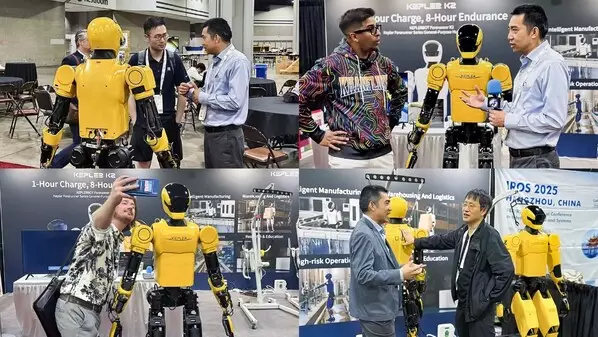
Kepler's booth quickly became a high-traffic destination at ICRA 2025. The K2 "Bumblebee" greeted attendees with natural gestures, navigated the venue with steady, autonomous mobility, and interacted fluidly with other robotic systems. Its engaging presence prompted a flurry of photos and videos, with many attendees lining up to pose with the robot.
Debo Hu, CEO of Kepler Humanoid Robot, stated, "The next major focus for the humanoid robot sector is achieving a complete commercial value loop, and industrial environments present the clearest path to near-term deployment. Our fifth-generation humanoid robots are now in limited-series production, with industrial use cases as our initial focus. Our latest round of funding reinforces our confidence in the commercial viability of our platform."
Kepler Humanoid Robot is dedicated to developing industry-leading blue-collar humanoid systems. Purpose-built for industrial settings, the K2 "Bumblebee," stands 175 cm tall, weighs 75 kg , and features 52 degrees of freedom and more than 80 integrated sensors. Its onboard compute reaches 100 TOPS, enabling it to autonomously execute task sequences in structured operational environments.
As the humanoid category moves into early-stage mass production, robots must demonstrate high payload capacity, endurance, and cost-efficiency to achieve sustainable deployment.
The K2 "Bumblebee" features Kepler's proprietary planetary roller screw actuators, engineered for smooth motion control and reduced energy draw. With near-zero static power consumption, the robot offers extended uptime. Combined with its innovative series-parallel architecture and advanced actuation system, the K2 supports payloads of 15 kg per arm and up to 30 kg with both arms. The robot delivers up to 8 hours of operational time on a single 1-hour charge. Additionally, its proprietary rotary actuators enable millimeter-level precision for fine motor tasks.
In addition, the Kepler K2 "Bumblebee" also includes Kepler's proprietary Dexterous Hands, each featuring 11 degrees of freedom, 25 force-sensing contact points per finger, and a 6-axis force/torque sensor at the wrist. These capabilities allow for advanced manipulation tasks across a range of industrial applications.
Kepler reports that over 80% of the robot's core hardware is developed and manufactured in-house—supporting vertical integration, reducing costs, and improving supply chain resilience. The base model of the K2 "Bumblebee" is priced at $30,000 and can perform the equivalent workload of approximately 1.5 full-time human workers in comparable timeframes.
Deployment flexibility is a key enabler for humanoid adoption. According to Goldman Sachs, humanoid robots are expected to begin integration into manufacturing environments between 2024 and 2027. Kepler is targeting intelligent manufacturing, warehousing and logistics, niche industries, academic research, and education as its primary markets. The company's commercialization roadmap prioritizes penetration of specific verticals before expanding into general-purpose use cases.
K2 "Bumblebee" units are currently being trialed across a range of real-world industrial scenarios. Kepler continues to expand its partnerships throughout the robotics value chain to accelerate the transition from prototyping to commercial-scale deployment.
** The press release content is from PR Newswire. Bastille Post is not involved in its creation. **
Kepler K2 "Bumblebee" Debuts at ICRA 2025, Captivating Attendees
DUBAI, UAE, Jan. 15, 2026 /PRNewswire/ -- Mantle, the high-performance distribution and liquidity layer bridging traditional finance (TradFi), real-world assets (RWAs) and on-chain liquidity, today announced the integration of Infinex, a comprehensive cross-chain DeFi aggregation platform featuring a passkey-first wallet, unified portfolio management, and integrated trading capabilities.
The deployment of Infinex on Mantle significantly enhances access to Mantle-based assets and decentralized applications, offering users a streamlined, intuitive interface to discover liquidity, manage portfolios, and execute DeFi strategies seamlessly across multiple blockchain networks.
By expanding its presence on Infinex's marketplace, Mantle continues to advance its mission of making decentralized finance (DeFi) more accessible, efficient, and scalable, further empowering developers, traders, and liquidity providers with frictionless access to a growing on-chain ecosystem.
Why This Integration Matters
Infinex aggregates liquidity from multiple protocols and simplifies advanced DeFi actions, including swaps, bridging, and yield opportunities all into a single, unified experience. This removes the need for users to navigate fragmented interfaces, making it easier to engage with Mantle-native assets and applications.
The integration strengthens Mantle's on-chain reach and interoperability, supporting broader ecosystem adoption as users increasingly seek seamless, cross-protocol access to DeFi services.
A Unified Trading Experience on Mantle
As Mantle continues to develop its modular Layer-2 ecosystem designed to unlock capital efficiency and institutional-grade utility for DeFi while making real-world finance flow seamlessly, integrations like Infinex delivers immediate, real-world value to users and partners alike.
Through Infinex, users can now discover, access, and deploy Mantle-native assets alongside a wide range of DeFi capabilities, including:
- Seamless Swaps: Executing token exchanges with optimized routing for the best available prices and minimal slippage.
- Integrated Bridging: Facilitating cross-chain asset transfers directly within the platform, removing the need for users to navigate separate, often confusing, bridging interfaces.
- Optimized Yield Opportunities: Presenting and automating access to various yield-generating strategies, including staking, lending, and liquidity provision, all from a single dashboard.
This unified experience lowers barriers to participation while enhancing liquidity flow and user engagement across Mantle's growing DeFi landscape.
Strategic Importance for Mantle's Ecosystem
The Infinex integration expands Mantle's visibility beyond its native ecosystem and facilitates deeper, more efficient liquidity flows across chains. As Mantle continues to attract a diverse range of DeFi builders, from decentralized exchanges and autonomous yield tools to AI-powered interfaces and RWA platforms, broader access through cross-chain aggregators plays a key role in driving on-chain activity, volume, and user adoption.
This milestone supports Mantle's long-term strategy to build a robust, accessible, and high-performance ecosystem that serves both sophisticated DeFi users and the next wave of mainstream participants.
About Mantle
Mantle positions itself as the premier distribution layer and gateway for institutions and TradFi to connect with on-chain liquidity and access real-world assets, powering how real-world finance flows.
With over $4B+ in community-owned assets, Mantle combines credibility, liquidity and scalability with institutional-grade infrastructure to support large-scale adoption. The ecosystem is anchored by $MNT within Bybit, and built out through core ecosystem projects like mETH, fBTC, MI4 and more. This is complemented by Mantle Network's partnerships with leading issuers and protocols such as Ethena USDe, Ondo USDY, OP-Succinct and EigenLayer.
For more information about Mantle, please visit: mantle.xyz
For more social updates, please follow: Mantle Official X & Mantle Community Channel
For media enquiries, please contact: contact@mantle.xyz
About Infinex
Infinex is a crypto superapp that combines the best aspects of multichain wallets, DEX aggregation, perps trading, and much more. Through seamless UX, support for 20+ chains and passkey technology, Infinex provides the safest and easiest way to get onchain. Follow Infinex on X, and set up an account today at Infinex.xyz
** The press release content is from PR Newswire. Bastille Post is not involved in its creation. **
Mantle Expands Global DeFi Access through Infinex Integration