Skip to Content Facebook Feature Image

Former designer decodes secrets of China's J-10 fighter jet series

China

China

China

Former designer decodes secrets of China's J-10 fighter jet series

2025-06-03 15:52 Last Updated At:19:27

A veteran former designer involved in the development of the J-10 fighter jet series has unveiled some of the secrets behind the iconic Chinese-made jet, which has recently been in the spotlight for its role in international conflicts.

The J-10 fighter jet, also dubbed "Vigorous Dragon", is a single-engine, multi-role combat aircraft using a delta wing and canard design developed by the AVIC Chengdu Aircraft Industrial (Group) Co., Ltd. The J-10CE is an improved version of the J-10, designed for export as a single-engine, single-seat, multi-role third-generation fighter jet.

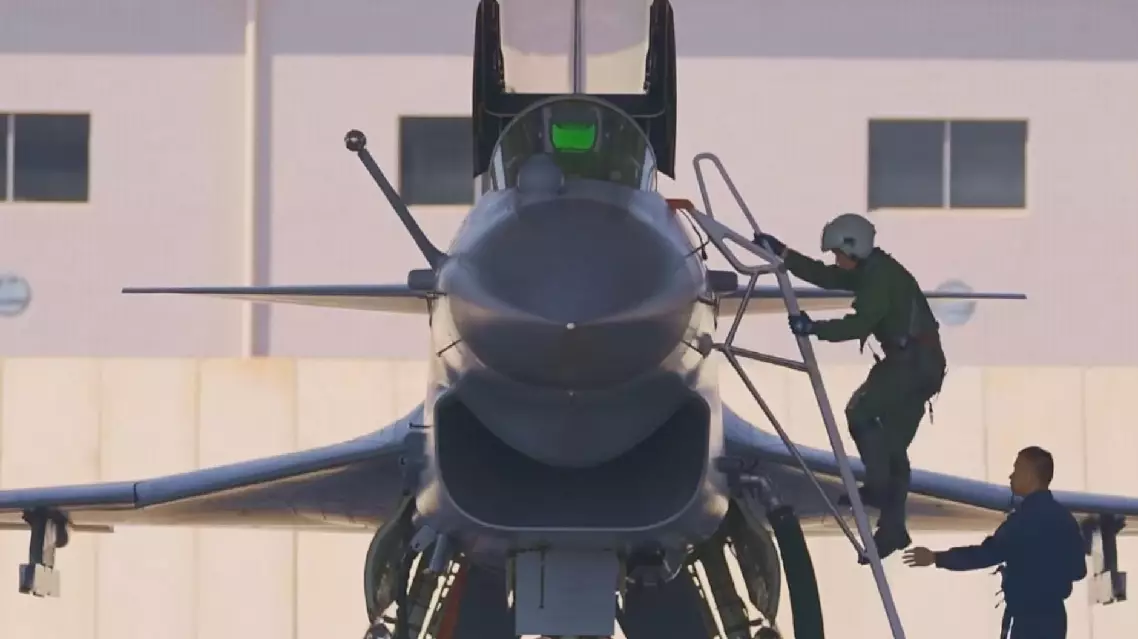
In an aircraft hangar in southwest China's Chengdu City, Xie Pin, the former deputy chief designer who was involved in the development of the J-10 fighter jet, said that the J-10CE features collaborative combat capabilities, long-range multi-target strikes, and multi-mode precision strikes against ground targets, even in strong electromagnetic interference environments.

"It's been over 40 years since development started for the J-10 series. But as you can see, it still looks so beautiful and modern. This fighter jet has a canard configuration. This is the canard wing. What's the benefit of it? When it intersects with the leading edge of the main wing, it creates a vortex, and this vortex, after passing over the upper surface of the wing, increases the airflow speed, which in turn increases its lift," said the 86-year-old designer.

Although its design dates back more than 40 years, the J-10CE remains a powerful fighter thanks to continuous technological upgrades. For example, to reduce its radar cross-section, the aircraft's cockpit has been coated with a special film. Additionally, its intake has been designed with a unique structure, further enhancing its stealth capabilities.

"This intake is called a 'clamshell' intake. The intake is located underneath the aircraft's fuselage, with a gap in the middle, allowing the low-energy boundary layer airflow to be directed into the gap and expelled. This helps reduce the aircraft's drag. The weight of this kind of intake is also light," said Xie.

Over the years, radar and weaponry systems have undergone significant improvements, enhancing the aircraft's capabilities in modern combat. These upgrades have substantially improved the aircraft's operational range and firepower, making the J-10CE a formidable force in the sky.

"In the past, the J-7 and J-8 fighters we worked on were 'nearsighted'. Why? Because they couldn't detect targets at long distances. Now, with advanced radar technology, the J-10 fighter jet can detect targets up to about 200 kilometers. Additionally, the J-10 fighter jet has 11 external hardpoints, which can carry weapons, various pods, and long-range, beyond-visual-range missiles. So it possesses formidable lethality," said Xie.
Former designer decodes secrets of China's J-10 fighter jet series
Former designer decodes secrets of China's J-10 fighter jet series
Former designer decodes secrets of China's J-10 fighter jet series

Former designer decodes secrets of China's J-10 fighter jet series
The annual number of inbound and outbound travelers passing through Hong Kong's West Kowloon Station on the Guangzhou-Shenzhen-Hong Kong Express Rail Link exceeded 30 million for the first time on Sunday, fueled by accelerated regional integration and relaxed visa policies.

The daily average number of border crossings through West Kowloon Station reached 85,000 this year, while the highest single-day figure hit 136,000, according to the Shenzhen General Station of Exit and Entry Frontier Inspection in south China's Guangdong Province.

The West Kowloon Station connects Hong Kong with 96 stations in 19 provincial-level regions on the Chinese mainland.

"We mainly want to visit the Canton Tower in Guangzhou and experience the cruise on the Pearl River," said Mr. Sun, a Hong Kong resident, at the station.

The accelerated integration is also boosting study trips between Hong Kong and Guangdong Province.

"Today we will go to Xingning in Meizhou to film our Classical Prose Recitation Competition. We hope that during this trip, students will be able to learn about the culture of our motherland," said Lin Qing, a teacher at Hong Kong's South Yuen Long Government Primary School.

"I'm really looking forward to this trip because we can learn about Guangzhou, and also about some of the development and culture of the Maritime Silk Road," said a student from Hong Kong's Tseung Kwan O Government Secondary School.

This year, nearly 1.4 million foreign tourists have made entry and exit trips via West Kowloon Station, up 24 percent year on year.

China's National Immigration Administration (NIA) in November expanded the country's 240-hour visa-free transit program to five additional ports, including West Kowloon Station on the Guangzhou-Shenzhen-Hong Kong Express Rail Link.

"We want to go to Guangzhou and to Shenzhen. Guangzhou -- we know a little bit about older culture -- and Shenzhen I know a little bit because it's a tech hub. I love tech, so I really want to see more," said a tourist from the Netherlands at West Kowloon Station.

"We are going to Huizhou, and also to Shenzhen. Yeah," said a tourist from Spain.

"Because also we are content creators about drones. I think China brands are innovating in the technology world. So it's incredible, because I love to fly drones and try new technology," another Spanish tourist said.

China's new policy introduced in November raised the total number of ports eligible for the 240-hour visa-free transit from 60 to 65.

Under the policy, travelers from 55 eligible countries who meet certain criteria can enter China through any of these ports in 24 provincial-level regions and stay for up to 240 hours, or 10 days, without a visa before heading to a third destination, according to the NIA.

HK's West Kowloon Station sees annual passenger flow exceed 30 million

HK's West Kowloon Station sees annual passenger flow exceed 30 million

Recommended Articles