GREATER NOIDA, India & EL DORADO HILLS, Calif.--(BUSINESS WIRE)--Jun 3, 2025--
This press release features multimedia. View the full release here: https://www.businesswire.com/news/home/20250602511758/en/
As enterprises fast-track AI initiatives, infrastructure costs are becoming more fragmented, unpredictable, and difficult to track and manage. Untracked usage, cost attribution gaps, shared services, and siloed billing data make it difficult to understand true cost drivers or measure returns on investment. The R Systems–Mavvrik partnership helps organizations shift from reactive tracking to proactive financial governance for measuring accountability across AI, cloud, and hybrid environments.
“As enterprises accelerate AI adoption, they’re not just managing higher infrastructure costs but also navigating a new layer of financial and operational complexity. Traditional cost models were never designed for the dynamic, GPU-intensive, and hybrid environments AI demands. This R Systems–Mavvrik partnership is about helping businesses move from reactive cost tracking to proactive financial governance, so they can scale responsibly, with clarity, control, and confidence,” said Srikara Rao, CTO, R Systems.
The joint solution combines R Systems’ Dexterity Assessment Framework with Mavvrik’s real-time cost intelligence platform to deliver actionable insights and measurable control.
Key Solution Benefits
For more details visit https://www.rsystems.com/our-partners/mavvrik/
About R Systems
R Systems is a leading digital product engineering company that designs and develops chip-to-cloud software products, platforms, and digital experiences that empower its clients to achieve higher revenues and operational efficiency. Our product mindset and engineering capabilities in Cloud, Data, AI, and CX enable us to serve key players in the high-tech industry, including ISVs, SaaS, and Internet companies, as well as product companies in telecom, media, finance, manufacturing, health and public services verticals.
R Systems uses its expertise in automation and integration including RPA and No-Code-Low-code platforms to help enterprises across these verticals achieve their OKRs.
www.rsystems.com
About Mavvrik
Mavvrik is the financial control centre for AI and hybrid infrastructure. With real-time visibility, intelligent cost attribution, and proactive guardrails, Mavvrik helps enterprises manage costs across cloud, SaaS, and on-prem environments—enabling faster decisions, improved forecasting, and sustained margin protection.

Financial Governance Solution by R Systems & Mavvrik
BISMARCK, N.D. (AP) — Federal officials on Thursday gave final approval for the Dakota Access oil pipeline to continue operating its contentious Missouri River crossing, an outcome that comes nearly a decade after boisterous protests against the project on the North Dakota prairie.
The U.S. Army Corps of Engineers’ decision to grant the key easement means the pipeline will keep operating but with added conditions for detecting leaks and monitoring groundwater, among others. The announcement brings an end to a drawn-out legal and regulatory saga stemming from the protests in 2016 and 2017, though further litigation over the pipeline is likely.
The $3.8 billion, multistate pipeline has been transporting oil since June 2017 from North Dakota’s Bakken oil field to a terminal in Illinois. The line carries about 4% of U.S. daily oil production, or roughly 540,000 barrels per day,
The Corps is “decisively putting years of delays to rest and moving out to safely execute this crossing beneath Lake Oahe," Assistant Secretary of the Army for Civil Works Adam Telle said in a statement.
The pipeline crosses the river upstream from the Standing Rock Sioux Tribe’s reservation, which straddles the Dakotas. The tribe has long opposed the pipeline, fearing a spill and contamination of its water supply. In 2016 and 2017, thousands of people camped and protested for months near the river crossing.
The protests resulted in hundreds of arrests and related criminal cases and lawsuits, some of them still ongoing, including litigation that threatens the future of the environmental group Greenpeace.
In December, the Corps released its final environmental impact statement nearly six years after a federal judge ordered a more rigorous review of the pipeline's crossing. In that document, the Corps endorsed the option to grant the easement for the crossing and keep the pipeline operating with modifications.
Those measures include enhanced leak detection and monitoring systems, expanded groundwater and surface water monitoring and third-party expert evaluation of the leak and detection systems, among others, the Corps said. The conditions also include studies of the sinking of the earth coordinated with affected tribes.
The Corps had weighed several options, including removing or abandoning the pipeline's river crossing or even rerouting it north. The agency said its decision “best balances public safety, protection of environmental resources, and leak detection and response considerations while meeting the project’s purpose and need.”
Pipeline developer Energy Transfer hailed the decision, saying the pipeline has been safely operating for nearly 10 years and is critical to the country’s energy infrastructure.
“We want to thank the Corps for the tremendous amount of time and effort put in by so many to bring this matter to a thoughtful close,” said Vicki Granado, a company spokesperson.
The Associated Press sent text messages and emails to media representatives for the tribe and left a voicemail at the tribe's headquarters. They didn't immediately respond Thursday.
North Dakota Republican Gov. Kelly Armstrong, Interior Secretary and former North Dakota governor Doug Burgum and U.S. Senators John Hoeven and Kevin Cramer each welcomed the decision to ensure the pipeline continues operating.
The Corps' announcement came as officials and oil industry leaders were gathered for a trade conference in Bismarck.
Energy Transfer and Enbridge are in early stages of a project to move about 250,000 daily barrels of light Canadian crude oil through the Dakota Access Pipeline by using another pipeline and building a 56-mile connecting line, spokespersons for the companies said. Enbridge will decide sometime in mid-2026 whether to move ahead.
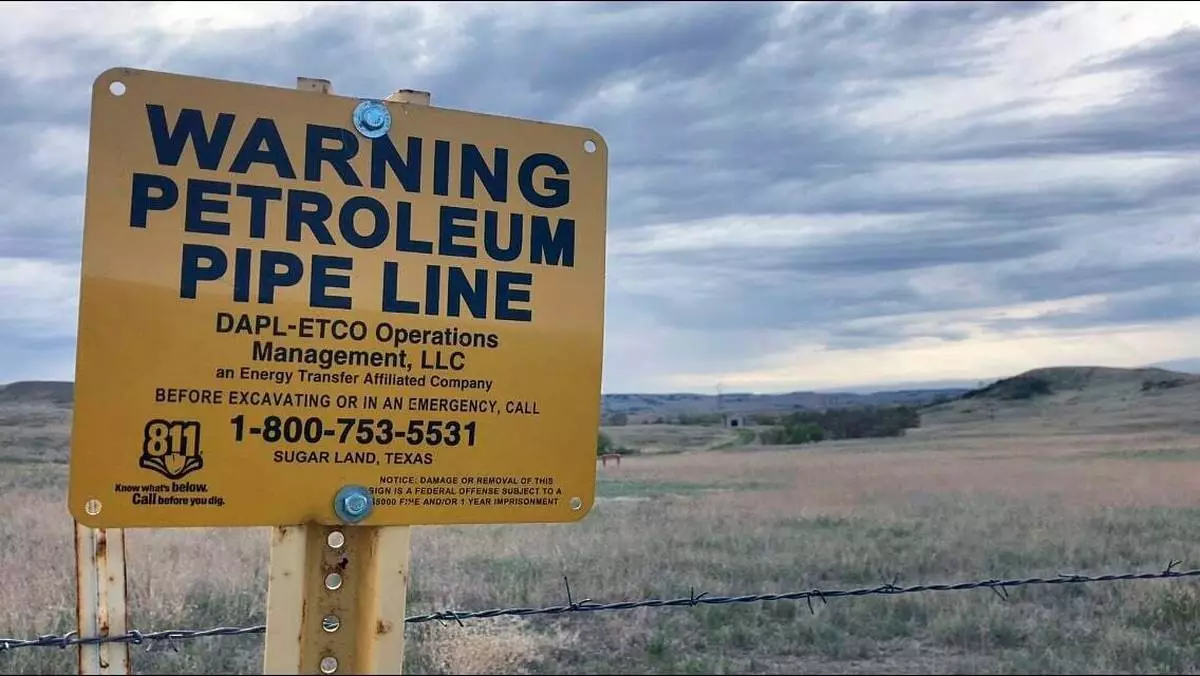
FILE - A sign for the Dakota Access Pipeline is seen north of Cannonball, N.D. and the Standing Rock Reservation on May 20, 2021. (AP Photo/Matthew Brown, File)