Meta's deal to help revive an Illinois nuclear power plant was one way of signaling that the parent company of Facebook and Instagram is preparing for a future built with artificial intelligence.
Meta's 20-year deal with Constellation Energy follows similar maneuvers from Amazon, Google and Microsoft, but it will take years before nuclear energy can meet the tech industry's insatiable demand for new sources of electricity.
AI uses vast amounts of energy, much of which comes from burning fossil fuels, which causes climate change. The unexpected popularity of generative AI products over the past few years has disrupted many tech companies' carefully laid plans to supply their technology with energy sources that don't contribute to climate change.
Even as Meta anticipates more nuclear in the future, its more immediate plans rely on natural gas. Entergy, one of the nation’s largest utility providers, has been fast-tracking plans to build gas-fired power plants in Louisiana to prepare for a massive Meta data center complex.
France has touted its ample nuclear power — which produces about 75% of the nation's electricity, the highest level in the world — as a key element in its pitch to be an AI leader. Hosting an AI summit in Paris earlier this year, French President Emmanuel Macron cited President Donald Trump’s “drill baby drill” slogan and offered another: “Here there’s no need to drill, it’s just plug baby plug.”
In the U.S., however, most of the electricity consumed by data centers relies on fossil fuels — burning natural gas and sometimes coal — according to an April report from the International Energy Agency. As AI demand rises, the main source of new supply over the coming years is expected to be from gas-fired plants, a cheap and reliable source of power but one that produces planet-warming emissions.
Renewable energy sources such as solar and wind account for about 24% of data center power in the U.S., while nuclear comprises about 15%, according to the IEA. It will take years before enough climate-friendlier power sources, including nuclear, could start slowing the expansion of fossil fuel power generation.
A report released by the U.S. Department of Energy late last year estimated that the electricity needed for data centers in the U.S. tripled over the past decade and is projected to double or triple again by 2028 when it could consume up to 12% of the nation’s electricity.
It takes a lot of computing power to make an AI chatbot and the systems they're built on, such as Meta's Llama. It starts with a process called training or pretraining — the “P” in ChatGPT — that involves AI systems “learning” from the patterns of huge troves of data. To do that, they need specialized computer chips — usually graphics processors, or GPUs — that can run many calculations at a time on a network of devices in communication with each other.
Once trained, a generative AI tool still needs electricity to do the work, such as when you ask a chatbot to compose a document or generate an image. That process is called inferencing. A trained AI model must take in new information and make inferences from what it already knows to produce a response.
All of that computing takes a lot of electricity and generates a lot of heat. To keep it cool enough to work properly, data centers need air conditioning. That can require even more electricity, so most data center operators look for other cooling techniques that usually involve pumping in water.
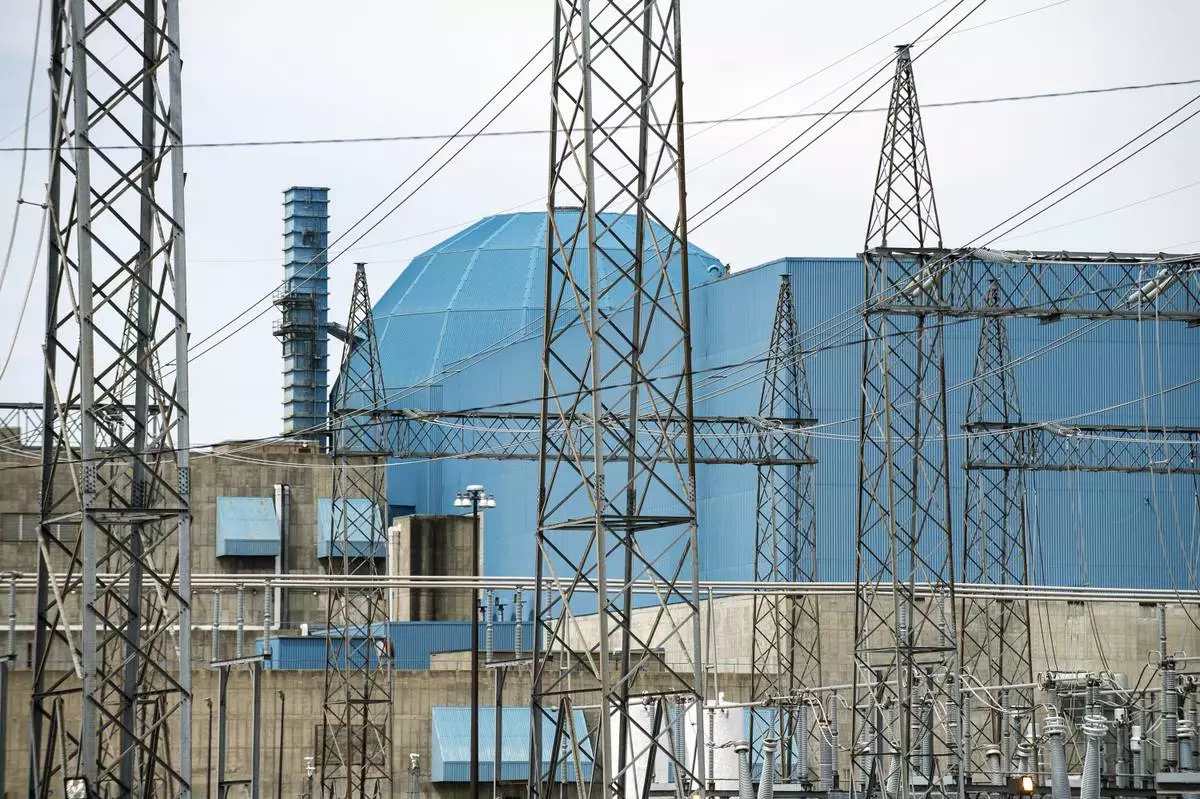
FILE - This June 2, 2016 file photo shows the Clinton Clean Energy Center in Clinton, Ill. (John Dixon/The News-Gazette via AP, File)
FILE - This combo image shows Meta's logo, top, at the company's headquarters in Menlo Park, Calif., Nov. 9, 2022 and The Constellation Energy building, Dec. 19, 2005 in a Baltimore. (AP Photo/Godofredo A. Vásquez, Gail Burton, File)
SAN FRANCISCO & JACKSONVILLE, Fla.--(BUSINESS WIRE)--Jan 12, 2026--
Abridge, the leading enterprise-grade AI for clinical conversations, is collaborating with Availity, the nation’s largest real-time health information network, to launch a first-of-its kind prior authorization experience. The engagement uses cutting-edge technology grounded in the clinician-patient conversation to facilitate a more efficient process between clinicians and health plans in medical necessity review.
This press release features multimedia. View the full release here: https://www.businesswire.com/news/home/20260112960386/en/
Rather than creating parallel AI systems across healthcare stakeholders, Abridge and Availity are working together to ensure shared clinical context at the point of conversation powers administrative processes, such as prior authorization review and submission, improving outcomes for patients and the teams delivering care.
This collaboration unites two trusted and scaled organizations: combining Abridge’s enterprise-grade AI platform, serving over 200 health systems and projected to support over 80 million patient-clinician conversations in 2026, with Availity’s next-generation, FHIR-native Intelligent Utilization Management solution, which helps payers and providers digitize and operationalize coverage requirements within administrative workflows.
Availity’s FHIR-native APIs enable fast, scalable, and secure connectivity of payer information across the entire healthcare ecosystem. With Abridge’s Contextual Reasoning Engine technology, clinicians can gain visibility into relevant clinical information during the conversation to support documentation aligned with prior authorization requirements.
“At Availity, we’ve invested in building AI-powered, FHIR-native APIs designed to bring clinical policy logic directly into provider workflows,” said Russ Thomas, CEO of Availity. “By embedding our technology at the point of conversation, we’re enabling faster, more transparent utilization management decisions rooted in clinical context. We’re excited to collaborate with Abridge and to demonstrate what’s possible when payer intelligence meets real-time provider workflows.”
The development of real-time prior authorization is just a component of a broader revenue cycle collaboration that is focused on applying real-time conversational intelligence across the patient, provider, and payer experiences. The companies intend to support integration by collaborating on workflow alignment between their respective platforms in the following areas:
“Abridge and Availity are each bringing national scale, deep trust, and a track record of solving important challenges across the care and claims experience to this partnership,” said Dr. Shiv Rao, CEO and Co-Founder of Abridge. “We’re building real-time bridges between patients, providers, and payers, unlocking shared understanding, focused at the point of conversation.”
About Availity
Availity empowers payers and providers to deliver transformative patient experiences by enabling the seamless exchange of clinical, administrative, and financial information. As the nation's largest real-time health information network, Availity develops intelligent, automated, and interoperable solutions that foster collaboration and shared value across the healthcare ecosystem. With connections to over 95% of payers, more than 3 million providers, and over 2,000 trading partners, Availity provides mission-critical connectivity to drive the future of healthcare innovation. For more information, including an online demonstration, please visit www.availity.com or call 1.800.AVAILITY (282.4548). Follow us on LinkedIn.
About Abridge
Abridge was founded in 2018 to power deeper understanding in healthcare. Abridge is now trusted by more than 200 of the largest and most complex health systems in the U.S. The enterprise-grade AI platform transforms medical conversations into clinically useful and billable documentation at the point of care, reducing administrative burden and clinician burnout while improving patient experience. With deep EHR integration, support for 28+ languages, and 50+ specialties, Abridge is used across a wide range of care settings, including outpatient, emergency department, and inpatient.
Abridge’s enterprise-grade AI platform is purpose-built for healthcare. Supported by Linked Evidence, Abridge is the only solution that maps AI-generated summaries to source data, helping clinicians quickly trust and verify the output. As a pioneer in generative AI for healthcare, Abridge is setting the industry standard for the responsible deployment of AI across health systems.
Abridge was awarded Best in KLAS 2025 for Ambient AI in addition to other accolades, including Forbes 2025 AI 50 List, TIME Best Inventions of 2024, and Fortune’s 2024 AI 50 Innovators.

Abridge and Availity Collaborate to Redefine Payer-Provider Synergy at the Point of Conversation
Abridge and Availity Collaborate to Redefine Payer-Provider Synergy at the Point of Conversation