BERKELEY, Calif.--(BUSINESS WIRE)--Mar 11, 2026--
Ambi Robotics, a leading provider of AI-powered robotics for commercial operations, today introduced AmbiVision, an AI-powered item intelligence and perception software application designed to automate complex item identification, tracking, and Cognitive optical character recognition (OCR) to support reliable downstream automation in logistics and distribution operations. AmbiVision expands Ambi’s AI Skill Suite capabilities under AmbiOS with visual intelligence built for high-speed real-world operations.
This press release features multimedia. View the full release here: https://www.businesswire.com/news/home/20260311741488/en/
AmbiVision is available as a software application within AI Skill Suite, powered by AmbiOS. The technology is already operating within existing customer deployments and AmbiVision’s high-resolution data visibility is compatible with leading vision systems, such as the DataMan 380 from Cognex.
By combining AI-powered Cognitive OCR with image-based scanning, AmbiVision interprets routing and handling from printed text and visual cues when barcode data is damaged, unreadable, or unavailable. Beyond text recognition, the system provides a comprehensive intelligence layer for automated workflows:
By integrating these advanced AI skills, AmbiVision allows automated workflows to extract critical information reliably, improving accuracy and efficiency while significantly reducing manual intervention across sorting and material handling processes.
“AmbiVision delivers the intelligence necessary to autonomously handle any item, especially where traditional machine vision fails,” said Jeff Mahler, CTO and co-founder of Ambi Robotics. “We developed AmbiVision because existing solutions were too rigid for the inconsistent labeling and varied text found in real-world distribution centers. By leveraging our 250,000 hours of production data, combined with best-in-class vision hardware, we are helping 3PLs and retailers unlock new levels of efficiency for items that were previously impossible to automate.”
In high-volume logistics and fulfillment environments, damaged or low-quality barcodes, and packages without them entirely, frequently disrupt automated workflows. When these systems fail, workers must manually intervene to read shipping labels and determine routing information, which slows operations and increases the risk of errors.
AmbiVision helps automated systems move beyond barcode dependency by leveraging high-resolution visual data to identify items, perform pose estimation, and assess dimensions and materials in real time. The system also includes advanced defect detection to identify visible damage before it moves further down the supply chain. These capabilities support a broader range of automated applications beyond simple sorting, including:
Ambi Robotics is offering a complimentary 30-day AmbiVision deployment program to demonstrate the technology in live commercial operations. Through the program, Ambi Robotics installs an AmbiVision scan tunnel directly within a participating facility and processes the operation’s live inventory for a 30-day evaluation period. At the conclusion of the deployment, Ambi Robotics delivers a detailed performance report outlining read rates, accuracy, and decode times for key identifiers such as purchase order numbers, item codes, and lot numbers. The program is offered at no cost and is limited to three participating companies at a time, selected from a growing waitlist.
“As a former executive at Walmart and UPS, I understand that technology must be proven with demonstrated ROI before it is implemented at scale,” said Jim Liefer, CEO of Ambi Robotics. “We are proving the reliability of AmbiVision on the very items that currently cause bottlenecks in our customers’ facilities. By providing this transparency and data upfront, we can demonstrate exactly how this intelligence layer will streamline their specific, real-world workflows.”
Organizations interested in participating in this one-of-a-kind program can join the waitlist to reserve their complimentary AmbiVision deployment at www.ambirobotics.com/ambivision.
About Ambi Robotics
Ambi Robotics is an artificial intelligence (AI) and robotics company developing the foundational infrastructure to automate the world’s most demanding physical operations. Powered by AmbiOS, the company’s hardware-agnostic operating system, Ambi Robotics leverages the industry’s largest repository of real-world operational data to deploy high-performance robotic systems at scale. Headquartered in Berkeley, Calif., Ambi Robotics brings together the world's leading roboticists and AI researchers to help Fortune 500 enterprises scale physical productivity through adaptable AI and industrial-grade reliability. For more information, please visit www.ambirobotics.com.
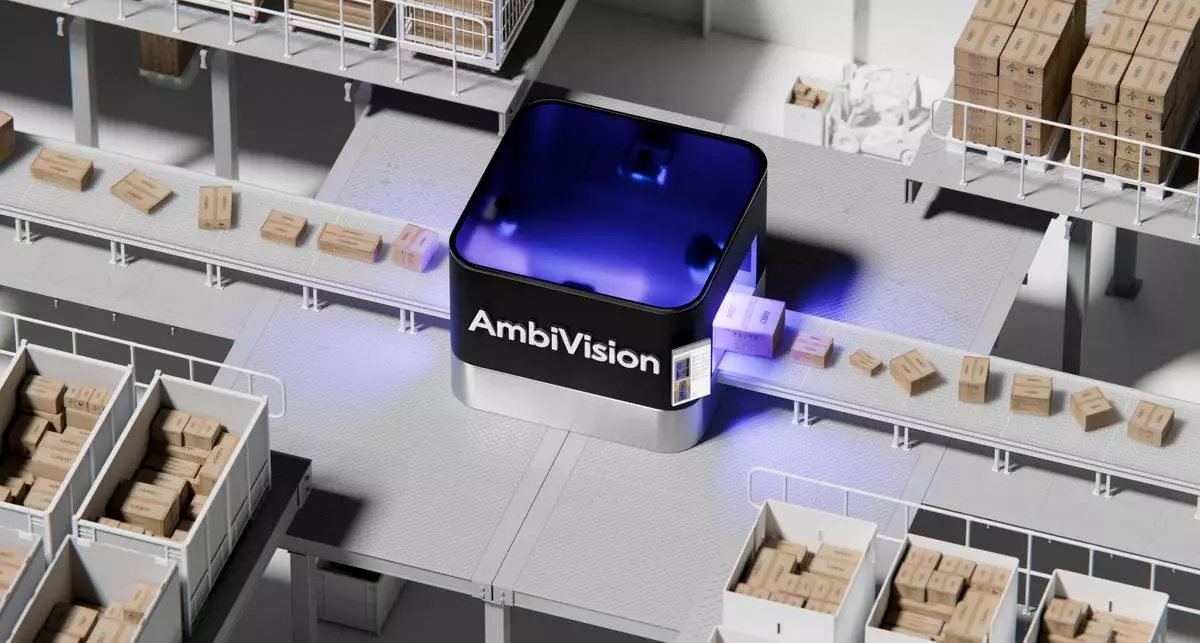
AmbiVision is a new application under AmbiOS utilizing five AI skills from Ambi's AI Skill Suite including measurement, tracking, reading, inspection, and quality control.
OKLAHOMA CITY (AP) — Shai Gilgeous-Alexander isn't scoring the way he usually does, but the Oklahoma City Thunder are still winning the way they normally do.
Gilgeous-Alexander, the reigning NBA MVP, averaged 31.1 points during the regular season. In the Western Conference semifinals against the Los Angeles Lakers, he is averaging 20 points and taking only 14 shots per game.
Oklahoma City has still won the first two games by an average of 18 points. Gilgeous-Alexander and Chet Holmgren each scored 22 points, and the defending champion Thunder beat the Lakers 125-107 on Thursday night.
Ajay Mitchell, starting in place of injured Jalen Williams, is averaging 19 points on 50% shooting in the series for Oklahoma City.
“I think the coaching staff does a good job at just getting all of us ready,” said Mitchell, a second-year guard. "And we have a lot of competitors. Like, everyone’s a competitor on our team. So every time the lights are bright, everyone’s ready to go.”
Holmgren is the leading scorer for the Thunder in the best-of-seven series with 23 points per game. The 2026 All-Star also is averaging 10.5 rebounds and 2.5 blocks.
Jared McCain, a midseason acquisition from the Philadelphia 76ers, barely played in the first round against Phoenix but has averaged 15 points and made 8 of 10 3-pointers in the series.
“He goes in there, stays in character, stays aggressive," Thunder coach Mark Daigneault said. "He’s going to shoot the next shot. He makes the right plays, plays inside the team. He competes defensively, has had good defensive possessions for us. And he was huge tonight. You need that in a playoff series.”
The Lakers again were without scoring champion Luka Doncic, who is out indefinitely with a strained left hamstring. They also were missing forward Jarred Vanderbilt, the reserve forward who dislocated the pinkie on his right hand during the second quarter of Game 1. The Lakers had three players finish with five fouls, limiting their aggressiveness late in the game.
Los Angeles guard Austin Reaves, who struggled with his shot in Game 1, scored 31 points on 10-for-16 shooting in Game 2. LeBron James, coming off a 27-point effort in Game 1, followed that up with 23.
With the Lakers up 63-61 early in the third quarter, Gilgeous-Alexander got tied up with Reaves and was called for his fourth foul. Upon review, it was upgraded to a flagrant 1 for Gilgeous-Alexander's follow through. Oklahoma City's Alex Caruso was called for a technical foul as the situation was being sorted out.
Gilgeous-Alexander left the game with the Lakers up 65-61, but the Thunder rallied and took control without him. On a fast break, Holmgren found a trailing Jaylin Williams, who hit a 3-pointer and was fouled. His free throw put the Thunder up 85-74.
The Thunder outscored the Lakers 32-15 while Gilgeous-Alexander was out in the third quarter to take a 93-80 lead into the fourth.
“It was amazing," Gilgeous-Alexander said. “They strung together stops, they’re playing the right way offensively and things are going their way. Full confidence in those guys. They know how to win basketball games. And we've proven that. They’ve proven that no matter who’s on the floor, they know how to get the job done. And they just did it again tonight."
The Lakers cut Oklahoma City's lead to five in the fourth quarter before the Thunder pulled away again.
Los Angeles will host Game 3 on Saturday.
“We just stuck with it,” Holmgren said. “It’s the game of basketball. It’s not always going to go your way. It’s about how you respond. And this team has proven many times that we know how to respond. And we did so tonight.”
This story has been corrected to show that Shai Gilgeous-Alexander is averaging 20, not 19, points per game against the Lakers.
AP NBA: https://apnews.com/hub/NBA
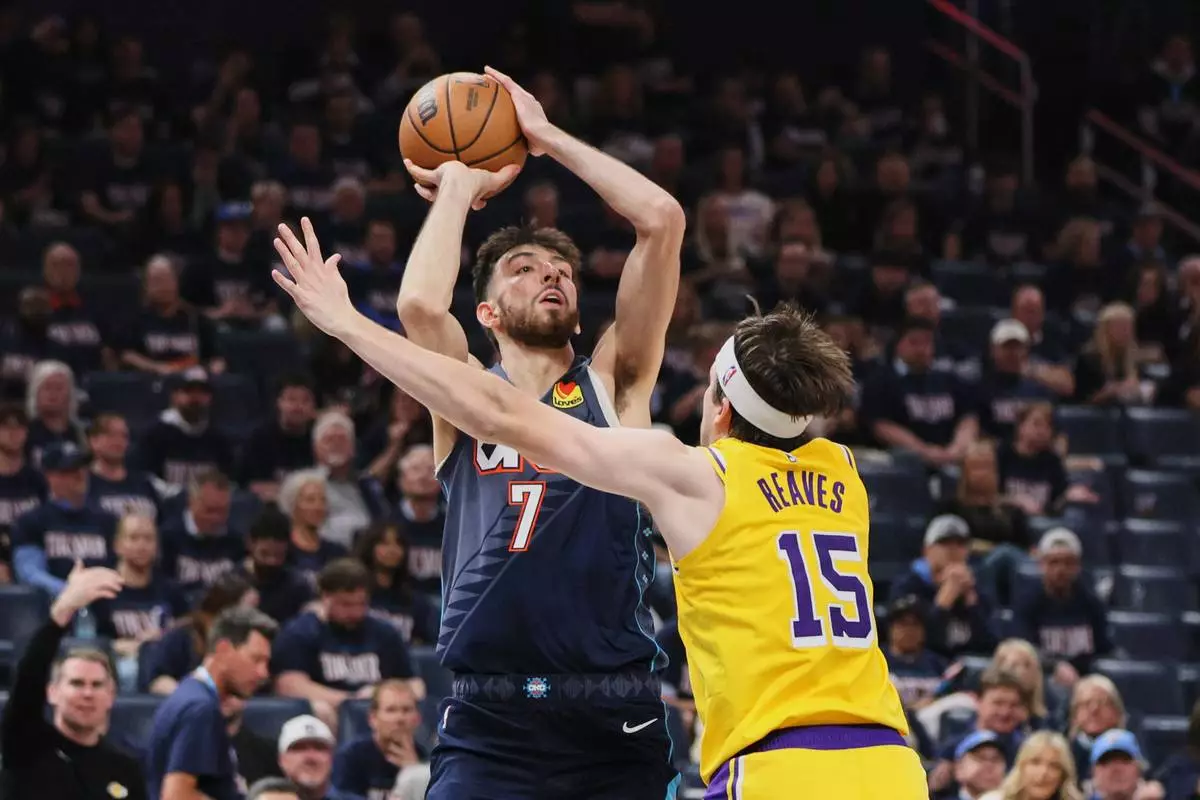
Oklahoma City Thunder's Chet Holmgren (7) shoots over Los Angeles Lakers' Austin Reaves (15) in the second half of Game 2 in a second-round NBA basketball playoffs series Thursday, May 7, 2026, in Oklahoma City. (AP Photo/Nate Billings)
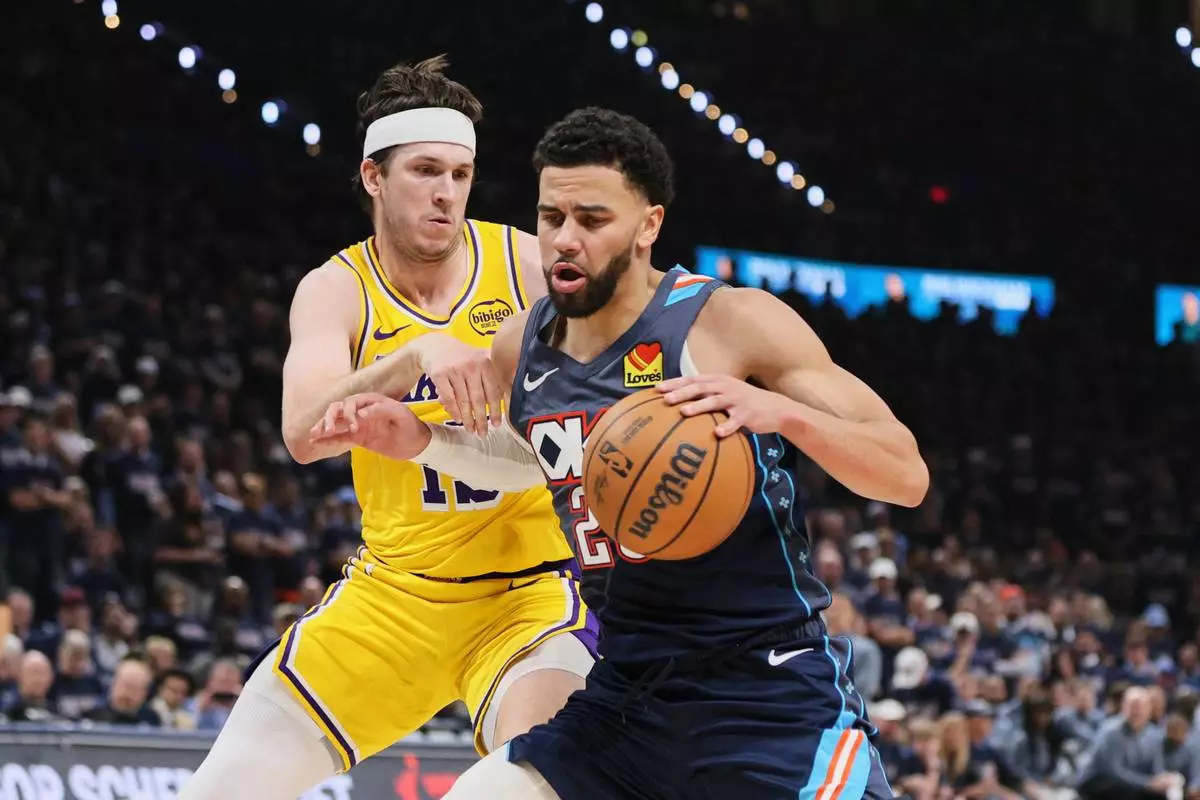
Oklahoma City Thunder guard Ajay Mitchell, front, works for a shot as Los Angeles Lakers' Austin Reaves, rear, defends in the second half of Game 2 in a second-round NBA basketball playoffs series Thursday, May 7, 2026, in Oklahoma City. (AP Photo/Nate Billings)
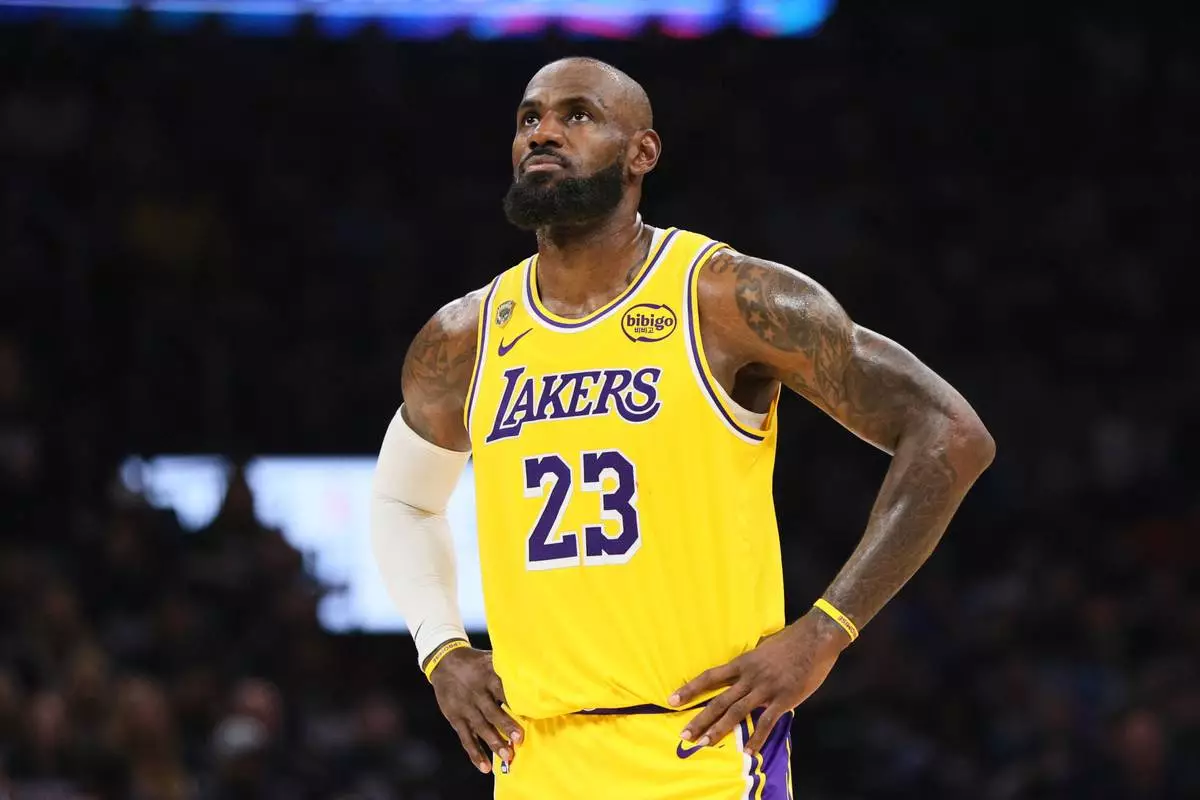
Los Angeles Lakers' LeBron James stands on the court in the second half of Game 2 in a second-round NBA basketball playoffs series against the Oklahoma City Thunder Thursday, May 7, 2026, in Oklahoma City. (AP Photo/Nate Billings)
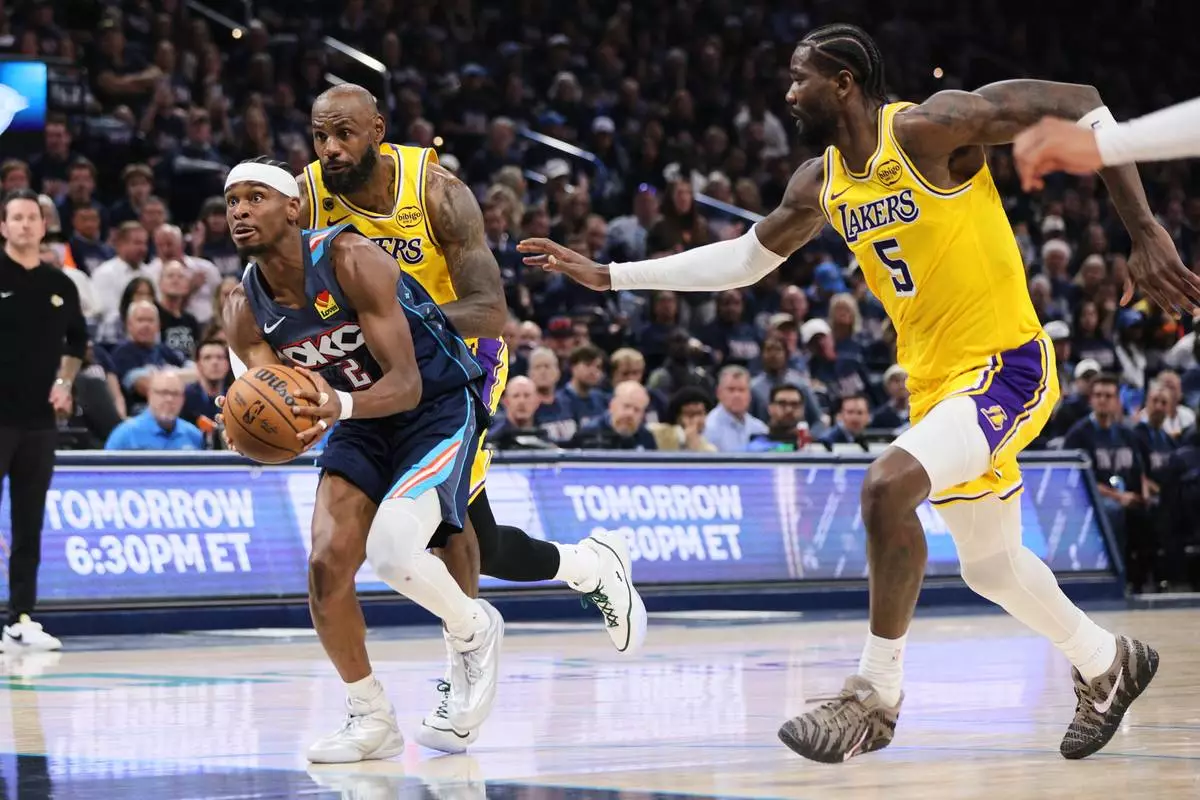
Oklahoma City Thunder guard Shai Gilgeous-Alexander (2) drives to the basket past Los Angeles Lakers' Deandre Ayton (5) and LeBron James, rear, in the second half of Game 2 in a second-round NBA basketball playoffs series Thursday, May 7, 2026, in Oklahoma City. (AP Photo/Nate Billings)
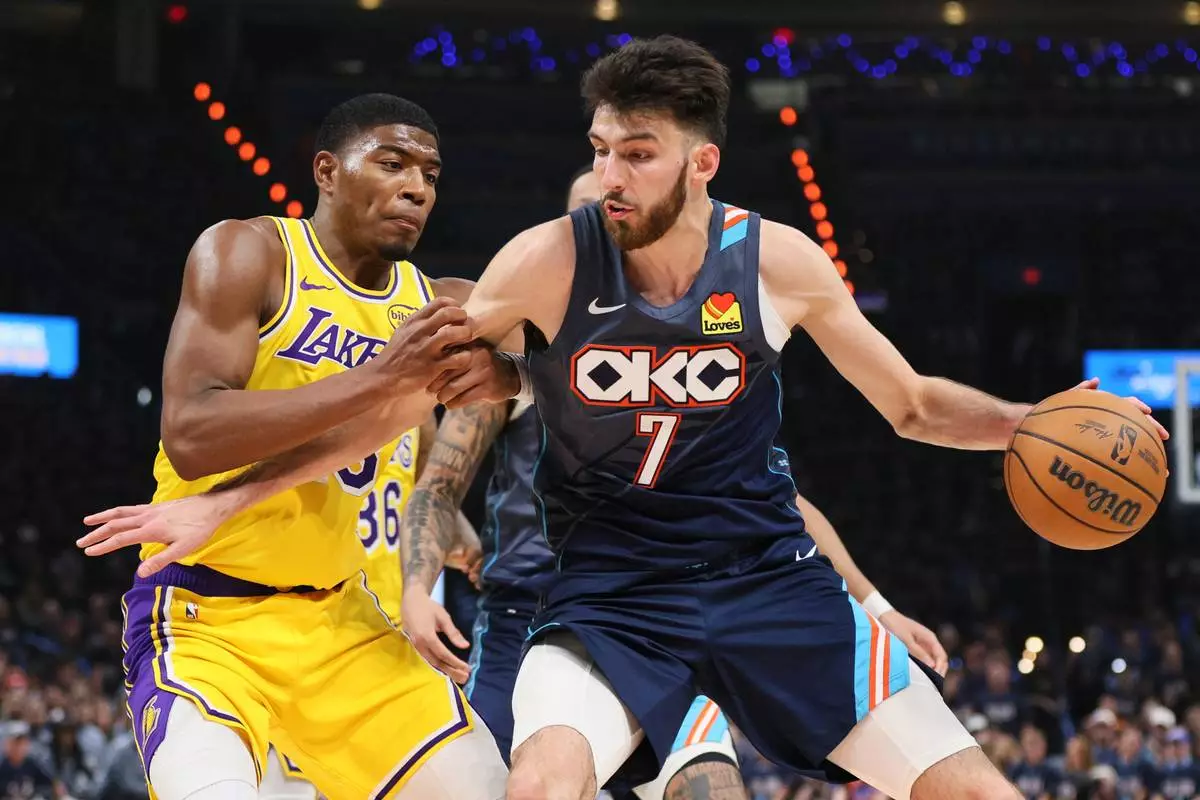
Oklahoma City Thunder center Chet Holmgren (7) works to the basket against Los Angeles Lakers forward Rui Hachimura (28) in the second half of Game 2 in a second-round NBA basketball playoffs series Thursday, May 7, 2026, in Oklahoma City. (AP Photo/Nate Billings)