NEW YORK (AP) — U.S. President Donald Trump hiked nearly all of his tariffs on steel and aluminum imports to a punishing 50% on Wednesday in a move that's set to hammer businesses from automakers to home builders, and likely push up prices for consumers even further.
Foreign-made steel and aluminum is used in household products like soup cans and paper clips, as well as big-ticket items like a stainless-steel refrigerators and cars. Economists warn that such heightened levies could significantly squeeze the wallets of both companies and shoppers alike. But Trump argues that his latest import taxes are necessary to protect U.S. industries.
The 50% tariffs went into effect just after the clock struck midnight on Wednesday. The two metals had previously faced 25% tariffs worldwide since mid-March, when Trump’s order to remove steel exemptions and raise aluminum’s levy from his previously-imposed 2018 import taxes went into effect.
Steel and aluminum from the U.K. is the exception. British imports of these metals are still levied at 25%, per a proclamation issued by Trump on Tuesday afternoon, which pointed to a recent trade deal reached between the two countries.
Here's what else we know.
Trump says it's all about protecting U.S. industries. He reiterated that argument on Friday, when he first announced the 50% tariff on imported steel during a visit with steelworkers in Pennsylvania, where he also discussed a “planned partnership” between U.S. Steel and Japan’s Nippon Steel.
In his speech at U.S. Steel’s Mon Valley Works–Irvin Plant in suburban Pittsburgh, Trump said that the tariff hike would “further secure the steel industry in the U.S.” Shortly after, he took the same tone when sharing plans to also raise tariffs on imported aluminum.
In Tuesday's proclamation, Trump also said that the higher tariffs would ensure that imported steel and aluminum would “not threaten to impair the national security."
“In my judgment, the increased tariffs will more effectively counter foreign countries that continue to offload low-priced, excess steel and aluminum in the United States,” he said in the proclamation.
While some analysts have credited the tariffs Trump imposed during his first term with strengthening domestic production of steel and aluminum, many others have warned that stark new levies can make it difficult for the industry to adjust.
Some organizations representing metal workers also note that tariffs aren't the only solution needed to boost U.S. manufacturing.
“While tariffs, used strategically, serve as a valuable tool in balancing the scales, it’s essential that we also pursue wider reforms of our global trading system," David McCall, international president of the United Steelworkers union said in a statement, noting that work must be done “in collaboration with trusted allies" like Canada — the top exporter of steel and aluminum to the U.S. — to help “contain the bad actors."
Matt Meenan, vice president of external affairs at the Aluminum Association, added that the trade group “appreciates President Trump’s continued focus on strengthening the U.S. aluminum industry,” but that “tariffs alone will not increase U.S. primary aluminum production.”
“We also need consistent, predictable trade and tariff policy to plan for current and future investment,” Meenan said.
Meanwhile, the American Primary Aluminum Association, which advocates for stronger trade enforcement, applauded Trump's latest tariff increase on foreign aluminum.
“For decades, subsidized foreign producers have hollowed out domestic aluminum manufacturing," APAA President Mark Duffy said in a statement, calling Trump a "strong leader who is fighting to rebuild domestic manufacturing and protect thousands of American aluminum jobs.”
A range of businesses that rely on foreign-made steel and aluminum have already begun feeling the impacts of Trump's previously-imposed levies. But the latest anticipated hikes could drive up costs even more.
Steel and aluminum are used in a range of products like washing machines, consumer electronics and cars. Much of the auto industry relies on a global supply chain. And even if you aren't in the market to buy a new vehicle, repairs could involve parts that use imports of either metal, driving up overall maintenance and ownership costs.
In the grocery aisle, steel and aluminum are ubiquitous in the packaging for many foods, including canned tuna, soup and nuts. Experts warn that hiking import taxes on these materials could led to higher grocery prices overall, further straining consumers wallets.
The aluminum and metal tariffs also carry wider implications for construction and transportation as a whole, as many key building parts and materials are made with these metals. Economists further warn of spillover impacts. Even if a product isn't directly packaged in steel or aluminum, there could be higher costs to build the shelf it's sold on, for example, or truck used to transport it to the store. And all of that could trickle down to the consumer down the road.
If foreign competition becomes “priced out" due to these new tariffs, U.S. steel and aluminum producers may also find room to raise their own prices. As a result, even companies that don't buy these foreign metals could end up paying more.
Steel prices have already climbed 16% since Trump became president in mid-January, according to the government’s Producer Price Index. And as of March 2025, steel cost $984 a metric ton in the U.S., significantly higher than than in Europe ($690) or China ($392), per the U.S. Commerce Department.
As part of trade deal reached on May 8, the U.K. said that the U.S. had agreed to exempt the country from its then-universal 25% duties, which would allow British steel and aluminum to come into the U.S. duty-free. That has yet to happen. But in his proclamation issued Tuesday, Trump acknowledged that it was “necessary and appropriate” to implement the deal.
The duty on British steel and aluminum will now stay at 25% instead of zero. But that rate could go up starting on July 9 if the U.S. government determines that Britain has not held up its end of the bargain, the details of which remain unclear.
British Prime Minister Keir Starmer has said that he is confident a trade deal exempting the U.K. from U.S. metals tariffs entirely will be in force before Trump’s July 9 deadline.
“We are the only country in the world that isn’t paying the 50% tax on steel and that will be coming down,” Starmer told lawmakers in the House of Commons on Wednesday. “We are working on it to bring it down to zero, that is going to happen.”
Gareth Stace, head of the industry body U.K. Steel, added that Trump’s decision to keep tariffs on British steel at 25% was a “welcome pause” but warned that continuing uncertainty was making American customers “dubious over whether they should even risk making U.K. orders.”
Other countries may also seek reprieve — or retaliation.
Late Tuesday, Mexican Secretary of Economy Marcelo Ebrard said that doubling the tariff rate on imported steel and aluminum “it is unfair and unsustainable” because it will damage both countries' economies. Ebrard added that he will be in Washington on Friday to meet with top U.S. officials and plans to present Mexico’s arguments “to be excluded from this measure, because it does not make sense.”
Meanwhile, the European Union has outlined countermeasures in response to levies imposed on aluminum and steel earlier in the year. The 27-nation bloc later delayed those actions until July 14 in efforts to ease negotiations, but recently said that was preparing a list of measures to enact if a trade deal with the U.S. crumbles.
AP Writers Jill Lawless in London, Maria Verza in Mexico City, Josh Boak and Michelle Price in Washington, D.C., contributed to this report.
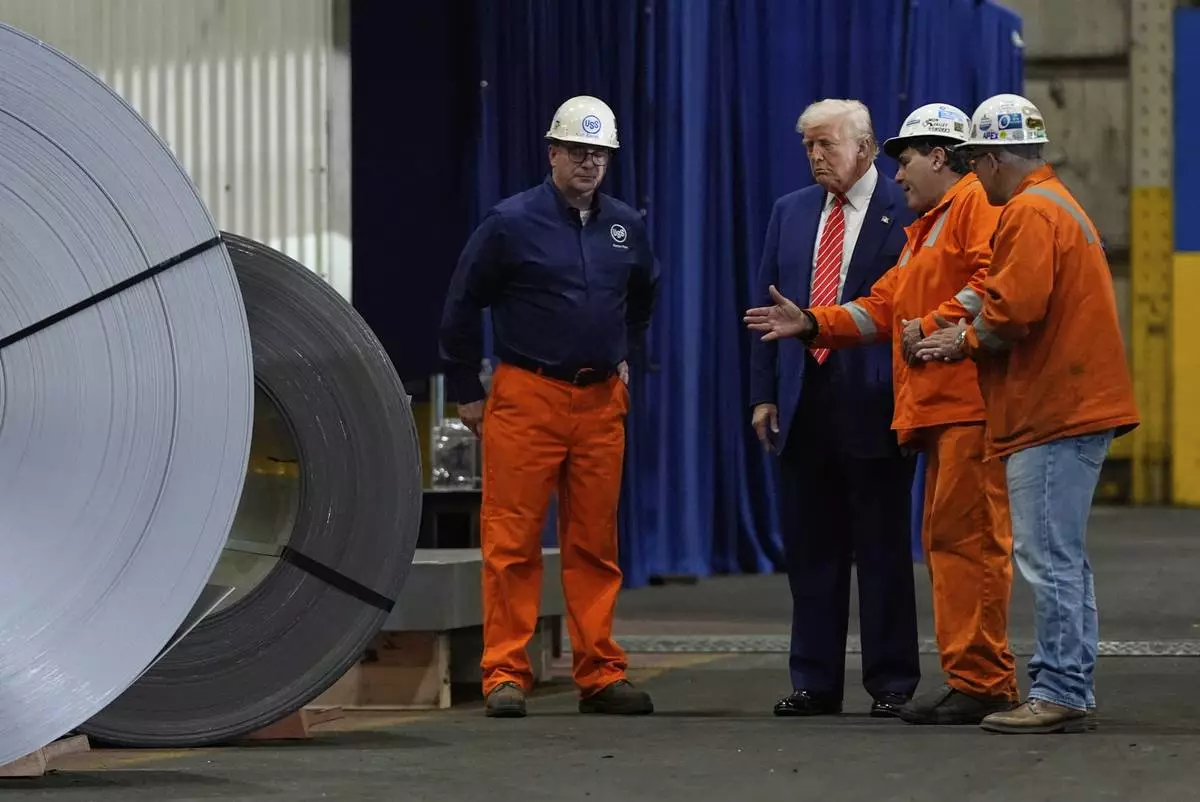
President Donald Trump talks to workers as he tours U.S. Steel Corporation's Mon Valley Works-Irvin plant, Friday, May 30, 2025, in West Mifflin, Pa. (AP Photo/Julia Demaree Nikhinson)