Skip to Content Facebook Feature Image

Gale, Part of Cengage Group, Introduces AI Leveler Tool in Beta to Personalize Learning and Support Student Reading Comprehension

News

Gale, Part of Cengage Group, Introduces AI Leveler Tool in Beta to Personalize Learning and Support Student Reading Comprehension
News

News

Gale, Part of Cengage Group, Introduces AI Leveler Tool in Beta to Personalize Learning and Support Student Reading Comprehension

2025-06-04 20:26 Last Updated At:21:02

BOSTON--(BUSINESS WIRE)--Jun 4, 2025--

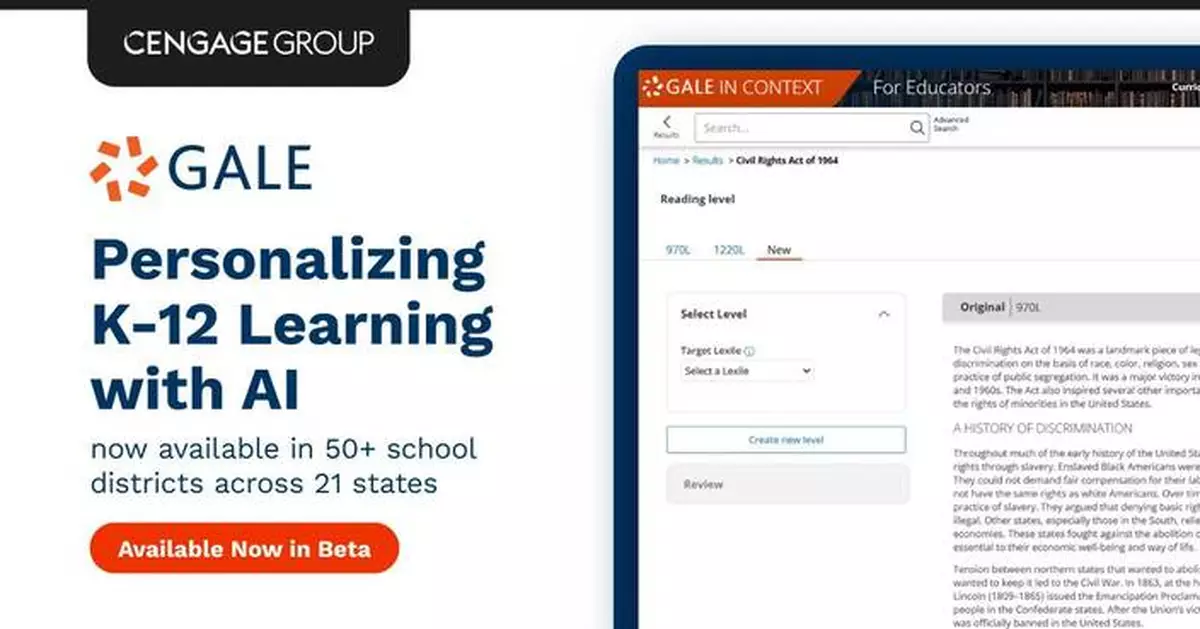
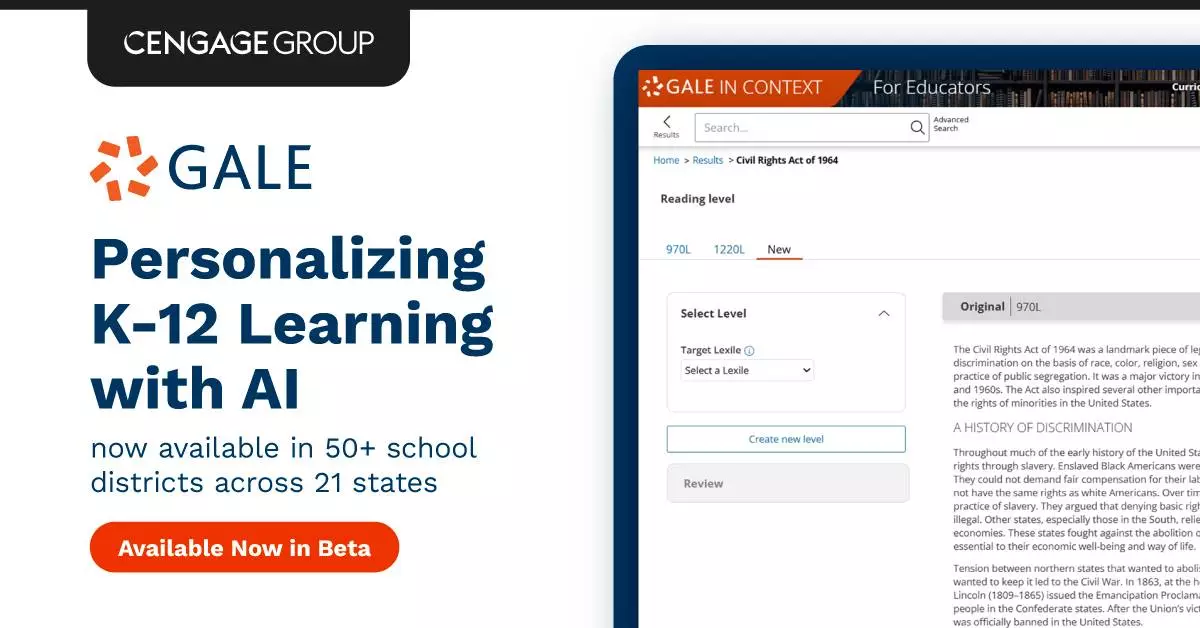
Today, Gale, part of Cengage Group, announced the launch of AI Leveler, a generative AI-powered (GenAI) tool within Gale In Context: For Educators that allows K-12 educators to adjust and personalize the reading level of instructional content for each student.

This press release features multimedia. View the full release here: https://www.businesswire.com/news/home/20250604987826/en/

AI Leveler provides a safe and convenient way for K–12 educators to efficiently adapt Gale educational resources, enabling personalized learning that improves reading comprehension. This personalization is crucial, especially as the 2024 National Assessment of Educational Progress (NAEP) reports that 1 in 3 American students fail to demonstrate basic, age-appropriate reading skills.

“Educators are at the heart of learning, and our focus is on giving them the tools they need to personalize instruction and drive student success,” said Darren Person, Chief Digital Officer at Cengage Group. “With AI Leveler, we’re enabling educators to tailor instruction at scale—especially in critical areas like reading and STEM—while maintaining full control over content quality and the classroom experience. Adjustments to reading levels can be made discreetly, respecting student privacy and allowing learners to engage with material at the level that suits them best. We developed this tool based on direct educator feedback to ensure it supports efficient, safe, and high-quality instruction tailored to individual student needs.”

AI Leveler helps educators deliver tailored scaffolding to students to address gaps in reading comprehension. This approach enables more learners to engage with grade-level concepts while building and strengthening their skills. Unlike some standalone AI tools that generate content, AI Leveler does not create instructional material. Instead, it works exclusively with trusted, authored and sourced content from Gale, helping personalize how that content is delivered. This ensures source transparency and keeps high-quality, curriculum-aligned materials at the center of the learning experience.

Key features include:

AI Leveler is part of Cengage Group’s broader commitment to advance AI and machine learning technologies to personalize learning, improve student outcomes, enhance and scale the instructor experience and, ultimately, connect education to real-world careers. It follows recent launches of Cengage’s Student Assistant,Faculty Insight Dashboard and Infosec’s Skills Navigator, all of which are AI-powered tools designed to enhance the human element of education.

“At Cengage Group, we continue to evolve learning and prioritize technologies like GenAI to reimagine what’s possible for both educators and learners,” said Person. “Improving and enhancing learning outcomes – with the help of personalized learning tools – is our main priority, and GenAI-powered enhancements, like AI Leveler, allow educators to strategically and safely personalize learning to improve reading comprehension. We want educators to feel empowered to change the trajectory of learning for each student in a safe, controlled environment, and AI Leveler is just one example of how we’re making that a reality. We look forward to introducing this product to our customers and continuing to complement their teaching efforts with tools that will help them continue making a difference in the classroom.”

Integrated directly into Gale In Context: For Educators, the tool allows educators to save and assign this adapted content through platforms such as Google Classroom, Canvas and Schoology. The AI Leveler beta release also leverages AI techniques to strengthen the “Find Resources by Standard” tool to provide better alignment between standards and content.

Gale In Context: For Educators is an award-winning instructional tool developed by curriculum experts that merges current, relevant, standards-aligned content with rich lesson plans.

For more information about Gale and its new AI Leveler tool, visit the product webpage.

About Cengage Group
Cengage Group, a global education technology company serving millions of learners, provides affordable, quality digital products and services that equip students with the skills and competencies needed to be job ready. For more than 100 years, we have enabled the power and joy of learning with trusted, engaging content, and now, integrated digital platforms. We serve the higher education, workforce skills, secondary education, English language teaching and research markets worldwide. Through our scalable technology, including MindTap and Cengage Unlimited, we support all learners who seek to improve their lives and achieve their dreams through education. Visit us at www.cengagegroup.com or find us on LinkedIn or X.

About Gale
Gale, part of Cengage Group, believes in the power and joy of learning. For schools, the company helps drive positive outcomes by providing essential, curriculum-aligned content that empowers educators to solve curriculum challenges and meet students where they are. Gale’s K-12 offerings extend from educational databases and custom eBook collections to instructional tools and professional development resources. For more information, please visit: www.gale.com/schools.

Follow Gale on:
Gale, Part of Cengage Group, Introduces AI Leveler Tool in Beta to Personalize Learning and Support Student Reading Comprehension


Gale, Part of Cengage Group, Introduces AI Leveler Tool in Beta to Personalize Learning and Support Student Reading Comprehension

CAIRO (AP) — Iranians began to regain internet access on Wednesday after authorities ended a monthslong shutdown. But users said service was slow and spotty in some areas, with apps like YouTube and Instagram heavily restricted, as they were before the cutoff began during nationwide protests in January.

Authorities justified the outage as a military imperative after the United States and Israel attacked Iran on Feb. 28. Their decision to lift some restrictions this week came as negotiators appeared to be closing in on a more permanent truce. But many Iranians feared access could be cut off again at a moment's notice.

Internet tracking company Netblocks said Iran’s connectivity, which measures the ability of devices to connect to the internet, is at around 86% of capacity from before the cutoff. Internet analysis firm Kentik said internet traffic, which measures the amount of data transferred and is a good illustration of usage, was at around 40%.

Amir Rashidi, an Iranian cybersecurity analyst, said there were still widespread disruptions. “It's too early to say the shutdown is over,” he wrote on X.

Iran’s roughly 90 million people have been cut off from the internet for most of 2026, one of the world’s longest and strictest national shutdowns. Young people with online careers saw their incomes evaporate. Job losses and the closure of online businesses added to the war's steep economic costs.

The cutoff made it difficult for Iranian families to communicate through months of unrest and war. At some points, phone lines were also cut off, though they were later restored.

A woman living in Tehran said that for months she was barely able to speak to her sons living abroad. She couldn't believe authorities had restored access, saying she had assumed they would find some justification to prolong the outage.

A taxi driver said service was restored but weak. He expressed hope it would improve so he could use messaging apps with family and friends. Both spoke on condition of anonymity for security reasons.

Prices spiked during the shutdown, with residents in Tehran at times paying around $7.50 per gigabyte. Prices are back down to around $2.25 for 30 gigabytes, roughly where they were before the protests.

Even then, Iran tightly controlled access to popular social media sites, leading many to rely on virtual private networks, or VPNs. The cost of those workarounds soared during the shutdown, making them unaffordable for many as the economy was battered.

Businesses have started reappearing online, announcing their return with posts on sites like Instagram and Telegram.

A gamer and tech influencer in the central city of Isfahan said the shutdown had caused him to lose a lot of his audience on YouTube and Instagram, where he had spent years building up a large following.

“All my views and interactions are way down. I’ve been erased from the algorithm,” he said in a voice note sent by WhatsApp, adding that his internet connection was still slower than before the shutdown.

“The situation is such that many content producers have had their income reduced to zero, have moved on to other jobs, or have been forced to sell their equipment to survive,” he said. He spoke on condition of anonymity for fear of reprisal.

Iranian authorities first shut down the internet in January during mass anti-government protests that were eventually stamped out in a violent crackdown. Thousands of people were killed and tens of thousands detained.

That cutoff was just starting to ease when the government imposed a complete internet blackout after the start of the war, when U.S. and Israeli strikes killed Iran's supreme leader and other top officials.

The government faced criticism for the prolonged shutdown, which caused even more harm to an economy devastated by inflation, strikes on key industries and a U.S. blockade on Iranian ports.

The internet cutoff cost an estimated $30-40 million daily, with indirect losses likely twice that much, a member of Iran’s Chamber of Commerce, Afshin Kolahi, told a local newspaper last month. About 10 million people have jobs that depend on internet connectivity, according to Communications Minister Sattar Hashemi.

Iranians still had access to a national net, but that has a far narrower reach, and users complained of poor service and heavy censorship. Senior government officials are given SIM cards granting them access to the global internet. Under pressure, the government expanded access to the SIM cards to some professions during the shutdown.

A woman checks her smartphone while sitting on a bench along a sidewalk in northern Tehran, Iran, Tuesday, May 26, 2026. (AP Photo/Vahid Salemi)

A woman checks her smartphone while sitting on a bench along a sidewalk in northern Tehran, Iran, Tuesday, May 26, 2026. (AP Photo/Vahid Salemi)

Recommended Articles