Skip to Content Facebook Feature Image

NATO is on the cusp of accepting Trump's 5% defense investment demand, Rutte says

News

NATO is on the cusp of accepting Trump's 5% defense investment demand, Rutte says
News

News

NATO is on the cusp of accepting Trump's 5% defense investment demand, Rutte says

2025-06-06 09:52 Last Updated At:10:00

BRUSSELS (AP) — Most U.S. allies at NATO endorse President Donald Trump’s demand that they invest 5% of gross domestic product on their defense needs and are ready to ramp up security spending even more, NATO Secretary-General Mark Rutte said Thursday.

“There’s broad support,” Rutte told reporters after chairing a meeting of NATO defense ministers at the alliance’s Brussels headquarters. “We are really close,” he said, and added that he has “total confidence that we will get there” by the next NATO summit in three weeks.

More Images
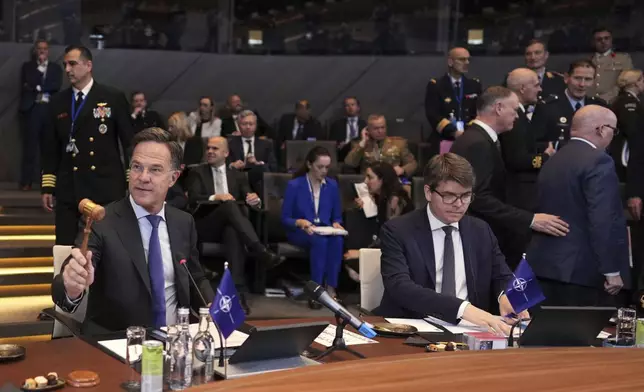
NATO Secretary General Mark Rutte, left, bangs a gavel to signify the start of a meeting of NATO defense ministers at NATO headquarters in Brussels, Thursday, June 5, 2025. (AP Photo/Virginia Mayo)
NATO Secretary General Mark Rutte, left, bangs a gavel to signify the start of a meeting of NATO defense ministers at NATO headquarters in Brussels, Thursday, June 5, 2025. (AP Photo/Virginia Mayo)
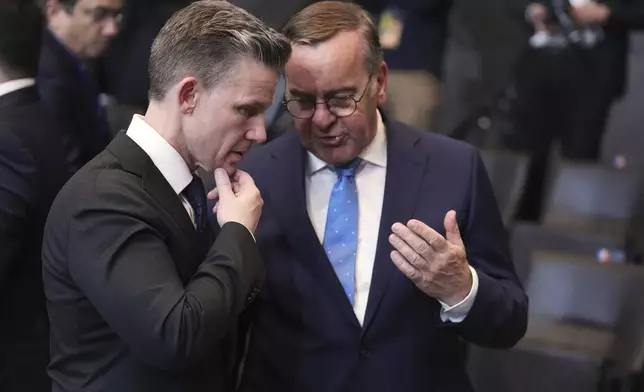
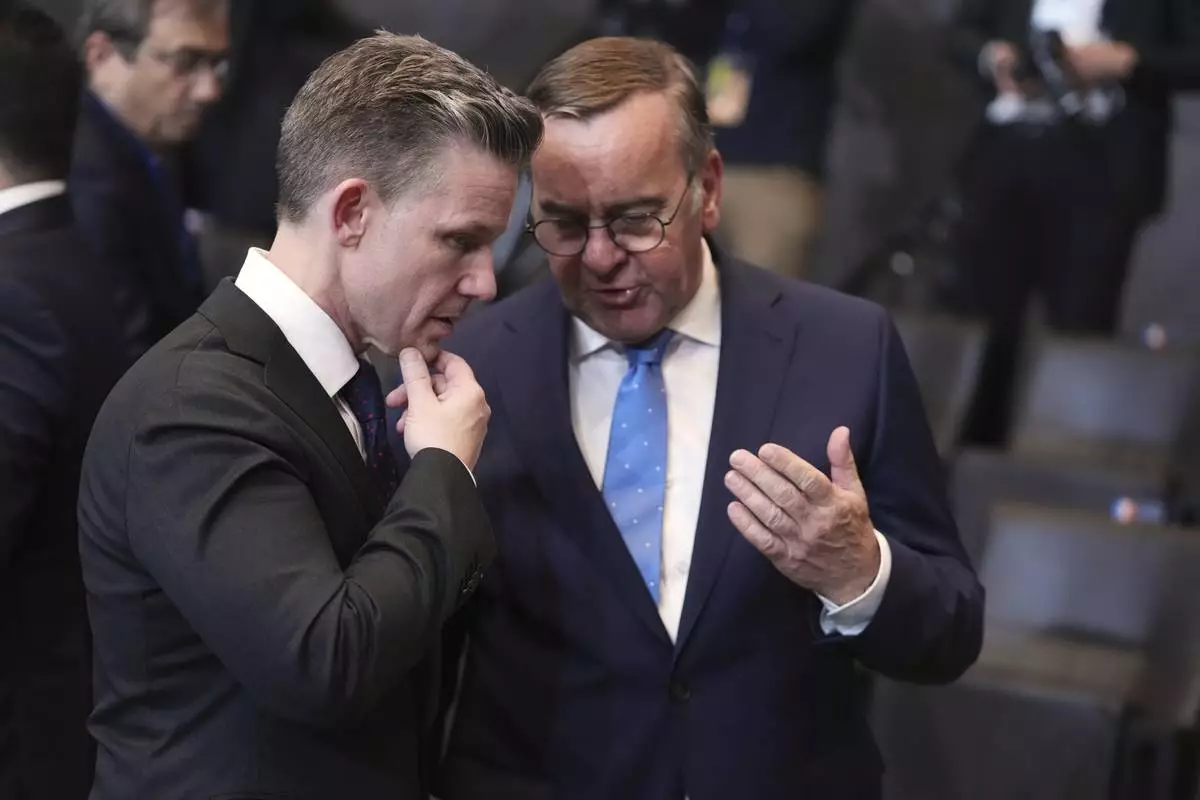
Germany's Defense Minister Boris Pistorius, right, speaks with Sweden's Defense Minister Pal Jonson during a meeting of NATO defense ministers at NATO headquarters in Brussels, Thursday, June 5, 2025. (AP Photo/Virginia Mayo)
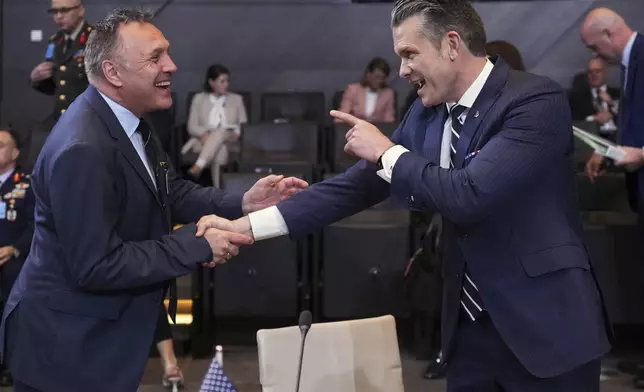
Germany's Defense Minister Boris Pistorius, right, speaks with Sweden's Defense Minister Pal Jonson during a meeting of NATO defense ministers at NATO headquarters in Brussels, Thursday, June 5, 2025. (AP Photo/Virginia Mayo)
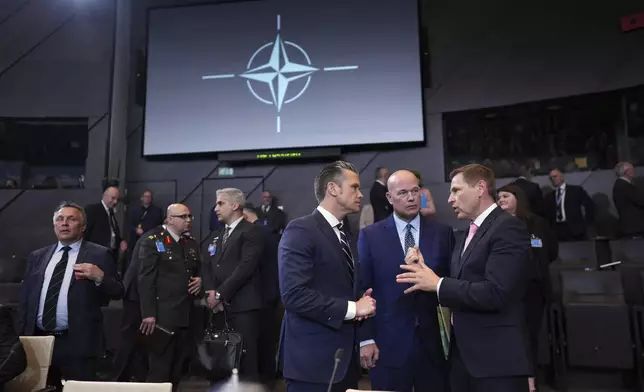
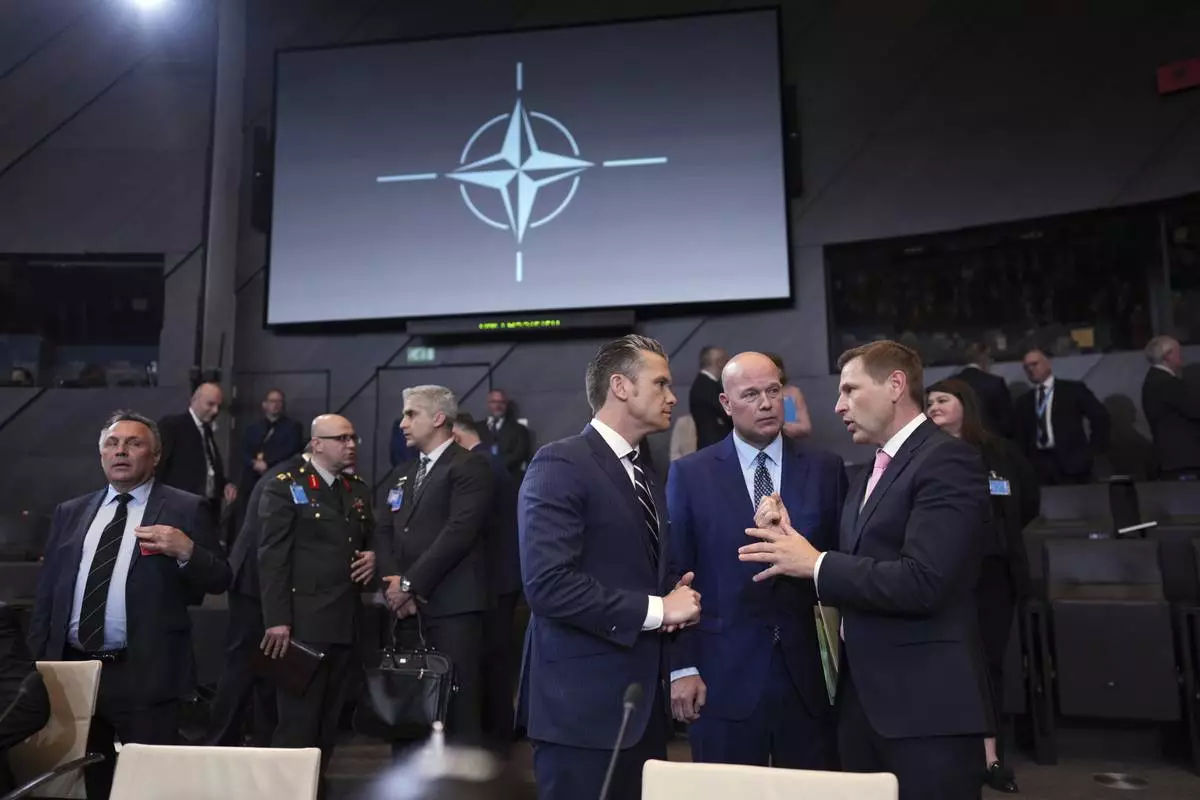
Defense Secretary Pete Hegseth, center, speaks with Estonia's Defense Minister Hanno Pevkur, right, during a meeting of NATO defense ministers at NATO headquarters in Brussels, Thursday, June 5, 2025. (AP Photo/Virginia Mayo)

Defense Secretary Pete Hegseth, center, speaks with Estonia's Defense Minister Hanno Pevkur, right, during a meeting of NATO defense ministers at NATO headquarters in Brussels, Thursday, June 5, 2025. (AP Photo/Virginia Mayo)

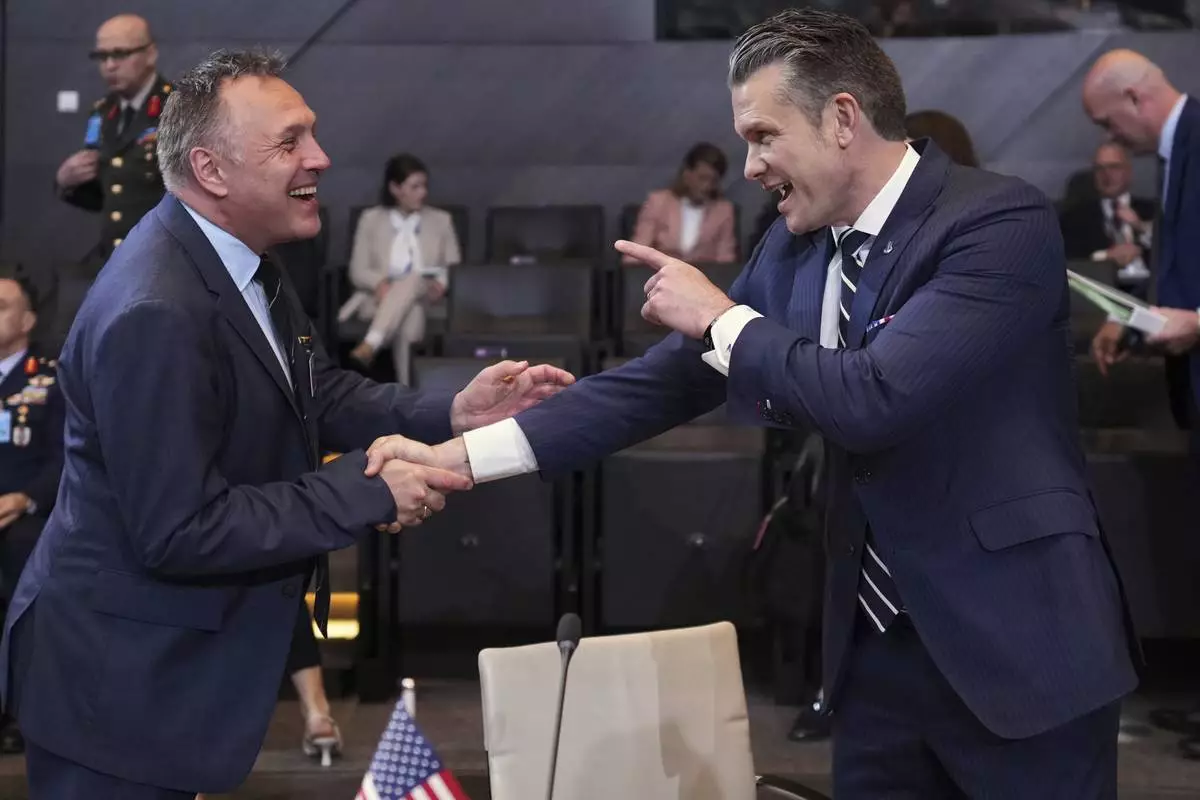
Defense Secretary Pete Hegseth, right, speaks with Norway's Defense Minister Tore Sandvik during a meeting of NATO defense ministers at NATO headquarters in Brussels, Thursday, June 5, 2025. (AP Photo/Virginia Mayo)

Defense Secretary Pete Hegseth, right, speaks with Norway's Defense Minister Tore Sandvik during a meeting of NATO defense ministers at NATO headquarters in Brussels, Thursday, June 5, 2025. (AP Photo/Virginia Mayo)

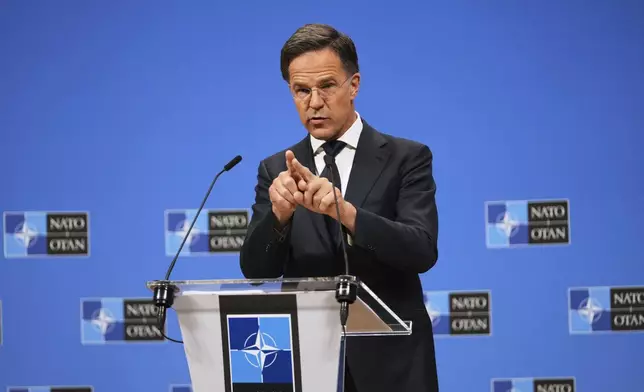
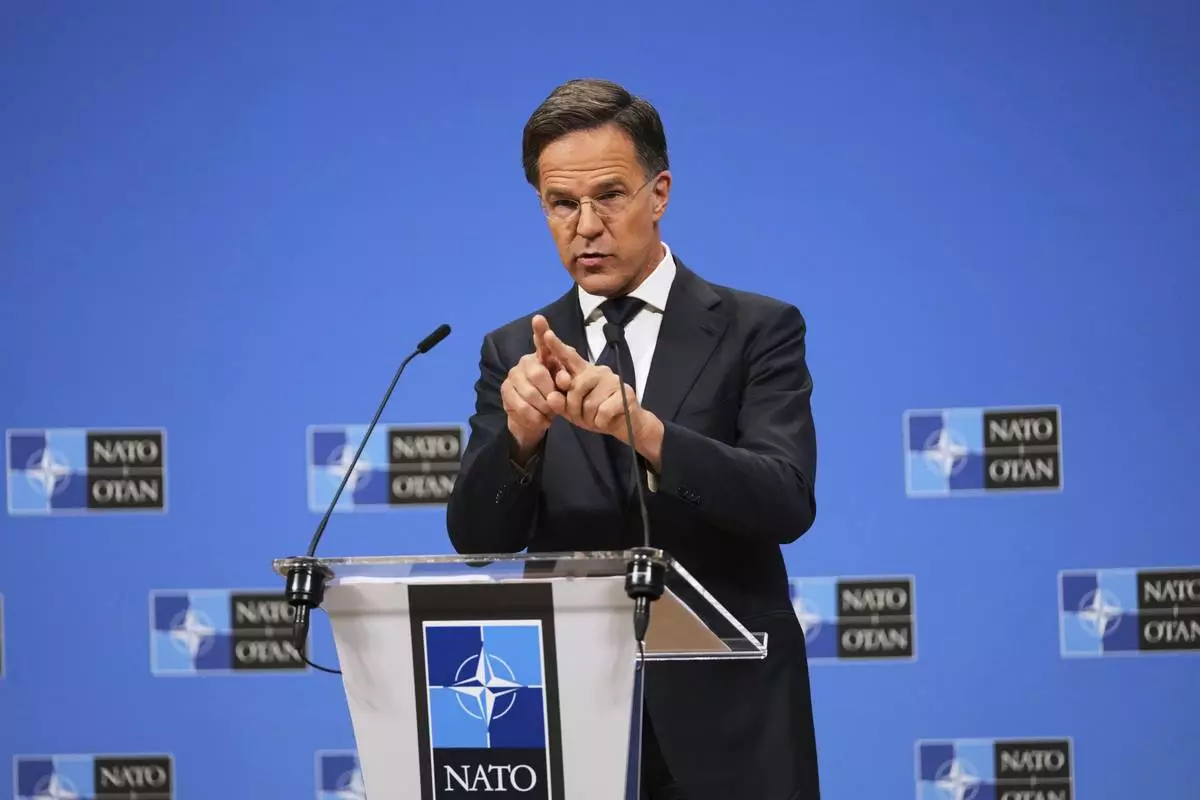
NATO Secretary General Mark Rutte speaks during a media conference prior to a meeting of the Ukraine Defense Contact Group at the NATO headquarters in Brussels, Wednesday, June 4, 2025. (AP Photo/Virginia Mayo)
NATO Secretary General Mark Rutte speaks during a media conference prior to a meeting of the Ukraine Defense Contact Group at the NATO headquarters in Brussels, Wednesday, June 4, 2025. (AP Photo/Virginia Mayo)

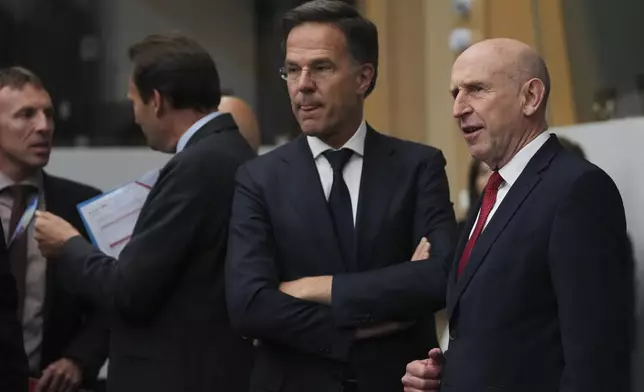
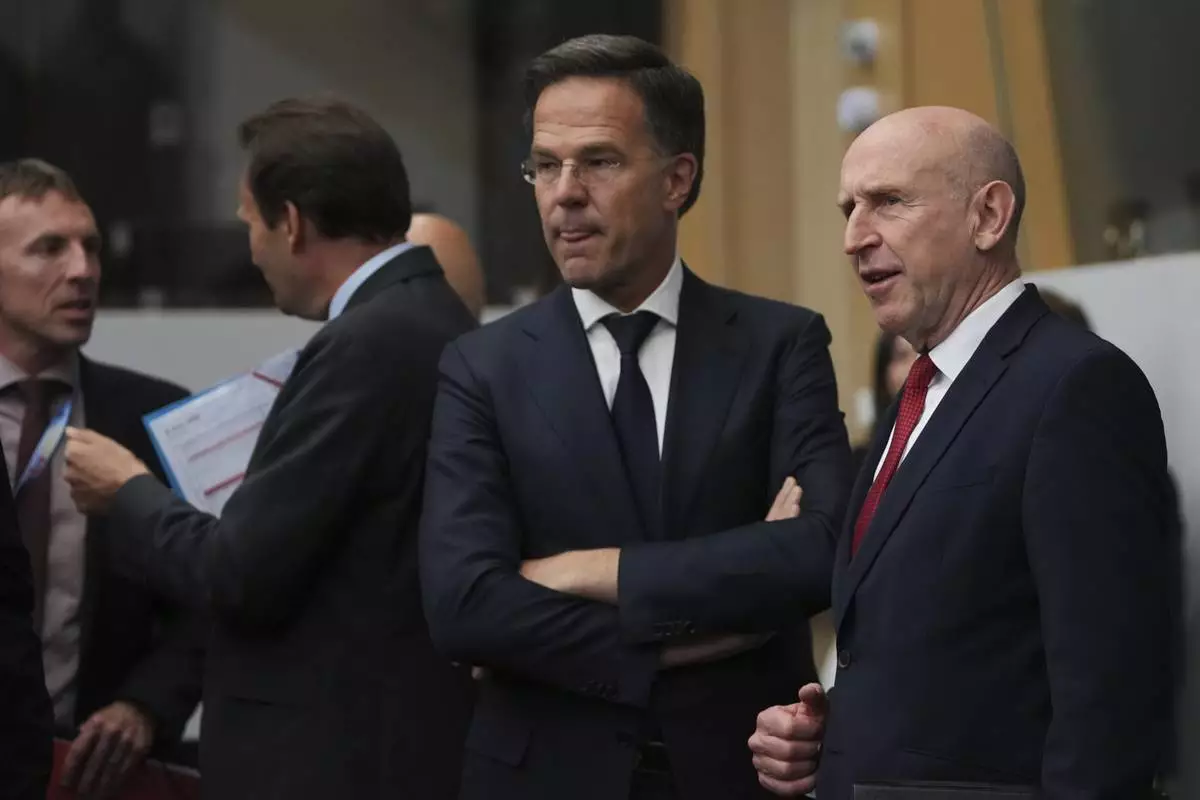
Britain's Defense Secretary John Healey, right, speaks with NATO Secretary General Mark Rutte, center, during a meeting of the Ukraine Defense Contact Group at the NATO headquarters in Brussels, Wednesday, June 4, 2025. (AP Photo/Virginia Mayo)

Britain's Defense Secretary John Healey, right, speaks with NATO Secretary General Mark Rutte, center, during a meeting of the Ukraine Defense Contact Group at the NATO headquarters in Brussels, Wednesday, June 4, 2025. (AP Photo/Virginia Mayo)

Defense Secretary Pete Hegseth, third right, arrives for a meeting of NATO defense ministers at NATO headquarters in Brussels, Thursday, June 5, 2025. (AP Photo/Virginia Mayo)

Defense Secretary Pete Hegseth, third right, arrives for a meeting of NATO defense ministers at NATO headquarters in Brussels, Thursday, June 5, 2025. (AP Photo/Virginia Mayo)

European allies and Canada have already been investing heavily in their armed forces, as well as on weapons and ammunition, since Russia launched a full-scale invasion of Ukraine in 2022.

At the same time, some have balked at U.S. demands to invest 5% of GDP on defense — 3.5% on core military spending and 1.5% on the roads, bridges, airfields and sea ports needed to deploy armies more quickly.

In 2023, as Russia’s full-scale war on Ukraine entered its second year, NATO leaders agreed to spend at least 2% of GDP on national defense budgets. So far, 22 of the 32 member countries have done so, and others still struggle to do so.

Trump and his NATO counterparts appear likely to endorse the new goal at a summit in The Hague on June 24-25. Trump insists that U.S. allies should spend at least 5% so America can focus on security priorities elsewhere, mostly in the Indo-Pacific and its own borders.

He has gained important leverage over the other NATO countries by casting doubt over whether the United States would defend allies that spend too little. At the same time, Trump has imposed tariffs on ally and foe alike, citing U.S. security concerns.

The new goal would involve a 1.5% increase over the current 2% goal for defense budgets. It means that all 32 countries would be investing the same percentage.

The United States spends by far more than any other ally in dollar terms.

But according to NATO’s most recent figures, it was estimated to have spent 3.19% of GDP in 2024, down from 3.68% a decade ago. It’s the only ally whose spending has dropped since 2014.

While the two new figures do add up to 5%, factoring in improvements to civilian infrastructure so that armies can deploy more quickly significantly changes the basis on which NATO traditionally calculates defense spending.

The seven-year time frame is also short by the alliance’s usual standards. The far more modest 2% target – set after Russia annexed Ukraine’s Crimean Peninsula in 2014 – was meant to be reached over a decade.

According to U.S. Defense Secretary Pete Hegseth, Trump has done nothing less than save NATO.

He told reporters that European allies around the table on Thursday had said: “We hear you. We all need increased capabilities. We all need to spend more. Thank you, President Trump, for reviving this alliance. It was an alliance that was sleepwalking to irrelevance.”

The extra spending will also be needed should the Trump administration announce a force draw down in Europe, where around 84,000 U.S. troops are based, leaving European allies to plug any security gaps.

Asked what the Pentagon’s plans are, Hegseth did not explain but he said: “It would only be responsible for the United States to continually assess our force posture, which is precisely what we’ve done.”

“America can’t be everywhere all the time, nor should we be, and so there are reasons why we have troops in certain places,” he said, offering the assurance that any review would be done “alongside our allies and partners to make sure it’s the right size.”

During the meeting, Hegseth and his defense counterparts also approved purchasing targets for stocking up on weapons and military equipment to better defend Europe, the Arctic and the North Atlantic, as part of the U.S. push to ramp up security spending.

The “capability targets” lay out goals for each of the 32 nations to purchase priority equipment like air defense systems, long-range missiles, artillery, ammunition, drones and “strategic enablers” such as air-to-air refueling, heavy air transport and logistics. Each nation’s plan is classified, so details are scarce.

The new targets are assigned by NATO based on a blueprint agreed upon in 2023 — the military organization’s biggest planning shakeup since the Cold War — to defend its territory from an attack by Russia or another major adversary.

Under those plans, NATO would aim to have up to 300,000 troops ready to move to its eastern flank within 30 days, although experts suggest the allies would struggle to muster those kinds of numbers.

The member countries are assigned roles in defending NATO territory across three major zones — the high north and Atlantic area, a zone north of the Alps, and another in southern Europe.

NATO planners believe that the targets must be met within 5-10 years, given the speed at which Russia is building its armed forces now, and which would accelerate were any peace agreement reached to end its war on Ukraine.
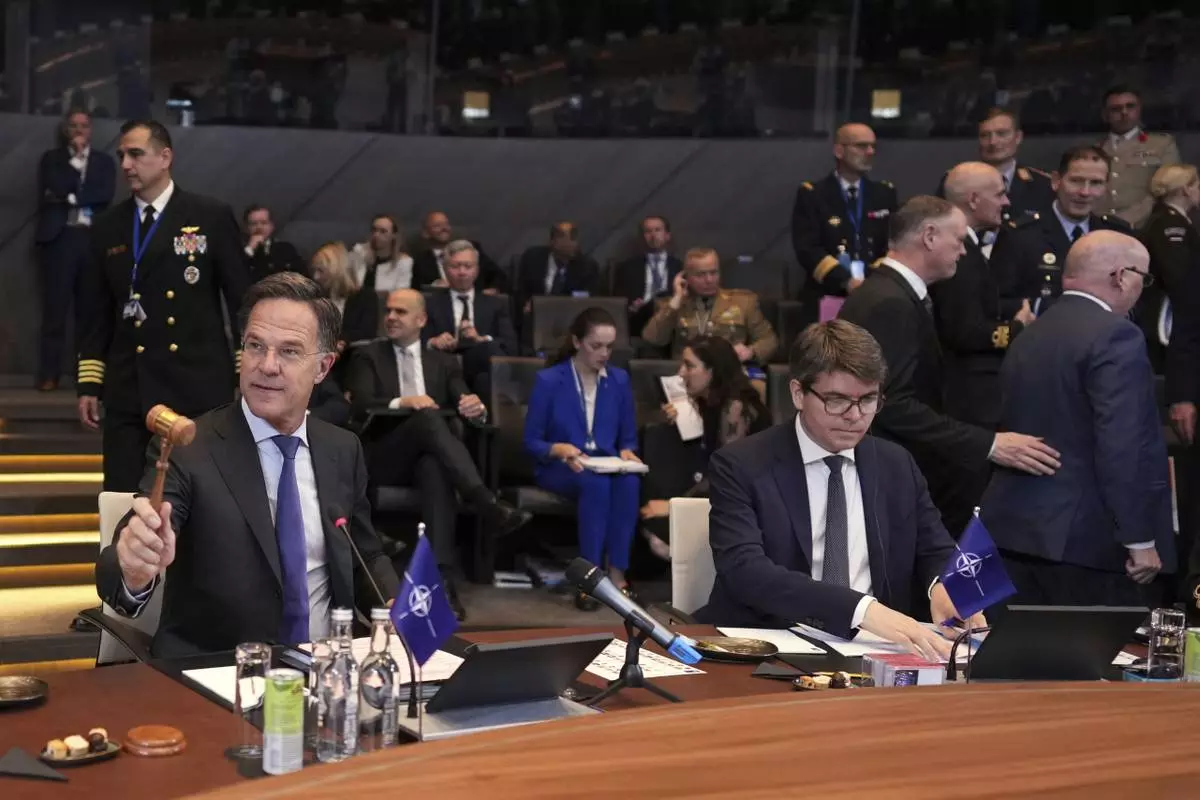
NATO Secretary General Mark Rutte, left, bangs a gavel to signify the start of a meeting of NATO defense ministers at NATO headquarters in Brussels, Thursday, June 5, 2025. (AP Photo/Virginia Mayo)
NATO Secretary General Mark Rutte, left, bangs a gavel to signify the start of a meeting of NATO defense ministers at NATO headquarters in Brussels, Thursday, June 5, 2025. (AP Photo/Virginia Mayo)
Germany's Defense Minister Boris Pistorius, right, speaks with Sweden's Defense Minister Pal Jonson during a meeting of NATO defense ministers at NATO headquarters in Brussels, Thursday, June 5, 2025. (AP Photo/Virginia Mayo)
Germany's Defense Minister Boris Pistorius, right, speaks with Sweden's Defense Minister Pal Jonson during a meeting of NATO defense ministers at NATO headquarters in Brussels, Thursday, June 5, 2025. (AP Photo/Virginia Mayo)
Defense Secretary Pete Hegseth, center, speaks with Estonia's Defense Minister Hanno Pevkur, right, during a meeting of NATO defense ministers at NATO headquarters in Brussels, Thursday, June 5, 2025. (AP Photo/Virginia Mayo)

Defense Secretary Pete Hegseth, center, speaks with Estonia's Defense Minister Hanno Pevkur, right, during a meeting of NATO defense ministers at NATO headquarters in Brussels, Thursday, June 5, 2025. (AP Photo/Virginia Mayo)

Defense Secretary Pete Hegseth, right, speaks with Norway's Defense Minister Tore Sandvik during a meeting of NATO defense ministers at NATO headquarters in Brussels, Thursday, June 5, 2025. (AP Photo/Virginia Mayo)

Defense Secretary Pete Hegseth, right, speaks with Norway's Defense Minister Tore Sandvik during a meeting of NATO defense ministers at NATO headquarters in Brussels, Thursday, June 5, 2025. (AP Photo/Virginia Mayo)

NATO Secretary General Mark Rutte speaks during a media conference prior to a meeting of the Ukraine Defense Contact Group at the NATO headquarters in Brussels, Wednesday, June 4, 2025. (AP Photo/Virginia Mayo)
NATO Secretary General Mark Rutte speaks during a media conference prior to a meeting of the Ukraine Defense Contact Group at the NATO headquarters in Brussels, Wednesday, June 4, 2025. (AP Photo/Virginia Mayo)

Britain's Defense Secretary John Healey, right, speaks with NATO Secretary General Mark Rutte, center, during a meeting of the Ukraine Defense Contact Group at the NATO headquarters in Brussels, Wednesday, June 4, 2025. (AP Photo/Virginia Mayo)

Britain's Defense Secretary John Healey, right, speaks with NATO Secretary General Mark Rutte, center, during a meeting of the Ukraine Defense Contact Group at the NATO headquarters in Brussels, Wednesday, June 4, 2025. (AP Photo/Virginia Mayo)

Defense Secretary Pete Hegseth, third right, arrives for a meeting of NATO defense ministers at NATO headquarters in Brussels, Thursday, June 5, 2025. (AP Photo/Virginia Mayo)
Defense Secretary Pete Hegseth, third right, arrives for a meeting of NATO defense ministers at NATO headquarters in Brussels, Thursday, June 5, 2025. (AP Photo/Virginia Mayo)

Glenn Hall, a Hockey Hall of Famer whose ironman streak of 502 starts as a goaltender remains an NHL record, has died. He was 94.

Nicknamed “Mr. Goalie,” Hall worked to stop pucks at a time when players at his position were bare-faced, before masks of any kind became commonplace. He did it as well as just about anyone of his generation, which stretched from the days of the Original Six into the expansion era.

A spokesperson for the Chicago Blackhawks confirmed the team received word of Hall’s death from his family. A league historian in touch with Hall’s son, Pat, said Hall died at a hospital in Stony Plain, Alberta, on Wednesday.

A pioneer of the butterfly style of goaltending of dropping to his knees, Hall backstopped Chicago to the Stanley Cup in 1961. He won the Conn Smythe Trophy as most valuable player of the playoffs in 1968 with St. Louis when the Blues reached the final before losing to Montreal. He was the second of just six Conn Smythe winners from a team that did not hoist the Cup.

His run of more than 500 games in net is one of the most untouchable records in sports, given how the position has changed in the decades since. Second in history is Alec Connell with 257 from 1924-30.

“Glenn was sturdy, dependable and a spectacular talent in net,” Commissioner Gary Bettman said. “That record, set from 1955-56 to 1962-63, still stands, probably always will, and is almost unfathomable — especially when you consider he did it all without a mask.”

Counting the postseason, Hall started 552 games in a row.

Hall won the Calder Trophy as rookie of the year in 1956 when playing for the Detroit Red Wings. After two seasons, he was sent to the Black Hawks along with legendary forward Ted Lindsay.

Hall earned two of his three Vezina Trophy honors as the league's top goalie with Chicago, in 1963 and '67. The Blues took him in the expansion draft when the NHL doubled from six teams to 12, and he helped them reach the final in each of their first three years of existence, while winning the Vezina again at age 37.

Hall was in net when Boston's Bobby Orr scored in overtime to win the Cup for the Bruins in 1970, a goal that's among the most famous in hockey history because of the flying through the air celebration that followed. He played one more season with St. Louis before retiring in 1971.

“His influence extended far beyond the crease," Blues chairman Tom Stillman said. “From the very beginning, he brought credibility, excellence, and heart to a new team and a new NHL market.”

A native of Humboldt, Saskatchewan, Hall was a seven-time first-team NHL All-Star who had 407 wins and 84 shutouts in 906 regular-season games. He was inducted into the Hall of Fame in 1975, and his No. 1 was retired by Chicago in 1988.

Hall was chosen as one of the top 100 players in the league's first 100 years.

Blackhawks chairman and CEO Danny Wirtz called Hall an innovator and “one of the greatest and most influential goaltenders in the history of our sport and a cornerstone of our franchise.”

“We are grateful for his extraordinary contributions to hockey and to our club, and we will honor his memory today and always,” Wirtz said.

The Blackhawks paid tribute to Hall and former coach and general manager Bob Pulford with a moment of silence before Wednesday night’s game against St. Louis. Pulford died Monday.

A Hall highlight video was shown on the center-ice videoboard. The lights were turned off for the moment of silence, except for a spotlight on the No. 1 banner for Hall that hangs in the rafters at the United Center.

Fellow Hall of Famer Martin Brodeur, the league's leader in wins with 691 and games played with 1,266, posted a photo of the last time he saw Hall along with a remembrance of him.

“Glenn Hall was a legend, and I was a big fan of his,” Brodeur said on social media. “He set the standard for every goaltender who followed. His toughness and consistency defined what it meant to play.”

AP Sports Writer Jay Cohen in Chicago contributed to this report.

AP NHL: https://apnews.com/hub/nhl

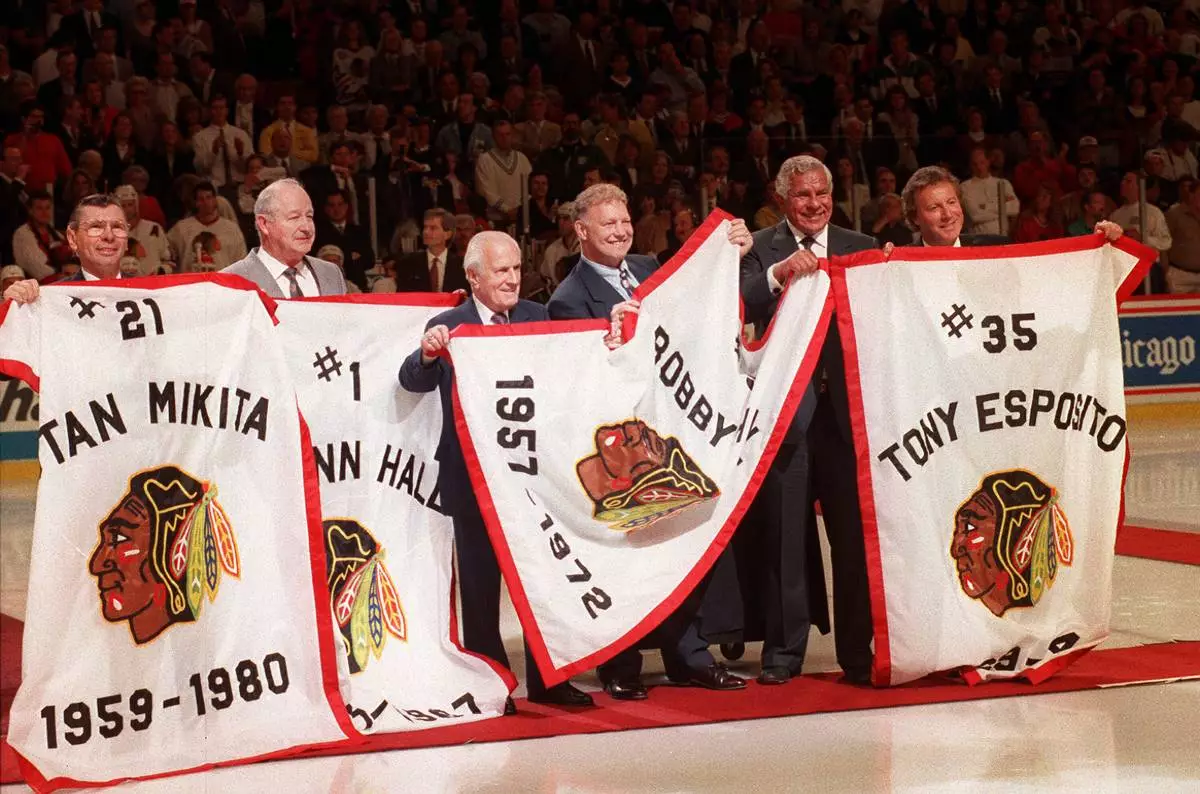
FILE - Glenn Hall, second from left, stands with fellow former Chicago Blackhawks players Stan Mikita, former general manager Tommy Ivan, Bobby Hull, Bill Wirtz and Tony Esposito during a pre-game ceremony at the Chicago Stadium in Chicago, Ill., April 14, 1994. (AP Photo/Fred Jewell, File)

FILE - Glenn Hall, second from left, stands with fellow former Chicago Blackhawks players Stan Mikita, former general manager Tommy Ivan, Bobby Hull, Bill Wirtz and Tony Esposito during a pre-game ceremony at the Chicago Stadium in Chicago, Ill., April 14, 1994. (AP Photo/Fred Jewell, File)

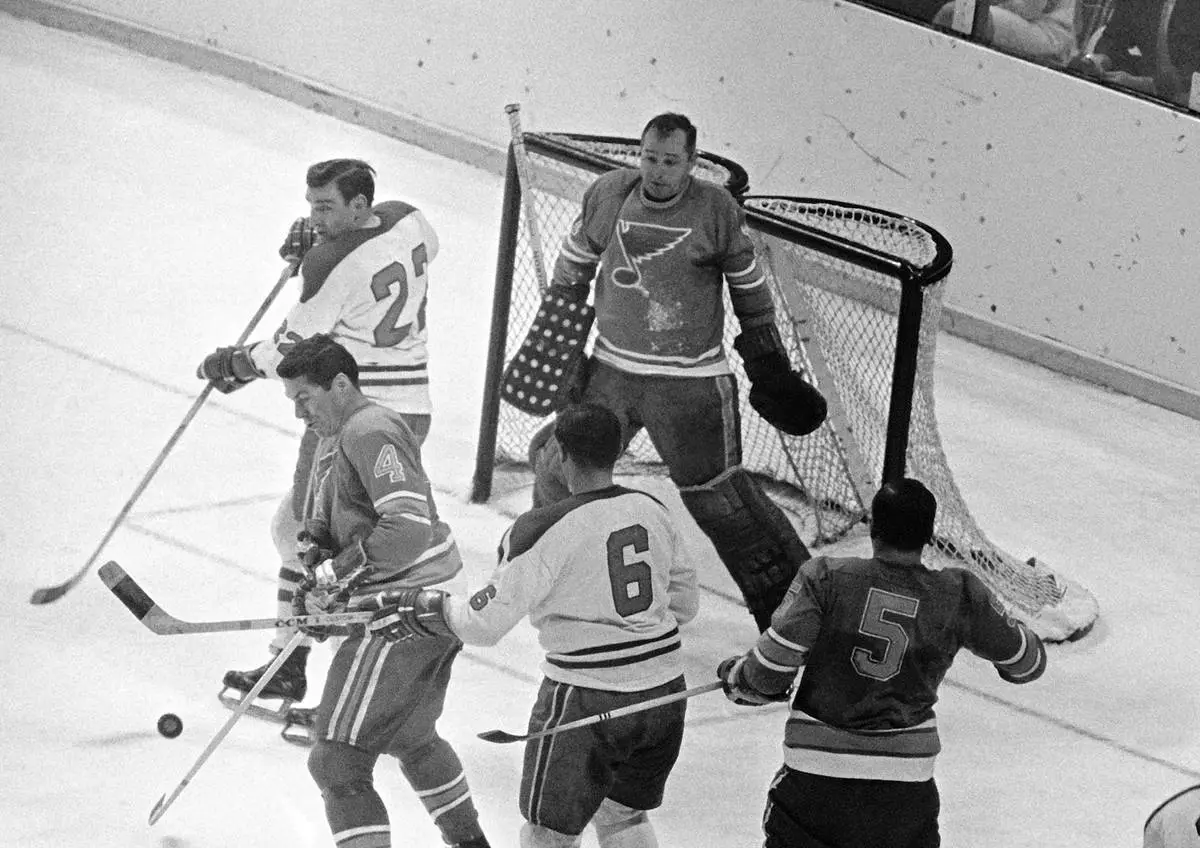
FILE - St. Louis Blues goalie Glenn Hall, top right, is pinned to his net waiting to make a save on a Montreal Canadians shot as Blues' Noel Picard (4) tries to block the puck while Canadiens' John Ferguson (22) and Ralph Backstorm wait for a rebound in the third period of their NHL hockey Stanley Cup game, May 5, 1968. (AP Photo/Fred Waters, File)

FILE - St. Louis Blues goalie Glenn Hall, top right, is pinned to his net waiting to make a save on a Montreal Canadians shot as Blues' Noel Picard (4) tries to block the puck while Canadiens' John Ferguson (22) and Ralph Backstorm wait for a rebound in the third period of their NHL hockey Stanley Cup game, May 5, 1968. (AP Photo/Fred Waters, File)

Recommended Articles