Northwest China's Xinjiang Uygur Autonomous Region continues to expand and fortify the late-last-year completed 3,046-km green belt encircling the Taklimakan Desert to achieve broader ecological management objectives.
The Taklimakan Desert, once known as the "sea of death," covers 337,600 square kilometers, and its circumference measures 3,046 km, making it the largest desert in China and the second-largest drifting desert in the world.
It has taken more than 40 years to enclose the desert with a green belt fully. This incredible achievement has been part of China's Three-North Shelterbelt Forest Program since 1978, the world's largest afforestation initiative scheduled to be completed by 2050.
Alongside the green belt, which was completed on November 28, 2024, efforts have been made to promote the development of sand-terrain industries, such as the growing of over 20 types of Chinese medicinal materials and other crops, to benefit local residents.
"This year, I plan to lease an additional five mu (about 0.33 hectares) of land to plant peanuts and isatis root. These crops can both combat desertification and bring economic benefits. Currently, there is much less windy and sandy weather compared to before," said a local villager in Minfeng County of Hotan Prefecture.
Minfeng County continues to expand the width of the protective barrier. Recently, villagers in Minfeng have been busy making straw checkerboard sand barriers to prevent the spread of sand sources.
"Planting economic trees such as prune plum trees, red date trees, peach trees, and apricot trees inside the grass grids not only extends the service life of the grass grids but also enhances the survival rate of seedlings," said Jia Lei, deputy director of the forestry and grassland bureau in Minfeng County.
This year, Minfeng plans to complete the paving of straw checkerboard barriers on 66,000 mu (about 4,400 hectares) of land, with 44,000 mu (about 2,933.3 hectares) already paved.
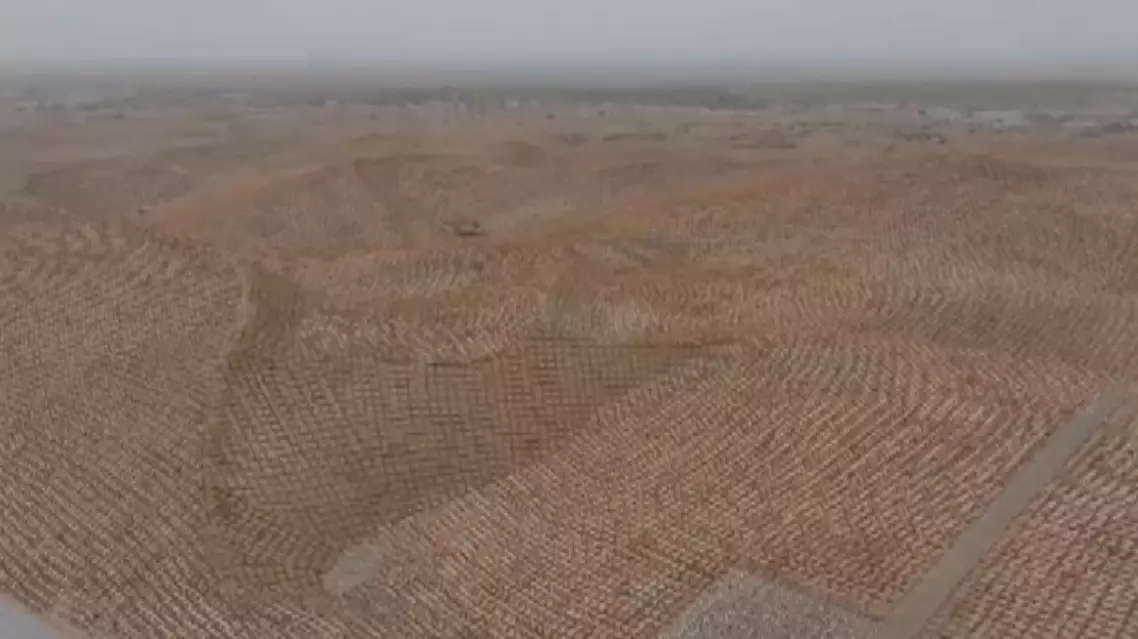
Xinjiang continues expanding width of protective barrier of China's largest desert