China's Three-North Shelterbelt Forest Program (TSFP), a large-scale afforestation project, has achieved significant results since the full launch of its intensified campaign in June 2023, completing 8.2 million hectares of afforestation and sand control tasks across three key battlefronts.
Over the past two years, China has allocated 57.7 billion yuan (about 8 billion U.S. dollars) of central government funding for 369 projects under the TSFP.
A dynamic project management system has been established, featuring a rolling advancement mechanism to ensure continuous progress in planning, implementation, and completion.
The program has also promoted cross-regional large-scale desertification control, using photovoltaic sand fixation, roadside sand stabilization, and mechanized desert control measures.
"Over the past two years, we have worked together to tackle the challenges in the Three-North region such as the scarcity of superior tree and grass species and low level of smart and mechanical means in sand control. We have promoted the use of over 100 key scientific and technological achievements in the Three-North region, raising the proportion of mechanical sand control and afforestation to nearly 50 percent, and the utilization rate of superior tree and grass species has exceeded 70 percent," said Lu Qi, director of the TSFP research institute, also chief scientist from the Chinese Academy of Forestry.
So far, significant progress has been made in the eastern, central and western battlefronts, namely the Horqin-Hunshandake sand area, the Yellow River "bend" area, and the Hexi Corridor-Taklimakan Desert edge area.
In the eastern region, the Horqin and Hunshandake sand area has accelerated the elimination of mobile sand dunes, completing over 948,000 hectares of afforestation.
In the central region, the Yellow River "bend" area has tackled ecological issues such as sand and flood control, finishing 3.184 million hectares of projects and effectively reducing sediment flow into the Yellow River.
In the western region, the Hexi Corridor-Taklimakan Desert edge area has strengthened the building of forest belts around the desert, pushing back the edge of the Tengger Desert by 25 kilometers.
"Adhering to the simultaneous promotion of green expansion, green revitalization, and green protection, we have completed construction tasks of 123 million mu (8.2 million hectares) over the past two years. It has been two years with the highest investment, the largest number of completed sand-control tasks, and the most obvious construction achievements in the history of the 'Three North' program," said Zhang Shengdong, deputy head of the National Forestry and Grassland Administration's Ecological Conservation Department.
The TSFP, launched in 1978 and planned to be completed by 2050, is an ecological project against desertification. This cross-century program consists of eight phases of work and is currently in its sixth phase.
China is among the countries with the most serious desertification problem in the world. The 'Three-North' regions, which refer to the north, northwest, and northeast of China, account for 45 percent of China's total land area while containing 84 percent of the desertified land.
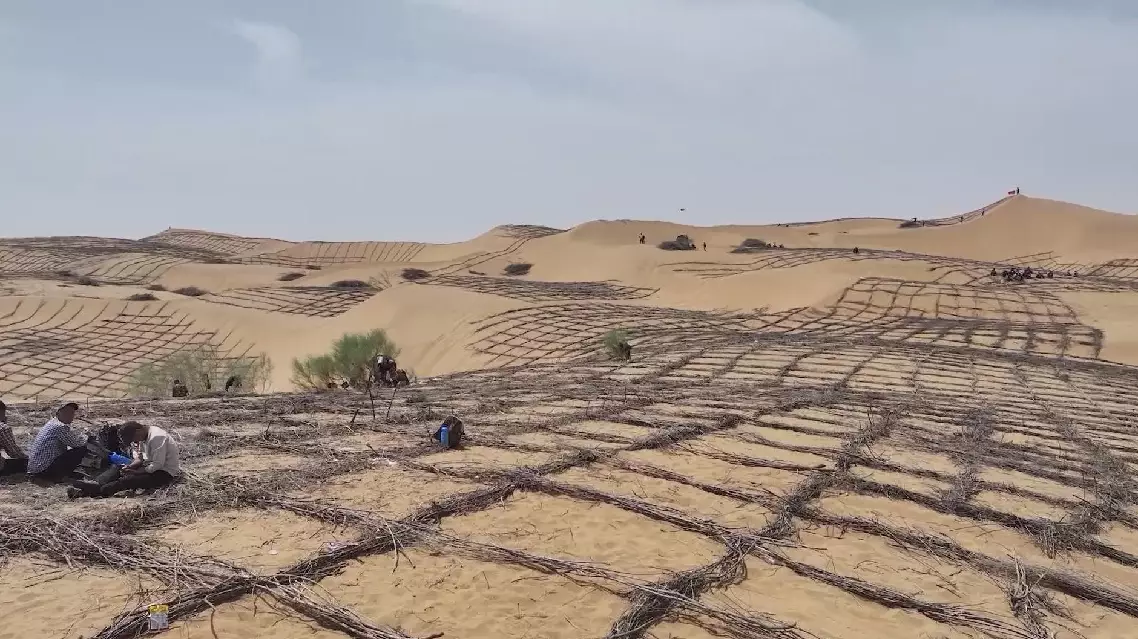
Three-North Shelterbelt Forest Program makes milestone progress in desert control