A scorching heatwave has gripped China's Beijing, Hebei, Shanxi and Shandong areas, prompting authorities to issue high-temperature alerts and activate emergency response measures.
On Thursday, the Beijing Meteorological Observatory recorded the city’s first high-temperature day of the year and issued an orange heat alert, the second highest level in the country's warning system.
By 15:00 on Thursday, the temperature in Beijing's plain regions had risen to above 36 degrees Celsius, with certain areas surpassing 38 degrees Celsius. On Friday, Beijing's temperature is anticipated to remain near 35 degrees Celsius.
Elsewhere in northern China, Hebei Province also experienced severe heat conditions, with temperatures rising above 37 degrees Celsius. The meteorological authorities maintained the issuance of an orange high-temperature warning.
Yuncheng City in north China's Shanxi Province, which neighbors Hebei, is also scorched by heatwave, with temperature soaring to 37 degrees Celsius on the same day. Sanitation water-spraying trucks were deployed to keep its roads cool.
In response to the temperature rising above 37 degrees Celsius, Zibo City in east China's Shandong Province has utilized sprinkler vehicles and trucks fitted with mist cannons to effectively reduce the road surface temperature.
"We have adopted a working mode that prioritizes mechanical operations supplemented by manual work. We try to ensure that front-line workers are not exposed to high-temperature periods and environments," said Chen Lei, an official at Zhangdian District Comprehensive Administrative Law Enforcement Bureau.
Local authorities have also set up rest areas, where heatstroke prevention medicine is available, and sanitation workers and other outdoor workers can cool off with beverages.
"We prepared some heatstroke prevention medicine in advance. Every morning, we boil mung bean soup in advance to ensure that the front-line workers could drink it any time they need to. This can help prevent heatstroke and cool them down," said Ma Bo, manager of manual operation center under Zibo branch of Beijing Enterprises Urban Environmental Services Group Limited.

Heatwave sweeps multiple Chinese cities
As the diplomatic engagement between the United States and Iran continues despite a faltering ceasefire, a former commander of Iran's Islamic Revolutionary Guard Corps (IRGC) has said that Iran is prepared to use military power to break the U.S. maritime blockade should the negotiations collapse or run on too long.
Mohsen Rezaee, who also currently serves as a member of the Iranian Expediency Discernment Council, struck a confident tone about Iran's current trajectory in an exclusive interview with China Global Television Network (CGTN) in Tehran on Wednesday.
He said the country has withstood over two decades of crippling sanctions and continued to move forward.
"We have been under sanctions for more than 20 years. The number of sanctions likely exceeds 2,000, targeting individuals, enterprises, corporations, ships, insurance companies, and even foreign countries that interacted with us. However, we have managed to find solutions to neutralize these sanctions, and we will continue to do so moving forward," he said.
He said Iran aims to ease the sanctions burden through talks with the U.S., although at the same time, he said, Iran is ready to shift to a military response if the path to a peaceful resolution closes.
"Furthermore, we will compel the U.S. to lift these sanctions. We will force the U.S. to end the maritime blockade -- either through negotiations or, should they resist, through direct action and we will attack U.S. warships. Therefore, despite all the pressures, the future of our economy is bright and promising, while the future of the US economy is bleak," he said.
While any new war against Iran would be a dead end, the best way out for the U.S. is to continue talks, according to the senior official.
"We have prepared ourselves so that if the maritime blockade continues beyond a certain timeframe, we will launch an attack and break the blockade. The Americans have no choice but to negotiate. Continuing this war is a journey into a very dark tunnel for the United States. The more America chooses to fight, the deeper it enters a tunnel with no end. Yet for us, the path is perfectly clear. America is moving toward us in the dark, while we are monitoring their every move," he said.
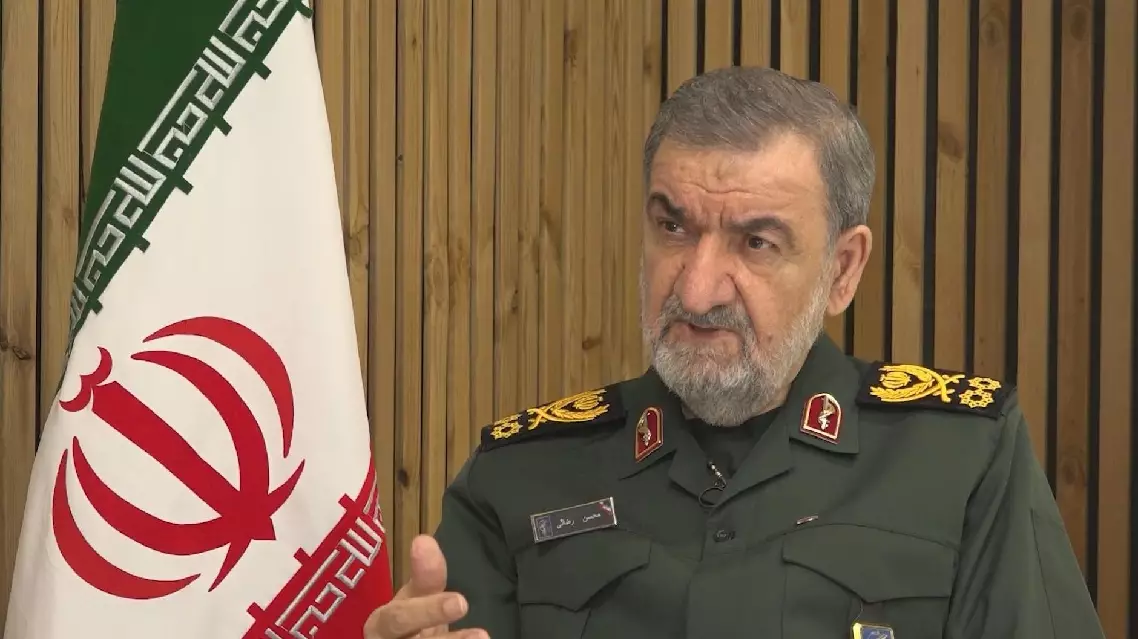
Former IRGC chief says Iran ready to break U.S. naval blockade by force if talks fail