The International Seabed Authority (ISA) will implement legal codes to regulate deep-seabed mineral exploration and exploitation, aiming to curb illegal unilateral actions, according to a senior official.
ISA oversees the management of the international seabed area and its resources. A key responsibility is to promote the sustainable use of deep-sea minerals and other resources while prioritizing the protection of the seabed's ecological environment.
In an exclusive interview with China Central Television (CCTV), Leticia Carvalho, Secretary-General of the ISA, introduced ongoing efforts to strengthen the organization’s framework for monitoring, intervening in, and sanctioning deep-sea mining activities that violate international law, marking a pivotal step toward transforming seabed regulation.
"First, let me make a very bold statement that the International Seabed Authority is very close to finalizing its framework. That's the one that should be universally agreed for exploration and exploitation, the so-called mining code," she said.
"I envisage that sanctions, breaks and permits, once issued, could be used as part of the tool kit of the International Seabed Authority in case of unlawful action. It's important also to say that it's envisaged that peer-to-peer actions and sanctions can also be done, and one state member of the International Seabed Authority that has followed the rules eventually might also take sanctions or measures against a non-state member that has decided to act unilaterally. So this is another layer of possibilities," she added.
Carvalho also urged member states to fulfill their obligations, which will empower the ISA to uphold the rule of law and govern the ocean effectively through the completion of legal codes for deep-sea mining within the year.
"So my message to June 8 and my hope is that member states will deliver their tasks, equipping the International Seabed Authority and the rule of the law and the governance of the ocean through the finalization of the mining code by this year. So then we will have all the pillars of the regime and governance of the oceans, of the ocean in place. And therefore the International Seabed Authority can act as stewardship, as the steward, as the custodian of the sea, deep seabed. And this is for the benefit of all humankind," she explained.

ISA advances legal framework to regulate deep-sea mining, preserve ocean governance
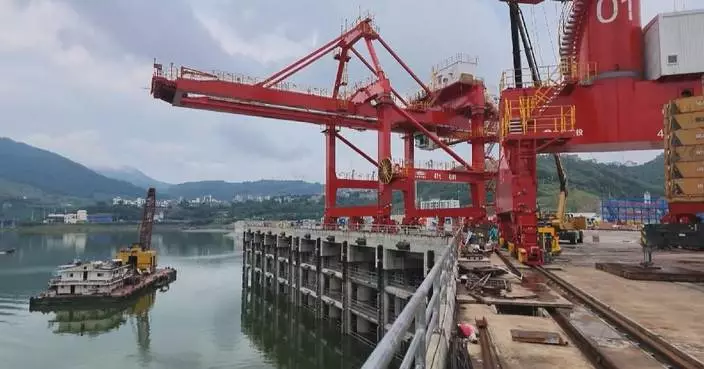
With the Pinglu Canal in the Guangxi Zhuang Autonomous Region officially open to shipping, Yangpu Port in south China's Hainan Province will fully leverage the policy and geographical advantages of the Hainan Free Trade Port (FTP) to accelerate its development into an international shipping hub, further connecting the New International Land-Sea Trade Corridor with global markets.
The canal stretches along the New International Land-Sea Trade Corridor, a strategic trade route connecting China's inland regions with ASEAN and other global markets. It is the first river-to-sea canal project planned and coordinated at the national level since the founding of the People's Republic of China in 1949.
Located in the northwest of the island province, Yangpu Port is the deep-water port closest to the main international shipping routes in the Beibu Gulf, and is also one of the maritime outlets of the New International Land-Sea Trade Corridor.
The opening of the Pinglu Canal to navigation has opened up a new sea-river intermodal transport corridor for goods entering and leaving the southwestern region, and has also brought new opportunities to some enterprises.
At a petrochemical enterprise in Danzhou City, robotic arms are bagging and packaging chemical products on a conveyor belt, and these goods will be shipped to southwest China's Guizhou Province and other places.
Most of this enterprise's customers in the Chinese mainland are concentrated in the southwestern Chinese provinces of Yunnan, Sichuan and Guizhou. At present, the enterprise is adjusting its future shipping plans in response to the logistics changes brought by the opening of the Pinglu Canal to navigation.
"We plan to shift about 70 percent of our goods to this new sea-river intermodal transport corridor, and overall logistics costs are expected to drop by 30 to 40 percent. Next year we also plan to build another plant in Hainan, which will allow us to take advantage of the free trade port's policies, import raw materials from places like Indonesia, and after processing, sell the products to the southwestern region or re-export them. This is expected to add about 200,000 tons of production capacity," said Wei Jianqiang, head of Hainan Oxiranchem Co., Ltd.
Behind the enterprises' expansion of production and the busier flow of goods, there is also the upgraded service support made possible by the opening of the Pinglu Canal to navigation. In this regard, the relevant authorities have also made full preparations.
"After the Pinglu Canal opens to navigation, we will strengthen safeguard measures in areas such as facilitating the entry and exit of container ships on fixed routes, credit-based regulation, and cross-regional coordination," said Jiang Yufeng, head of the Xiaochantan Maritime Patrol and Law Enforcement Brigade, Yangpu Maritime Safety Administration.
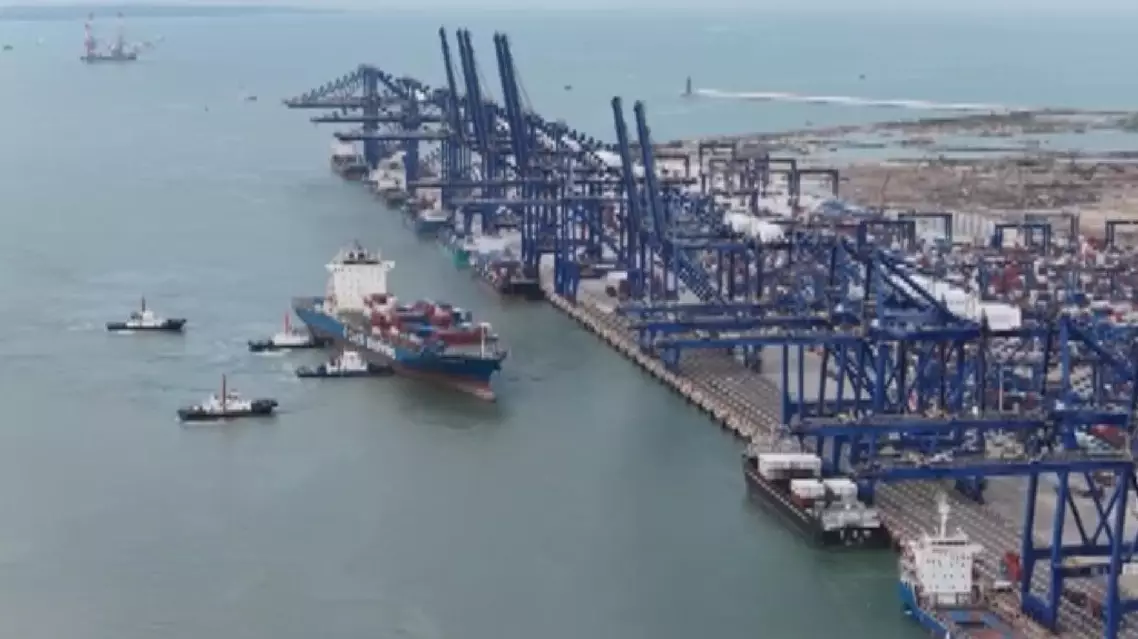
Pinglu Canal underscores growing role of Yangpu Port as int'l shipping hub