Skip to Content Facebook Feature Image

Indoor ski resorts gain popularity in China as summer heat arrives

China

China

China

Indoor ski resorts gain popularity in China as summer heat arrives

2025-06-09 04:08 Last Updated At:10:12

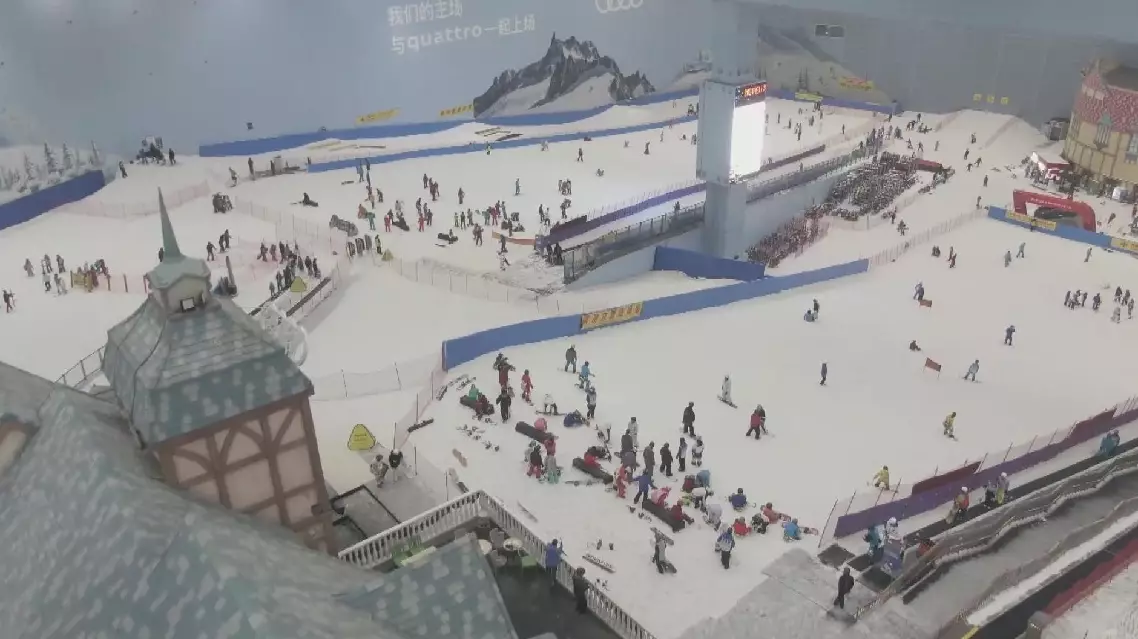
Indoor ski resorts have emerged as popular destinations for people in China to escape the summer heat.

The Shanghai L+SNOW Indoor Skiing Theme Resort, the world's largest indoor snow park covering over 98,000 square meters, is seeing a steady stream of visitors in recent days.

"It's pretty cool. I'm from Singapore, where it's summer all year round. So, I really want to find indoor places to have fun. I'm planning to spend the weekend here because I have been to other indoor ski resorts, and this one seems to be more fun with more facilities and thoughtful services," said a skier.

Since its opening in September last year, this ski resort has been attracting over 6,000 visitors daily on holidays, with the booking rates of three surrounding hotels reaching nearly full occupancy. 

In cooperation with the hotels, the resort is offering service packages covering skiing and water facilities as well as discounts this summer to lure tourists.

"We have launched a service package, which has been well received by visitors, especially families with children," said Li Ling, marketing director of the resort.

In Guangzhou, capital city of south China's Guangdong Province, an indoor ski resort has built five different slopes to accommodate various skill levels, offering options for both beginners and expert skiers.

"Here, you can do both snowboarding and skiing. This place is especially crowded on weekends, with nearly half of the visitors from Hong Kong," said a skier from Hong Kong.

The resort received more than 1 million skiers last year, and nearly 30 percent were from Hong Kong and Macao, as a result of the facilitated traveling within the Guangdong-Hong Kong-Macao Greater Bay Area.

Meanwhile, the Gulongxia scenic spot in Guangdong's Qingyuan City has upgraded its river rafting route, making it currently the longest of its kind in Guangdong.

With a drop of 378 meters, the facility is providing numerous visitors with a thrilling experience, a beautiful scenery, and a fun way to cool off.
Indoor ski resorts gain popularity in China as summer heat arrives

Indoor ski resorts gain popularity in China as summer heat arrives

A former television host from Taiwan, Zhai Xuan, has made a pivotal decision to leave mainstream broadcasting in order to create content that provides a better understanding of the Chinese mainland and cross-strait relations.

Zhai, a seasoned television host with over a decade of experience in Taiwan's media landscape, recently addressed an audience at an event in Beijing, where she revealed her complete transition into independent online media.

In her remarks, she articulated her aspiration to bridge what she perceives as a significant information gap between audiences on both sides of the Strait, highlighting her commitment to fostering a deeper understanding and connection through her new endeavors.

"I was really surprised by all the fake news. There were stories saying people on the mainland can't afford tea eggs or that they live in mud houses and in Taiwan, this was the main information many people received," said Zhai.

Zhai said she initially began producing online videos to challenge such perceptions while continuing her work as a television host.

In April 2025, she travelled to the mainland with her father to fulfill her late grandfather's wish to return to his hometown. The trip, which reunited family members separated since 1949, was recorded in a video series titled "Journey to Find Our Roots", drawing attention from viewers in both Taiwan and the mainland.

"Many people in Taiwan told me that after watching, they wanted to apply for a mainland travel permit immediately and go looking for their relatives. Some had long forgotten these things, but after seeing my story, they began thinking about their hometowns and family members they had never met and decided to search for their roots," Zhai shared her story at the event.

By mid-2025, Zhai said she began to feel increasing pressure amid rising political tensions and a tightening atmosphere around cross-Strait exchanges in Taiwan.

After more than 12 years in the industry, Zhai resigned from her position, believing it was the right thing to do.

"At that moment, I felt this was a major issue,not just for me, but for Chinese people on both sides of the Strait. If I backed down then, I wouldn’t be standing on the right side," said Zhai.

Since leaving television, Zhai has broadened her online programming to encompass a range of daily-life topics, including practical guidance on applying for a mainland travel permit and using commonly employed mobile applications, in addition to content that delves into historical memory and cultural connections across the Strait.

As the debate over cross-Strait relations continues in Taiwan, Zhai said she remains committed to her current path.

Former Taiwan TV host bridges cross-Strait divide via online media

Former Taiwan TV host bridges cross-Strait divide via online media

Recommended Articles