MARAAT AL-NUMAN, Syria (AP) — A contractor digging into the earth where the rubble of a destroyed house had been cleared away in northern Syria stumbled across a surprise: the remains of an underground Byzantine tomb complex believed to be more than 1,500 years old.
The discovery emerged last month in the town of Maarat al-Numan in Idlib province, which is strategically located on the route between the cities of Aleppo and Damascus. The community became a touchpoint in the nearly 14-year Syrian civil war that ended with the fall of former President Bashar Assad in a lightning rebel offensive in December.
Click to Gallery
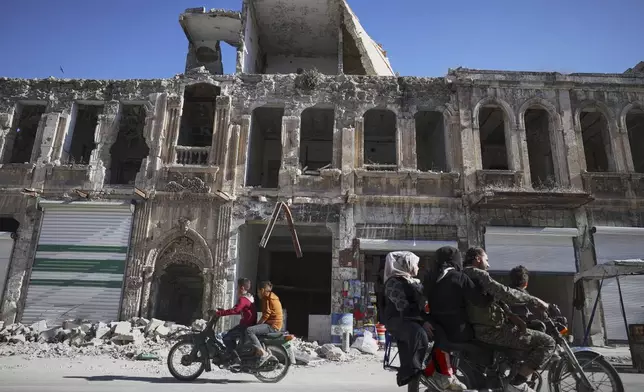
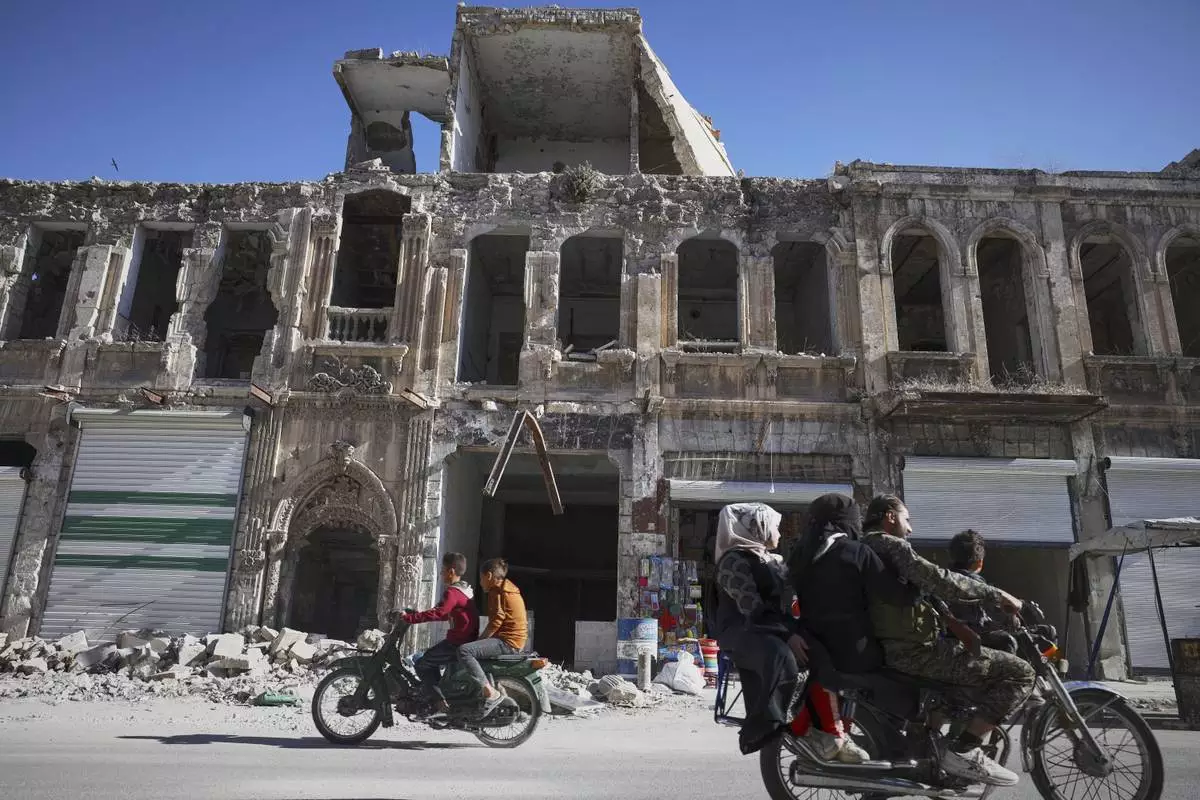
Residents drive past the war-damaged ancient market of Maarat al-Numan, near the site where a Byzantine underground tomb complex, believed to be over 1,500 years old, was uncovered by a contractor during the reconstruction of a war-damaged house, in Maarat al-Numan, Idlib suburb, Syria, on Friday, May 30, 2025. (AP Photo/Omar Albam)
Residents drive past the war-damaged ancient market of Maarat al-Numan, near the site where a Byzantine underground tomb complex, believed to be over 1,500 years old, was uncovered by a contractor during the reconstruction of a war-damaged house, in Maarat al-Numan, Idlib suburb, Syria, on Friday, May 30, 2025. (AP Photo/Omar Albam)
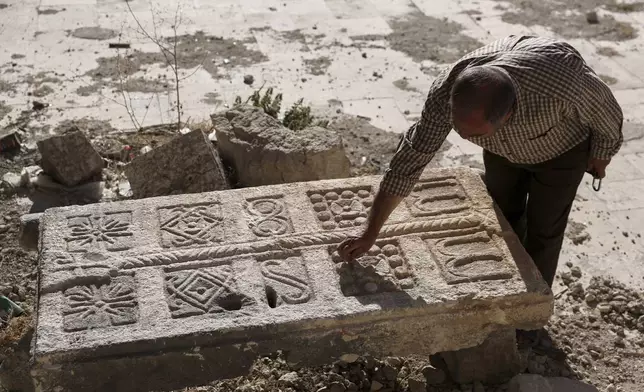
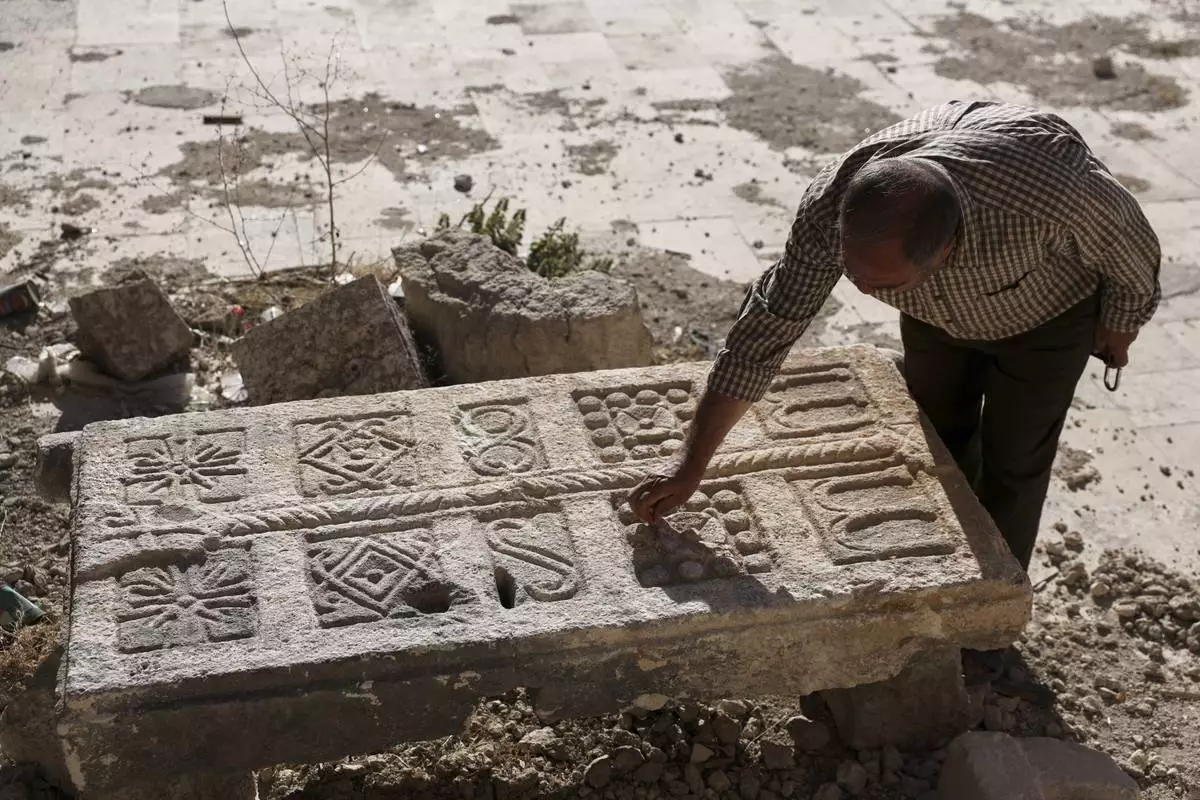
A guard inspects an engraved stone, originally found at a Byzantine underground tomb complex believed to be over 1,500 years old and uncovered by a contractor during the reconstruction of a war-damaged house and brought to a museum yard in Maarat al-Numan, Syria, Friday, May 30, 2025. (AP Photo/Omar Albam)
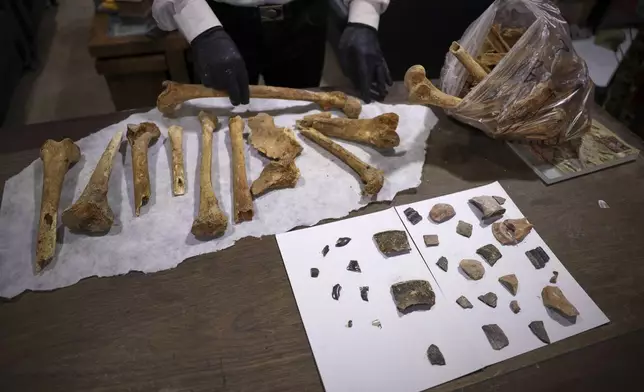
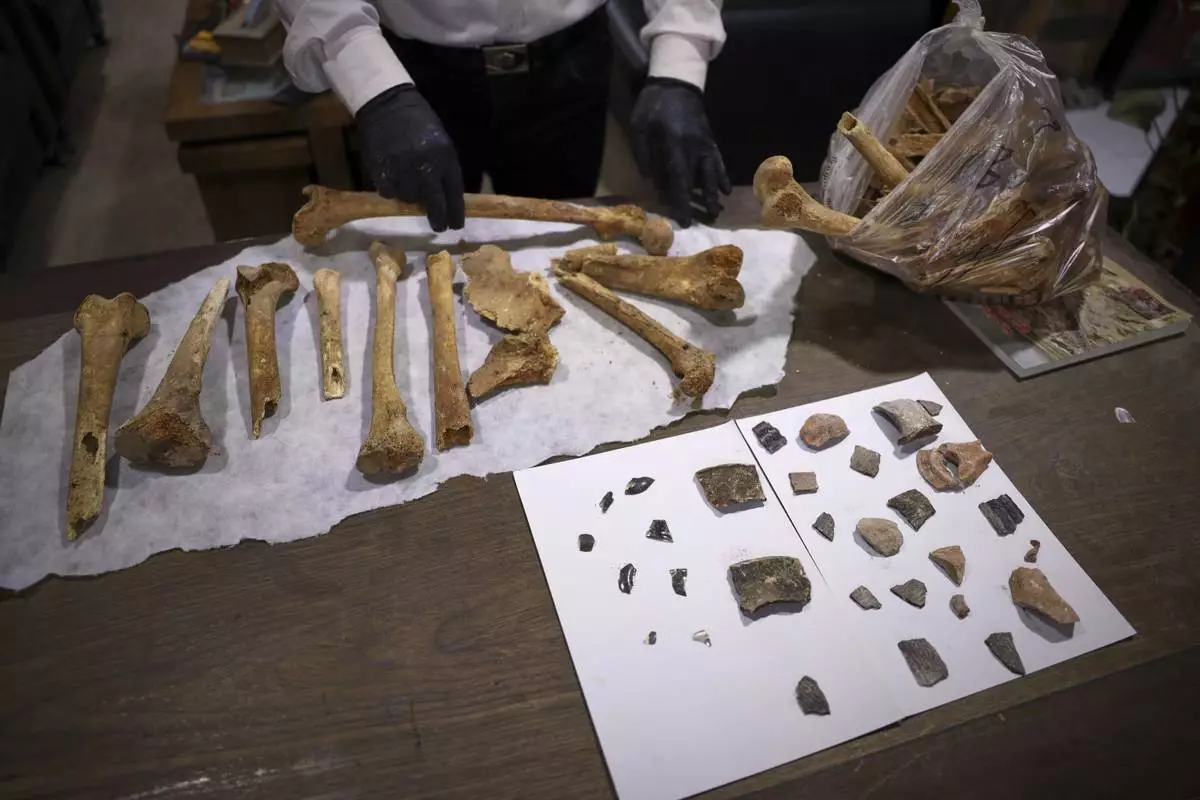
Hassan Ismail of the Idlib Museum examines bones from a Byzantine underground tomb complex, believed to be over 1,500 years old, discovered by a contractor during the reconstruction of a war-damaged house in Maarat al-Numan, Idlib suburb, at the Idlib Museum, Syria, Friday, May 30, 2025. (AP Photo/Omar Albam)
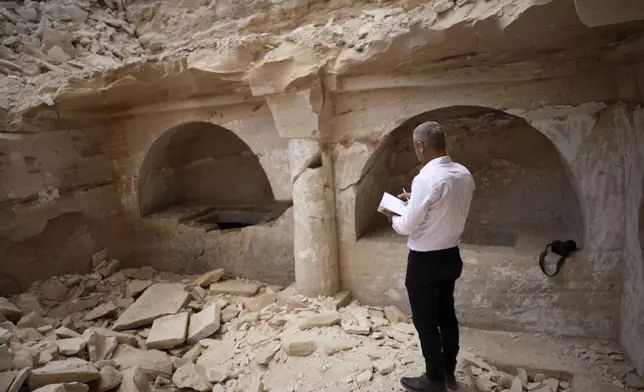
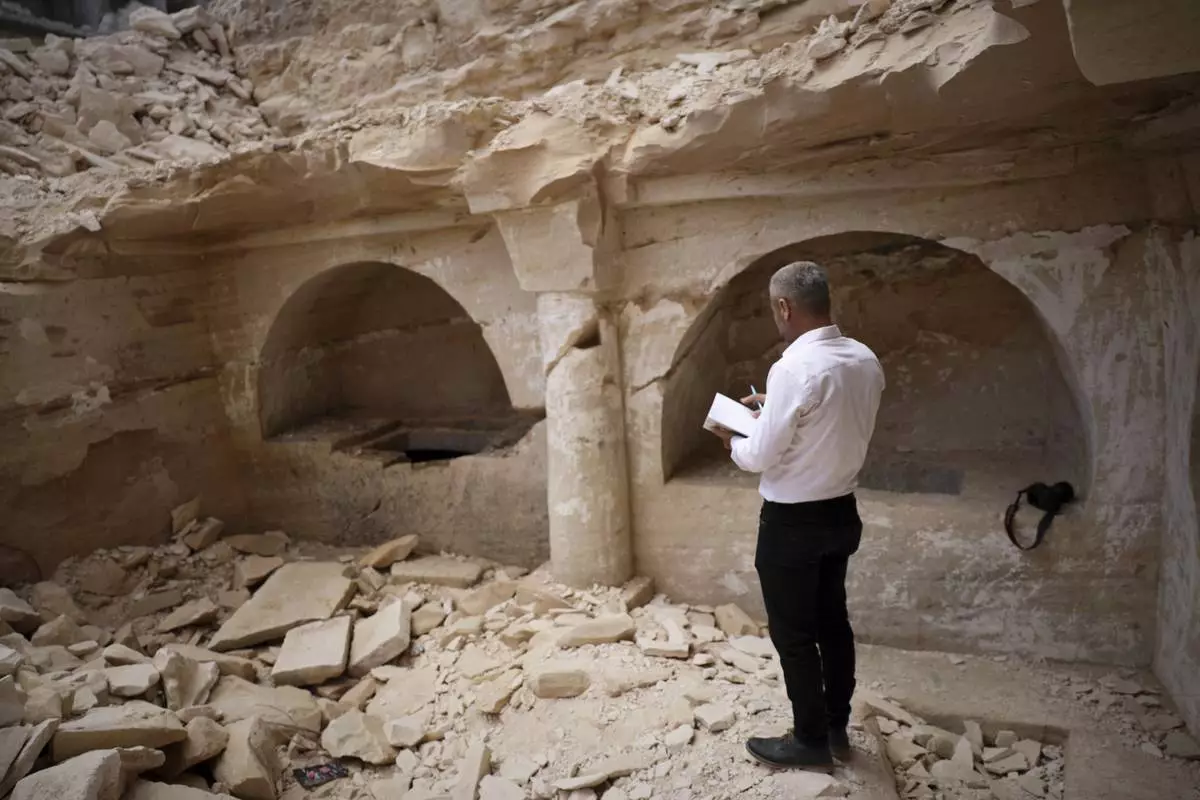
Hassan Ismail of the Idlib Museum takes notes at a Byzantine underground tomb complex, believed to be over 1,500 years old, uncovered by a contractor during reconstruction of a war-damaged house in Maarat al-Numan, Idlib suburb, Syria, on Friday, May 30, 2025. (AP Photo/Omar Albam)
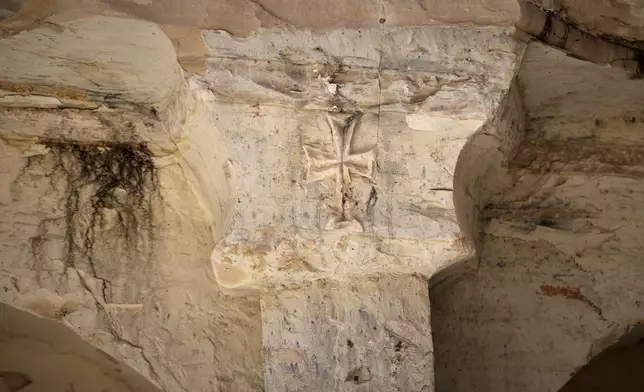
A sign of the cross is etched into the top of a stone column at a Byzantine underground tomb complex, believed to be over 1,500 years old, uncovered by a contractor during reconstruction of a war-damaged house in Maarat al-Numan, Idlib suburb, Syria, on Friday, May 30, 2025. (AP Photo/Omar Albam)
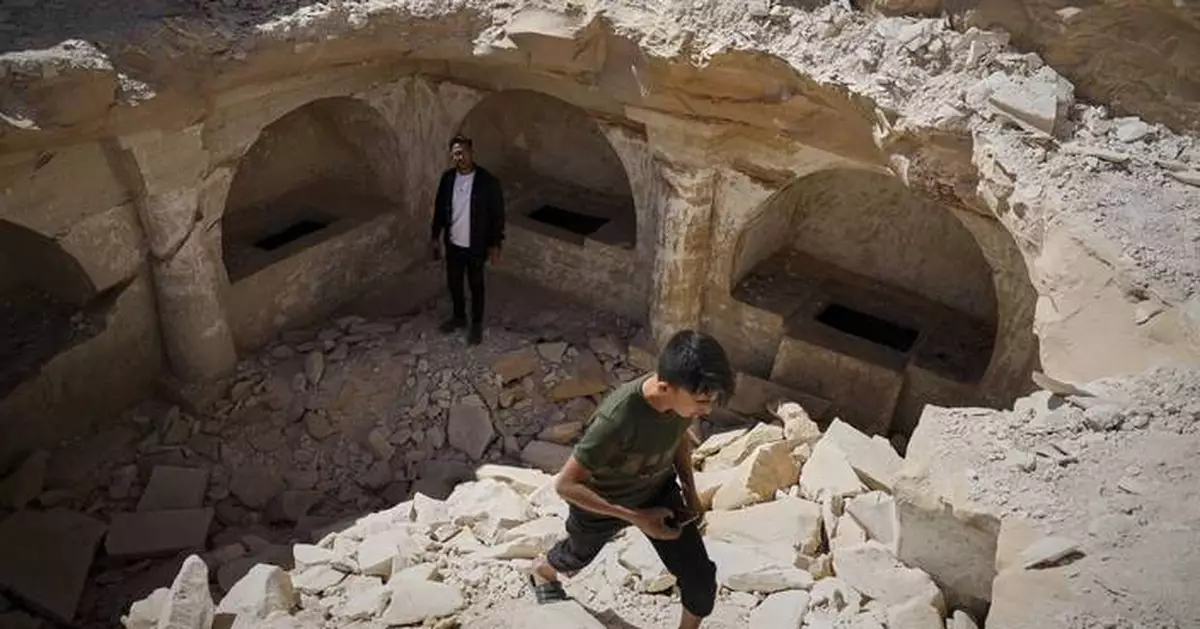
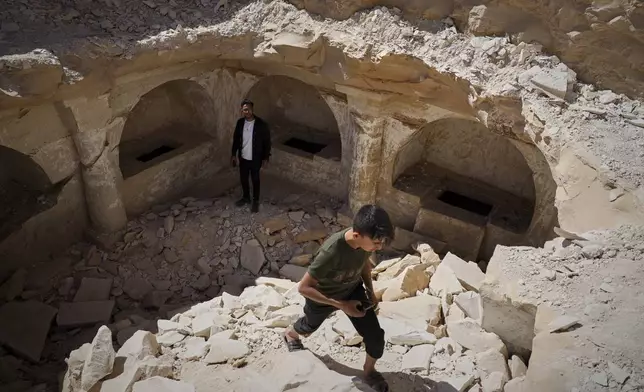
A boy walks out of a pit after exploring the tombs from a Byzantine underground complex, believed to be over 1,500 years old, uncovered by a contractor during the reconstruction of a war-damaged house in Maarat al-Numan, Idlib suburb, Syria, Friday, May 30, 2025. (AP Photo/Omar Albam)
Assad’s forces seized the area back from opposition control in 2020. Houses were looted and demolished. Aerial images of the area show many houses still standing but without roofs.
Now residents are beginning to return and rebuild. In the course of a reconstruction project, stone openings were uncovered indicating the presence of ancient graves. Residents notified the directorate of antiquities, which dispatched a specialized team to inspect and secure the site.
Aboveground, it’s a residential neighborhood with rows of cinder-block buildings, many of them damaged in the war. Next to one of those buildings, a pit leads down to the openings of two burial chambers, each containing six stone tombs. The sign of the cross is etched into the top of one stone column.
“Based on the presence of the cross and the pottery and glass pieces that were found, this tomb dates back to the Byzantine era,” said Hassan al-Ismail, director of antiquities in Idlib. He noted that the discovery adds to an already rich collection of archeological sites in the area.
Idlib "has a third of the monuments of Syria, containing 800 archaeological sites in addition to an ancient city,” al-Ismail said.
The Byzantine Empire, which began in the 4th century AD, was a continuation of the Roman empire with its capital in Constantinople — today's Istanbul — and Christianity as its official religion.
Abandoned Byzantine-era settlements called Dead Cities stretch across rocky hills and plains in northwest Syria, their weathered limestone ruins featuring remnants of stone houses, basilicas, tombs and colonnaded streets.
In the past, the owners of sites where archeological ruins were found sometimes covered them up, fearful that their property would be seized to preserve the ruins, said Ghiath Sheikh Diab, a resident of Maarat al-Numan who witnessed the moment when the tomb complex was uncovered.
He said he hoped the new government will fairly compensate property owners in such cases and provide assistance to the displaced people who have returned to the area to find their homes destroyed.
The years of war led to significant damage to Syria’s archeological sites, not only from bombing but from looting and unauthorized digging.
Some see in the ruins a sign of hope for economic renewal.
Another local resident, Abed Jaafar, came with his son to explore the newly discovered tombs and take pictures.
“In the old days, a lot of foreign tourists used to come to Maarat just to see the ruins,” he said. “We need to take care of the antiquities and restore them and return them to the way they were before … and this will help to bring back the tourism and the economy.”
Sewell reported from Damascus, Syria.
Residents drive past the war-damaged ancient market of Maarat al-Numan, near the site where a Byzantine underground tomb complex, believed to be over 1,500 years old, was uncovered by a contractor during the reconstruction of a war-damaged house, in Maarat al-Numan, Idlib suburb, Syria, on Friday, May 30, 2025. (AP Photo/Omar Albam)
A guard inspects an engraved stone, originally found at a Byzantine underground tomb complex believed to be over 1,500 years old and uncovered by a contractor during the reconstruction of a war-damaged house and brought to a museum yard in Maarat al-Numan, Syria, Friday, May 30, 2025. (AP Photo/Omar Albam)
Hassan Ismail of the Idlib Museum examines bones from a Byzantine underground tomb complex, believed to be over 1,500 years old, discovered by a contractor during the reconstruction of a war-damaged house in Maarat al-Numan, Idlib suburb, at the Idlib Museum, Syria, Friday, May 30, 2025. (AP Photo/Omar Albam)
Hassan Ismail of the Idlib Museum takes notes at a Byzantine underground tomb complex, believed to be over 1,500 years old, uncovered by a contractor during reconstruction of a war-damaged house in Maarat al-Numan, Idlib suburb, Syria, on Friday, May 30, 2025. (AP Photo/Omar Albam)
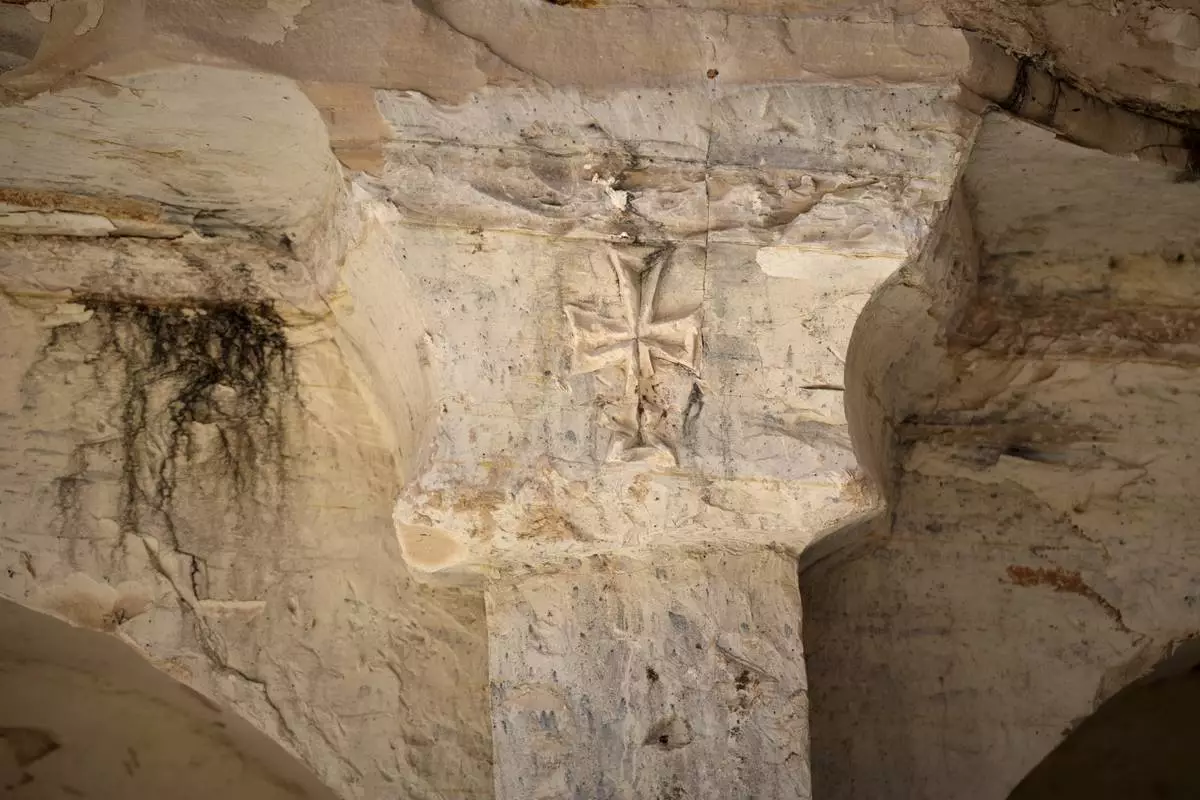
A sign of the cross is etched into the top of a stone column at a Byzantine underground tomb complex, believed to be over 1,500 years old, uncovered by a contractor during reconstruction of a war-damaged house in Maarat al-Numan, Idlib suburb, Syria, on Friday, May 30, 2025. (AP Photo/Omar Albam)
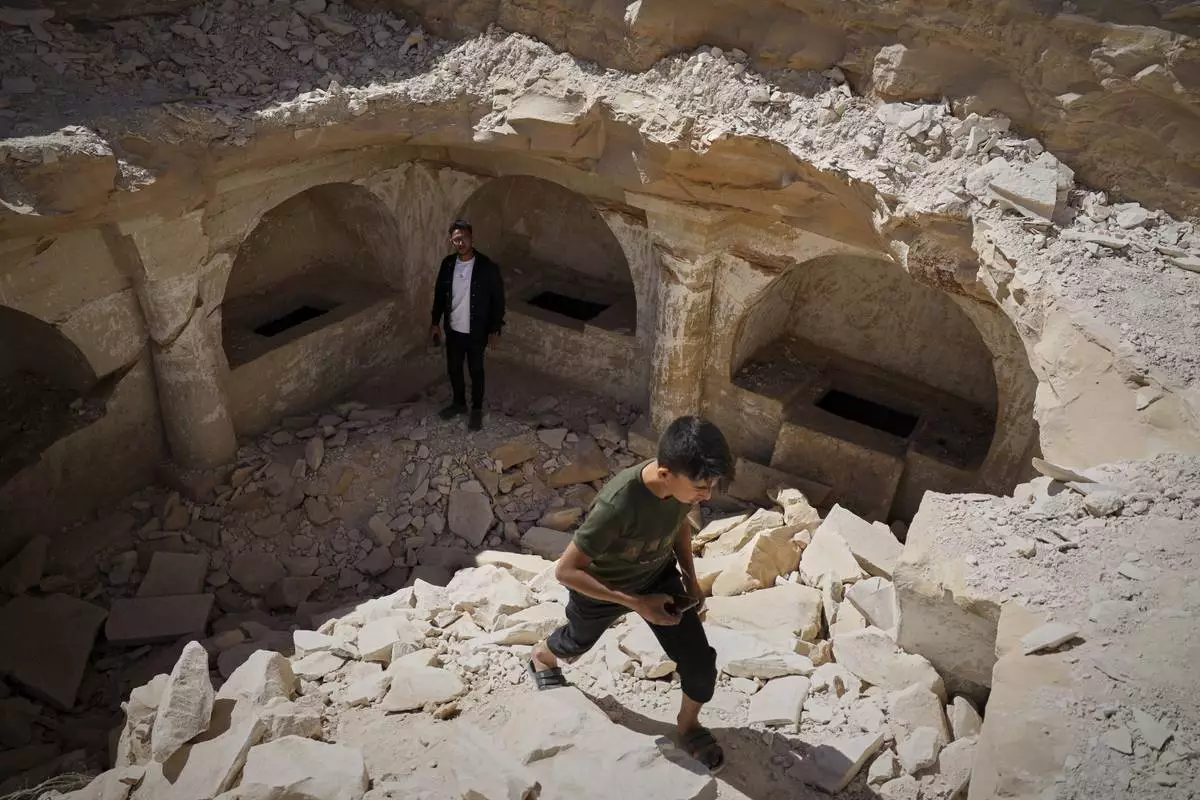
A boy walks out of a pit after exploring the tombs from a Byzantine underground complex, believed to be over 1,500 years old, uncovered by a contractor during the reconstruction of a war-damaged house in Maarat al-Numan, Idlib suburb, Syria, Friday, May 30, 2025. (AP Photo/Omar Albam)
MALABO, Equatorial Guinea (AP) — Pope Leo XIV arrived in Equatorial Guinea on Tuesday on the fourth and final leg of his Africa journey, and denounced the “colonization” of Africa's minerals and the “lust for power” in a country whose repressive leader has been in office since 1979.
Adoring crowds in the largely Catholic country lined the road from the airport into the capital, Malabo, cheering the first pope to visit since St. John Paul II in 1982. Wearing his formal red mozzetta cape, Leo thrilled the flag-waving masses by arriving at the presidential palace in his open-sided popemobile.
“There is a lot of joy today because we waited 44 years for the pope to come,” said Diosdao Marques, a senior Catholic official in the country. “It’s a blessing for the country, we hope many things will change and we will deepen our faith.”
The former Spanish colony on Africa’s western coast is run by Africa’s longest-serving president, Teodoro Obiang Nguema Mbasogo, who has been accused of widespread corruption and authoritarianism.
The discovery of offshore oil in the mid-1990s transformed Equatorial Guinea’s economy virtually overnight, with oil now accounting for almost half of its GDP and more than 90% of exports, according to the African Development Bank.
Yet more than half of the country’s nearly 2 million people live in poverty. And rights groups including Human Rights Watch — as well as court cases in France and Spain — have documented how revenues have enriched the ruling Obiang family rather than the broader population.
Leo, who arrived from Angola, met with Obiang at the presidential palace and then addressed government authorities, diplomats and civil service representatives. Noting that the encounter occurred on the first anniversary of Pope Francis’ death, Leo quoted the late pope in denouncing income inequalities that he said had been exacerbated by a global economy focused on the pursuit of profit at all cost.
“Such an economy kills,” Leo said. “In fact, it is even more evident today than in years past that the proliferation of armed conflicts is often driven by the colonization of oil and mineral deposits, occurring with no regard for international law or the self-determination of peoples.”
He said all public authorities must “dismantle the obstacles” to sustainable and human development, “a mission grounded in the fundamental principles of solidarity and the universal destination of goods,” he said.
The meetings took place in the old presidential palace. The government has built a new capital on the mainland, named Ciudad de la Paz, or City of Peace, but the transfer of government buildings hasn’t been completed yet.
Authorities have said the decision to build the new capital was strategic, given the potential for expansion of the city carved out in the middle of a tropical forest. But critics said the relocation of the capital would exacerbate existing inequalities and give further opportunities for the presidential circle to enrich themselves
Leo referred to the new capital by citing to the famous work of St. Augustine, “City of God,” in which the 5th-century philosopher interpreted humanity through two models: The “earthly city” where people live temporarily, and the eternal “city of God,” characterized by God’s unconditional love and love of one another, especially the poor.
Leo didn't call out the corruption associated with the Obiang family or the criticism of the new capital. But he suggested Equatorial Guinea should look to the “City of God” as a model for its new capital.
“The earthly city is centered upon the proud love of self, on the lust for power and worldly glory that leads to destruction,” he said. “It is essential to discern the difference between that which lasts and that which passes, remaining free from the pursuit of unjust wealth and the illusion of dominion."
Equatorial Guinea is officially a secular country, but the Catholic Church is at the center of its political and social systems.
Church leaders “are very much interconnected intrinsically with the government,” said Tutu Alicante, a U.S.-based activist who runs the EG Justice rights group. “Part of it is the fear the government has instilled in everyone, including the church, and part of it is the monetary gains that the church derives from this government.”
The Rev. Fortunatus Nwachukwu, No. 2 in the Vatican’s missionary evangelization office, said the Catholic Church is present in difficult civil spaces and knows how to operate in them to carry out its mission.
“Should the church go to war against the government? Surely no,” Nwatchukwu said. “Should the church swallow everything as if it were normal? No. The church has to continue preaching justice, always in defense of life, human dignity and the common good.”
That is particularly challenging in Equatorial Guinea, which with about 75% of its population Catholic is one of the most Catholic countries in Africa.
But it’s also one of the most oppressed. In addition to official corruption, the country’s government also faces rampant accusations of harassment, arrest and intimidation of political opponents, critics and journalists.
Equatorial Guinea is also one of several African nations that have been paid millions of dollars in controversial deals with the Trump administration to receive migrants deported from the U.S. to countries other than their own.
AP reporting shows that at least 29 such migrants with no ties to the country have been deported there. Some remain in detention in Malabo with restrictions on legal and medical support, while others have been forcibly returned to their countries where they face persecution.
Leo, who will visit a prison in the port city of Bata on Wednesday, has criticized the Trump administration’s overall migration deportation policy as “extremely disrespectful.”
The country has consistently ranked among the bottom 10 countries in Transparency International’s annual corruption perception index, though the government has in recent years taken some steps to improve the situation with a new anti-corruption law, said Transparency International’s regional advisor for Africa, Samuel Kaninda.
Kaninda said he hoped the pope’s visit would draw attention to such shortcomings, and give the people of Equatorial Guinea hope. Even if the government exploits the visit to signal a papal endorsement of its rule, historically pope trips to even authoritarian regimes have ended up as a net positive experience for the people, he said.
“The risk is there, but at the same time, we see more of the opportunity to shed more light on a lot more that is happening there,” he said.
Associated Press writers Monika Pronczuk in Malabo, Equatorial Guinea and Ope Adetayo in Lagos, Nigeria, contributed to the reporting.
Associated Press religion coverage receives support through the AP’s collaboration with The Conversation US, with funding from Lilly Endowment Inc. The AP is solely responsible for this content.
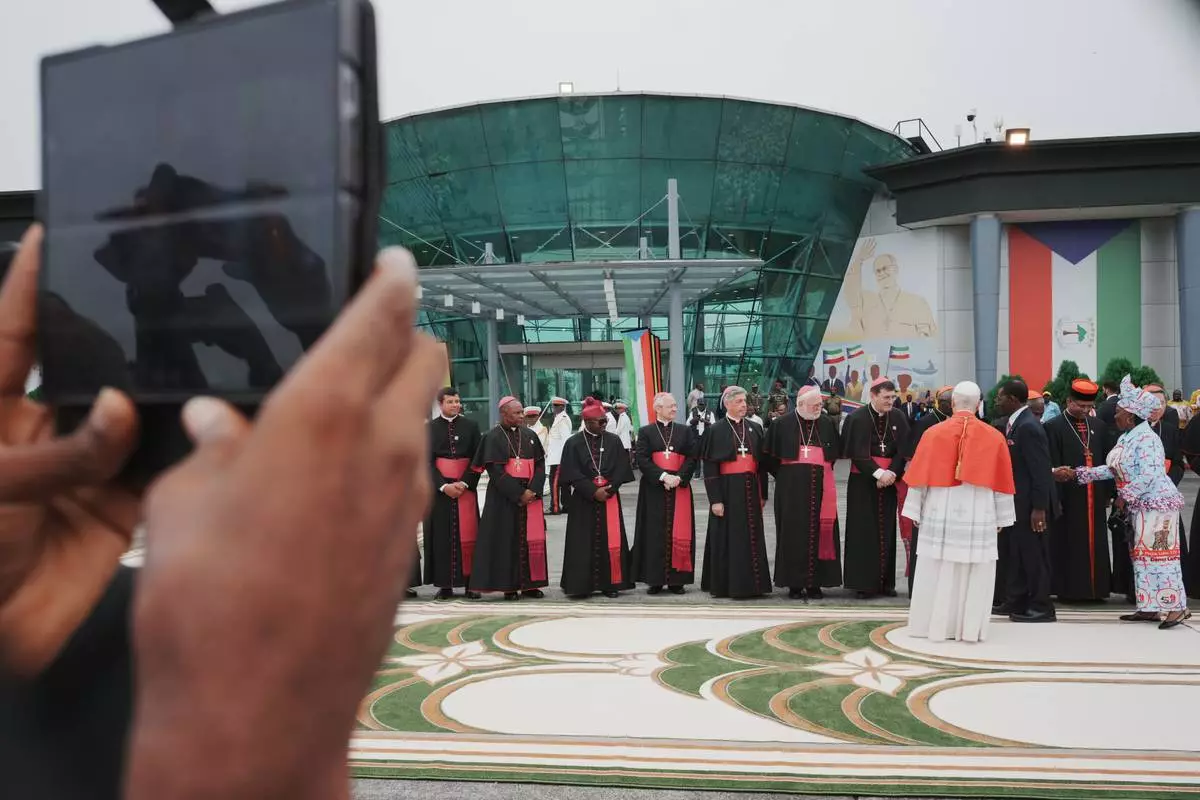
Pope Leo XIV is welcomed by Equatorial Guinea's President Teodoro Obiang Nguema Mbasogo, fifth from right, and his wife, second from right, Constancia Mangue de Obiang, upon his arrival at Malabo International Airport in Malabo, Equatorial Guinea, Tuesday, April 21, 2026, on the ninth day of his 11-day pastoral visit to Africa. (AP Photo/Andrew Medichini)
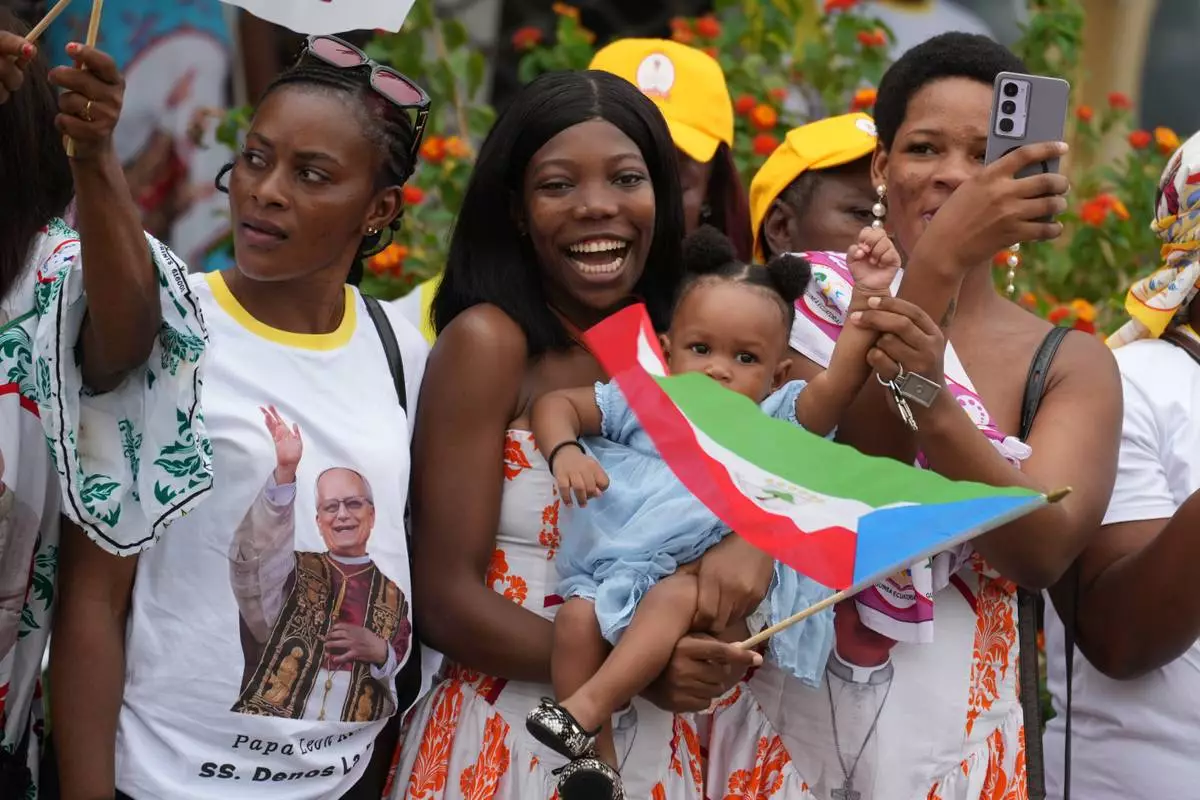
People wait for Pope Leo XIV in Malabo, Equatorial Guinea, Tuesday, April 21, 2026, on the ninth day of his 11-day pastoral visit to Africa. (AP Photo/Andrew Medichini)
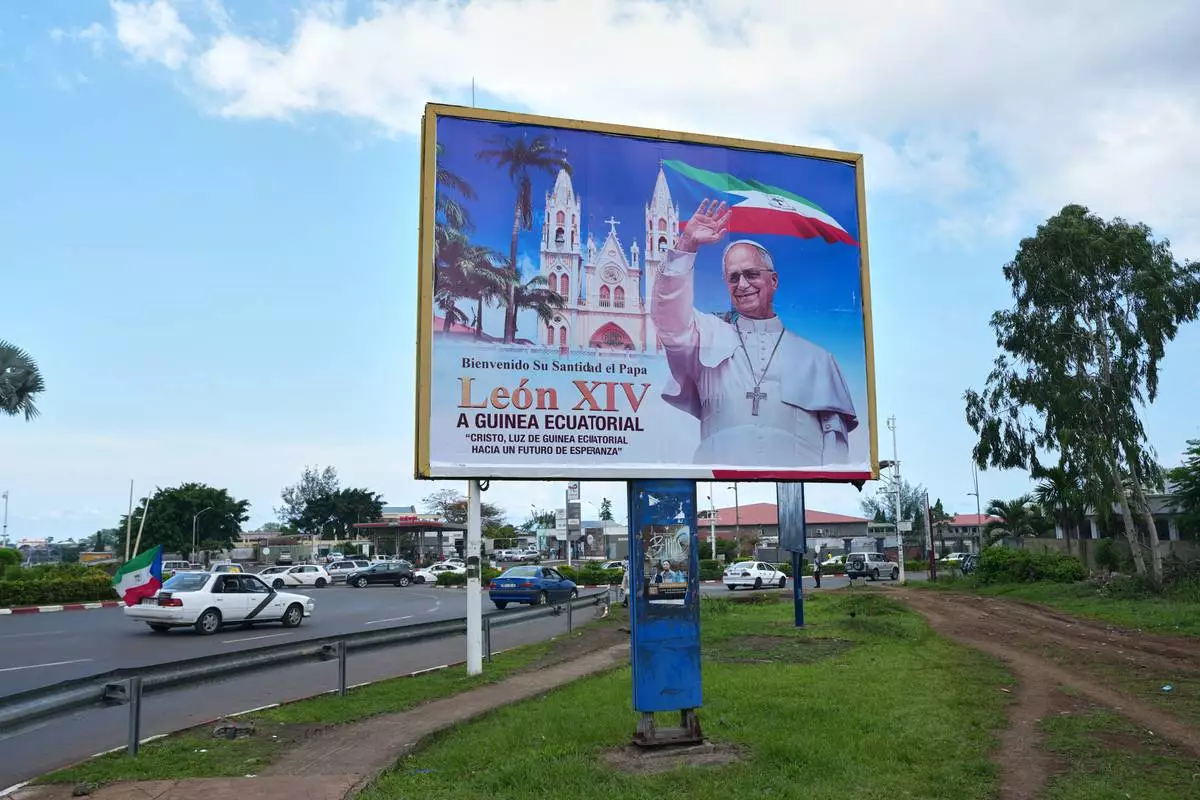
A billboard featuring Pope Leo XIV is seen ahead of his visit in Malabo, Equatorial Guinea, Friday, April 17, 2026. (AP Photo/Misper Apawu)
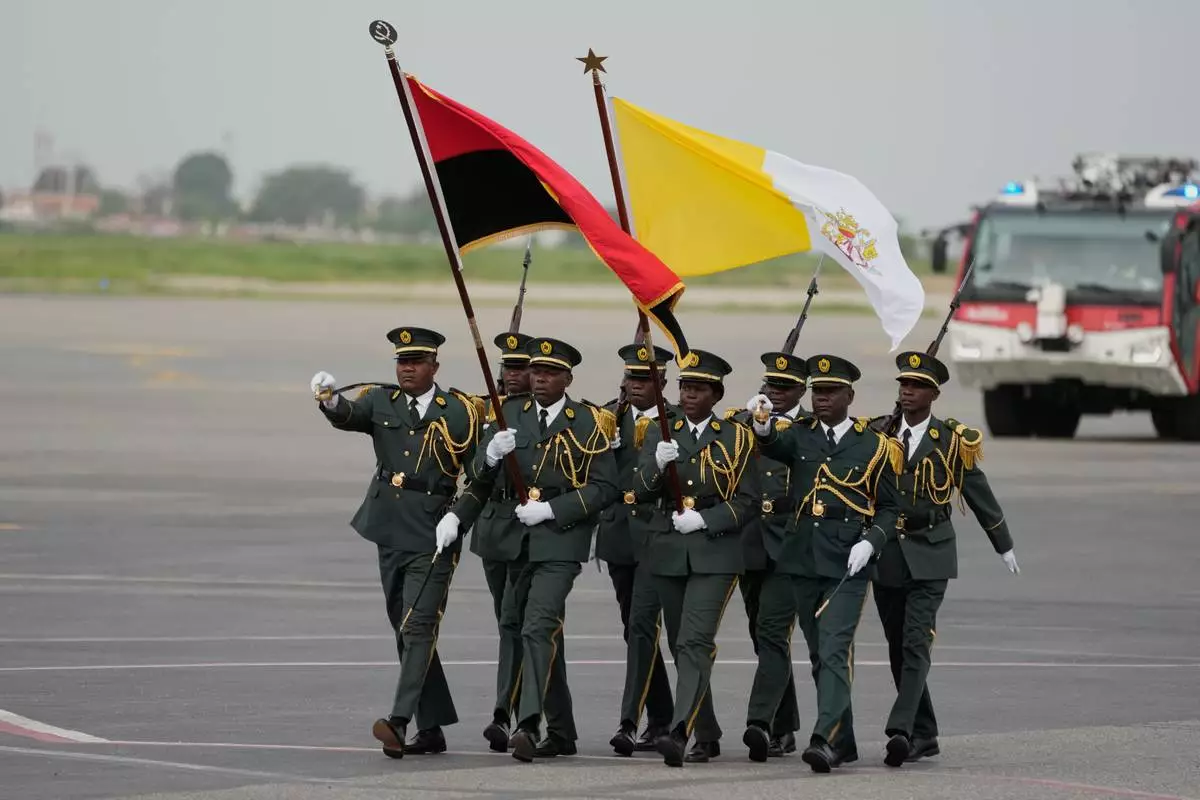
Soldiers march carrying the Vatican flag, right, and Angolan flag prior to Pope Leo XIV's departure for Equatorial Guinea, at the airport in Luanda, Angola, Tuesday, April 21, 2026. (AP Photo/Themba Hadebe)
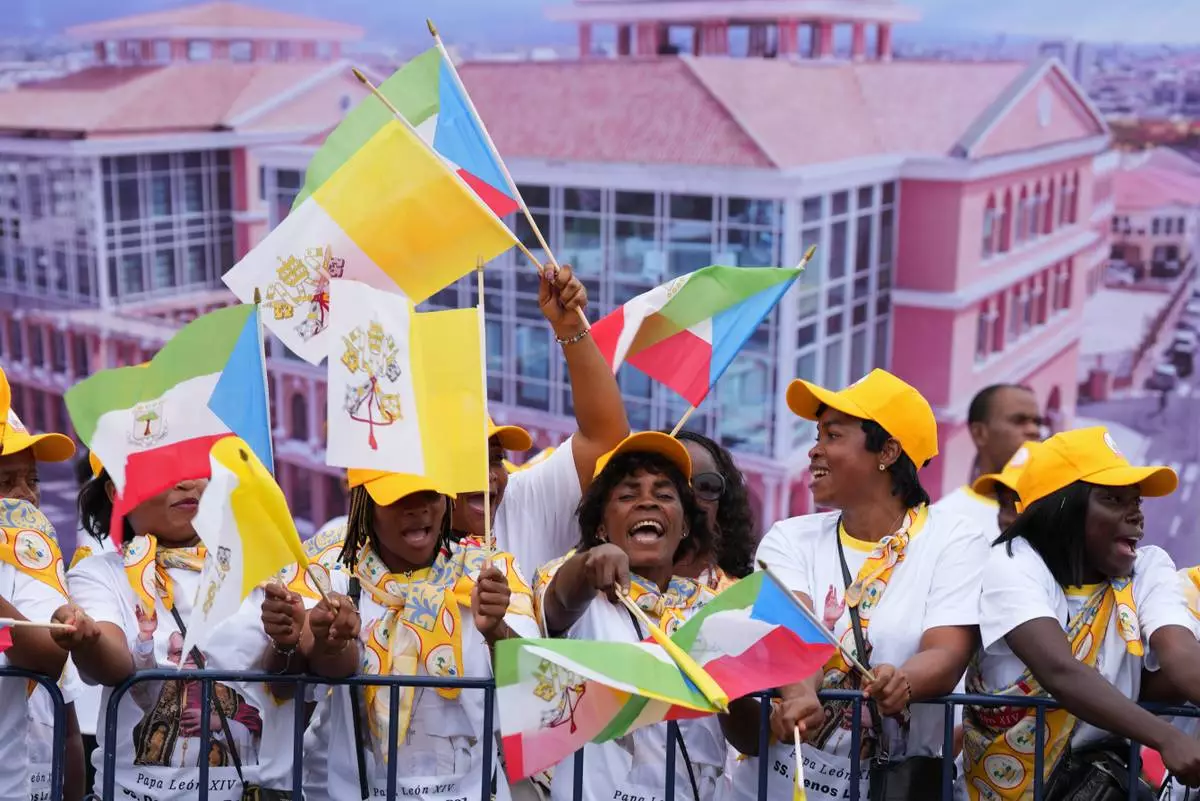
Faithful wait for the arrival of Pope Leo XIV at the airport in Malabo, Equatorial Guinea, Tuesday, April 21, 2026. (AP Photo/Misper Apawu)
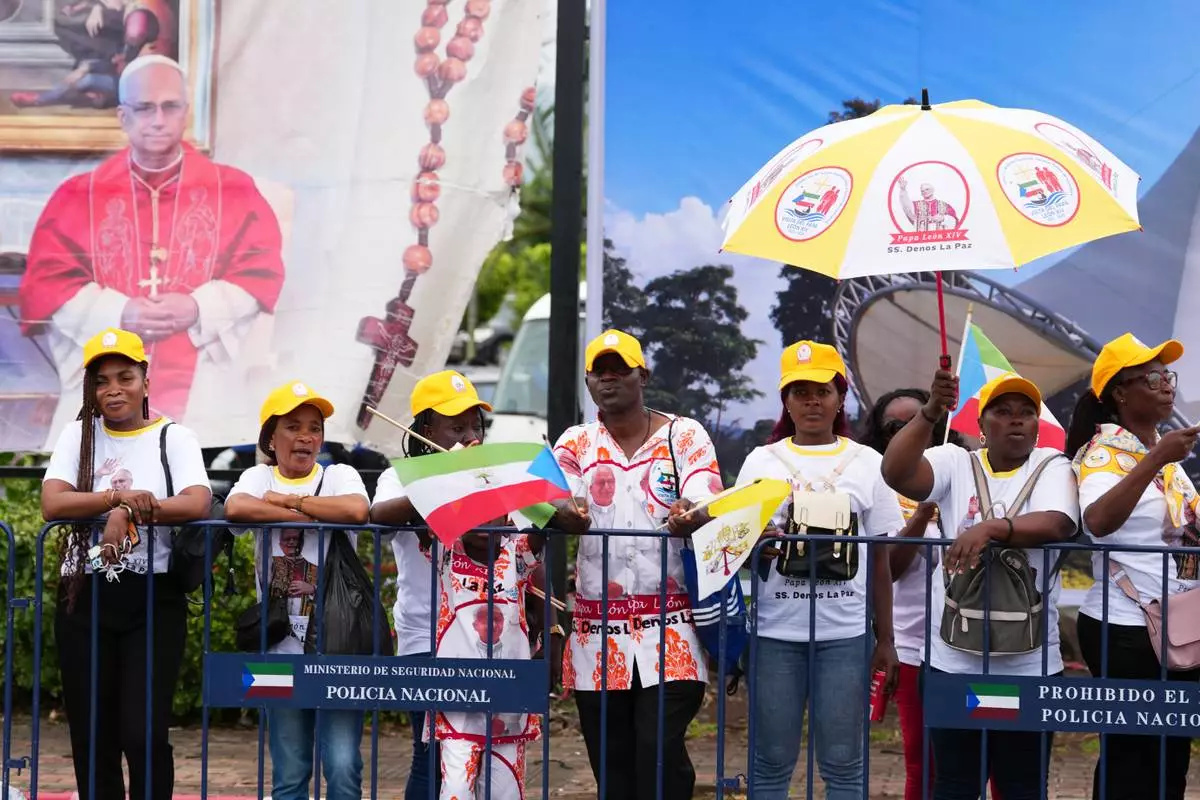
Faithful wait for the arrival of Pope Leo XIV at the airport in Malabo, Equatorial Guinea, Tuesday, April 21, 2026. (AP Photo/Misper Apawu)
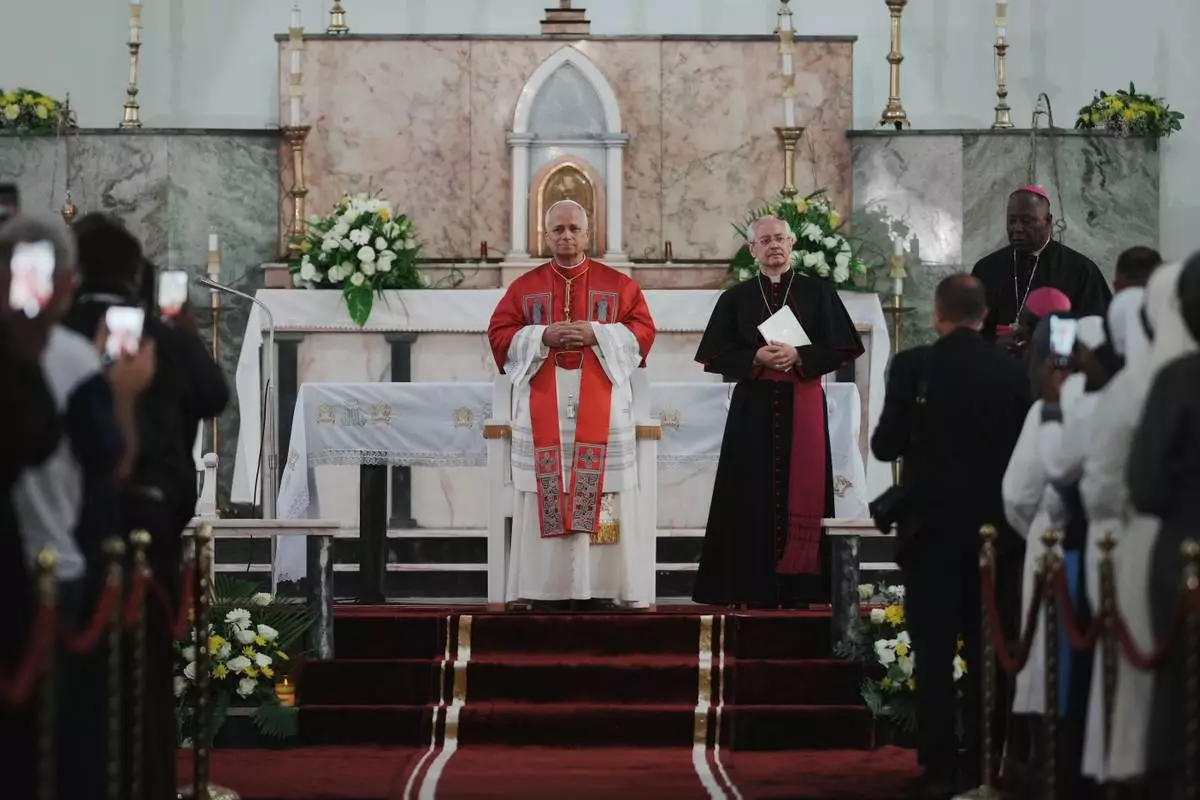
Pope Leo XIV arrives at the Parish of Our Lady of Fatima in Luanda, Angola, for a meeting with bishops, priests, consecrated men and women, and pastoral workers Monday, April 20, 2026, on the eighth day of an 11-day apostolic journey to Africa (AP Photo/Andrew Medichini)
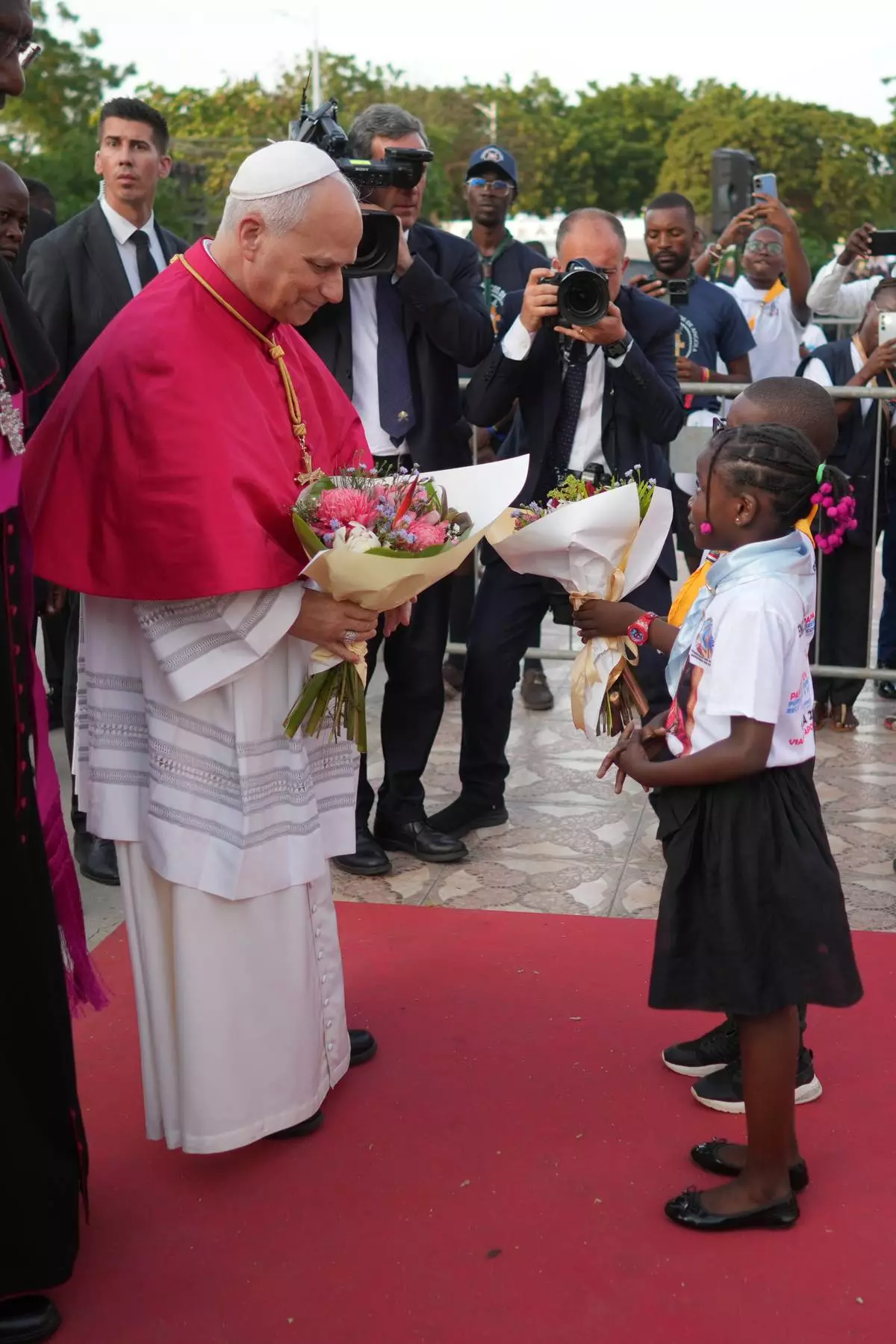
Pope Leo XIV arrives at the Parish of Our Lady of Fatima in Luanda, Angola, for a meeting with bishops, priests, consecrated men and women, and pastoral workers Monday, April 20, 2026, on the eighth day of an 11-day apostolic journey to Africa (AP Photo/Andrew Medichini)
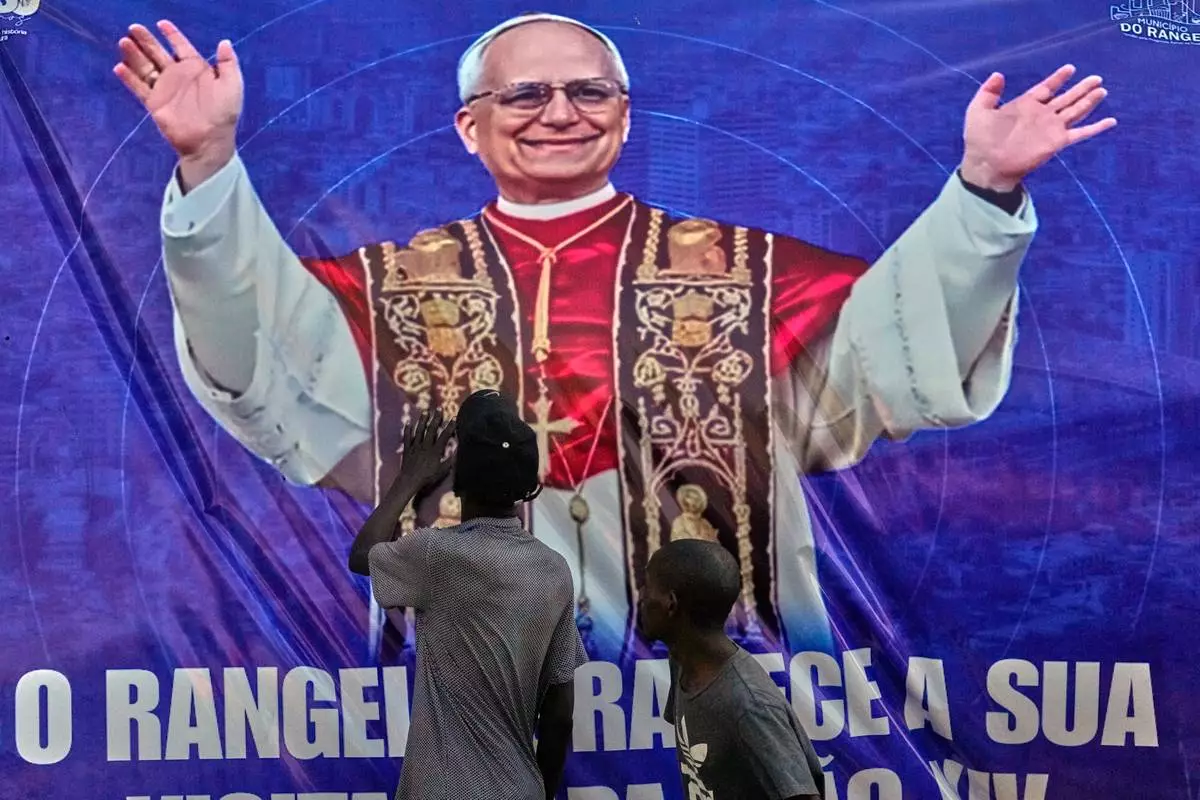
People touch a banner bearing an image of Pope Leo XIV in Luanda, Angola, Monday, April 20, 2026. (AP Photo/Themba Hadebe)
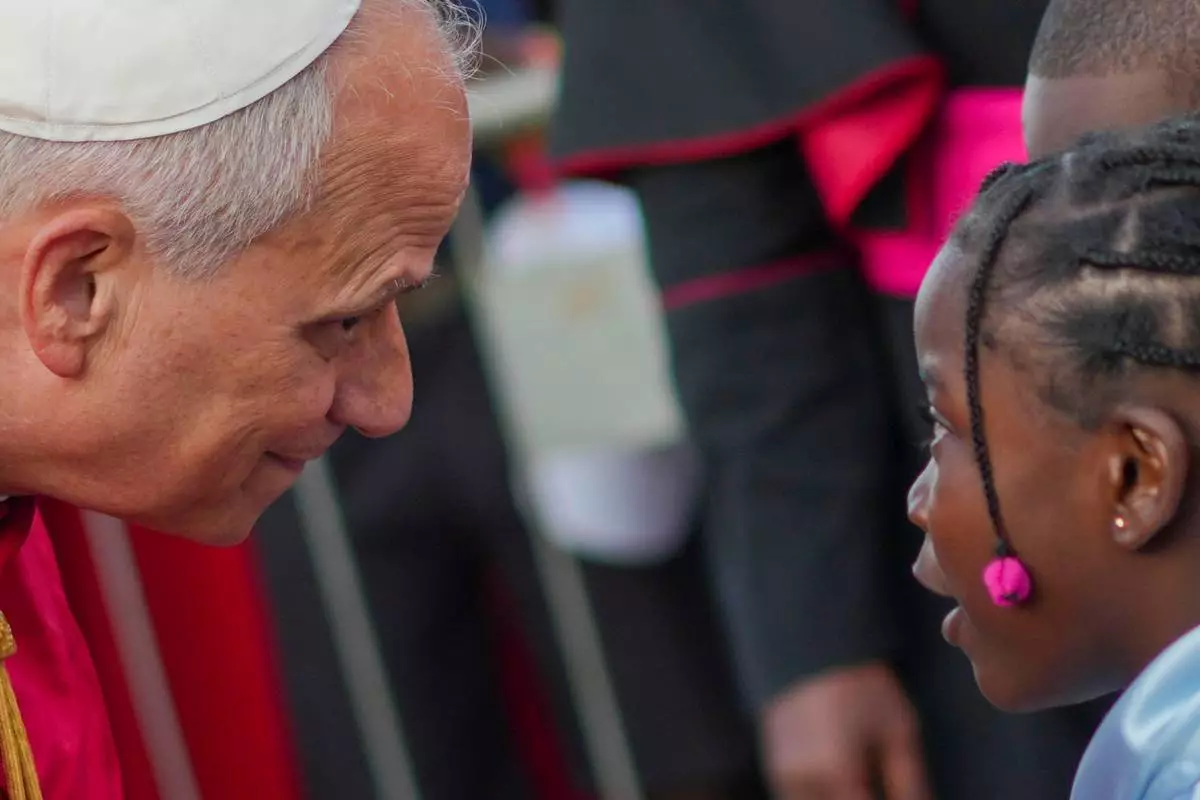
Pope Leo XIV listens to a girl as he arrives at the Parish of Our Lady of Fatima in Luanda, Angola, for a meeting with bishops, priests, consecrated men and women, and pastoral workers Monday, April 20, 2026, on the eighth day of an 11-day apostolic journey to Africa (AP Photo/Andrew Medichini)