A 30-year-old audio equipment manufacturer and exporter in south China's tech hub of Shenzhen has successfully pivoted to the domestic market amid the sweeping tariffs from the United States by forging a collaboration partnership with a company in Beijing.
In collaboration with a Beijing-based solution provider, the company has not only overcome a sudden export slump, but also unlocked new growth opportunities in China's booming smart home entertainment sector.
Chen Weisong, founder and chairman of Shenzhen Shengtianlong Audio-Visual Technology, and Hei Weiwei, general manager of Beijing Yuanxiang Intelligent Technology, are now working together to develop cutting-edge smart audiovisual products aimed at revolutionizing home theater experiences.
They made acquaintance only a month ago, after Chen posted a collaboration notice on a domestic supply chain platform to explore new opportunities and fill the gap created by withdrawn export orders.
Chen decided to expand into the European, Middle East and Southeast Asian markets when he sensed growing trade tensions between China and the United States in 2018, and reduced his company's reliance on the U.S. market to just 20 percent. However, for a renowned brand with more than 200 patents, that still means millions of products exported to the United States per year. After U.S. President Donald Trump announced the "Liberation Day" tariffs in early April, Chen had 3 million yuan (about 420,000 U.S. dollars) worth of products stranded in warehouses.
Fortunately, only three hours after Chen posted the notice, he received a call from Hei, who flew to Shenzhen the next morning.
"It was rare to see exporters posting product information and cooperation notices on the domestic supply chain platform. I was just wondering why there were some more suppliers on the platform, and it turned out they were all very strong in their businesses," Hei said.
Hei had been searching for high-quality audio suppliers to jointly develop ultra-high-definition audiovisual products that meet China's industry standards, addressing the long-standing issue that Chinese products are strong in visual performances but weak in acoustics.
Impressed by the quality of Chen's products and his company's research and development capabilities, Hei proposed a partnership to combine their strengths and develop smart home theater systems together.
"When we presented our joint product concept to downstream businesses, they said they will place orders as soon as our products are ready," Hei said.
Motivated by urgent market demands, Chen and his team have been working tirelessly, visiting suppliers in various cities like Huizhou and Jieyang to source raw materials and core components for their new products.
Chen found that the domestic audio industry was witnessing increased specialization, with increasing demand for premium audio products driving innovation in materials and manufacturing processes.
"Domestic consumers' rising requirements for the quality of audiovisual products, including acoustic experiences, are pushing us to upgrade our designs, techniques, and supply chain partners. So, we are striving to meet domestic needs. This market holds huge potential," said Chen Zhigang, a Huizhou-based supplier.
The first product developed by Chen and Hei has already been released and started small-scale production, with five more series in development.
Meanwhile, the one-month halt of U.S. orders has ended, with American clients placing additional orders for 10 more containers, so Chen's six production lines are all running at full capacity.
"This year, we plan to sell 20 or 30 percent of our products in the domestic market. My goal is to raise the proportion to at least 50 percent in the future," Chen said.

Shenzhen audio exporter seeks domestic partners amid US tariffs
The three astronauts of China's Shenzhou-21 crewed spaceflight mission returned safely to Earth on Friday after completing their planned tasks aboard the Tiangong space station.
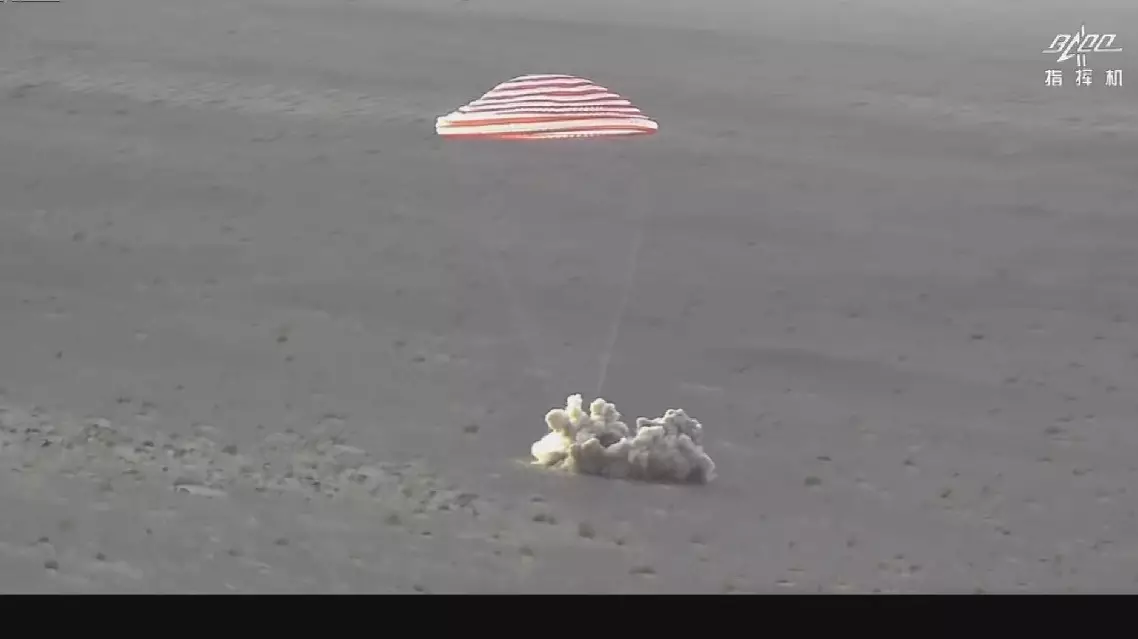
The return capsule of the Shenzhou-22 spaceship, carrying Shenzhou-21 astronauts Zhang Lu, Wu Fei and Zhang Hongzhang, touched down at the Dongfeng landing site in north China's Inner Mongolia Autonomous Region at 20:11 Beijing Time (1211 GMT), according to the China Manned Space Agency.
The returned astronauts were reported to be in good physical condition after landing, according to staff on site.
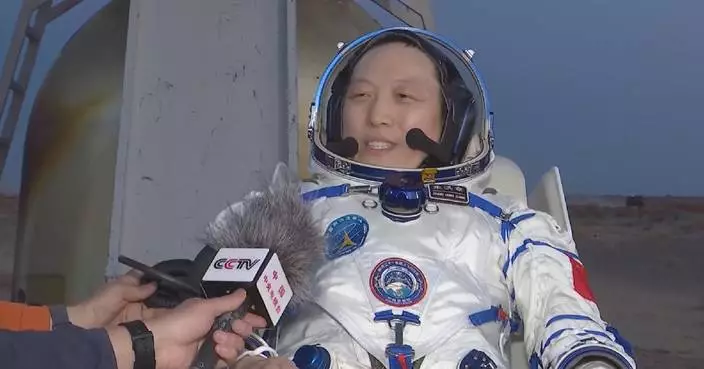
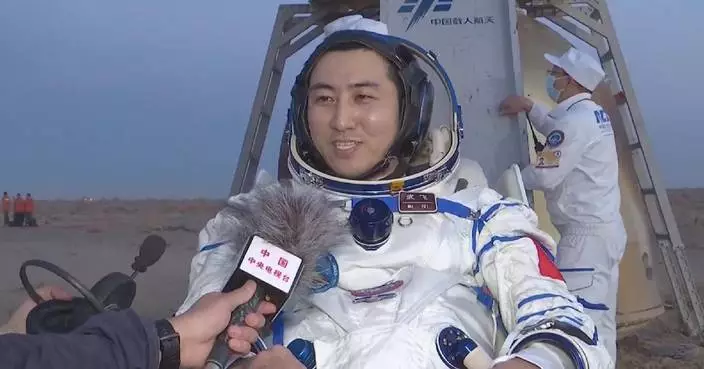
Zhang Lu was the first to exit the return capsule after it touched down on Earth.
"I'm thrilled to once again return to the embrace of our motherland. The Shenzhou-21 crew's seven-month stay in orbit would not have been possible without the care of our families and comrades, the support of leaders at all levels and all colleagues involved in the project, and above all, the backing of our country and our people. One sentence sums up my thoughts on my second space mission: 'It takes a whole team's devotion to make one person's voyage into the sea of stars,' " Zhang said in an interview with China Central Television (CCTV) shortly after he was carried out of the return capsule.
"I also have a gift to share with everyone. On the day of the Shenzhou-21 launch, the ground support team gave us an apple, wishing us a safe and smooth mission. Our safe return is their greatest wish. Tomorrow is May 30, the National Science and Technology Workers' Day. So when we left the space station, we specifically brought back an apple. We want to give it to all science and technology workers, and say 'thank you for your hard work'. At the same time, I wish our space industry continued prosperity, and every mission safe and smooth," he said.
"Returning to Earth and to the embrace of our motherland, I feel extremely secure and proud. Being entrusted with such a significant responsibility in my first space mission is a great honor. It is the trust of my country, the guidance of my predecessors, and the teamwork of the entire crew that enabled me to successfully complete the mission. This mission has taught me that the most beautiful posture of youth is to march out for the country. I will turn this space experience into the driving force for my continued progress, and continue to fight and strive for the manned space program," said crew member Wu Fei.
"From the ground laboratory to China's space station, it is our great motherland that has enabled me to achieve a perfect integration of my scientific ideals and spaceflight dreams. With the support of the entire project team, the assistance of researchers and scientists, and the care of so many people, our crew has worked as one and successfully completed all assigned scientific projects, including the first successful in-orbit breeding of small mammals, the growing of a thriving space vegetable garden with an even wider varieties, and the collection of valuable data from projects such as in-situ electrochemical and optical studies on lithium-ion batteries," said Zhang Hongzhang, who was the last of the astronauts to exit the spacecraft.
"Looking at Earth from space, I deeply felt that humanity is an indivisible community with a shared future. Now that I am back on Earth and have returned to my motherland, I feel an immense sense of security and warmth. Going forward, I will continue to build on these achievements and contribute to making China a strong power in space, science and technology," he said.
The returned crew members will now head to Beijing by plane and enter a quarantined recovery period, during which they will undergo comprehensive medical examinations and health assessments and start their recuperation process.
Prior to their return, the astronauts completed all planned tasks and handed over the space station to their three colleagues of the Shenzhou-23 mission who boarded the space station on May 25.
The crew's planned stay in-orbit was extended by approximately one month to further verify the technologies regarding the long-term stay of astronauts in orbit and fully use the supplies delivered by the Shenzhou-22 spacecraft in an emergency launch.
The Shenzhou-21 crew's original spaceship, which sent them into space on Oct 31 last year, was previously returned to Earth carrying the astronauts of the preceding Shenzhou-20 mission after tiny cracks were found in the viewport window of the Shenzhou-20 manned spacecraft's return capsule. That spacecraft was later safely brought back to Earth.
Shenzhou-21 crew return to Earth after successful seven-month mission in space