Protesters clashed with U.S. law enforcement officers in Los Angeles on Sunday during the latest demonstrations against immigration raids that swept across California over the weekend.
The clash came after agents from Immigration and Customs Enforcement (ICE) and other federal law enforcement agencies raided several locations in southern California on Friday, which sparked mass protests.
Washington vowed on Saturday to continue the raids despite opposition from local communities and officials. U.S. President Donald Trump took extraordinary action on Saturday by calling up 2,000 National Guard troops to quell immigration protests in the Los Angeles region.
On Sunday, crowds of demonstrators took to the streets in Los Angeles, calling for the withdrawal of National Guard troops, arguing that their arrival would only escalate tensions.
In downtown Los Angeles, protesters faced off with National Guard soldiers in front of a detention center, where the detained immigrants kept knocking on windows.
Tensions rose as police officers used tear gas and rubber bullets to disperse the crowd, leading to several arrests.
"You all told us to come here for opportunity, we came and then now it's like, oh, you have to leave. But when I was the working class, you all loved me, right? But now that we're too many people, what's the issue? " said Regina, a protester.
"We're here protesting for our families that are being separated in our neighborhoods and we want justice," said Sophia, another protester.
She further argued that the arrival of National Guard troops only makes things worse.
"They're just making it worse. It's just making us not trust our own government. They're throwing things at us. We're just in an unsafe space," she added.
The protesters also criticized ICE for targeting immigrants who are hard-working and have contributed to the community.
"It's a fight for our community. LA wouldn't be what it is without us. There is no need for it. I'm a victim of the fires in Altadena and they didn't help at all. They didn't even let us go back to our home," said Giselle, a protester.

Protesters clash with law enforcement officers in Los Angeles
A new round of trade-in subsidy program is energizing China's consumer market these days, with provinces across the country seeing a surge in demand for cars, home appliances and digital devices.
In north China's Shanxi Province, the new trade-in subsidy program, which started on January 9, has further helped boost sales in home appliances and digital devices which are covered by the new round of subsidies.
To enjoy the subsidies, six types of home appliances, including refrigerators and washing machines, must meet national Level 1 energy-efficiency or water-efficiency standards. Digital and smart products include four types, such as mobile phones and tablets, with a sales price cap of 6,000 yuan (about 800 U.S. dollars) per item.
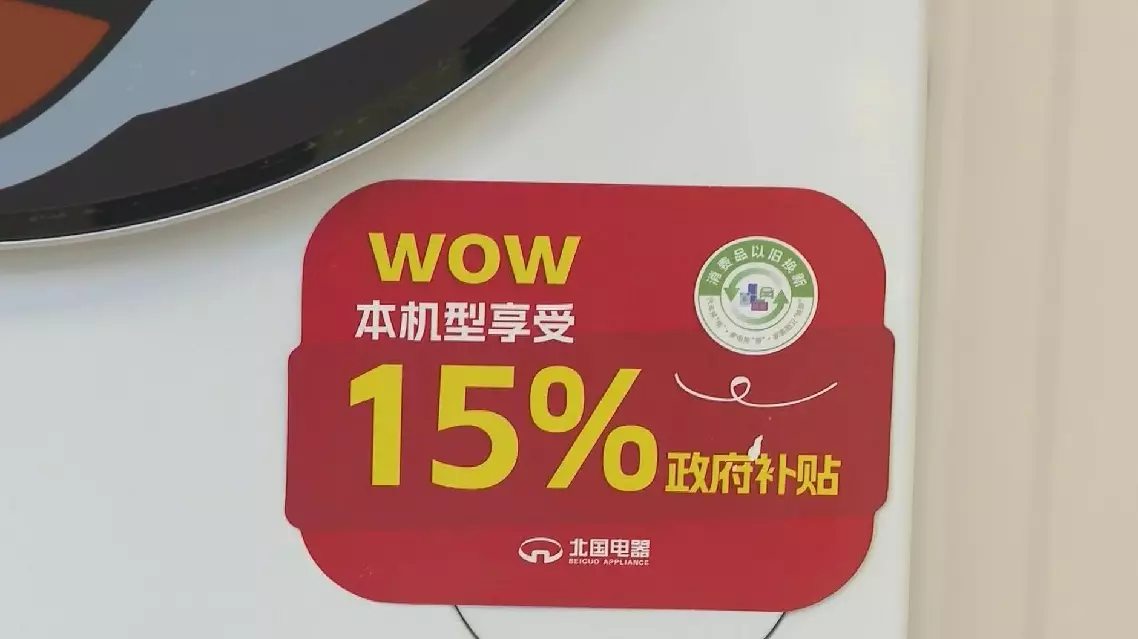
In both categories, subsidies are set at 15 percent of the final transaction price. For home appliances, the maximum subsidy is 1,500 yuan per item. For digital products, the cap is 500 yuan per item. Each consumer can receive a subsidy for one unit in each category.
Neighboring Shanxi, Hebei Province kicked off the year of 2026 with the new round of trade-in subsidy program starting on January 1.
The subsidies cover automobiles, home appliances, and digital products. Individual consumers who purchase designated Level 1 energy-efficiency appliances or eligible digital products priced at no more than 6,000 yuan can receive subsidies equal to 15 percent of the transaction price. The maximum subsidy is 1,500 yuan per appliance and 500 yuan per digital or smart device, with each person limited to one subsidized item in each category.
Data showed that from Jan 1 to 9, Hebei's home appliance trade-in program alone disbursed more than 130 million yuan in subsidies, driving sales of over 920 million yuan.
In east China's Jiangsu Province, the new trade-in subsidy program, taking effect for two weeks, has brought the province a boom in trade-in.
At a local 4S store in Jiangsu's Suqian City, showroom traffic has spiked as salespeople walked customers through the new benefits from the trade-in subsidy program.
"Under the scrappage-and-replacement scheme, customers who buy a new energy vehicle (NEV) can receive a subsidy worth 12 percent of the vehicle price, capped at 20,000 yuan (about 2,860 U.S. dollars). For combustion-engine cars, the subsidy is 10 percent, with an upper limit of 15,000 yuan. For trade-ins, NEVs are able to receive a subsidy worth 8 percent of the vehicle price, up to 15,000 yuan, while combustion-engine cars will receive a 6-percent subsidy, with a cap of 13,000 yuan," said Sun Yue, a saleswoman at the store.
In the home appliance sector, Jiangsu's policy this year stipulates that only products that meet China's Level 1 energy-efficiency standard are eligible for subsidies. The scheme covers six major categories, including refrigerators and washing machines.
Consumers who purchase qualifying appliances can receive a subsidy equal to 15 percent of the final retail price, up to a maximum of 1,500 yuan per item. Each person is limited to one subsidized unit per product category.
Four types of digital and smart products, such as mobile phones and tablets, are eligible for a 15-percent subsidy capped at 500 yuan per unit, with a retail price no more than 6,000 yuan.
"With the national subsidy policy back in place this year, I went to the store to check what discounts I could get. It knocked 500 yuan off the price. [The discounted price is] very reasonable," said Wang Kang, a resident of Jiangsu's Xuzhou Province.
To enhance the shopping experience for consumers, many retailers are pairing subsidies with "one-stop" services that combine the delivery of new products with on-site collection of old ones.
"After consumers place an order for new home appliances, our staff will schedule a time to pick up the old units. Recycling the old appliance can also further offset the purchase price of the new one," said Yang Jie, a sales supervisor at a major home appliance company.
China's new trade-in program sparks consumption boom