SEATTLE--(BUSINESS WIRE)--Jun 9, 2025--
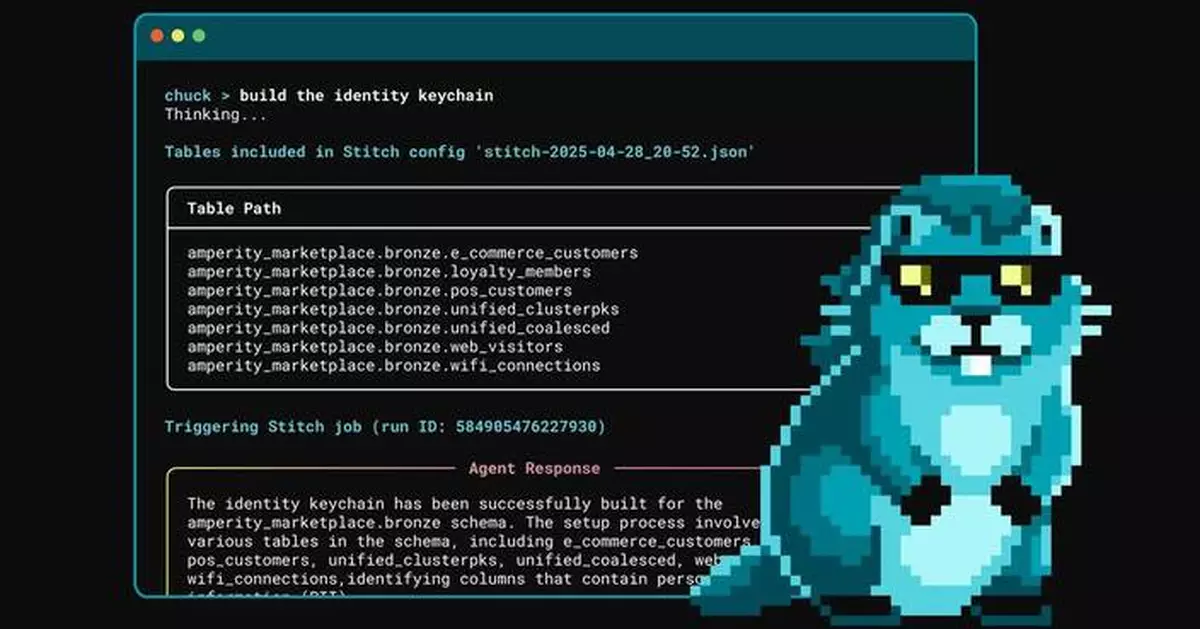
Amperity, the AI-powered customer data cloud, today launched Chuck Data, the first AI Agent built specifically for customer data engineering. Chuck uses Amperity's years of experience and patented identity resolution models, trained on billions of data sets across 400+ enterprise brands, as critical knowledge behind the AI. Chuck runs in the terminal and empowers engineers to quickly understand their data, tag it, and resolve customer identities in minutes - all from within their Databricks lakehouse.
This press release features multimedia. View the full release here: https://www.businesswire.com/news/home/20250609092916/en/
As pressure mounts to deliver business-ready insights quickly, data engineers are hitting a wall: while infrastructure has modernized, the work of preparing customer data still relies on manual code and brittle rules-based systems. Chuck changes that by enabling data engineers to “vibe code” - using natural language prompts to delegate complex engineering tasks to an AI assistant.
Chuck connects directly to a user’s Databricks environment, leveraging native compute and large language model (LLM) endpoints to execute high-impact workflows like identity resolution, compliance tagging, and data profiling.
“Customer data engineering is full of repetitive, painful work, so we built Chuck to get rid of it,” said Derek Slager, co-founder and CTO at Amperity. “Chuck understands your data and helps you get stuff done faster, whether you’re stitching identities or tagging PII. No orchestration, no UI gymnastics—it’s just fast, contextual, and command-driven.”
Key Features of Chuck Data:
Built for Databricks, Backed by Amperity’s Identity Expertise
Chuck runs entirely in your terminal, using your Databricks environment for compute, storage, and LLM execution. With a single install, engineers can run natural language commands that eliminate manual code and deliver accurate, scalable customer profiles.
A core capability of Chuck is running Amperity’s patented identity resolution algorithm - the same trusted Stitch technology used in its enterprise CDP. Users can run unlimited free Stitch on datasets up to 1 million records with a generous budget of credits for larger data sets included for free with the research preview program.
Paid plans unlock unlimited runs, access to Amperity’s stable ID algorithm, and enterprise support.
Experience Chuck Data Live at Databricks Data + AI Summit
Amperity will demo Chuck live at Booth #704 during the Databricks Data + AI Summit, June 9–12 in San Francisco. Stop by to see how Chuck:
Want to see Chuck in action? Check out the demo at https://amperity.com/capabilities/chuck.
About Amperity
Amperity's Customer Data Cloud empowers brands to transform raw customer data into strategic business assets with unprecedented speed and accuracy. Through AI-powered identity resolution, customizable data models, and intelligent automation, Amperity helps technologists eliminate data bottlenecks and accelerate business impact. More than 400 leading brands worldwide, including Alaska Airlines, DICK'S Sporting Goods, BECU, and Wyndham Hotels & Resorts, rely on Amperity to drive customer insights and revenue growth. Founded in 2016, Amperity operates globally with offices in Seattle, New York City, London, and Melbourne. For more information, visit amperity.com or follow us on LinkedIn, X, Facebook and Instagram.
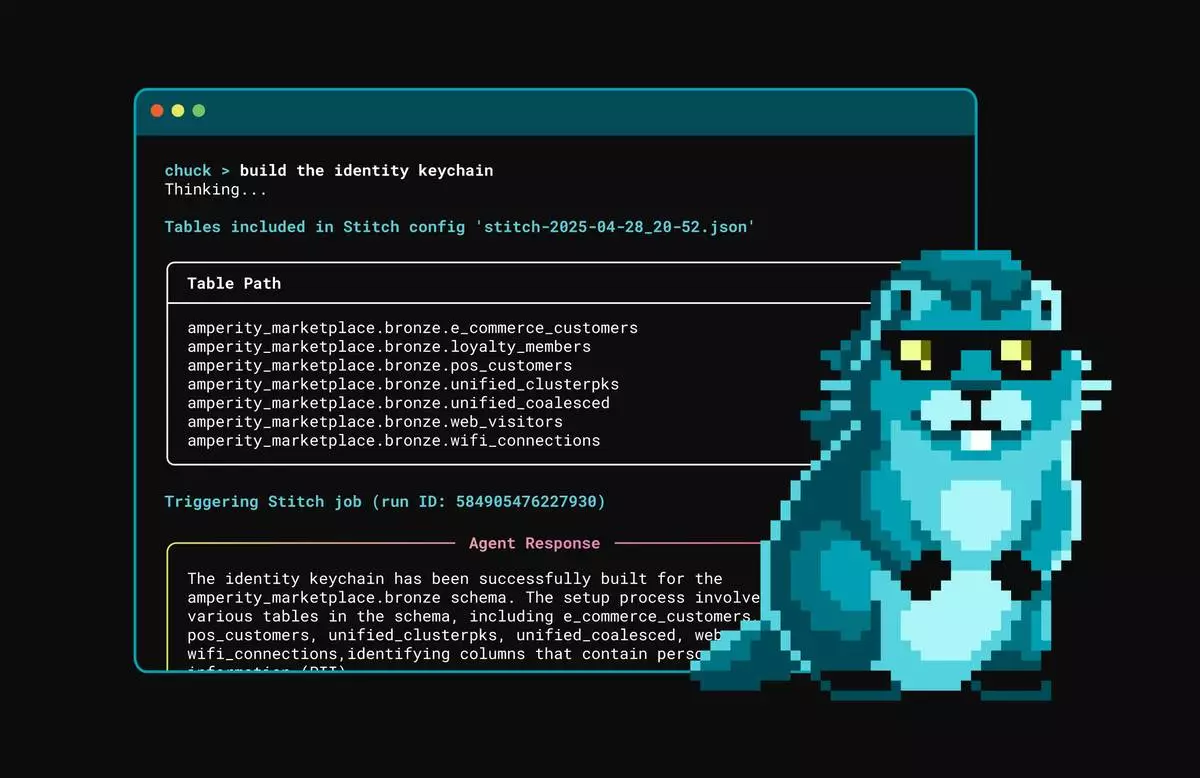
Amperity launches Chuck Data, the first AI agent purpose-built for customer data engineering in Databricks. Chuck brings the vibe coding revolution to enterprise data teams - accelerating identity resolution, improving accuracy, and cutting down manual overhead. It's a faster, smarter way to get customer data ready for action.
KNOXVILLE, Tenn. (AP) — Encouraging fans to get inside Neyland Stadium earlier than usual with President Donald Trump coming to Tennessee's college football game against Texas sure worked Saturday.
Security checks on the stadium's perimeter went relatively smoothly with Tennessee officials opening the stadium 30 minutes earlier than normal. Fans got half-price off concessions as a reward for showing up early, and Tennessee faithful had the stands half full 90 minutes before kickoff and nearly packed an hour before.
Those in their seats were treated to a low-altitude flyover by Air Force One as the president came into town with the Volunteers and Longhorns warming up on the field below. Trump landed at 11:28 a.m. EDT ahead of the noon kickoff, according to reporters traveling with the president.
Trump's motorcade arrived at Neyland Stadium just as the national anthem was being sung at 11:59 a.m. Trump pumped his fist a couple of times when shown in his seat on the videoboards with Tennessee's U.S. senators on either side. One of them, Marsha Blackburn, is running for governor of Tennessee.
The president's motorcade left at 2:07 p.m. with the game in the second half.
The president's visit didn't appear to affect communications between coaches and players on the field thanks to some coordination before Saturday's game.
Longhorns coach Steve Sarkisian said earlier this week that teams had to be ready to lose all communication on their headsets between coaches on the field and the players “anytime (Trump) enters the stadium, leaves the stadium or changes locations within the stadium.”
ABC/ESPN reported Saturday that both schools worked with the Secret Service on audio channels in hopes of keeping communications clear, noting an official timeout for a serious disruption could be an option.
The Southeastern Conference matchup between the No. 1 Longhorns and No. 14 Volunteers in Knoxville already was one of the biggest games in the country this weekend. Trump came to watch Texas quarterback Arch Manning play for the first time in the stadium where his uncle Peyton became famous.
Trump has attended more college football games than any recent sitting president, and he arrived in Knoxville in the midst of a midterm election season and a heated debate over the role of money in college sports that Congress is trying to resolve. He has attended national championship games and regular season contests in the SEC and Army vs. Navy.
He also attended Game 3 of the NBA finals between the New York Knicks and San Antonio Spurs in June, went to the 2025 Daytona 500 car race, and presented the World Cup trophy to Spain at the final in July. And last year, he was the first president to attend a Super Bowl. He left the Super Bowl after halftime.
Headset communications emerged as the latest subplot surrounding this presidential visit. Coaches communicate with each other on their headsets throughout the game and also call in plays to the quarterback. Disruptions to those communications, from a deafening crowd, technical glitch or presidential security measure, can present problems for coaches and teams.
Coaches involved in last season's College Football Playoff championship between Miami and Indiana in New Orleans cited that game as an example of how Trump's movements affected them.
Trump left in the fourth quarter of a tense Indiana 27-21 victory. Sarkisian said Miami coach Mario Cristobal told him Trump's leaving at that point disrupted communications on the Hurricanes' final possession, which ended with a game-clinching interception.
Indiana coach Curt Signetti disputed Sarkisian's version of events around the final drive. But Cignetti noted communications briefly cut off in a key moment of the fourth quarter as Indiana was trying to protect its lead.
In his weekly radio show on Thursday, Cignetti recalled that when Trump left the game “around the 7-minute mark ... there were two or three plays we couldn't hear at all.”
That included a misdirection touchdown run by Miami's Malachi Toney.
“Communication device came back right after the (Toney’s) touchdown,” Cignetti said. “And we had no problem the rest of the game.”
According to the media pool report of Trump's movements at the game, the president left the stadium with “with just under 8 minutes left in the 4th quarter.”
The White House on Friday insisted Trump’s departure caused no problems for the teams.
“No, President Trump’s departure from the CFP championship in January did not cause headset or comms issues for the teams,” the White House posted on X.
It's unclear if Trump's presence at other games like the Super Bowl have created issues. An NFL spokesman declined to comment Friday when asked if league officials work with the Secret Service when a president attends a game like the Super Bowl to minimize any impact on team communications.
University of Tennessee officials sent a midweek advisory encouraging fans to arrive “significantly earlier” than for a typical game. Neyland Stadium has an official capacity of 101,915 with this game the 30th consecutive sellout.
Fans were warned of the Secret Service conducting enhanced screening at the stadium gates and to “expect increased wait times as kickoff approaches.”
Vertuno reported from Austin, Texas.
Sign up for Top 25 poll alerts here, visit the Top 25 here and see AP’s full college football coverage here
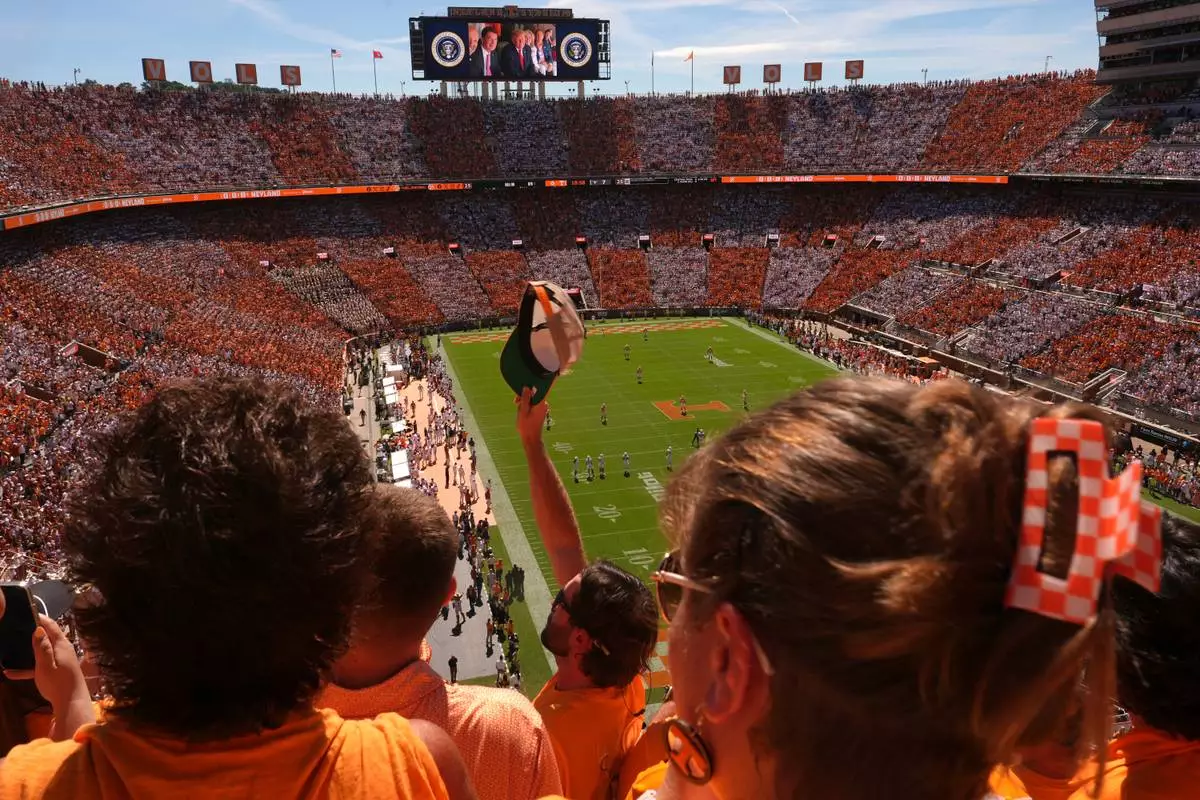
Attendees cheer as President Donald Trump is pictured on screen during an NCAA college football game between Tennessee and Texas at Neyland Stadium, Saturday, Sept. 26, 2026, in Knoxville, Tenn. (AP Photo/Julia Demaree Nikhinson)
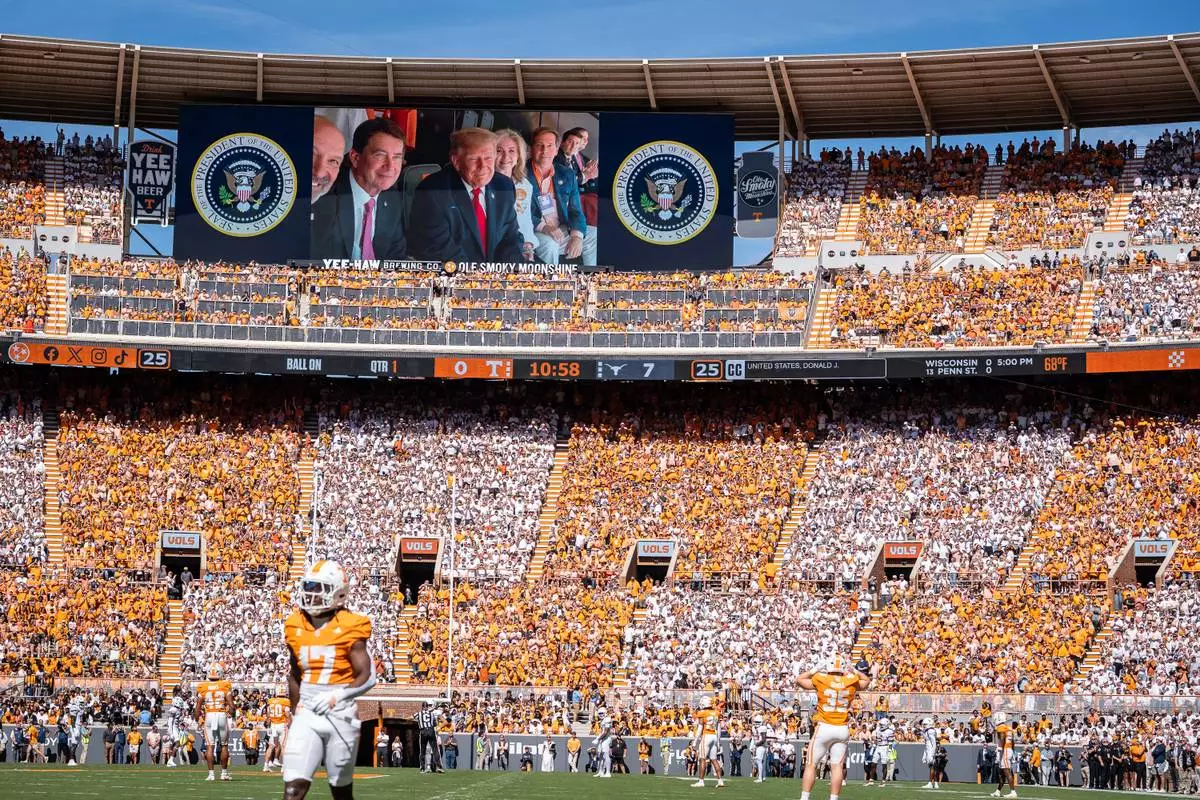
President Donald Trump is displayed on the scoreboard as he attends the Tennessee-Texas NCAA college football game in Knoxville, Tenn., Saturday, Sept. 26, 2026. (Sara Diggins/The San Antonio Express-News via AP)
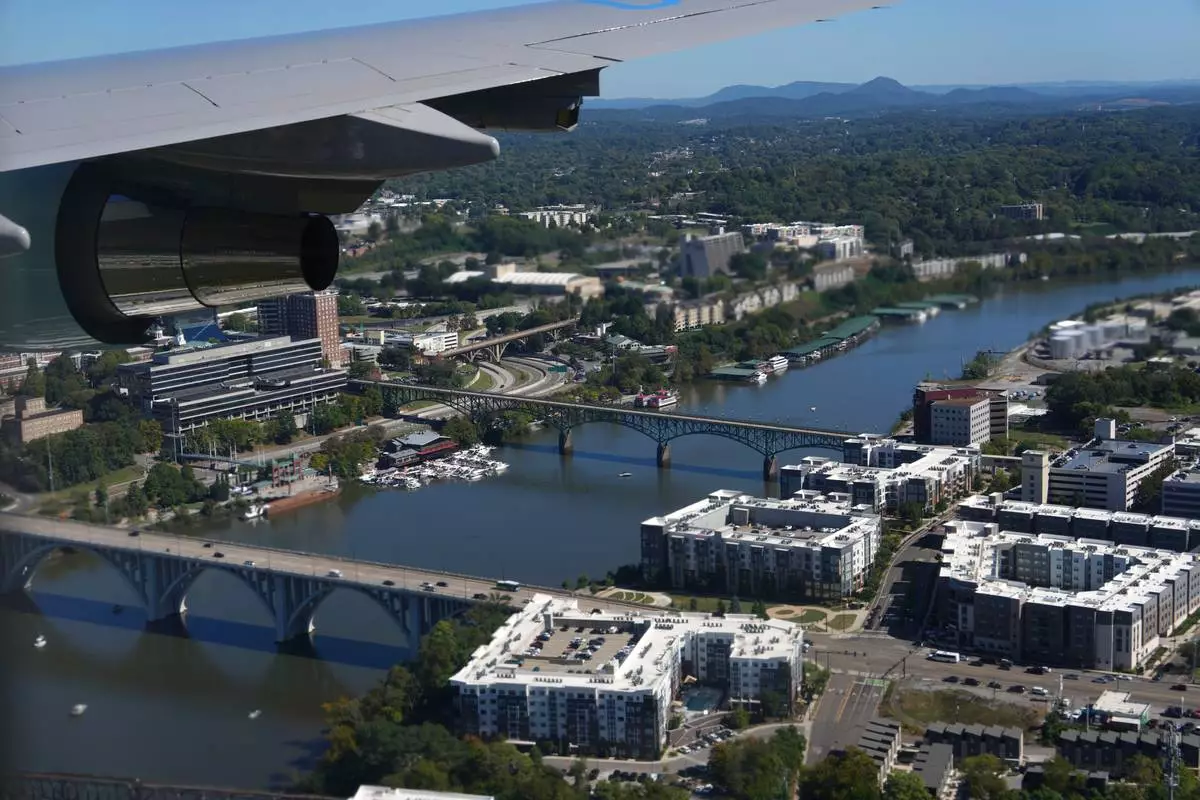
The wing of Air Force One, with President Donald Trump on board, is pictured as the plane flies over Knoxville, Tenn., en route to an NCAA college football game between Tennessee and Texas, Saturday, Sept. 26, 2026. (AP Photo/Julia Demaree Nikhinson)
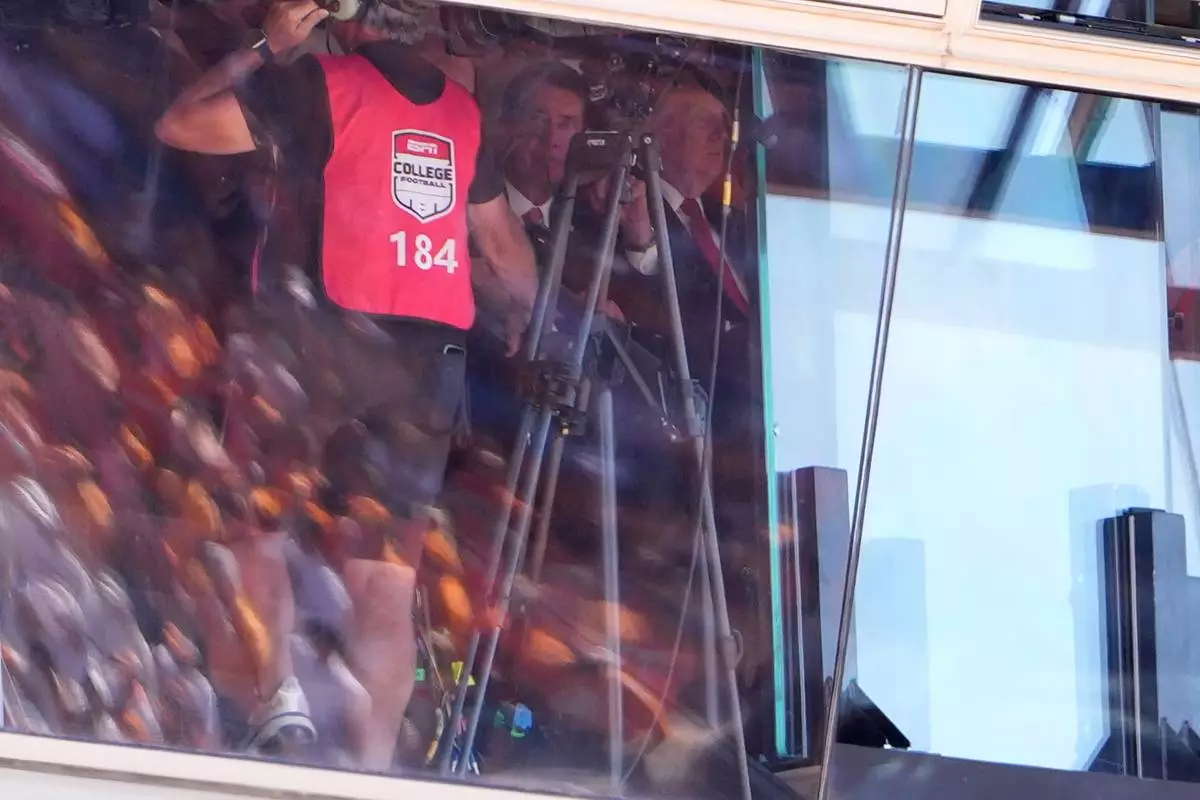
President Donald Trump, from right, and Sen. Bill Hagerty, R-Tenn., attend an NCAA college football game between Tennessee and Texas at Neyland Stadium, Saturday, Sept. 26, 2026, in Knoxville, Tenn. (AP Photo/Julia Demaree Nikhinson)
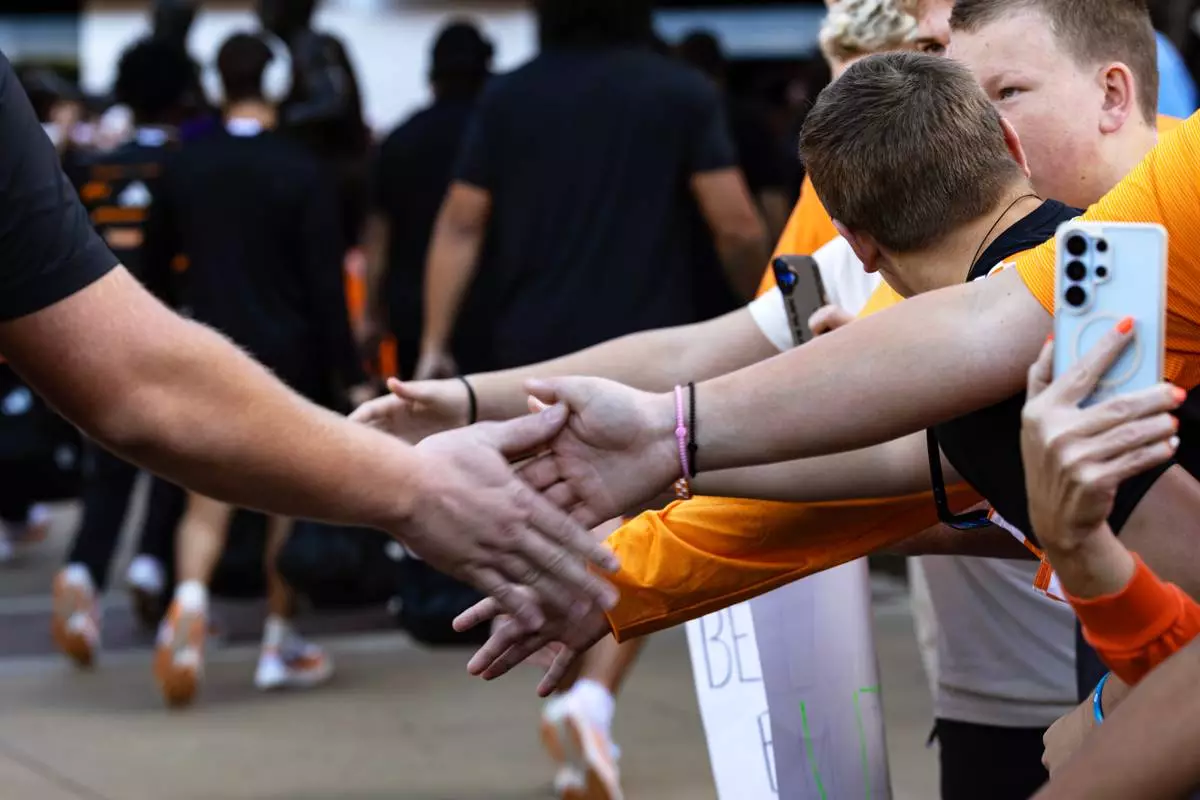
Fans greet players during the Vol Walk before an NCAA college football game between Tennessee and Texas, Saturday, Sept. 26, 2026, in Knoxville, Tenn. (AP Photo/Wade Payne)
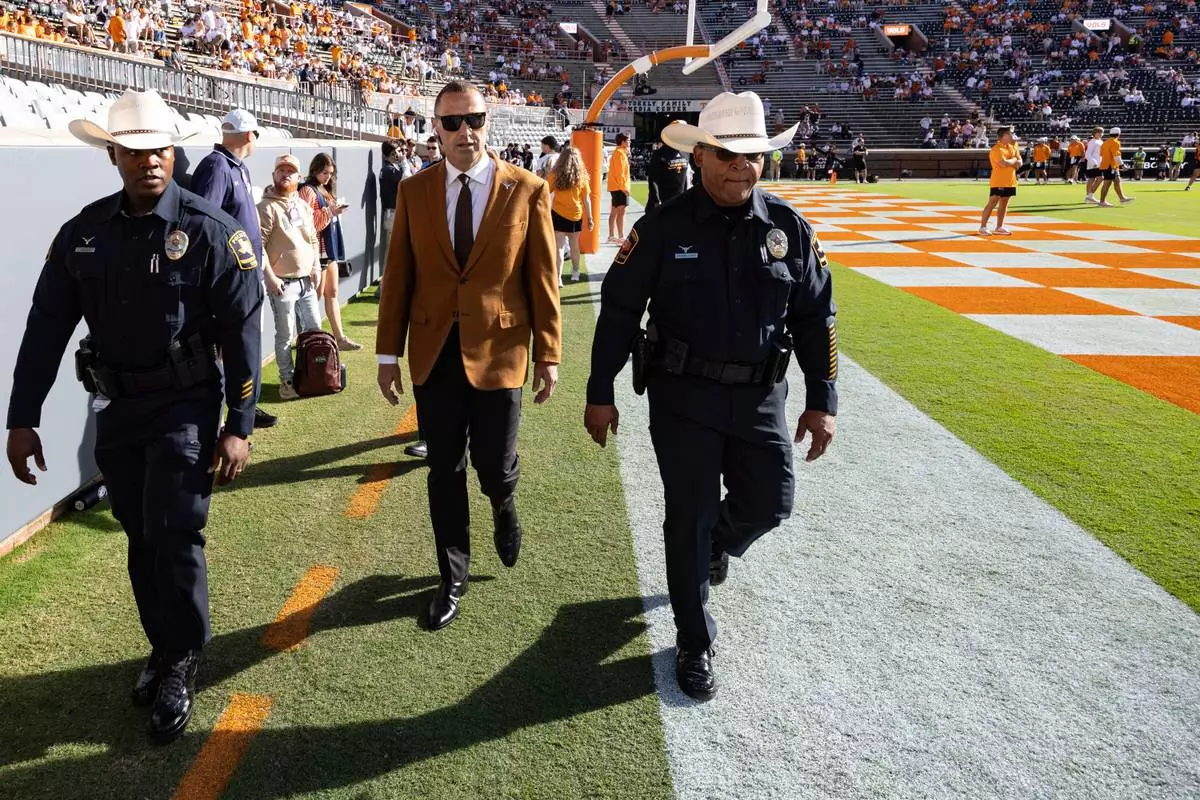
Texas head coach Steve Sarkisian is escorted into Neyland Stadium before an NCAA college football game between Tennessee and Texas, Saturday, Sept. 26, 2026, in Knoxville, Tenn. (AP Photo/Wade Payne)
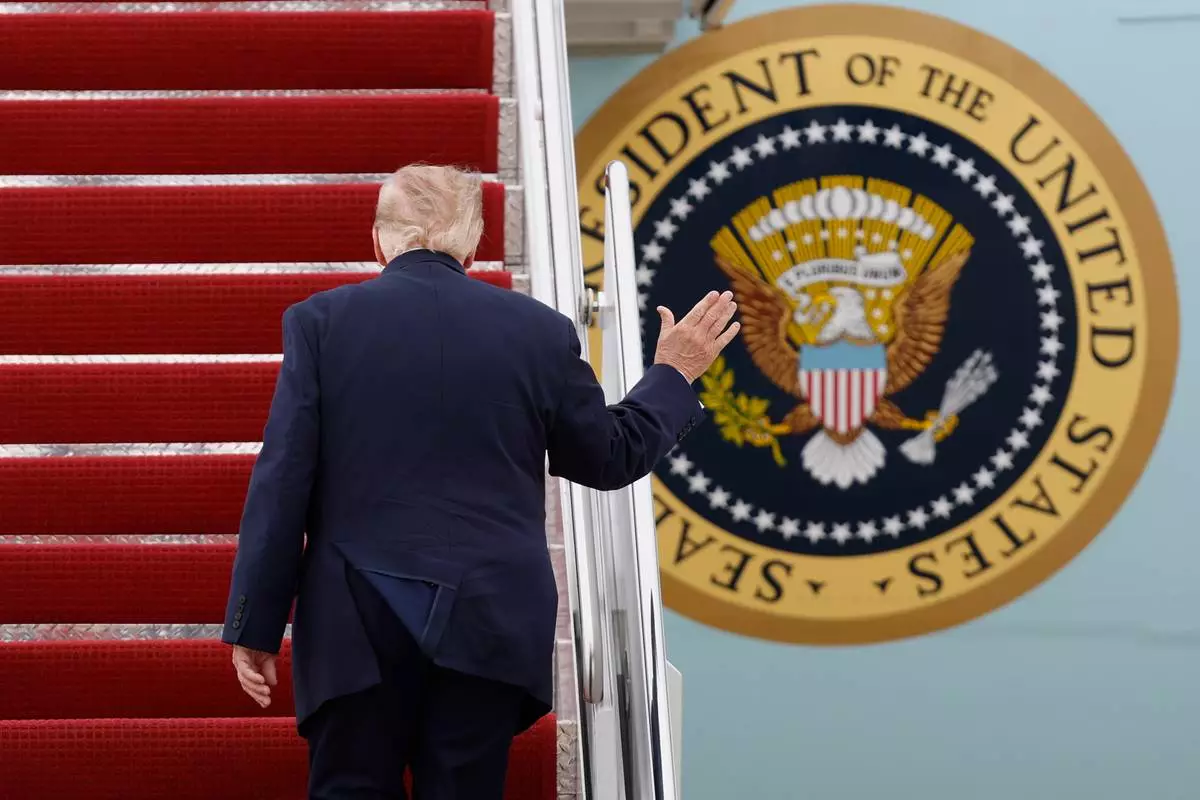
President Donald Trump walks up the stairs of Air Force One upon his departure at Joint Base Andrews, Md., Saturday, Sept. 26, 2026, en route to watch the Texas versus Tennessee NCAA college football game in Knoxville, Tenn. (AP Photo/Luis M. Alvarez)
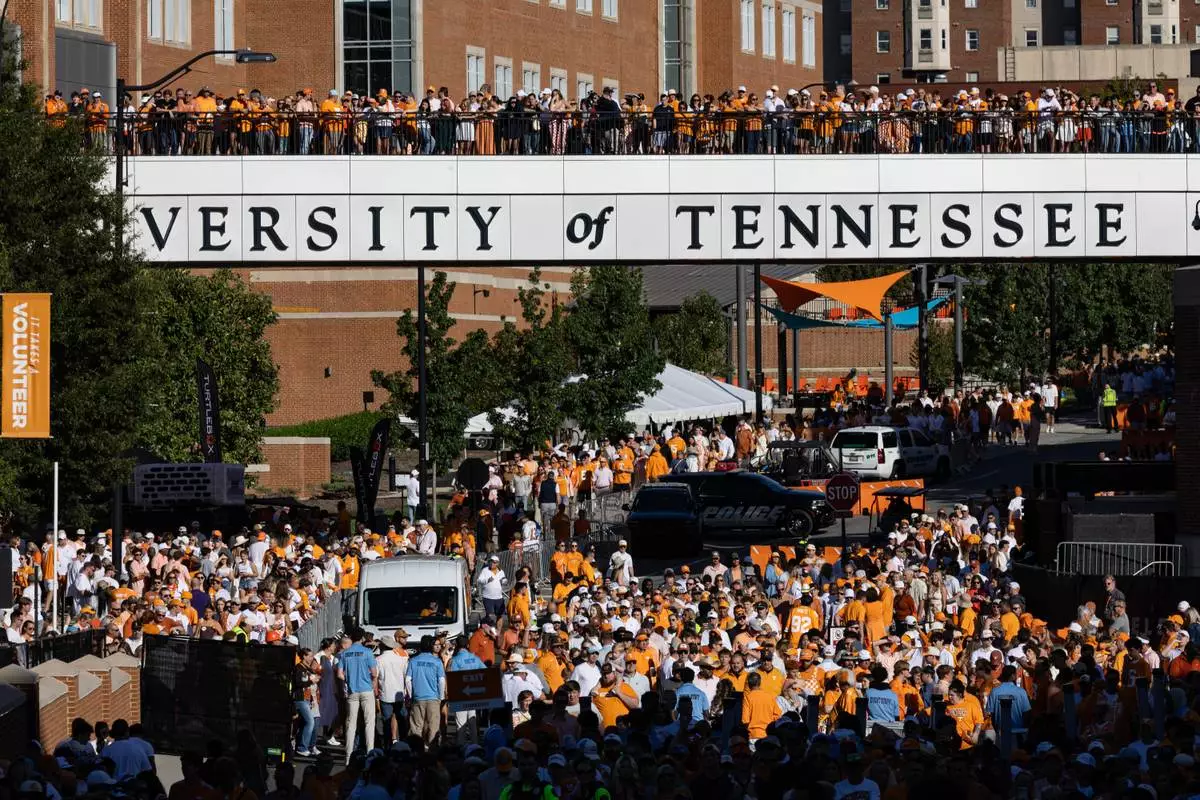
Fans watch from the bridge during the Vol Walk before an NCAA college football game between Tennessee and Texas, Saturday, Sept. 26, 2026, in Knoxville, Tenn. (AP Photo/Wade Payne)
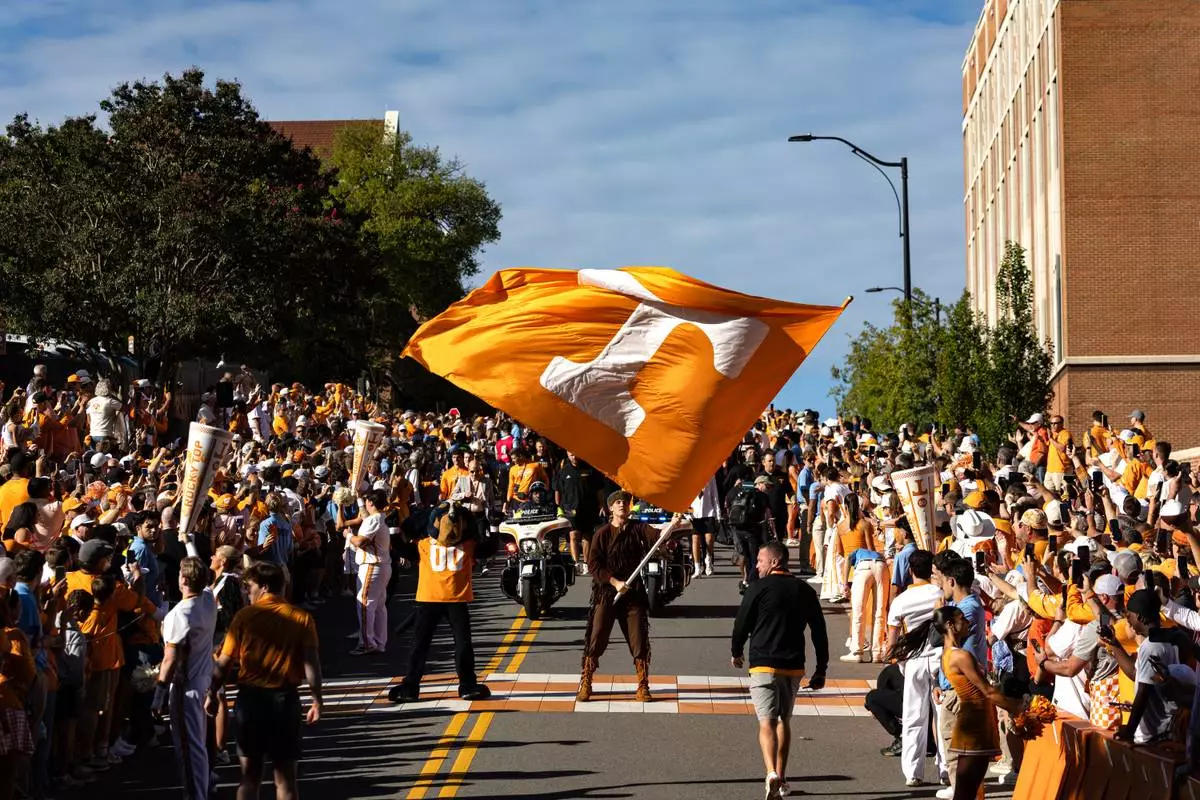
Tennessee mascot waves the Power T flag during the Vol Walk before an NCAA college football game between Tennessee and Texas, Saturday, Sept. 26, 2026, in Knoxville, Tenn. (AP Photo/Wade Payne)