Demonstrators gathered outside the U.S. Embassy in Mexico City on Monday to express support for the Mexican community in the United States following recent mass roundups of migrants and resulting protests in Los Angeles, California.
More than 1,000 protesters clashed and faced off with National Guard troops in downtown Los Angeles on Sunday during the latest demonstrations against immigration raids that swept across California over the weekend.
Some 42 Mexicans have been arrested so far, including 37 men and five women, in the protests in Los Angeles, according to Mexico's Secretary of Foreign Affairs Juan Ramon de la Fuente.
Citizens in Mexico's capital are denouncing what they call the "repression and human rights violations" of their "brothers and sisters" in the U.S. Many see the National Guard deployment as racism against the Hispanic community.
"We are migrants supporting our brothers and sisters in the United States who have been subjected to brutal and criminal persecution without any sympathy or mercy," said Maria Garcia, a protester.
Protesters said that Mexico's relationship with its northern neighbor has deteriorated significantly since Donald Trump's return to the White House and that the decision to send the military to control the demonstrations is a step too far.
Mexican President Claudia Sheinbaum urged the U.S. authorities on Monday to follow the law on deportation proceedings and respect human dignity.
The president of Mexico said that the government will not tolerate practices that violate human rights, making a "respectful but firm" request that the U.S. authorities act in accordance with due process and respect for human dignity.
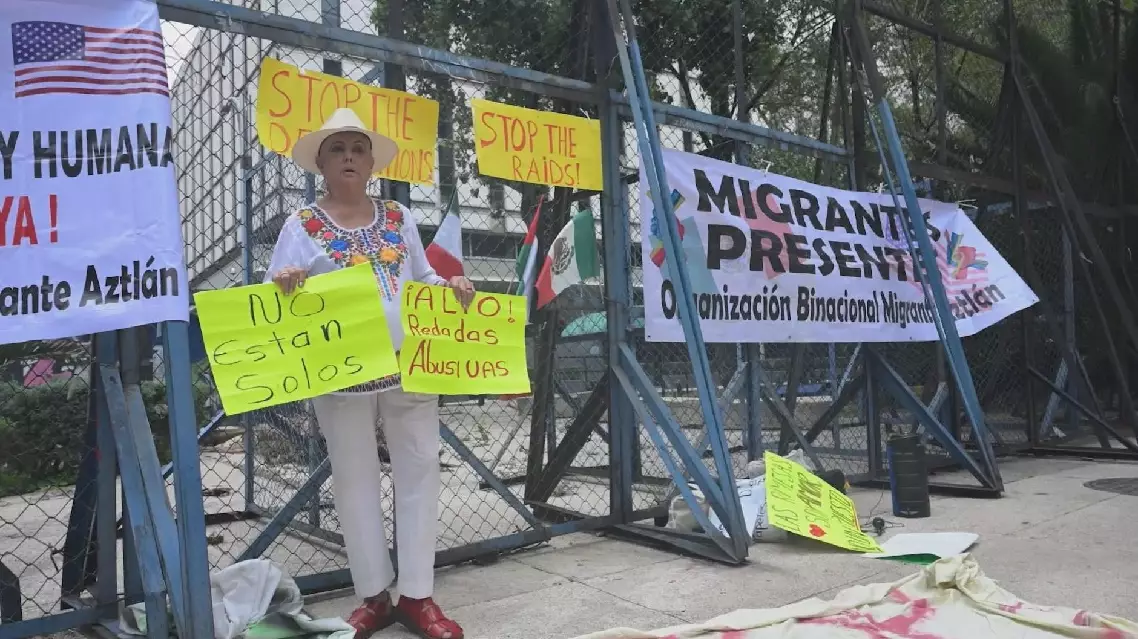
Demonstrations erupt at US embassy in Mexico City to support Mexican community in Los Angeles
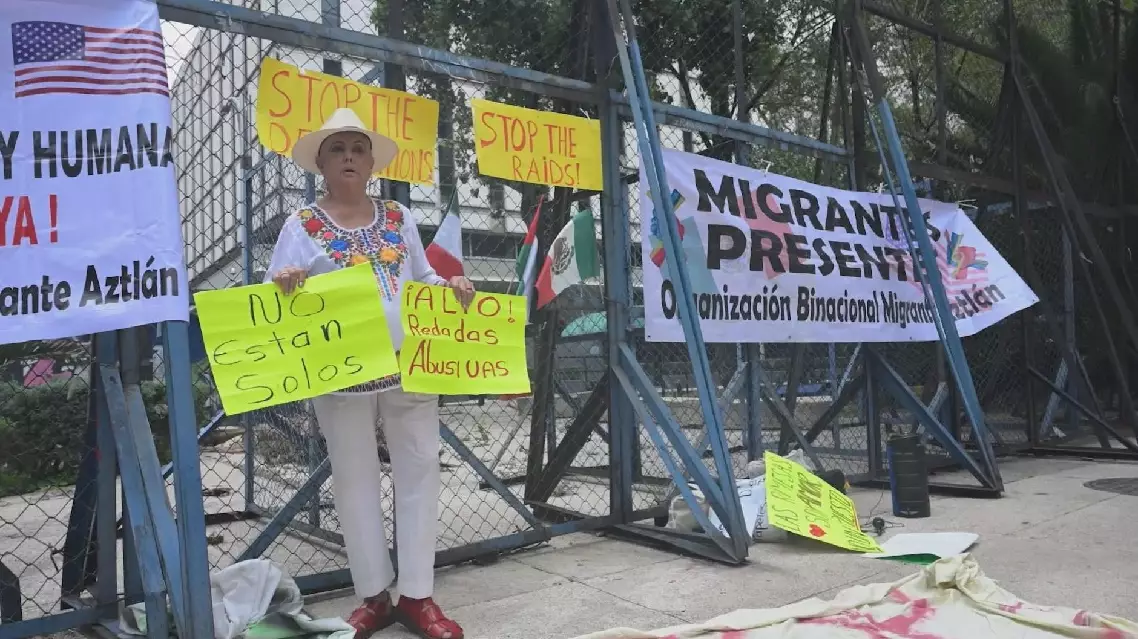
Demonstrations erupt at US embassy in Mexico City to support Mexican community in Los Angeles
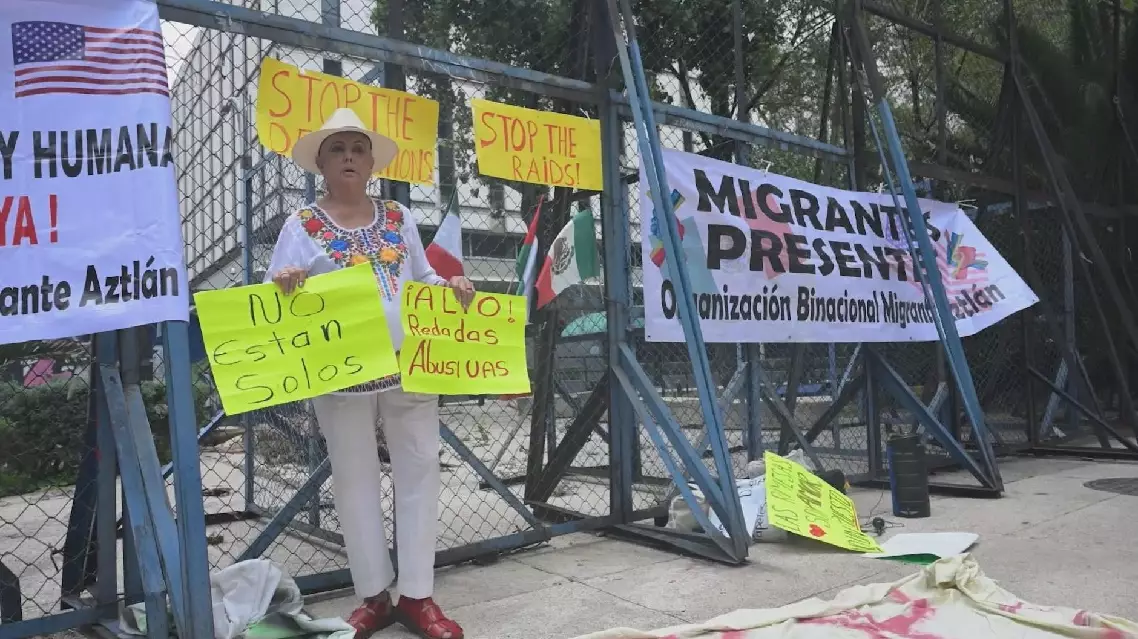
Demonstrations erupt at US embassy in Mexico City to support Mexican community in Los Angeles
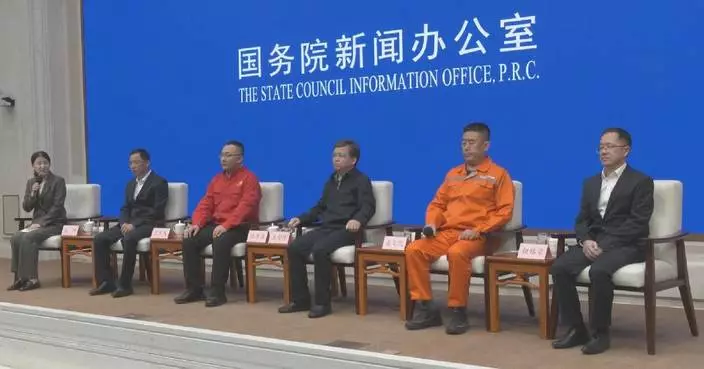
The Chinese government has stepped up its ecological conservation and green development efforts this year, with new policies aimed at ensuring harmony between humanity and nature as the country modernizes.
To upgrade its legal system for ecological protection, China this year has adopted a new Ecological and Environmental Code, a new National Parks Law and revised Regulations on Nature Reserves.
China has also started implementing its stricter ambient air quality standards since March and is taking measures in key counties to tackle pollution and stagnant water in small water bodies, and remove heavy metal pollution from agricultural soil.
"Building a beautiful China is a major strategic effort being made by the Communist Party of China Central Committee with Xi Jinping at its core, taking into account the overall situation of modernization featuring harmony between humanity and nature as well as people's aspirations for a better life. It requires us to reject the short-sighted approach of draining the pond to catch the fish and the practice of leaving ecological deficits to future generations. Instead, it asks us to shoulder the historical responsibility of benefiting generations to come by laying a solid ecological foundation for the great rejuvenation of the Chinese nation. This is not only a change in the development paradigm, but also an innovation in the concept of civilization," said Li Hongwei, a professor at the Social and Ecological Civilization Teaching and Research Department of the Central Party School of the Communist Party of China.
In addition to national measures, countless local projects are also underway to address specific issues.
Jiangsu Province in east China has established the country's first application and service system presenting real-time 3D visualizations of the province and its cities and counties to provide digital support for targeted ecological governance.
In east China's Jiangxi and Zhejiang, a number of protection and restoration projects for abandoned mines and marine ecosystems are accelerating.
"Now, we have started the application process for Shan-Shui Initiative projects, encouraging and guiding neighboring provinces to break down boundaries, plan and jointly apply for cross-provincial Shan-Shui Initiative projects for the same natural geographical unit, and carry out inter-provincial prevention and control efforts around national ecological security barriers such as the Three Eco-zones and Four Shelterbelts," said Zhang Jianjun, deputy director general of the Department of Territorial Space Ecological Restoration at the Ministry of Natural Resources.
The Shan-Shui Initiative, which translates as "mountains and rivers" initiative, is China's ambitious country-wide effort to restore 10 million hectares of natural spaces, including mountains, forests, grasslands and waterways, by 2030.
The Three Eco-zones and Four Shelterbelts are the Qinghai-Tibet Plateau Eco-zone, the Yellow River Eco-zone (including the Loess Plateau Ecological Barrier), the Yangtze River Eco-zone (including the Sichuan-Yunnan Ecological Barrier), and the Northeast, North, South, and Coastal Shelterbelts.
This year, the Ministry of Ecology and Environment will push for implementing ultra-low emission standards for 100 million tons of cement clinker production and 50 million tons of coking production.
In the meantime, the ministry will promote the building of more zero-carbon industrial parks and factories, revise regulations for the management of carbon emission trading, and continue increasing supply for the national voluntary greenhouse gas emission reduction trading market.
China has already seen fruitful results from its ecological conservation efforts this year.
The Xiliao River, once the only major river among China's seven major river systems to suffer long-term drought, has seen full spring water flow return for the second consecutive year, signaling new progress in the ecological recovery of the river basin.
The latest satellite remote-sensing images show that in some sections, the water area has increased from less than 5 percent of the waterway in 2024 to 90 percent today.
The rising water levels over the past two years have also led to the return of migratory birds and other ecological improvements.
Progress has also been made in biodiversity. This year, a breakthrough has been made in wild reproduction of the Chinese sturgeon, a group of endangered Baer's pochards were released into the wild for the first time in the world by Chinese biologists, and the populations of giant pandas, crested ibises, and Hainan gibbons continue to recover.
On the consumption front, China has improved a trade-in subsidies program for consumers choosing to upgrade to energy-efficient home appliances.
Meanwhile, a national campaign to double the number of charging facilities for electric vehicles in three years is in full swing, with a goal of establishing a nationwide network of 28 million charging facilities by the end of 2027 to meet the needs of more than 80 million electric vehicles.

China intensifies conservation, green development programs