Heavy storm tore through north China's Hebei Province and east China's Shandong Province on Monday, with downpours, gales, and hail disrupting traffic and agricultural production.
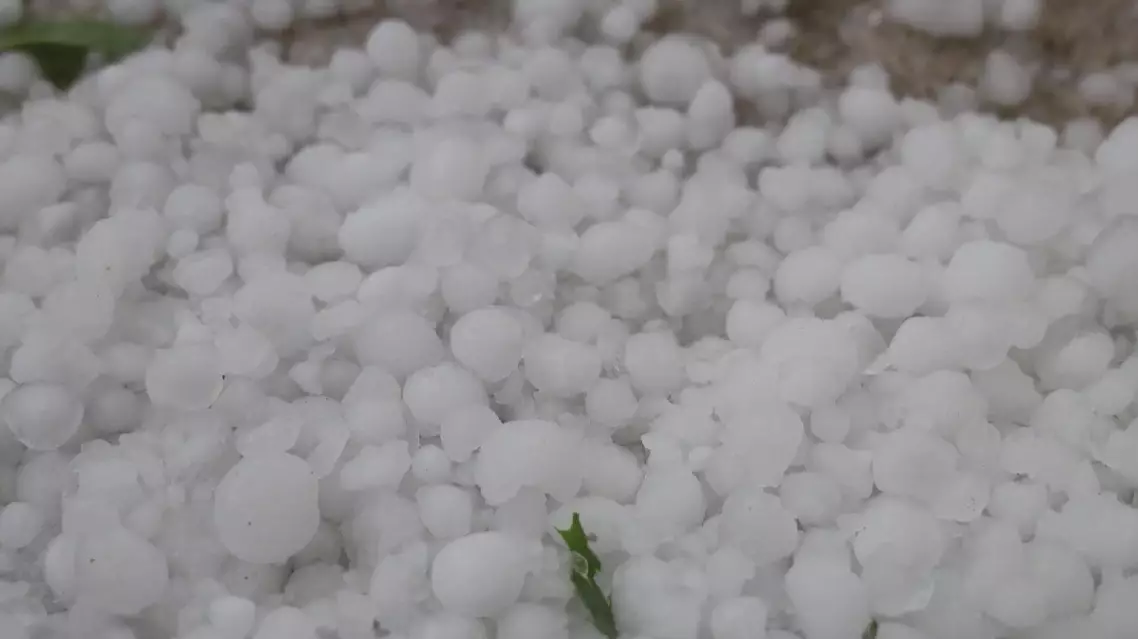
In Hebei, footage recorded in Qian'an in Tangshan City showed the sky turning black by mid-afternoon as hail pummeled streets, winds ripped roofs from buildings and downed trees along roads.
Similar scenes played out in the coastal Qinhuangdao City, where hail poured down for 20 minutes. The adverse weather caused damage to fruit trees and crops in Tangshan and some parts of Qinhuangdao.
Also, torrential rains, strong winds, and hail lashed Dezhou City in Shandong on Monday. Laoling City of Dezhou recorded the heaviest rainfall at 121.3 millimeters, while Ningjin County saw the strongest winds.
The severe weather disrupted agricultural operations, forcing villagers to scramble during brief breaks in the downpour to salvage their wheat harvests.
At around 18:00, Dezhou was engulfed in a dusty haze as fierce winds whipped through the city. Thirty minutes later, the sandstorm gave way to torrential rain, which brought traffic into chaos.
In Ningjin, Laoling, and Qingyun County, hail pelted the ground for approximately five minutes before returning to rain. The stormy weather finally tailed off by 20:00.
Farmers in Wucheng County seized every minute between rain bursts to reap their crops, with their over 700,000 mu (about 46,667 hectares) of wheat reaching critical harvest time. The rain forced them to transport their grains with trucks to drying facilities to avoid spoilage.
"It's very convenient. We just deliver the grains directly without needing to sun-dry it ourselves," said Han Jinfu, a farmer of Hanzhuang Village.
"Our company operates 31 drying units with a daily processing capacity of approximately 1,500 tonnes," said Zhang Jimin, deputy general manager of Zhongxiang Agricultural Development Co., Ltd in Wucheng County.
Storm, hail disrupt traffic, damage crops in Hebei, Shandong
Flowers with novel appearances drew strong interest from visitors at this year's Hortiflorexpo IPM Beijing, which ran from April 10 to 12.
With more Chinese consumers seeking products that offer emotional value, expo visitors were noticing not only traditional, beautiful flowers, but also those newer, more distinctive varieties.
Among the many blooms on display, those featuring widely recognized icons stood out as especially eye catching.
"This is the Psychopsis papilio, also known as 'Monkey King'. You can see that its flower has three tendrils, which vividly resembles the pheasant feathers worn by Monkey King," said Zha Niyi, an exhibitor, introducing the flower commonly known as the butterfly orchid.
Monkey King, or Sun Wukong, is from a classic Chinese novel, Journey to the West, written by Wu Cheng'en during the Ming Dynasty (1368-1644). Monkey King has stood as one of the most iconic symbols of Chinese culture, embodying generations of Chinese people's imagination of a hero.
This growing consumer interest is also evident in the flowers' sales volumes. In 2025, China’s fresh-cut flower exports surged by over 40 percent, surpassing 200 million U.S. dollars for the first time. Over the past five years, the country's total flower exports have exceeded two billion U.S. dollars.
"This demonstrates that China's flower industry has a solid export base and strong production capacity with the approach of high-quality development," said Zhang Li, deputy director of the Market Circulation Branch of the China Flower Association.
As Chinese consumers become more willing to pay for experiences that generate positive emotions, visitors at the exhibition were increasingly drawn to flowers with cute names and auspicious meanings.
Consumers' growing desire for emotional fulfillment is also driving the wider development in the flower-consumption market. "A single flower can give rise to an entire industry and a whole sector," said Wang Caiyun, president of the Osmanthus Branch of the China Flower Association.
China has grown into the world's largest flower producer, a major consumer, and a leading trading country. Its flower economy now delivers annual output worth more than 520 billion yuan (about 76.16 billion U.S. dollars), driving employment and income growth for more than 220,000 business entities.
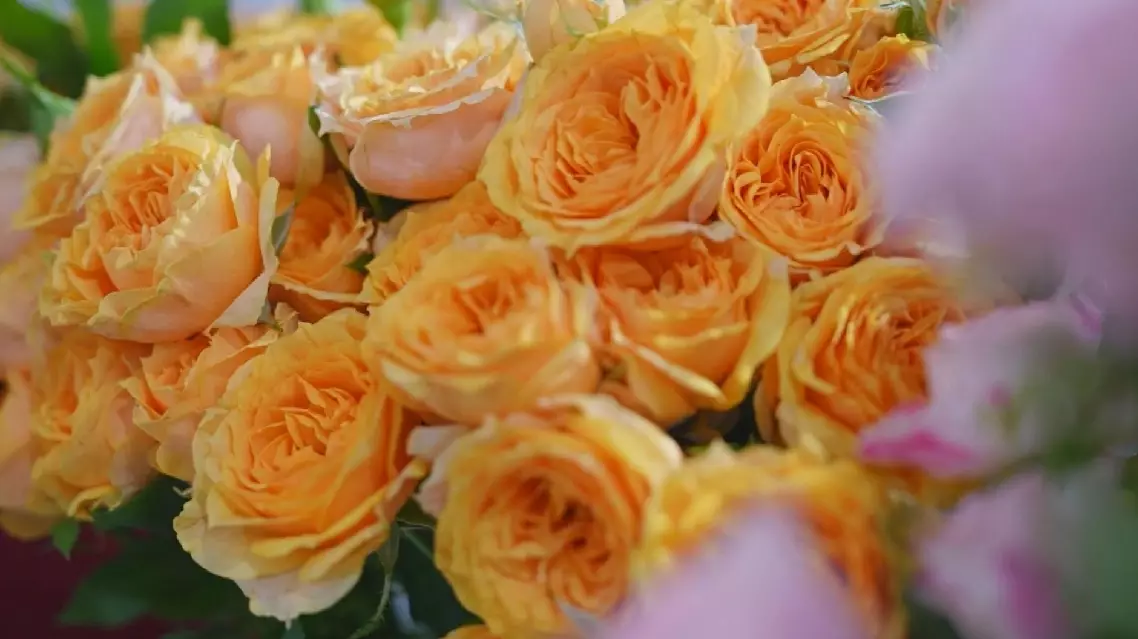
Novel flowers catch eyes at Hortiflorexpo IPM Beijing