Skip to Content Facebook Feature Image

World's first wind sail-assisted Aframax tanker officially named

China

China

China

World's first wind sail-assisted Aframax tanker officially named

2025-06-11 15:52 Last Updated At:16:07

The world's first Aframax tanker equipped with wind sail-assisted propulsion technology and built by a Chinese shipbuilding company was officially named on Wednesday, featuring a groundbreaking dual-propulsion system that integrates fuel oil and wind power for energy saving.

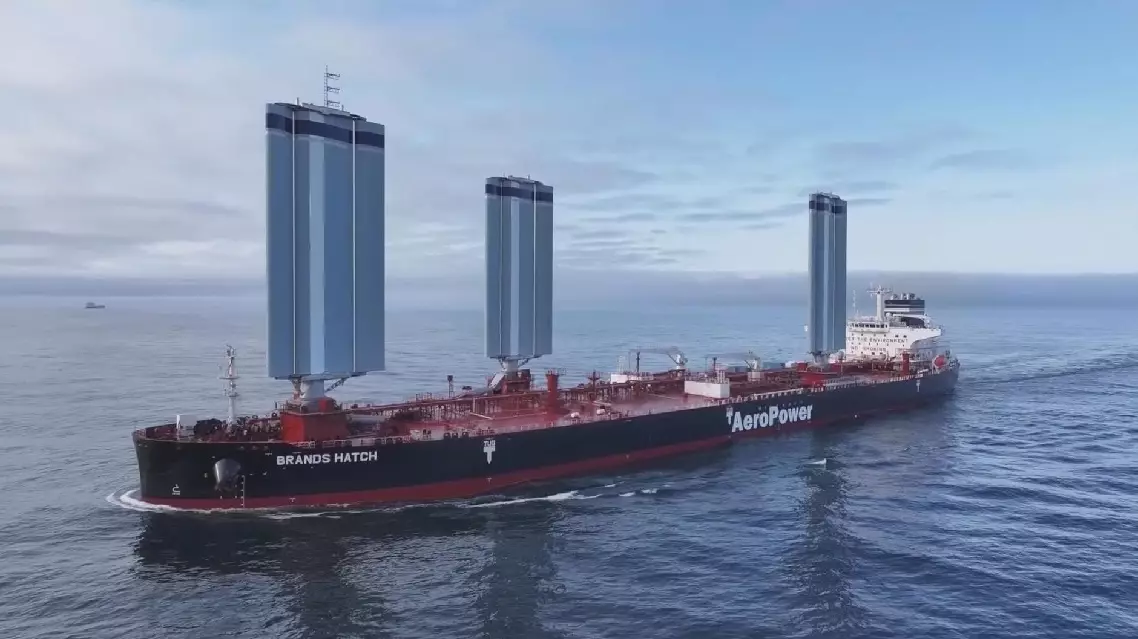
The tanker, built by Shanghai Waigaoqiao Shipbuilding Co., Ltd., a subsidiary of China State Shipbuilding Corporation Limited, has been christened "Brands Hatch," a name inspired by a technically challenging racing circuit in Britain.

It will be officially delivered and will start operations in the coming days.

This massive tanker spans nearly 250 meters in length and 44 meters in width, comparable in size to two and a half football fields. It has the capacity to transport over 800,000 barrels of crude oil in a single voyage.

The highlight of the tanker is its three towering 40-meter sails. During navigation, these sails stand vertically on the deck, complementing traditional fuel oil with wind power to enhance energy efficiency.

"This is China's first Aframax tanker equipped with rigid wing sails. Unlike conventional canvas sails, these are made from fiberglass composite materials. Each sail unit consists of three blades, with each blade precisely controlled by hydraulic actuators at the base and an intelligent control system -- proving more adept at wind tracking than even the most experienced captain. Like sunflowers following sunlight, the system automatically captures optimal wind directions in real time to maximize energy efficiency," said Liu Junhong, technical director of the Design and Research Institute at Shanghai Waigaoqiao Shipbuilding Co., Ltd.

The tanker pioneers a groundbreaking dual-propulsion system integrated with fuel oil and wind power, delivering cleaner and more energy-efficient operations.

Liu further elaborated on the reason for installing these sails on the tanker.

"The Aframax tanker is a mainstream vessel internationally and is highly popular in the market. Its design features a broad hull and stable navigation, especially on the monsoon routes in the Indian Ocean and the Atlantic Ocean, where wind power is abundant, making it an ideal track for wind energy utilization. Simply put, when the sea breeze is strong, the sails can offer an additional push, reducing the fuel consumption of the main engine and thus achieving energy savings," Liu said.

"Based on our test results, under ideal sea conditions with a 20-knot sea breeze, fuel conservation of 14.5 tons per day can be achieved, resulting in a reduction of 45 tons in carbon dioxide emissions. When calculated using average voyage data, fuel saving ranging from about 5 percent to 12 percent can be attained, culminating in an annual reduction of 5000 tons in carbon emissions," she said.

According to Liu, in the future, the wind sail system, featuring an intelligent control system for easy operation of a single sail weighing over 200 tons from the cabin platform, will also be applied to bulk carriers, 150,000-ton and 300,000-ton oil tankers, and other vessels with spacious deck areas..
World's first wind sail-assisted Aframax tanker officially named
World's first wind sail-assisted Aframax tanker officially named

China and Germany, as major countries, should shoulder their responsibilities, uphold mutual respect, transcend differences in social systems, historical backgrounds and cultures, and build a more mature model of positive interaction and a more stable bilateral policy framework, Chinese Foreign Minister Wang Yi said on Monday in Beijing.

Wang, also a member of the Political Bureau of the Communist Party of China Central Committee, told German Foreign Minister Johann Wadephul that it is hoped that Germany will view China's development as an opportunity for deeper cooperation and a driving force for mutual benefit and win-win outcomes, and work together to promote the steady and healthy development of the China-Germany all-round strategic partnership.

Noting that this is the first visit to China by a German foreign minister since the formation of Germany's new government -- though the visit has encountered twists and turns -- Wang quoted a Chinese saying: "Good things come to those who wait." He emphasized that "the timing is not the key; what truly matters is the purpose. The visit should be for cooperation, not confrontation; for enhancing mutual understanding and trust, not widening differences."

Wang further urged Germany to encourage the EU to return to a rational and pragmatic China policy, adhere to the correct direction of mutually beneficial cooperation, resolve differences through dialogue, and avoid politicizing economic issues, instrumentalizing trade issues, or securitizing normal cooperation.

Wang emphasized that the one-China principle serves as an important political foundation for China-Germany relations, and there is no room for ambiguity. He further noted that unlike Germany, Japan has yet to conduct a thorough reflection on its history of aggression in the eight decades since the end of WWII.

Wadephul said that in the face of a turbulent global landscape, Germany and China need to shoulder special responsibilities, strengthen communication and coordination, and become reliable and predictable partners for each other.

He said that Germany remains firmly committed to the one-China policy, and this position is unwavering.

German enterprises in China have full confidence in the Chinese market and are willing to further deepen their presence in the country, Wadephul said, adding that Germany supports the EU and China in seeking mutual benefit and win-win outcomes through dialogue and stands ready to play a constructive role in this regard.

The two sides also exchanged views on the Ukraine crisis. Wadephul elaborated on Germany's position and expressed hope that China would leverage its influence to help bring about an early end to the crisis.

Wang reaffirmed China's consistent stance, emphasizing that all parties should cherish the current momentum for a political settlement, work towards the same goal, and ultimately reach a fair, durable and binding peace agreement through dialogue and negotiations.

China supports all efforts conducive to peace and will continue to play a constructive role in this regard, Wang added.

Chinese FM calls on China, Germany to shoulder responsibilities as major countries for more stable bilateral policy framework

Chinese FM calls on China, Germany to shoulder responsibilities as major countries for more stable bilateral policy framework

Recommended Articles