The United Nations marked its first-ever "International Day for Dialogue among Civilizations" on Tuesday.
In 2024, the 78th UN General Assembly unanimously adopted a China-led resolution with 82 co-sponsors, establishing June 10 as the annual International Day for Dialogue Among Civilizations.
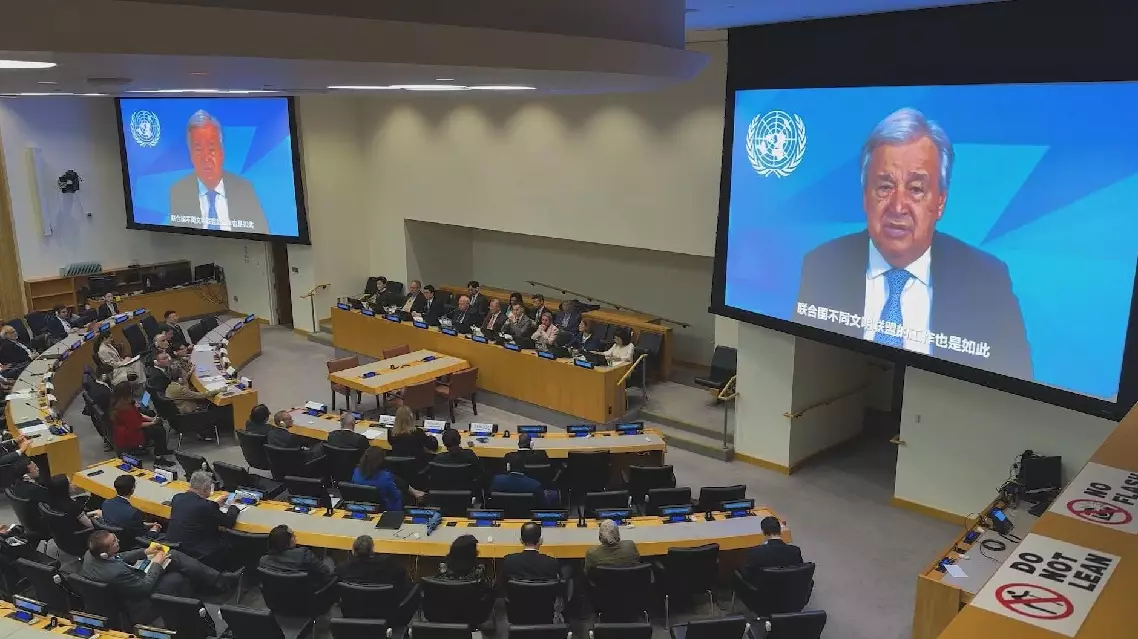
A special event was held Monday at the UN headquarters in New York to celebrate the day meant to serve as a clarion call for promoting peaceful co-existence among all nations through global discourse, greater cooperation and mutual respect.
The Chinese mission to the UN also hosted celebration activities on Monday, attended by over 1,000 people, including senior diplomats from various UN missions, UN Secretariat officials, and local New Yorkers.
"We do hope that this spirit of dialogue will be carried forward, and as people say, will yield some concrete results in harmonizing relations among countries," said Fu Cong, permanent representative of China to the UN.
The day was observed around the world. The premier event in New York included a symposium with dignitaries and academics. They discussed the need to fortify "global solidarity and cooperation" through shared values and open communication.
"There is no alternative. More and more we need dialogue. We need to respect each other. It's over - the hegemony of one country, one culture or one civilization, it's over. Today, everybody says we are a multipolar world -- different actors, different cultures, different relations, different civilizations, so it's a reality," said UN Under Secretary General Miguel Angel Moratinos.
Attendees said musical performances, drama and multimedia artwork on display also help underscore the importance of using cultural awareness as a bridge to dialogue.
"Any dialogue starts with the understanding of each other, and of course, without knowing the history and culture, you wouldn't be able to find this common ground," said Anna Evstigneeva, deputy permanent representative of the Russian Federation to the UN.
UN marks inaugural International Day for Dialogue among Civilizations
Some Iranians in Türkiye are crossing back over the border, driven by worry and desperation, as a nationwide communications blackout in Iran has left them cut off from their loved ones.
Protests have erupted in many Iranian cities since Dec. 28. They initially began with Tehran bazaar merchants demonstrating against the sharp devaluation of the national currency rial, and soaring inflation, before spreading to other cities. The unrest has led to casualties among both security forces and civilians.
At the Turkish-Iranian border, many are returning with no certainty about what awaits them, filled instead with questions and growing fear for those on the other side of the border.
"I went to Van yesterday for internet. I urgently needed to use the internet. I got it done. Now I'm heading straight back. There are protests everywhere. We can't get any news. We can't communicate with our families. And it's not just me, there are many Iranians outside the country who can't reach their families," said Feriste, an Iranian citizen.
With communications blacked out across Iran, those outside the country feel powerless to check on the situation back home. For some, this silence has prompted them to return across the border, even as tensions continue to rise.
"We can't get any news. There is no internet. Everything is shut down. I want to search. I want to find out. I want to see my brother. I'm going to see my family," said Husnu, an Iranian citizen.
"I work in Türkiye, and I have no news from Iran at all. I'm going back because I'm worried about my family. It's been days since I last heard from them, and because I'm worried, I'm returning to Iran now. Of course, we are concerned about our safety. We don't know what awaits us there," said another Iranian.
With protests escalating and government blackouts still in place, many Iranians are caught between staying in safety abroad and risking everything to reconnect with their families.
"We had to come to Türkiye because we couldn't reach our families. Schools were closed already. All official institutions were shut down. We have no information about other cities either, because there is no communication network there. There is no television, no internet. We can't even check Twitter," said Nazlican, another Iranian citizen.
Iranians in Türkiye return home, fearing for their families amid unrest in Iran