Christine Lagarde, president of the European Central Bank (ECB), highlighted the importance of cooperation between China and the European Union (EU) in dealing with global challenges.
In an interview with China Global Television Network (CGTN), Lagarde said all central banks in the world are currently facing similar issues because of the unprecedented shocks and uncertainty.
She mentioned ECB's ongoing collaboration with China's central bank, the People's Bank of China (PBOC), describing the longstanding relationship as a vital part of managing shared economic pressures.
"Now, with the PBOC, the central bank of China, we have a longstanding relationship, a good relationship. We cooperate, we work together, we look at the same issues. We have this deep understanding of issues. That's one of the reasons I'm visiting China is to continue to support and feed that excellent relationship that we have had," she said.
This year marks the 50th anniversary of the establishment of the diplomatic relations between China and EU.
Reflecting on this historic relationship, Lagarde pointed to both Europe and China have enjoyed the benefits of international trade expansion over the last few decades and underscored the need for continued international cooperation.
"I think that we have to persevere and we have to continue that global cooperation. It doesn't mean that we agree on everything. It doesn't mean that we open all doors without restrictions because each of the regions,each of the countries is going to focus on its degree of security, in terms of supply, in terms of general security, but we have to cooperate and we have to work together and try to make the best of that cooperation in the interest of all parties," she said.
When asked about the importance for China and EU to strengthen ties as the value of openness and cooperation and multilateralism are under challenges, Lagarde said both China and EU have an interest in pursuing the multilateral approach to global issues.
"So I think it means cooperating, it means playing by the rules. It means staying the course even when sometimes there are difficulties or challenges and sitting at the table and trying to resolve those issues in order to move forward because the collective interest is the wellbeing of population, is stability in the world, is peace, is financial stability without which there cannot be much progress and benefit for the people," she said.
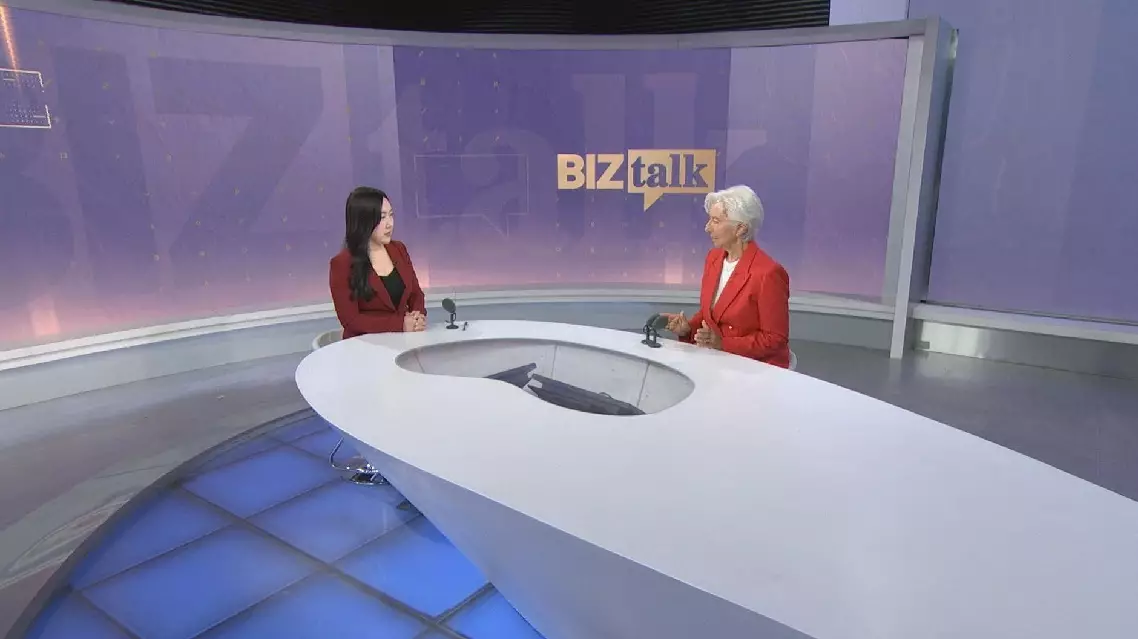
ECB chief underscores China-EU cooperation amid global challenges