DES MOINES, Iowa (AP) — Local officials warned more than half a million Iowans in the state's capital city and suburbs on Thursday that near-record level of pollutants in its rivers could make drinking water dangerous if immediate steps are not taken to reduce demand.
But the officials declined to explain what they believe has caused the surge in nitrate levels, which has historically been tied to runoff from farmland draining into Des Moines-area rivers.
The water utility, Central Iowa Water Works, issued a first-ever ban on lawn watering for the region after seeing the highest levels of nitrates in the river water since 2013. Federal regulations require a maximum nitrate level of 10 milligrams per liter. The current level being provided to 600,000 customers is 9, local officials said.
“If we end up in a space where we’re well over that … threshold, we’re really going to start worrying about our pregnant women and our children under the age of six months,” said Juliann Van Liew, public health director for Polk County.
Van Liew warned that drinking water with too-high levels of nitrate could potentially cause birth defects and a condition when an infant’s blood doesn’t have enough oxygen, commonly known as blue baby syndrome.
Tami Madsen, executive director of Central Iowa Water Works, said it is not unusual to see an increase given Iowa’s “nitrate seasons” but noted this year has been unusually high. Still, she deferred on an explanation of what is driving the higher rates.
“Unfortunately, this is a first and this is not history that anyone should be proud of,” Madsen said of the ban on lawn watering.
She urged cooperation. “If we continue on the path we’re on today, where people are still choosing to water their lawn over producing water that meets safe drinking water standards, we’ll be back here to talk to you all about a violation of the Safe Drinking Water Act,” Madsen said.
Officials made clear the water currently meets regulations and is safe to drink. But while the water utility works to treat the water to reduce nitrate pollutants to a safe level, Des Moines metro residents’ demand is higher than the amount they are able to treat. The utility said it has been treating water for 55 days, at a cost of between $14,000 and $16,000 a day.
In the past, the high cost to Des Moines and the rest of Polk County has led officials to go to farmers directly, to the statehouse and to court in a tug-of-war with the state’s dominant agricultural industry. The officials have long complained that nitrates and phosphorous from farm fertilizers pour off fields, concerned about rivers so polluted that even the utility's sophisticated and costly equipment could fall short in purifying.
In 2015, the utility took the issue to court to ask for the millions of dollars it was being forced to spend to filter unsafe levels from drinking water taken from the Des Moines and Raccoon rivers. A judge ultimately dismissed the lawsuit against three northwest Iowa counties, ruling the issue was one for the Legislature to address.
The state’s Republican leaders at the time lauded the ruling, saying the lawsuit wasn’t necessary to improve water quality because farmers and government subdivisions already are taking steps to ensure water quality.
The nitrate issue goes back decades and involves a huge watershed area in agriculture-heavy Iowa, said Chris Jones, a retired University of Iowa research engineer trained as an analytical chemist whose research focused on water quality in agricultural landscapes. He also previously worked at Des Moines Water Works.
The root cause of the nitrate problem is runoff from fertilizer and manure from agricultural operations, and June 1 is roughly the peak in Iowa, he said. Two new treatment plants have helped, but Jones suggested the long-term situation needs changes in agriculture.
“Although the idea that lawn watering is an aesthetic and maybe not needed," he said, “the fact that they’re telling people not to use water in this way is a real red flag about the situation with water quality.”
Associated Press writer Jack Dura contributed from Bismarck, North Dakota.
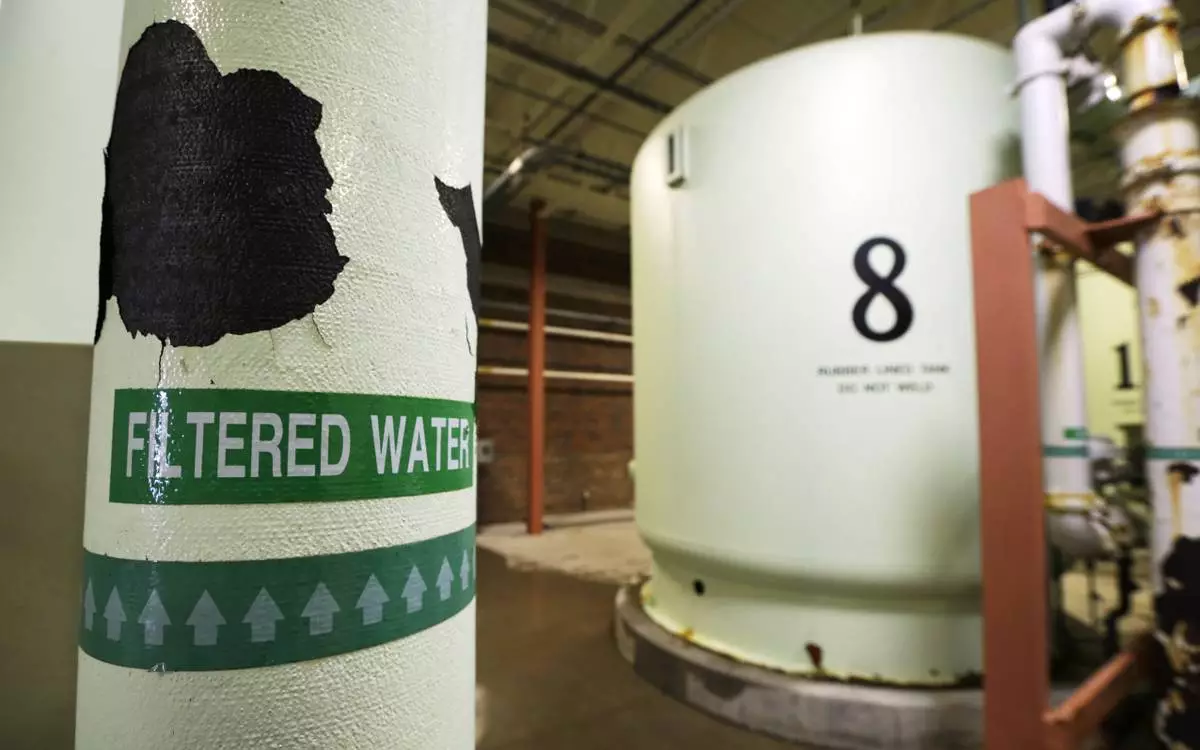
FILE - A sign is seen on a pipe in the Nitrate Removal Facility at the Des Moines Water Works treatment plant, May 16, 2013, in Des Moines, Iowa. (AP Photo/Charlie Neibergall, File)